Pius VIII
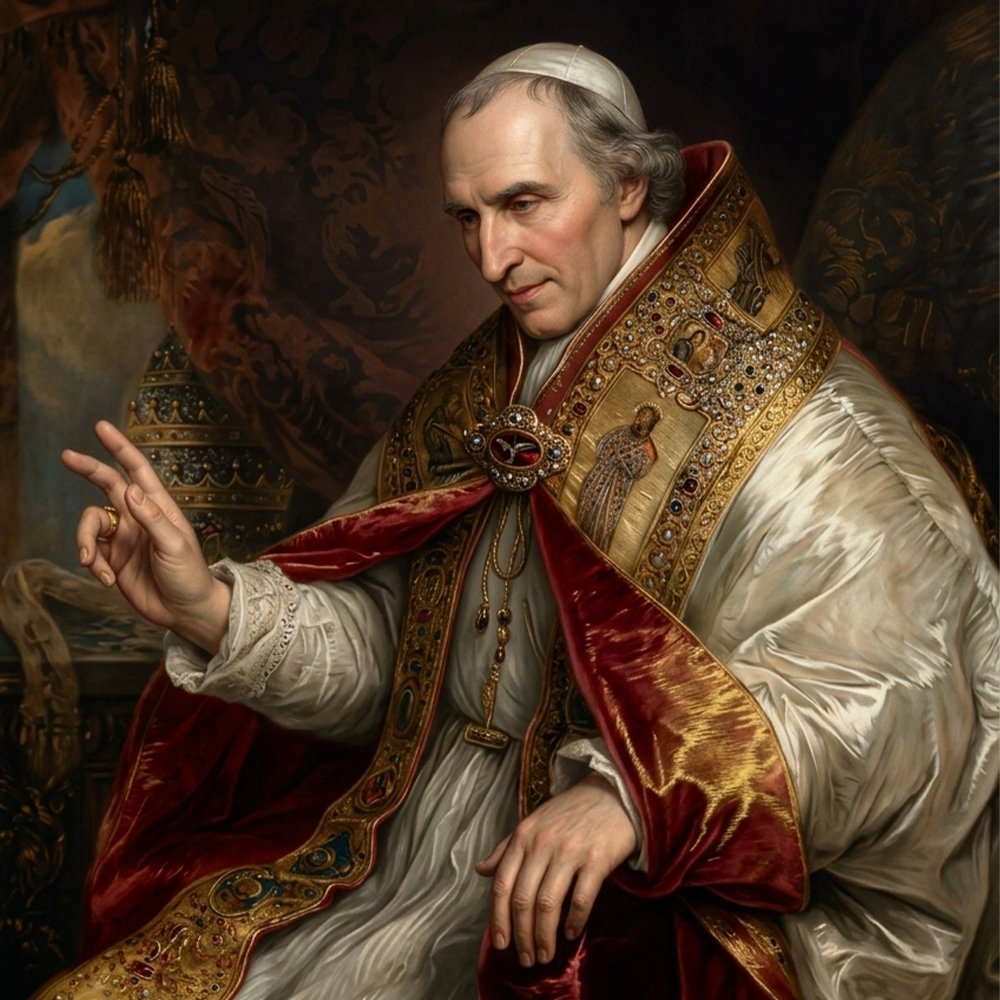
Pope Pius VIII (1829-1830)
BIOGRAPHICAL DATA
Birth name: Francesco Saverio Maria Felice Castiglioni
Birth: November 20, 1761, Cingoli, Marche, Papal States (Italy)
Papal election: March 31, 1829
Coronation: April 5, 1829
Pontificate: March 31, 1829 – November 30, 1830 (1 year, 8 months)
Death: November 30, 1830, Quirinal Palace, Rome (age 69)
Burial: St. Peter’s Basilica, Vatican City
Cognome: “Pope of the Mixed Marriages”, “Transition Pope”
NOTE: His pontificate was the shortest of the 19th century. Despite his frail health and brief reign, Pius VIII addressed significant issues including Catholic Emancipation in Britain, the July Revolution in France, and the vexing problem of mixed marriages between Catholics and Protestants .
EARLY LIFE AND EDUCATION
Birth and Family
Francesco Saverio Castiglioni was born on November 20, 1761, in Cingoli, a town in the Marche region of central Italy, then part of the Papal States . He was the third of eight children born to Count Ottavio Castiglioni (1714-1804) and his wife Sanzia Teresa Ghislieri . The Castiglioni family was noble, and Francesco could claim an ancestor who was Pope Celestine IV (1241) .
His full baptismal name was recorded as Francesco Saverio Maria Felice .
Education
Castiglioni received his early education at the Collegio Campana, run by the Society of Jesus (Jesuits) . He then proceeded to the University of Bologna, one of the oldest and most prestigious universities in Europe. There, he distinguished himself as a student of law, earning a doctorate in canon law and civil law (in utroque iure) in 1785 .
Priestly Ordination
He was ordained to the priesthood in Rome on December 17, 1785, by Cardinal Giuseppe Maria Doria Pamphilj .
EARLY ECCLESIASTICAL CAREER
Vicar General and Prelate
In the years following his ordination, Castiglioni served in a series of pastoral and administrative roles within the Papal States, gaining valuable experience:
Vicar General of Anagni (1788-1790)
Vicar General of Fano (1790-1797)
Vicar General of Ascoli Piceno (1797-1800)
Bishop of Montalto (1800-1816)
On August 11, 1800, he was appointed Bishop of Montalto by Pope Pius VII . He received his episcopal consecration on August 17, 1800, in the Roman church of Santi Domenico e Sisto, with Cardinal Giuseppe Maria Doria Pamphilj serving as the principal consecrator .
Resistance to Napoleon and Exile
The Napoleonic era tested the loyalty of many churchmen. Bishop Castiglioni distinguished himself by his steadfast refusal to swear allegiance to Napoleon Bonaparte or to his puppet state, the Kingdom of Italy .
This act of defiance led to his arrest on July 29, 1808. He was taken first to Milan, then moved to Pavia, Mantua, and finally Turin, where he arrived on November 10, 1813. He was brought back to Milan on November 18. Throughout this period, he was effectively a prisoner, enduring hardship for his loyalty to the Pope . It was only after Napoleon’s final fall that he was able to return to his diocese on June 16, 1814 .
Cardinal and High Curial Office
Pope Pius VII, who greatly valued Castiglioni for his fidelity and expertise in canon law, rewarded him with promotion to the College of Cardinals. He was created Cardinal-Priest of Santa Maria in Traspontina on March 8, 1816 . In the same year, he was also appointed Bishop of Cesena .
In 1821, Pius VII called him to Rome to assume two of the most important positions in the Roman Curia: he became Cardinal-Bishop of the suburbicarian see of Frascati and was appointed Major Penitentiary (Grande Penitenziere), one of the highest offices in the Church, dealing with matters of conscience and the internal forum .
It was during this time that Pope Pius VII, who held him in the highest esteem, was known to refer to him as “Pius VIII,” indicating his wish that Castiglioni would one day succeed him .
THE CONCLAVE OF 1823
Following the death of Pius VII in 1823, Castiglioni entered the conclave as a leading candidate. He was known to be close to the late pope and to favor the more moderate and conciliatory policies associated with Pius VII’s great Secretary of State, Cardinal Ercole Consalvi . However, this alliance with Consalvi proved controversial. The more conservative and intransigent faction of cardinals, the zelanti, opposed Consalvi’s policies. As a result, Castiglioni failed to gain the necessary votes. Cardinal Annibale della Genga, a leader of the zelanti, was elected instead, taking the name Pope Leo XII .
CONCLAVE OF 1829 – ELECTION AS POPE
Death of Leo XII
Pope Leo XII died on February 10, 1829, after a pontificate of nearly six years .
The Conclave
The conclave to elect his successor opened on February 23, 1829, and was one of the most complex of the century .
Key Factions:
French Party: King Charles X of France favored a moderate candidate and had a very positive opinion of Cardinal Castiglioni. He was among several candidates supported by the French court .
Austrian Party: The Habsburg Emperor Francis I and the powerful Austrian chancellor Prince Metternich preferred a candidate who would maintain the conservative, pro-Austrian status quo.
Moderates: This group, including supporters of the late Pius VII’s policies, saw Castiglioni as their ideal candidate.
Zelanti (Intransigents): The conservative faction that had elected Leo XII was now divided.
The Political Deal:
A crucial behind-the-scenes agreement propelled Castiglioni to the papacy. The powerful and ambitious Cardinal Giuseppe Albani desired to be the next Cardinal Secretary of State, wielding the real political power. He approached the frail and ailing Castiglioni with a proposal: if elected, Castiglioni would appoint Albani as his Secretary of State. Castiglioni, recognizing his own physical limitations, signed the agreement without demur .
The Balloting:
The voting was protracted and complex. Castiglioni consistently received strong support. Other candidates, including Cardinals Emmanuele De Gregorio and the future Pope Gregory XVI (Bartolomeo Cappellari), were also in contention at various points . Finally, on March 31, 1829, Castiglioni was elected Pope. He received 47 votes out of 50 in the decisive ballot .
Choice of Name
In honor of his mentor and patron, the late Pope Pius VII, he chose the pontifical name Pius VIII .
Coronation
He was solemnly crowned on April 5, 1829, on the steps of the Vatican Basilica by Cardinal Giuseppe Albani, who, as agreed, was immediately appointed Cardinal Secretary of State .
THE PONTIFICATE (1829-1830)
Character and Style
Pius VIII was known for his personal piety, his expertise in canon law, and his generally broad-minded and conciliatory approach, which stood in marked contrast to the more rigid and police-oriented governance of his predecessor, Leo XII . A disciple of Pius VII, he aimed to revive that pope’s tradition of moderation. He was not greatly interested in the minutiae of politics, preferring to delegate foreign affairs to his Secretary of State, Cardinal Albani, while focusing his own attention on pastoral and doctrinal issues .
Governance of the Papal States
One of his first acts was to alleviate some of the more unpopular measures of Leo XII’s reign. He significantly mitigated the harsh police regime that had been imposed, abolishing the requirement for taverns to have grilles (cancelletti) that prevented the consumption of wine without a meal—a regulation deeply resented by the Roman populace. This small act of liberalization earned him a lasting place in Roman popular memory and was even commemorated in a lighthearted poem .
Key Doctrinal and Pastoral Documents
Despite his short reign, Pius VIII issued important documents addressing the major challenges of his time.
1. Encyclical Traditi Humilitati (May 24, 1829)
This was his only encyclical, setting forth the program for his pontificate . In it, he traced the breakdown of religion and the social order to several key modern errors :
Indifferentism: He condemned the “foul contrivance of the sophists of this age” that would place Catholicism on an equal footing with any other religion .
Bible Societies: He warned against the activities of Protestant Bible societies, which were distributing vernacular translations of the Bible without Catholic commentary. He wrote: “They print the Bibles in the vernacular and, absorbing an incredible expense, offer them free even to the uneducated. Furthermore, the Bibles are rarely without perverse little inserts to ensure that the reader imbibes their lethal poison instead of the saving water of salvation” .
Attacks on Marriage and Church Dogma: He defended the sacredness of marriage and Church teachings against modern assaults.
Secret Societies: He condemned the influence of Freemasonry and other secret societies .
2. Apostolic Brief Litteris Altero Abhinc (March 25, 1830)
This brief is perhaps the most significant document of his pontificate and the one for which he is best remembered . It addressed the vexed question of mixed marriages between Catholics and Protestants.
Context: The problem was particularly acute in Prussia, which after the Congress of Vienna (1815) had acquired the predominantly Catholic Rhineland and Westphalia. The Prussian government supported the rule that the father’s wishes should prevail in the religious upbringing of children, which often meant they were raised as Protestants .
Provisions:
Conditional Blessing: A mixed marriage could only receive the Church’s blessing (be considered a sacrament) if proper promises were made to ensure that all children of the marriage would be brought up in the Catholic faith .
“Passive Assistance”: If the non-Catholic party refused to make these promises, the priest could not bless the marriage. However, he was permitted to offer “passive assistance”—that is, to be present at the ceremony as an official witness to its legality, but without performing the sacred rites or treating it as a sacrament . This nuanced position aimed to prevent totally secular marriages while upholding the Church’s discipline.
The brief also reiterated the condemnation of masonic secret societies .
Response to Major Political Events
Pius VIII’s brief pontificate coincided with two watershed political events in Europe.
1. Catholic Emancipation in the United Kingdom (1829)
The Roman Catholic Relief Act 1829, also known as Catholic Emancipation, was passed by the British Parliament just weeks before Pius VIII’s election. It removed many of the legal restrictions on Catholics in the United Kingdom, allowing them to sit in Parliament and hold most public offices. Pope Pius VIII welcomed this development .
2. The July Revolution in France (1830)
In July 1830, a popular uprising in Paris overthrew the ultra-conservative King Charles X and replaced him with the more liberal King Louis-Philippe I, the “Citizen King.” This posed a diplomatic dilemma for the papacy, which had traditionally supported legitimate monarchs. Against the advice of Cardinal Albani and his own nuncio, Pius VIII demonstrated remarkable political realism. He accepted the new regime and recognized Louis-Philippe as the legitimate king of the French. He went a step further, granting the new king the traditional title of the French monarchy, “Roi Très Chrétien” (His Most Christian Majesty) . When some legitimist bishops and priests fled France in protest, he showed his disapproval by refusing them admission to the Papal States and urged them to stay at their posts .
Relations with Other Countries
United States: He approved the decrees of the First Provincial Council of Baltimore (October 1829), the first formal meeting of American bishops, which helped organize the rapidly growing Catholic Church in the United States .
Ireland and Poland: While pragmatic about Germany and France, he opposed what he saw as liberalizing movements in Ireland and Poland, likely viewing them through the lens of Austria’s and Cardinal Albani’s conservative influence .
Latin America: Under the pro-Austrian influence of Cardinal Albani, his policy toward the newly independent Latin American republics was less progressive than that of Leo XII and considered reactionary by some .
Other Activities
Cardinals Created: He held three consistories (July 27, 1829; March 15, 1830; July 5, 1830) and elevated a total of six men to the College of Cardinals .
Beatifications: He beatified two individuals: Benincasa da Montepulciano (December 23, 1829) and Chiara Gambacorti (March 4, 1830) .
Doctor of the Church: In 1830, he proclaimed Saint Bernard of Clairvaux a Doctor of the Church .
Usury: In a letter to a French bishop, he allowed the taking of moderate interest on loans, a significant step in the Church’s evolving teaching on usury .
ILLNESS, DEATH, AND RUMORS OF FOUL PLAY
Poor Health
Pius VIII was in very poor health from the moment of his election. He suffered from painful, suppurating sores on his neck and body, which left him so feeble that he could often do little more than sign documents prepared for him by Cardinal Albani, who ruled the Papal States in his stead .
Final Illness
In early November 1830, his condition worsened. He developed fistulas on his neck and knee, and his entire body became covered with pustules. He was critically ill by November 23, suffering from breathing difficulties. He received Viaticum on November 28 and the Anointing of the Sick (Extreme Unction) shortly thereafter .
Death
Pope Pius VIII died on November 30, 1830, at the age of 69, in the Quirinal Palace in Rome . His death marked the end of the shortest pontificate of the 19th century, lasting just 1 year and 8 months.
Conspiracy Theories
The circumstances of his death gave rise to rumors of poisoning. A diary entry by Prince Don Agostino Chigi, a contemporary member of the papal nobility, recorded that an autopsy revealed the Pope’s internal organs to be healthy, with only some weakness found in the lungs or heart, leaving the cause of death uncertain . Proponents of conspiracy theories have seized on this ambiguity as evidence of foul play, though no proof has ever been found to substantiate such claims .
He was succeeded by Pope Gregory XVI.
LEGACY AND HISTORICAL EVALUATION
Historical Assessment
Pope Pius VIII is one of the least remembered popes of the 19th century, his brief pontificate sandwiched between the longer and more impactful reigns of Leo XII and Gregory XVI . Historians generally regard him as a well-meaning, moderately liberal, but physically incapable figure whose rule was largely managed by others.
Oxford Reference notes that he “aimed at reviving the tradition of Pius VII” and was “not greatly interested in politics” but had a “keen concern for pastoral and doctrinal issues” .
Britannica characterizes him as “in strictly ecclesiastical matters… generally broad-minded and conciliatory,” noting his pragmatic acceptance of the July Revolution in France .
The Catholic Encyclopedia (via New Advent) describes his personal life as “irreproachable” and notes his lack of censoriousness toward others .
Key Contributions
Mixed Marriages: His brief Litteris altero abhinc provided a nuanced and influential framework for handling mixed marriages that would guide the Church for decades.
Political Pragmatism: His swift recognition of Louis-Philippe after the July Revolution demonstrated a realist approach to international relations, prioritizing the Church’s pastoral presence over ideological attachment to a fallen monarchy.
Moderate Governance: His relaxation of Leo XII’s more oppressive police measures in the Papal States, though minor, endeared him to the Roman people and signaled a less intransigent style of temporal rule.
Doctrinal Vigilance: His encyclical Traditi humilitati and other documents reaffirmed core Catholic teachings against indifferentism, secret societies, and unapproved Bible translations, showing continuity with the Church’s defensive posture against 19th-century liberalism.
Limitations
Brevity: His pontificate was simply too short to achieve any major, lasting reforms.
Ill Health: His physical frailty rendered him largely incapable of governing independently, leaving effective rule in the hands of Cardinal Albani, whose pro-Austrian policies were more reactionary than the pope’s own inclinations .
Pius VIII was a transitional figure in every sense. He was a transitional pope, elected for his presumed brevity. He governed in a transitional period, witnessing the end of the post-Napoleonic Restoration era with the July Revolution in France and the rise of a more aggressive liberalism. He sought to be a bridge between the conciliatory policies of Pius VII and the intransigent conservatism that would come to define the papacy under his successors, Gregory XVI and Pius IX.
His personal holiness, legal mind, and occasional flashes of political pragmatism were overshadowed by his debilitating illness and the overbearing influence of his Secretary of State. Yet, his decisions on mixed marriage and his acceptance of the new French regime showed a capacity for prudent and moderate leadership that, had he been healthier, might have made his pontificate more consequential.
As one source put it, a contemporary poem celebrated his abolition of the unpopular cancelletti in Rome’s taverns. While not a monumental achievement, it captured the gentle, moderate spirit of the man who, in his brief moment on the world stage, tried to “cancel the cancelletter” .
Requiescat in pace – Rest in peace, Pius VIII, the learned canonist who accepted a crown he was too ill to wear, and who navigated a revolutionary age with quiet pragmatism.