Leo XIII
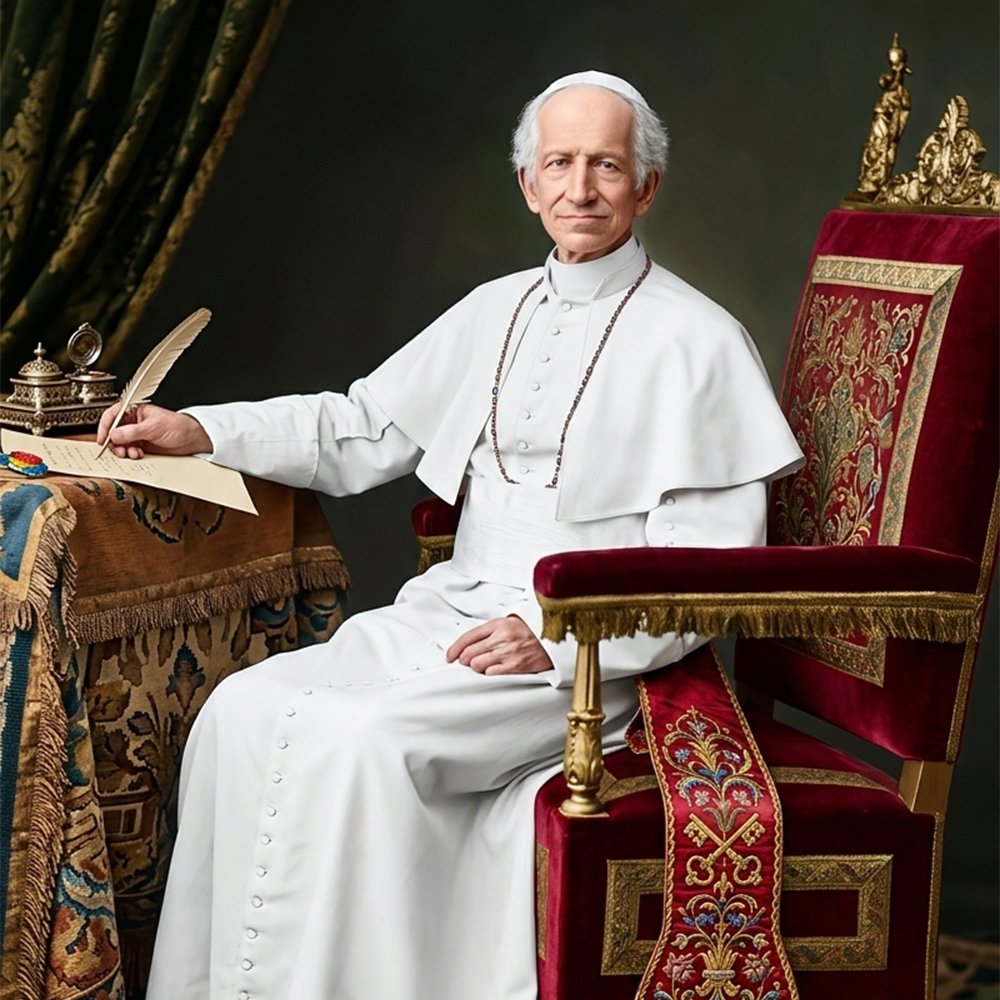
Pope Leo XIII (1878-1903)
BIOGRAPHICAL DATA
Birth name: Vincenzo Gioacchino Raffaele Luigi Pecci
Birth: March 2, 1810, Carpineto Romano, Papal States (Italy)
Papal election: February 20, 1878
Coronation: March 3, 1878
Pontificate: February 20, 1878 – July 20, 1903 (25 years, 5 months)
Death: July 20, 1903, Vatican City (age 93)
Burial: Basilica of St. John Lateran, Rome
Papal motto: “Lumen in Coelo” (Light in Heaven)
Cognome: “Pope of the Workers”, “Social Pope”, “Pope of Rerum Novarum”
NOTE: His 25-year pontificate was the third longest in history (after St. Peter and Pius IX). He was the first pope to be born in the 19th century and the first to die in the 20th century.
CHILDHOOD AND EDUCATION
Birth and Family
Birthplace: Carpineto Romano, a small town in the Lepini Mountains, about 50 miles southeast of Rome. At the time of his birth, this territory was part of the Papal States.
Family Background:
Father: Count Ludovico Pecci (1767-1832) – a colonel in the papal army who served as a civil official in the Napoleonic era
Mother: Countess Anna Prosperi-Buzi (1776-1824) – from a noble family of Carpineto
Siblings: Seventh of eight children (five sons, three daughters)
The Pecci family was of minor nobility, possessing a small estate at Carpineto but not wealthy
Family History:
The Pecci family had ancient roots in Siena (Tuscany), tracing their nobility back centuries
They relocated to the Papal States in the 16th century
Several family members served in the papal administration
His older brother Giuseppe Pecci (1807-1890) would also become a cardinal and collaborated closely with Leo’s intellectual projects
Early Childhood (1810-1818)
Napoleonic Context:
Born during the height of Napoleon’s power
The Papal States were occupied by French troops
Pope Pius VII was a prisoner of Napoleon at Fontainebleau (1809-1814)
The Pecci family remained loyal to the papacy throughout this period
Memories of the French Occupation:
Later in life, Leo XIII recalled his mother hiding him in a basket when French soldiers came searching for his father
The family endured hardship during the Napoleonic period
These early experiences shaped his lifelong suspicion of revolutionary movements
Education at Viterbo (1818-1824)
Jesuit College in Viterbo:
At age 8, Vincenzo and his brother Giuseppe were sent to the prestigious Jesuit college in Viterbo
The college was known for its rigorous classical curriculum
Students lived at the college, returning home only for vacations
Curriculum:
Latin and Greek classics (Horace, Virgil, Cicero, Homer)
Rhetoric and composition
History and geography
Italian literature
Mathematics
Religious instruction
Early Signs of Brilliance:
Both Pecci brothers excelled in their studies
Vincenzo was particularly noted for his Latin compositions
He developed a lifelong love of poetry and classical literature
He would later write Latin poetry throughout his life (publishing a collection as pope)
Personal Development:
The Jesuit education instilled discipline, intellectual rigor, and deep faith
He developed a special devotion to St. Thomas Aquinas (though he studied little Thomist philosophy at this stage)
Made his First Communion and Confirmation during these years
Roman College (1824-1832)
Transfer to Rome:
In 1824, at age 14, Vincenzo entered the Roman College (now the Pontifical Gregorian University)
The college was directed by the Jesuits and was the most prestigious institution of higher learning in the Papal States
Studies:
Philosophy (1824-1828): Studied logic, metaphysics, ethics, and natural philosophy (science)
Theology (1828-1832): Four-year program in dogmatic and moral theology
Languages: Perfected his Latin and Greek; studied Hebrew
Law: Also pursued studies in civil and canon law (though his doctorate in law would come later)
Academic Excellence:
Vincenzo was consistently at the top of his class
His professors recognized his exceptional intellectual gifts
He won numerous academic prizes and competitions
His dissertation in theology was praised for its clarity and depth
Ordination Delayed:
Despite completing his theological studies, he was not immediately ordained
He had not yet reached the canonical age for priesthood (24 at the time)
He also needed to complete additional studies in canon law
Doctoral Degrees:
Received doctorate in theology (1832)
Received doctorate in civil and canon law (in utroque iure) from the Sapienza University (1832)
Pontifical Academy of Noble Ecclesiastics (1832-1837)
Entry into the Academy:
After completing his doctorates, Vincenzo entered the Pontifical Academy of Noble Ecclesiastics
This institution trained young aristocrats for diplomatic service in the Vatican
Students were prepared for careers as nuncios, papal diplomats, and curial officials
Training:
Diplomatic protocol and practice
Advanced canon law
European languages (French, German, Spanish)
Political theory and international relations
Friendships:
Formed lasting friendships with fellow students who would later become influential cardinals and bishops
His network of contacts throughout Europe began here
Priestly Ordination (1837)
Ordination:
December 31, 1837 – Ordained a priest at the age of 27
The ordination took place in Rome
He celebrated his first Mass in the church of St. Andrea al Quirinale
Reason for Late Ordination:
He had pursued advanced studies before ordination (common for those destined for high office)
His diplomatic training delayed immediate entry into pastoral ministry
He was being groomed for a career in papal diplomacy
DIPLOMATIC AND PASTORAL CAREER
First Assignments in the Papal States
Delegate in Benevento (1838-1841):
At age 28, Monsignor Pecci was appointed Apostolic Delegate in Benevento, a papal enclave within the Kingdom of the Two Sicilies
Challenges: The province was plagued by banditry, corruption, and administrative chaos
Achievements: He reorganized the police, suppressed banditry, reformed the administration, and built roads and aqueducts
He gained a reputation as a capable and just administrator
Delegate in Perugia (1841-1843):
Transferred to Perugia, a larger and more important city in the Papal States
Continued his administrative reforms
Promoted education and public works
Gained popularity among the people
Nuncio to Belgium (1843-1846)
Appointment:
In 1843, at age 33, he was appointed Apostolic Nuncio to Belgium
He was consecrated Titular Archbishop of Damietta (an ancient see in Egypt) on February 19, 1843
This was a remarkable promotion for such a young cleric
Belgian Context:
Belgium had become independent from the Netherlands in 1830
It had a liberal constitution that guaranteed religious freedom
The Catholic Church flourished under this system
The Catholic University of Louvain was a center of intellectual life
Formative Experience:
Pecci saw firsthand that the Church could prosper without state protection
This experience would later influence his more conciliatory approach to modern states
He developed respect for constitutional government and religious liberty (within limits)
He was impressed by the intellectual vitality of Louvain
Relations with King Leopold I:
He established good relations with the Belgian monarchy
King Leopold I (a Lutheran married to a Catholic princess) respected the young nuncio
These diplomatic skills would serve him well as pope
End of Nunciature and “Exile” to Perugia
Return to Rome (1846):
Pope Gregory XVI died in 1846
The new pope, Pius IX, and his Secretary of State, Cardinal Antonelli, did not favor Pecci
Pecci had hoped for a curial appointment but was instead sent to a provincial diocese
Archbishop of Perugia (1846-1878):
Appointed Archbishop of Perugia on January 27, 1846
He would remain there for 32 years – a long “exile” from Rome
Initially disappointed, he threw himself into pastoral work
Archbishop of Perugia (1846-1878)
Pastoral Ministry:
Visited all 197 parishes of his diocese personally (multiple times)
Knew his clergy intimately
Was accessible to the people, especially the poor
Earned a reputation as a devoted shepherd
Seminary Reform:
Completely reformed the seminary of Perugia
Raised academic standards
Emphasized study of St. Thomas Aquinas (Thomism)
Insisted on rigorous intellectual formation combined with spiritual discipline
Many of his seminarians became exemplary priests and bishops
Social Concern:
Perugia was experiencing the social upheavals of industrialization
Pecci organized Catholic workers’ circles
Promoted cooperatives and credit unions
Mediated strikes and labor disputes
Defended workers’ rights while opposing socialism
These experiences prepared him for Rerum Novarum
Intellectual Activity:
Founded the Academy of St. Thomas Aquinas (1859)
Published scholarly pastoral letters on:
Education
Marriage
Liberalism
Socialism
Church-State relations
His writings circulated internationally, earning him a reputation as one of the most learned bishops in Europe
Political Turmoil (1859-1870):
The Risorgimento (Italian unification) swept through Italy
In 1860, Perugia was annexed to the Kingdom of Italy
Pecci lost temporal power but maintained spiritual authority
He navigated relations with the new Italian authorities with prudence and pragmatism
Unlike many bishops who adopted intransigent positions, he sought practical accommodations
Cardinal (1853)
Creation as Cardinal:
On December 19, 1853, Pope Pius IX created him Cardinal-Priest with the title of San Crisogono
The announcement was made public on December 22, 1853
He remained in Perugia, however, and was not called to Rome
Continued Pastoral Work:
Despite being a cardinal, he continued his pastoral work in Perugia
He refused to be drawn into curial politics
He maintained respectful but distant relations with Pius IX and Cardinal Antonelli
Camerlengo (1877)
Appointment:
On September 21, 1877, Pope Pius IX appointed him Camerlengo of the Holy Roman Church
This office made him responsible for administering the Church during the vacancy of the Holy See
The appointment required him to move to Rome
It was a clear signal that he might be considered for the papacy
Final Months of Pius IX’s Pontificate:
He witnessed the last months of Pius IX’s long reign
He was present at Pius IX’s death (February 7, 1878)
As Camerlengo, he formally verified the pope’s death and began preparations for the conclave
CONCLAVE OF 1878 AND ELECTION
Death of Pius IX
February 7, 1878:
Pope Pius IX died after the longest pontificate in history (31 years, 7 months)
He was buried temporarily in St. Peter’s (later moved to San Lorenzo fuori le Mura)
Situation of the Church:
The pope was the “Prisoner of the Vatican” – refusing to leave the Vatican in protest against the seizure of the Papal States
Diplomatic isolation: relations with Italy were broken, and conflicts existed with Germany (Kulturkampf), France, and other powers
The Church seemed besieged by modernity – liberalism, socialism, rationalism, and secularism were advancing
Many Catholics felt the Church was in a defensive, even desperate, position
The Conclave (February 18-20, 1878)
Participants:
64 cardinals entered the conclave
The conclave was held in the Vatican (the first to be held there since the loss of the Papal States)
Factions:
Zelanti (Intransigents): Wanted to continue Pius IX’s combative policies; opposed any reconciliation with modernity or liberal states
Moderates (Politicians): Recognized the need for a change in tone; wanted diplomatic openings and a less confrontational approach
Candidates:
The Zelanti favored Cardinal Luigi Bilio or Cardinal Camillo Di Pietro
The moderates coalesced around Cardinal Pecci
Pecci’s Advantages:
Age 68 – old enough to be a “transition” pope, but healthy enough to govern effectively
Experience: 32 years as a pastor, plus diplomatic experience
Reputation for learning and prudence
Not associated with the most controversial policies of Pius IX
Had maintained good relations with the Italian government (pragmatic but not compromising)
Election:
February 20, 1878, 3rd ballot: Cardinal Pecci received 44 votes (the necessary two-thirds)
He accepted with tears, saying he would take the name Leo XIII in honor of Leo XII, a pope he admired
The conclave lasted only three days – remarkably short
Choice of Name:
He chose Leo to honor Pope Leo XII (1823-1829), who had promoted culture and science
He deliberately avoided “Pius” to signal a change in tone, not just continuity
“Leo” also evoked strength (lion) and wisdom
Coronation and First Acts
Coronation (March 3, 1878):
The coronation took place in the Sistine Chapel
He received the triple tiara (though it would be the last formal coronation; Paul VI would abandon the ceremony in 1963)
First Public Act (March 3, 1878):
In a dramatic break with Pius IX’s practice, Leo XIII gave his Urbi et Orbi blessing from the external balcony of St. Peter’s
Pius IX had always blessed from the internal balcony, refusing to acknowledge the Italian occupation of Rome
This gesture signaled a new, more conciliatory approach
Inaugural Encyclical (April 21, 1878):
Inscrutabili Dei Consilio (On the Evils Affecting Modern Society)
Called for dialogue and engagement with the modern world
But firmly condemned errors of rationalism, materialism, and socialism
Set the tone for his pontificate: firm in doctrine, open in approach
THE PONTIFICATE (1878-1903) – 25 YEARS
General Characteristics
“Pope Diplomat”:
His diplomatic formation shaped his approach
He sought reconciliation with European powers without compromising principles
He was pragmatic and strategic
“Pope Intellectual”:
He was one of the most learned popes in history
He wrote 86 encyclicals (a record until Pius XII)
He was a philosopher, theologian, poet, and Latinist
He promoted science, culture, and biblical studies
“Pope Social”:
His greatest legacy is Rerum Novarum (1891), founding Catholic Social Doctrine
He addressed the condition of workers, the rights of labor, and the duties of capital
He offered a “third way” between capitalism and socialism
“Pope of Reconciliation”:
He ended the German Kulturkampf
He attempted rapprochement with France (the Ralliement)
He expanded the Church’s diplomatic network worldwide
ENCYCLICALS (86 ENCYCLICALS – RECORD!)
Classification
Leo XIII’s 86 encyclicals can be grouped into several categories:
Philosophical and Doctrinal: Laying the intellectual foundations for Catholic engagement with modernity
Social: Addressing the condition of workers and economic justice
Political: Church-State relations and Christian citizenship
Marian and Devotional: Promoting the Rosary and Marian piety
Biblical and Theological: Scripture study and ecclesiology
Historical and Hagiographical: Saints and Church history
National Situations: Addressing specific countries
I. PHILOSOPHICAL AND DOCTRINAL ENCYCLICALS
1. Aeterni Patris (August 4, 1879)
“On the Restoration of Christian Philosophy According to the Mind of St. Thomas Aquinas”
Context:
19th-century philosophy was dominated by rationalism, idealism, materialism, and positivism
Catholic theology lacked a unified philosophical foundation
Many Catholic thinkers were influenced by modern philosophies incompatible with faith
Content:
Proposes St. Thomas Aquinas as the model for Catholic philosophy
Argues that reason and faith are harmonious, not contradictory
Calls for the restoration of Scholastic philosophy, especially Thomism
Mandates the study of Aquinas in seminaries and Catholic universities
Key Quotes:
“The capital theses in the philosophy of St. Thomas are not to be placed in the category of opinions that can be debated pro and con, but are to be considered as the foundations upon which the whole science of natural and divine things rests.”
“Let carefully selected teachers endeavor to implant the doctrine of Thomas Aquinas in the minds of students, and let them clearly point out its solidity and excellence above all others.”
Significance:
Launched the Neo-Thomist revival that would dominate Catholic philosophy for 80+ years
Influenced thinkers like Jacques Maritain, Étienne Gilson, and Reginald Garrigou-Lagrange
Provided intellectual foundation for resistance to modernism
Unified Catholic philosophical education worldwide
Criticisms:
Some argue it rigidified Catholic thought and discouraged dialogue with modern philosophy
Others contend it was intended as a starting point for engagement, not an end in itself
2. Arcanum (February 10, 1880)
“On Christian Marriage”
Content:
Defends the sacramental nature of marriage
Affirms the indissolubility of marriage
Condemns civil divorce
Teaches that marriage is a holy contract, not merely a civil arrangement
Emphasizes the authority of the husband and father (in language reflecting its era)
Significance:
Reaffirmed traditional Catholic teaching against rising divorce rates in Europe
Influenced Church law on marriage until Vatican II
3. Diuturnum (June 29, 1881)
“On the Origin of Civil Power”
Content:
All political authority comes from God, not from the people or social contract
But the form of government (monarchy, republic, democracy) is a matter of human choice
Citizens are bound to obey legitimate authority, but may resist unjust laws
Condemns the idea of popular sovereignty as the sole source of authority
Significance:
Offered a moderate position between divine-right absolutism and revolutionary democracy
Allowed Catholics to accept republican governments while maintaining ultimate authority from God
4. Immortale Dei (November 1, 1885)
“On the Christian Constitution of States”
The Most Important Political Encyclical
Content:
Thesis (Ideal): Ideally, the State should recognize the Catholic Church as the true religion and cooperate with it
Hypothesis (Reality): Where Catholics are a minority, religious toleration may be permitted
The State has its own sphere of authority (temporal), distinct from the Church’s spiritual authority
But the two powers should cooperate harmoniously
Condemns separation of Church and State as an ideal (though accepts it as a practical necessity in some circumstances)
Rejects the notion that the State should be neutral toward religion
Key Quotes:
“God has divided the governance of the human race between two powers: the ecclesiastical and the civil. The one presides over divine interests, the other over human interests.”
“The Church does not condemn any form of government, provided it is just and directed to the common good.”
Significance:
Became the standard Catholic teaching on Church-State relations until Vatican II
Influenced Catholic political thought for generations
Its distinction between “thesis” and “hypothesis” allowed flexibility while maintaining principles
Later Development:
Vatican II’s Dignitatis Humanae (1965) would develop a more nuanced approach to religious freedom
But Leo XIII’s encyclical remains important for understanding Catholic political thought
5. Libertas (June 20, 1888)
“On Human Liberty”
Content:
Distinguishes between true liberty (freedom to do good) and false liberty (freedom to do evil)
Condemns liberalism that denies moral law and divine authority
Defends freedom of conscience in the sense of freedom to follow truth, not freedom to choose error
Affirms that true freedom is ordered by natural and divine law
Significance:
Clarified Catholic teaching on liberty in response to liberal ideologies
Influenced Catholic social and political thought
6. Sapientiae Christianae (January 10, 1890)
“On the Duties of Christian Citizens”
Content:
Christians have duties both to God and to civil society
When civil law contradicts divine law, Christians must obey God rather than men
Catholics should participate in political life to influence society for good
The Church has the right to guide the faithful in matters touching faith and morals
Significance:
Encouraged Catholic political engagement
Influenced the development of Catholic Action movements
7. Satis Cognitum (June 29, 1896)
“On the Unity of the Church”
Content:
The Church is a visible society, not just an invisible spiritual reality
Unity requires unity of faith, worship, and governance under the successor of Peter
The Catholic Church is the one true Church of Christ
Other Christian communities lack the fullness of ecclesial reality
Significance:
Clarified Catholic ecclesiology
Prepared the ground for later ecumenical discussions (though its tone is pre-ecumenical)
II. THE GREAT SOCIAL ENCYCLICAL: RERUM NOVARUM
8. Rerum Novarum (May 15, 1891)
“On the Condition of Workers”
The Most Important Encyclical of the Pontificate
Historical Context:
Industrial Revolution:
Massive urbanization and factory system
Proletarian working class: 14-16 hour workdays, starvation wages, child labor, unsafe conditions
No social safety net, no labor protections
Workers’ slums were breeding grounds for disease, crime, and despair
Socialist Response:
Karl Marx and Friedrich Engels: Communist Manifesto (1848), Das Kapital (1867)
Class struggle, revolution, abolition of private property
International Workers’ Association (First International, 1864)
Socialism was spreading rapidly among workers
Liberal Capitalism:
Laissez-faire ideology: markets should operate without regulation
Social Darwinism: the strong survive, the weak perish
Minimal state intervention, no protection for workers
Exploitation justified as economic freedom
Catholic Precursors:
Bishop Wilhelm Emmanuel von Ketteler of Mainz (Germany): sermons and writings on labor rights (1860s)
Cardinal Henry Edward Manning of Westminster (England): mediated London dock strike (1889)
Catholic workers’ circles in Germany, Belgium, France, Italy
Leo XIII’s own pastoral letters as Archbishop of Perugia
Content of Rerum Novarum:
1. Diagnosis:
“Some opportune remedy must be found quickly for the misery and wretchedness pressing so unjustly on the majority of the working class.”
The concentration of wealth in the hands of a few has imposed “a yoke little better than slavery” on the masses
2. Refutation of Socialism:
Private property is a natural right, not a concession from the state
The family has a right to property as the foundation of its independence
Socialism would destroy the family and reduce workers to state dependence
Class struggle is not inevitable; capital and labor should cooperate
3. Critique of Unbridled Capitalism:
Condemns exploitation of workers
Wages must be sufficient to support a worker and his family in reasonable comfort
Work should not be treated as a mere commodity
The state must protect workers from exploitation
4. Just Wage Doctrine:
A just wage is not merely what the market will bear
It must be sufficient to support a frugal and well-behaved worker
Ideally, it should allow the worker to save and acquire modest property
Wages are a matter of justice, not mere charity
5. Role of the State:
The state must intervene to protect workers’ rights
It should enact laws regulating hours, conditions, and child labor
It should enforce just wages and protect the weak
But it should respect the principle of subsidiarity: not doing what smaller organizations can do
6. Role of the Church:
The Church teaches both workers and employers their duties
It promotes charity, justice, and harmony
It provides spiritual resources to address social problems
7. Workers’ Associations (Unions):
Workers have the right to form associations (unions)
These associations are natural and necessary
They should be free from state interference
Catholic associations are preferred, but mixed associations may be acceptable
Key Quotes:
“Religion alone can remove the evil, root and branch.”
“The first and most fundamental principle, therefore, if one would undertake to alleviate the condition of the masses, must be the inviolability of private property.”
“Wages ought not to be insufficient to support a frugal and well-behaved wage-earner.”
“If through necessity or fear of a worse evil the workman accepts harder conditions because an employer or contractor will give him no better, he is the victim of force and injustice.”
Impact and Legacy:
Immediate Impact (1891-1900):
Explosion of Catholic workers’ organizations throughout Europe
Formation of Christian trade unions
Inspired Catholic social action and study groups
Influenced labor legislation in several countries
20th Century Development:
Quadragesimo Anno (Pius XI, 1931) – 40th anniversary, developed concept of subsidiarity
Mater et Magistra (John XXIII, 1961) – 70th anniversary, addressed new social questions
Laborem Exercens (John Paul II, 1981) – 90th anniversary, focused on human work
Centesimus Annus (John Paul II, 1991) – 100th anniversary, addressed post-Cold War world
Political Influence:
Inspired Christian Democratic parties in Europe (De Gasperi in Italy, Adenauer in Germany, Schuman in France)
Influenced labor movements in North America
Shaped Catholic social teaching in Latin America
Doctrinal Significance:
Founded modern Catholic Social Doctrine
Established a “third way” between capitalism and socialism
Provided a moral framework for economic life
Influenced international labor standards
III. ENCYCLICALS ON CONTEMPORARY ISSUES
9. Humanum Genus (April 20, 1884)
“On Freemasonry”
Content:
Condemns Freemasonry as a “mortal plague”
Describes its naturalistic philosophy as opposed to Christian revelation
Warns Catholics against joining Masonic lodges
Reiterates previous papal condemnations
Significance:
Reaffirmed the Church’s opposition to Freemasonry
Influenced Catholic policy well into the 20th century
10. In Plurimis (May 5, 1888)
“On the Abolition of Slavery”
Content:
Condemns the institution of slavery
Addresses specifically to the bishops of Brazil (the last Christian country with slavery)
Calls for the abolition of slavery
Praises those working for emancipation
Timing:
Issued just days before Brazil’s Lei Áurea (Golden Law) of May 13, 1888, which abolished slavery
Leo XIII congratulated Princess Isabel of Brazil for her role in abolition
Significance:
Important milestone in Catholic teaching on human dignity
Clarified that slavery is incompatible with Christian faith
11. Graves de Communi Re (January 18, 1901)
“On Christian Democracy”
Content:
Clarifies the meaning of “Christian democracy”
It is not a political system but social action on behalf of the people
Must be distinguished from socialism and revolutionary movements
Must remain under ecclesiastical authority
Does not imply approval of any particular form of government
Significance:
Allowed Catholic social action while preventing confusion with political democracy
Encouraged lay participation in social reform
IV. MARIAN AND DEVOTIONAL ENCYCLICALS
The “Rosary Pope”
Leo XIII was extraordinarily devoted to the Rosary and wrote 11 encyclicals on the subject:
Major Rosary Encyclicals:
Encyclical | Date | Focus |
|---|---|---|
Supremi Apostolatus Officio | September 1, 1883 | First Rosary encyclical, promoted October as Rosary month |
Superiore Anno | August 30, 1884 | Encouraged continued Rosary devotion |
Quamquam Pluries | August 15, 1889 | Added prayers to St. Joseph to Rosary devotions |
Octobri Mense | September 22, 1891 | On the Rosary as a spiritual weapon |
Magnae Dei Matris | September 8, 1892 | On the Rosary and Christian life |
Laetitiae Sanctae | September 8, 1893 | On the Rosary and social questions |
Iucunda Semper | September 8, 1894 | On the Rosary and the Church |
Adiutricem | September 5, 1895 | On the Rosary and Christian unity |
Fidentem Piumque | September 20, 1896 | On the Rosary and penance |
Augustissimae Virginis | September 12, 1897 | On the Rosary and the confraternities |
Diuturni Temporis | September 5, 1898 | Summary of Rosary teaching |
Key Themes:
The Rosary is a powerful spiritual weapon against modern evils
October is dedicated to the Rosary
Family Rosary strengthens Christian homes
Mary is the Mediatrix of graces
12. Quamquam Pluries (August 15, 1889)
“On Devotion to St. Joseph”
Content:
Recommends devotion to St. Joseph as patron of the universal Church
Adds prayers to St. Joseph to the Rosary during October
Presents St. Joseph as model of workers and protector of families
Significance:
Strengthened devotion to St. Joseph
Influenced later encyclicals on St. Joseph
V. BIBLICAL AND THEOLOGICAL ENCYCLICALS
13. Providentissimus Deus (November 18, 1893)
“On the Study of Holy Scripture”
Landmark Biblical Encyclical
Context:
Rationalist biblical criticism was challenging traditional understandings of Scripture
Some scholars denied the historicity of biblical events
Questions of inspiration, inerrancy, and interpretation were acute
Content:
On Inspiration and Inerrancy:
The books of Scripture are inspired by God; God is their principal author
Therefore, they are free from error in matters of faith and morals
The sacred writers “taught without error those truths which God wished to be set down in sacred writings for the sake of salvation”
On Interpretation:
Scripture must be interpreted according to the analogy of faith and the teaching of the Church
The literal sense is primary, but spiritual senses are also valid
Study of original languages (Hebrew, Greek) is encouraged
Textual criticism is permitted within limits
Archaeology and other sciences can help illuminate Scripture
On Apparent Conflicts with Science:
When Scripture seems to conflict with science, we should reexamine our interpretation
The sacred writers “did not intend to teach men the inner nature of visible things” but wrote in popular language
Truth cannot contradict truth
On Reading Scripture:
Encourages all Catholics, especially clergy, to read Scripture devoutly
Warns against private interpretation contrary to Church teaching
Establishment of Biblical Commission:
In 1902, Leo XIII established the Pontifical Biblical Commission
Its purpose: to promote and guide Catholic biblical studies
It was to ensure that scholarship remained faithful to Church teaching
Significance:
Balanced openness to scientific study with fidelity to tradition
Encouraged Catholic biblical scholarship
Paved the way for Pius XII’s Divino Afflante Spiritu (1943)
Influenced Vatican II’s Dei Verbum (1965)
VI. OTHER IMPORTANT ENCYCLICALS
14. Annum Sacrum (May 25, 1899)
“On the Consecration of the Human Race to the Sacred Heart”
Content:
Consecrates the entire human race to the Sacred Heart of Jesus
Sees this consecration as a response to the evils of the age
Invites all Catholics to join in this act of devotion
Significance:
Culmination of Leo XIII’s devotion to the Sacred Heart
Influenced Pius XI’s establishment of the feast of Christ the King (1925)
15. Testem Benevolentiae (January 22, 1899)
“On Americanism”
Context:
Some European Catholics were concerned about developments in the American Church
They feared “Americanism” – an adaptation of Catholic doctrine to American culture that might compromise traditional teachings
The controversy involved questions of religious liberty, separation of Church and State, and the role of the laity
Content:
Condemns certain errors associated with “Americanism”:
That the Church should adapt her doctrines to modern culture
That external spiritual guidance is less necessary for souls
That natural virtues are to be preferred to supernatural virtues
That religious vows are incompatible with Christian liberty
But praises the energy and zeal of the American Church
Does not condemn American institutions or the American way of life as such
Significance:
Addressed concerns about excessive accommodation to modernity
American bishops responded that the condemned errors were not taught in the United States
The controversy subsided but reflected ongoing tensions
REFORMS AND ACHIEVEMENTS
1. Opening of the Vatican Archives (1881)
Revolutionary Decision:
Leo XIII opened the Vatican Secret Archives to qualified scholars – Catholic and non-Catholic alike
This was unprecedented in papal history
Scholars gained access to documents dating back centuries
Motivation:
“The Church has nothing to fear from the truth”
Wanted to counter anti-Catholic historical narratives (e.g., about the Inquisition, Galileo)
Believed that honest scholarship would vindicate the Church
Impact:
Revolutionized medieval and early modern historical studies
Attracted scholars from around the world
Enhanced the Church’s intellectual credibility
Demonstrated confidence in historical truth
2. Vatican Observatory (1891)
Foundation/Refoundation:
Leo XIII re-established the Vatican Observatory (Specola Vaticana)
Located initially near St. Peter’s, later moved to Castel Gandolfo
Staffed by Jesuit astronomers
Purpose:
Demonstrate that the Church supports genuine science
Contribute to astronomical research
Counter the myth that the Church is hostile to science
Legacy:
The Observatory continues to this day, producing respected research
Symbolizes the compatibility of faith and science
3. Pontifical Academy of Sciences
Reorganization:
Leo XIII reorganized the Pontifical Academy of Sciences (originally founded 1603)
Opened it to leading scientists regardless of religious affiliation
Promoted dialogue between faith and science
4. Catholic Universities
Encouragement Worldwide:
Supported the foundation of Catholic universities:
Catholic University of America (Washington, D.C.) – 1887
Catholic universities in Latin America
Strengthened the Catholic University of Louvain (Belgium)
Supported the Institut Catholique in Paris
Purpose:
Provide higher education faithful to Catholic teaching
Form intellectual elite capable of engaging modern culture
Demonstrate that Catholicism is intellectually respectable
5. Reform of the Roman Curia
Reorganization (1899):
Leo XIII reorganized the Roman Curia for greater efficiency
Clarified the competencies of various congregations
Streamlined procedures
6. Relations with Eastern Churches
Orientalium Dignitas (1894):
Affirmed the dignity of Eastern Catholic rites
Forbade Latinization of Eastern Catholics
Promoted respect for Eastern traditions
Unity Efforts:
Engaged in dialogue with Orthodox churches (though without concrete results)
Encouraged study of Eastern Christianity
7. Missions
Expansion:
Created new dioceses in missionary territories
Supported missionary orders
Encouraged development of native clergy
DIPLOMATIC ACHIEVEMENTS
Germany: End of the Kulturkampf
Context:
The Kulturkampf (“Culture Struggle”) was Bismarck’s campaign against the Catholic Church in Germany (1871-1887)
Anticlerical laws expelled religious orders, restricted bishops, and imprisoned clergy
The Catholic Center Party resisted, but the Church was under severe pressure
Leo XIII’s Diplomacy:
Engaged in direct negotiations with Bismarck
Showed flexibility and pragmatism
Gradually, most anti-Catholic laws were repealed
By 1887, the Kulturkampf was effectively over
Significance:
Major diplomatic victory
Restored Church’s freedom in Germany
Enhanced papal prestige
France: The Ralliement
Context:
France was deeply divided between monarchists and republicans
Most French Catholics were monarchist, refusing to accept the Republic
Anticlerical laws were multiplying
The Church was politically isolated
Leo XIII’s Policy (1892):
Encyclical Au Milieu des Sollicitudes (February 16, 1892)
Called on French Catholics to accept the Republic (ralliement)
Distinguished between form of government (accidental) and just governance (essential)
Encouraged Catholics to work within republican institutions
Results:
Mixed success: many Catholics accepted; others remained intransigent
Did not prevent the 1905 French Law of Separation (after Leo’s death)
But laid groundwork for future Catholic participation in French democracy
Italy: The Roman Question
Context:
Since 1870, the pope was the “Prisoner of the Vatican”
The Non Expedit (1868) forbade Italian Catholics from participating in national politics
Relations with the Kingdom of Italy were broken
Leo XIII’s Policy:
Formally maintained Non Expedit
But allowed exceptions for local elections
Engaged in secret negotiations with Italian government (unsuccessful)
Did not resolve the Roman Question (left to Pius XI, 1929)
Expansion of Diplomatic Relations
New Nunciatures:
Established or restored diplomatic relations with numerous countries:
Latin American republics
Japan
Russia (limited)
United States (apostolic delegation)
PERSONAL CHARACTERISTICS AND DAILY LIFE
Physical Appearance
Descriptions:
Tall, thin, elegant
Ascetic face with penetrating eyes
Refined, aristocratic bearing
Dressed simply but with impeccable taste
Health:
Always considered frail, but lived to 93
Maintained rigorous schedule into his 90s
Suffered from various ailments but worked through them
Daily Routine
Schedule (as pope):
5:00 AM: Rose, prayed, prepared for Mass
6:00 AM: Celebrated Mass in private chapel
7:00 AM: Breakfast (simple)
8:00-12:00 AM: Audiences, meetings, work
12:00 PM: Lunch with household
1:00-3:00 PM: Rest, prayer
3:00-7:00 PM: Work, correspondence, study
7:00 PM: Dinner
8:00-9:00 PM: Rosary, evening prayer
9:00 PM: Retired
Personal Qualities
Intellectual:
Vast erudition in philosophy, theology, history, literature
Read Latin and Greek fluently
Wrote Latin poetry throughout his life (published as Carmina)
Kept abreast of scientific developments
Diplomatic:
Patient, strategic, pragmatic
Knew when to be firm and when to be flexible
Built relationships with leaders across Europe
Spiritual:
Deeply devoted to the Rosary (11 encyclicals)
Pious, prayerful, ascetic
Trusted in divine providence
Aristocratic:
Refined tastes
Appreciated art, music, literature
Comfortable with royalty and nobility
But also accessible to ordinary people
Relationship with His Brother
Cardinal Giuseppe Pecci (1807-1890):
Leo’s older brother was also a scholar and Thomist
Leo made him a cardinal in 1879
Giuseppe helped implement the Thomist revival
The brothers were intellectually close
Giuseppe’s death (1890) was a severe blow
LAST YEARS AND DEATH
The Long Pontificate
1893: Golden Episcopal Jubilee
Celebrated 50 years as a bishop
Pilgrimages from around the world
Demonstrations of affection and respect
1900: Holy Year
The first Holy Year of the 20th century
Millions of pilgrims came to Rome
Leo, at age 90, received them with remarkable energy
Presided at numerous ceremonies
Final Months
Spring 1903:
Health began to decline seriously
Suffered from pleurisy and weakness
Continued working as much as possible
Received visitors and diplomats
July 1903:
Confined to bed
Received last sacraments
Surrounded by cardinals and faithful aides
Death (July 20, 1903):
Died at 4:00 PM, age 93
Surrounded by cardinals
Last words: “Ite, Missa est” (“Go, the Mass is ended”) – appropriate for one whose life was a continuous offering
Funeral and Burial
Funeral:
Solemn funeral in St. Peter’s Basilica
Crowds lined the streets of Rome
International mourning
Burial:
Buried in St. Peter’s Basilica (temporarily)
Later transferred to Basilica of St. John Lateran (his own request)
His tomb is one of the most beautiful in Rome, sculpted in neoclassical style
Successor Conclave (1903)
Conclave:
62 cardinals gathered
Initially favored Cardinal Mariano Rampolla del Tindaro
Austrian Emperor Franz Joseph vetoed Rampolla (last use of veto)
Elected: Cardinal Giuseppe Sarto (Patriarch of Venice)
New Pope:
Took name Pius X
Marked a change in style: pastoral and intransigent rather than diplomatic and open
Leo XIII’s more conciliatory approach gave way to Pius X’s anti-modernist campaign
LEGACY AND HISTORICAL EVALUATION
Major Contributions
1. Catholic Social Doctrine:
Rerum Novarum (1891) founded modern Catholic social teaching
Influenced labor movements, political parties, and social legislation worldwide
Established principles that continue to guide the Church: dignity of work, just wage, right to organize, subsidiarity, common good
2. Thomist Revival:
Aeterni Patris (1879) launched Neo-Thomism
Shaped Catholic philosophy and theology for 80+ years
Produced thinkers like Maritain, Gilson, Garrigou-Lagrange
Provided intellectual foundation for resistance to modernism
3. Diplomatic Reconciliation:
Ended German Kulturkampf
Attempted French Ralliement
Expanded diplomatic network
Restored papal prestige after the isolation of Pius IX
4. Intellectual Openness:
Opened Vatican Archives
Founded Vatican Observatory
Promoted biblical studies
Encouraged dialogue with science
5. Prolific Teaching:
86 encyclicals covering all aspects of faith and life
Developed Catholic teaching on marriage, politics, liberty, Scripture, and devotion
One of the most intellectually productive pontificates
Limitations and Criticisms
1. Unresolved Roman Question:
Did not resolve the conflict with Italy
Left the “Prisoner of the Vatican” situation for his successors
Only resolved by Pius XI in 1929
2. Limited Success in France:
Ralliement only partially succeeded
Did not prevent the 1905 French Law of Separation
French anticlericalism continued
3. Outdated Political Doctrine:
Immortale Dei (1885) taught the ideal of the confessional State
This position was later nuanced by Vatican II
His teaching on religious liberty was less developed than later doctrine
4. Not a Pastor:
His background was diplomatic and intellectual, not pastoral
Some criticized him for being distant from ordinary people
Contrast with his successor Pius X (pastor of the poor)
5. Condemnation of Americanism:
Testem Benevolentiae (1899) chilled some initiatives in the American Church
Some historians argue it was based on misunderstandings
Historical Assessment
Contemporary View:
Widely respected as a great pope
Seen as a diplomat who restored papal prestige
Revered for his learning and wisdom
20th Century View:
Praised as founder of Catholic social teaching
Recognized as intellectual giant
His diplomatic achievements were acknowledged
21st Century View:
Appreciated for his forward-looking vision
Recognized as a bridge between 19th-century intransigence and 20th-century engagement
His social teaching remains foundational
Comparisons with Other Popes
Versus Pius IX (predecessor):
Pius IX: intransigent, isolated, “Prisoner of the Vatican”
Leo XIII: diplomatic, open, engaged with the world
Leo softened Pius’s confrontational approach
Versus Pius X (successor):
Leo XIII: intellectual, diplomatic, cautiously open
Pius X: pastoral, simple, intransigent against modernism
Pius X reversed some of Leo’s openness
Versus John XXIII (1958-1963):
Both opened windows to the modern world
John XXIII’s Pacem in Terris (1963) continued Leo’s social teaching
Leo prepared the ground for Vatican II
Versus John Paul II (1978-2005):
Both were intellectuals and social teachers
John Paul’s Centesimus Annus (1991) celebrated Rerum Novarum’s centenary
Both engaged with global politics and economics
Beatification Status
No Formal Cause:
Unlike Pius IX (beatified 2000) and Pius X (canonized 1954), Leo XIII has no formal beatification cause
Reasons:
His pontificate is seen as political and intellectual, not pastoral and spiritual
No popular cult has developed
The Galileo case and other controversies may complicate things
But:
His personal holiness is widely recognized
He lived an exemplary Christian life
His writings continue to inspire
CURIOSITIES AND PERSONAL DETAILS
1. Latin Poet Pope
Leo XIII wrote elegant Latin poetry throughout his life
His collection Carmina was published in multiple editions
Poems addressed religious and philosophical themes
He was recognized as one of the finest Latinists of his age
2. Longevity
Third longest pontificate in history (after St. Peter and Pius IX)
Lived to age 93 – remarkable for the 19th century
Outlived all but one of the cardinals who elected him
Saw five decades pass (born 1810, died 1903)
3. First Pope of the 20th Century
Born in 1810 (Napoleonic era)
Died in 1903 (dawn of the 20th century)
He spanned two centuries literally and symbolically
His pontificate bridged the 19th and 20th centuries
4. The Pecci Brothers
Leo and his brother Giuseppe were both cardinals
They worked closely together on Thomist revival
Their intellectual partnership was unique in papal history
Giuseppe’s death (1890) deeply affected Leo
5. The Vatican Observatory
Leo established the Observatory in response to criticism about Galileo
It continues to do serious scientific research
Jesuit astronomers have contributed to astrophysics
Symbolizes the Church’s commitment to science
6. The Rosary Pope
11 encyclicals on the Rosary
Promoted family Rosary devotion
October became the month of the Rosary
His personal devotion was legendary
7. Diplomatic Victories
Ended the Kulturkampf in Germany
Established relations with numerous countries
Mediated international disputes (Caroline Islands)
Restored papal prestige
8. Intellectual Legacy
86 encyclicals (record until Pius XII)
Founded the Pontifical Biblical Commission
Opened the Vatican Archives
Promoted Thomist philosophy
9. The “Worker Pope”
Despite aristocratic background, he championed workers’ rights
Rerum Novarum made him the “Pope of the Workers”
He was hailed by labor movements (though not socialist ones)
His concern for the poor was genuine
10. Tomb in St. John Lateran
He chose to be buried in St. John Lateran, not St. Peter’s
The Lateran is his cathedral as Bishop of Rome
His magnificent tomb is a pilgrimage site
Inscription praises his wisdom, learning, and social teaching
WRITINGS AND DOCUMENTS
Encyclicals (86)
Complete List (Selected):
Year | Encyclical | Subject |
|---|---|---|
1878 | Inscrutabili Dei Consilio | Evils of society |
1879 | Aeterni Patris | Thomist philosophy |
1880 | Arcanum | Christian marriage |
1881 | Diuturnum | Origin of civil power |
1884 | Humanum Genus | Freemasonry |
1885 | Immortale Dei | Christian constitution of states |
1888 | Libertas | Human liberty |
1888 | In Plurimis | Abolition of slavery |
1889 | Quamquam Pluries | St. Joseph |
1890 | Sapientiae Christianae | Duties of Christian citizens |
1891 | Rerum Novarum | Condition of workers |
1892 | Au Milieu des Sollicitudes | Church and State in France |
1893 | Providentissimus Deus | Study of Scripture |
1894 | Praeclara Gratulationis | Reunion of Christendom |
1895 | Longinqua | Catholicism in the United States |
1896 | Satis Cognitum | Unity of the Church |
1896 | Apostolicae Curae | Anglican orders |
1899 | Annum Sacrum | Consecration to Sacred Heart |
1899 | Testem Benevolentiae | Americanism |
1901 | Graves de Communi Re | Christian democracy |
Other Writings
Poetry: Carmina (Latin poems)
Letters: Thousands of letters to bishops, rulers, and others
Speeches: Numerous allocutions and addresses
Apostolic Letters: Various documents on particular subjects
FAMOUS QUOTES
“The Church has nothing to fear from the truth.” – On opening the Vatican Archives
“The worker is not a commodity.” – Rerum Novarum
“Private property is a natural right, but it has a social function.” – Rerum Novarum
“All forms of government are legitimate if they serve the common good.” – Au Milieu des Sollicitudes
“St. Thomas Aquinas is the Common Doctor of the Church.” – Aeterni Patris
“Go, the Mass is ended.” – Last words
“We who have been placed by God over the universal Church, and who by His grace have grown old in her service, have thought it Our duty to address you in this encyclical letter on the condition of the working classes.” – Opening of Rerum Novarum
Pope Leo XIII (Vincenzo Gioacchino Pecci, 1878-1903) was one of the most significant and influential popes in modern history. His 25-year pontificate transformed the papacy from an isolated, embattled institution into a respected moral voice on the world stage.
The Diplomat: He ended the German Kulturkampf, attempted reconciliation with France, expanded diplomatic relations worldwide, and restored papal prestige after the isolation of Pius IX.
The Intellectual: With 86 encyclicals, he taught on every aspect of faith and life. His Aeterni Patris launched the Thomist revival that shaped Catholic philosophy for generations. His Providentissimus Deus opened new horizons for biblical studies. He opened the Vatican Archives to scholars and founded the Vatican Observatory.
The Social Pope: His Rerum Novarum (1891) founded modern Catholic social teaching, defending workers’ rights, affirming private property with a social function, and proposing a “third way” between capitalism and socialism. It influenced labor movements, political parties, and social legislation worldwide.
The Reformer: He reorganized the Roman Curia, promoted Catholic education, supported missionary expansion, and encouraged dialogue with science and culture.
The Man: Aristocratic by birth, intellectual by formation, diplomatic by training, he was also a man of deep piety – devoted to the Rosary, the Sacred Heart, and St. Joseph. His personal holiness, though less celebrated than that of some popes, was genuine and profound.
Limitations: He did not resolve the Roman Question. His Ralliement policy in France had limited success. His teaching on Church-State relations would later be nuanced by Vatican II. He was criticized by some for being too intellectual, too diplomatic, too aristocratic.
Legacy: Yet these limitations do not diminish his achievements. Leo XIII gave the Church the intellectual and social tools to engage the modern world without compromising essential truths. He opened windows that Pius IX had sealed. He prepared the ground for Vatican II, for Catholic social teaching, for the Church’s global mission.
When he died in 1903 at age 93, the world mourned a giant. His successor, Pius X, would take the Church in a different direction, but Leo’s work endured. His encyclicals continue to be studied. His social teaching continues to inspire. His vision of a Church engaged with the world, faithful to tradition yet open to development, remains the model for Catholic engagement with modernity.
Final Assessment: Leo XIII was not just a great pope; he was a great man – one of the most learned, most prudent, most far-sighted leaders in Church history. His pontificate marked the transition from the embattled, defensive Catholicism of the 19th century to the engaged, missionary Catholicism of the 20th. He deserves his place among the giants of the papacy.
Requiescat in pace – Rest in peace, Leo XIII, Pope of the Workers, Pope of Rerum Novarum, light of the Church in a dark age.
“Instaurare omnia in Christo” – To restore all things in Christ. This motto of his successor Pius X might also serve as the epitaph of Leo XIII, who sought to restore all things – social order, intellectual life, political relations – in Christ.