Pius VII
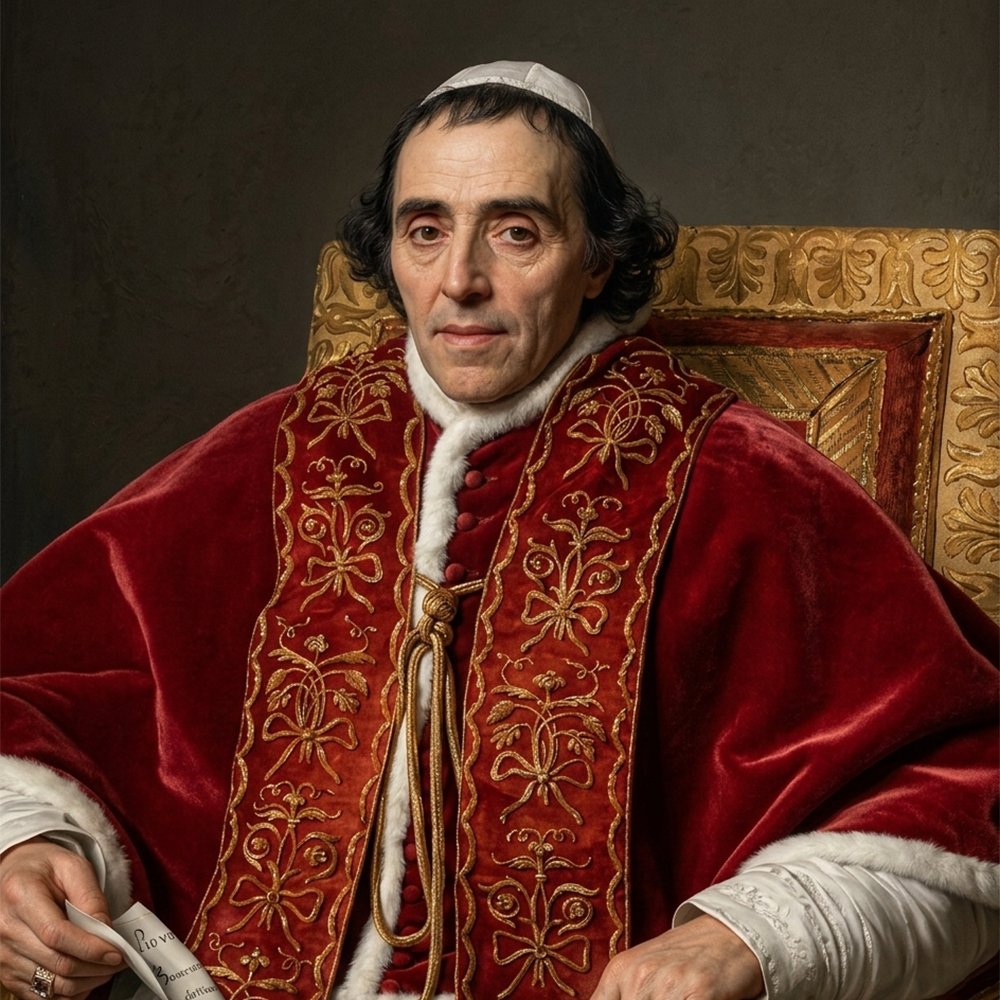
Pope Pius VII (1800-1823) – Complete Biography
BIOGRAPHICAL DATA
Birth name: Barnaba Niccolò Maria Luigi Chiaramonti
Birth: August 14, 1742, Cesena, Papal States (Emilia-Romagna, Italy)
Papal election: March 14, 1800
Coronation: March 21, 1800
Pontificate: March 14, 1800 – August 20, 1823 (23 years, 5 months, 6 days)
Death: August 20, 1823, Rome (age 81)
Burial: St. Peter’s Basilica, Vatican City
Religious order: Benedictines (Order of St. Benedict)
Papal motto: None officially recorded
Nicknames: “Pope of Napoleon”, “Prisoner Pope”, “Pope of the Restoration”
NOTE: One of the most dramatic and heroic pontificates in history – prisoner of Napoleon for 5 years!
FORMATION AND RELIGIOUS LIFE
Aristocratic Origins
Chiaramonti Family:
Count Scipione Chiaramonti: father, aristocrat of Cesena
Giovanna Coronata Ghini: mother, countess of Fabriano
Very noble family but not extremely wealthy
Ancient roots in Romagna (papal region)
Second of six children
Refined aristocratic education
Full baptismal name:
Barnaba: biblical prophet, companion of St. Paul
Niccolò: St. Nicholas
Maria: Virgin Mary
Luigi: St. Louis
Total: 4 names (common in aristocracy)
Benedictine Vocation and Formation
Entry into the Benedictine Order (1756):
Age 14 – Abbey of Santa Maria del Monte (Cesena)
Benedictines: “Ora et Labora” (pray and work)
Monastic intellectual tradition
Contemplative life and study
Religious name: Gregorio (in honor of St. Gregory the Great, Benedictine pope, 590-604)
Intellectual formation:
Monastery of Santa Giustina (Padua) – studies
St. Anselm College (Rome) – theology
Doctorate in Theology
Specialization: patristic theology, scholastic philosophy
Brilliant professor: taught theology in various abbeys
Priestly Ordination: 1765 (age 23)
Monastic Ecclesiastical Career
Professor and Abbot (1765-1782):
Taught Theology at:
Benedictine College of Parma
St. Anselm College (Rome)
Reputation for erudition
Published theological treatises
Abbot of San Callisto (Rome):
Superior of monastic community
Competent administration
Contemplative life balanced with responsibilities
Bishop of Tivoli (1782-1785)
Surprising appointment:
Pius VI appointed him Bishop of Tivoli (1782)
Age 40 – relatively young
Reluctance: preferred monastic life
Obedience: accepted
Pastoral work in Tivoli:
Diocese in the outskirts of Rome
Parish visitations
Charity to the poor
Reformed seminary
Only 3 years
Bishop of Imola (1785-1800) – 15 CRUCIAL YEARS
Promotion (1785):
Imola: important diocese (Emilia-Romagna)
15 years as bishop (1785-1800)
Period that shaped his worldview
Cardinal (1785):
Created cardinal by Pius VI (February 14, 1785)
Cardinal-Bishop of Imola
Prince of the Church
Experience of the French Revolution and Napoleon:
1789-1796: French Revolution
Shocking news reached Italy
Execution of Louis XVI (1793)
Persecution of the Church in France
Civil Constitution of the Clergy (1790)
Chiaramonti: concerned but moderate
1796-1797: Napoleonic Invasion of Italy
Napoleon Bonaparte (French general): Italian Campaign
Conquered northern Italy (1796-1797)
Cisalpine Republic (Milan) – French satellite
Imola occupied by French troops
Christmas Homily of 1797 – DECISIVE MOMENT:
Context: French troops in Imola
Cisalpine Republic established
Democracy (!) imposed
Italian clergy: mostly hostile
People confused
Chiaramonti: Revolutionary homily (by Catholic standards)
Content (summarized): “The democratic form of government is not in contradiction with the Gospel… The equality that Jesus Christ brought us is not contrary to democracy… Be good Christians and you will be excellent democrats.”
Arguments:
Democracy is not inherently anti-Christian
Different forms of government are legitimate (monarchy, republic, democracy)
Criterion: common good and justice
Catholics can be loyal citizens of republics
Do not defend absolutism as the only legitimate system
Reaction:
Scandal among reactionary cardinals
Acclaim from moderates
Napoleon: impressed (he would remember later!)
Pius VI (pope): did not condemn but discreetly disapproved
Historical importance:
First papal opening to democracy (!)
Precursor of Leo XIII (Rerum Novarum, 1891)
But at the time: very advanced
Pastoral work in Imola (1785-1800):
Visited all 144 parishes personally
Heroic charity during Napoleonic wars
Distributed personal fortune to the poor
Mediated between French occupiers and the population
Reputation for holiness and prudence
CONCLAVE OF 1799-1800 – THE LONGEST AND MOST DRAMATIC
Death of Pius VI and Total Crisis
August 29, 1799:
Death of Pius VI (Giovanni Angelo Braschi)
Location: Valence (France) – prisoner of Napoleon!
Captured in 1798, deported
Died in exile, humiliated
Apparent end of the Papal States (occupied by France)
Situation of the Church – worst in modern history:
Papal States: occupied by the French
Rome: Roman Republic (French satellite)
Pope dead in exile
Cardinals: scattered across Europe
Curia: nonexistent
Prophecy: “Pius VI will be the last pope” (revolutionaries)
Conclave in Venice (November 1799 – March 1800)
Impossibility of conclave in Rome:
Rome occupied
Unsafe
Need for neutral territory
Venice chosen:
Republic of Venice: neutral (but under Austrian influence)
Benedictine Monastery of San Giorgio Maggiore (island)
Emperor Francis II (Austria): permitted and protected
First time since 1431-1447 that a pope was elected outside Rome!
Start: December 1, 1799
35 cardinals present (of 46 living)
Many could not arrive (war, occupation)
Difficult conditions: cold, lack of resources
Longest conclave since the Middle Ages
Duration: 3 and a half months (105 days)
Deeply divided factions:
1. “Zelanti” (Intransigents):
Wanted an inflexible pope
Against any compromise with France/Napoleon
Restore total absolutism
Candidate: Cardinal Mattei (dean)
Supported by: Austria (Francis II), Kingdom of the Two Sicilies
2. “Politicians” (Moderates):
Necessary pragmatism
Negotiation with France inevitable
Candidate: Cardinal Chiaramonti (Imola)
Supported by: some French, moderates
Remembered the 1797 homily
Additional problem: Austrian veto
Austria (as Catholic power) had ius exclusivae (right of veto)
Francis II: against a pro-French candidate
Threat to block Chiaramonti
Total impasse:
More than 250 ballots (!)
No 2/3 majority
Harsh winter (1799-1800)
Elderly cardinals ill
Scarce resources
Growing desperation
Turning point (early March 1800):
Cardinal Consalvi (secretary of the conclave):
Brilliant diplomat
Convinced the Austrians: Chiaramonti is not a Jacobin, merely moderate
Argued: firmness without fanaticism needed
Zelanti exhausted
Moderates united
March 14, 1800:
Cardinal Chiaramonti elected
Majority finally reached
Age 57 – neither old nor young
Partial surprise: “compromise” candidate
Choice of name: Pius VII
Homage to Pius VI (predecessor, martyr of Napoleon)
Continuity
Symbol: resistance but also moderation
Coronation (March 21, 1800):
Basilica of San Giorgio Maggiore (Venice)
Not in St. Peter’s (Rome occupied!)
Simple ceremony (no resources)
Cardboard tiara covered with gold (!)
They had no real tiara
Improvised
Symbolism: Church humiliated but alive
First decision: Appointed Cardinal Ercole Consalvi Secretary of State
Historic partnership (1800-1823, with interruption)
Consalvi: brilliant diplomat
Pius VII: prudent pastor
Perfect complementary duo
THE PONTIFICATE (1800-1823) – 23 DRAMATIC YEARS
PHASE I: RETURN TO ROME AND CONCORDAT (1800-1804)
Return to Rome (July 3, 1800):
4 months after election
Triumphal journey through Italy
Crowds acclaimed him
Rome: partially liberated (Austrians temporarily expelled the French)
Solemn entrance into St. Peter’s
Papal States: partially restored
Situation:
Papal States reduced
Finances: zero
Administration: chaotic
But the pope had returned!
“Last pope” was not Pius VI!
Napoleon (First Consul since 1799):
Controlled France
Needed internal stability
Religious question: French majority Catholic, but Church disorganized
Political calculation: reconciliation with pope would strengthen the regime
CONCORDAT OF 1801 (JULY 15) – HISTORIC AGREEMENT
Negotiations (1800-1801):
Napoleon: sent emissaries
Pius VII (via Consalvi): negotiated
Difficult discussions (10 months)
Main terms:
Church accepted (painful concessions):
Renunciation of ecclesiastical property confiscated during the Revolution
Immense properties (1/3 of France!)
Never returned
Church: impoverished
Renunciation of the Civil Constitution of the Clergy (1790)
Resignation of all French bishops (titular and constitutional)
Total fresh start
Napoleon would appoint new ones (with papal approval)
Catholicism = “religion of the majority of the French” (not official religion!)
Church gained:
End of persecution
Public freedom of worship
State salary for clergy (State would pay priests!)
Bishops’ appointments: Napoleon nominates, Pope grants canonical institution
Seminaries reopened
Religious orders: some permitted
Signing: July 15, 1801 (Paris)
Cardinal Consalvi (for the pope)
Joseph Bonaparte (Napoleon’s brother)
Reaction:
Intransigent Catholics: Scandal!
“Capitulation”!
“Betrayal of principles”!
Emigré cardinals (in exile): furious
Some: near schism
Napoleon: Satisfied
Control over the French Church
Religious legitimation
Consolidated power
Pius VII: Heroic prudence
Saved the French Church from total destruction
Pragmatism without compromising faith
Sacrificed temporal power for spiritual mission
April 18, 1802: Solemn promulgation (Notre-Dame de Paris)
Te Deum of thanksgiving
Public reconciliation
Napoleon present
“Organic Articles” (problem):
Napoleon unilaterally added (without consulting the pope)
State regulations on the Church (Gallicanism)
Pius VII: protested but did not break
Permanent tension
Restoration of the Society of Jesus (1814)
Context:
Jesuits: suppressed by Clement XIV (1773)
Pressure from Bourbons (France, Spain, Portugal)
“Definitively and forever”
Survived only in Russia (Catherine the Great refused to promulgate the suppression)
Pius VII: Restored the Society (August 7, 1814)
Bull Sollicitudo Omnium Ecclesiarum
“Definitively and forever” reversed!
Jesuits: officially returned
Resumed colleges, missions
Importance:
Strengthened Ultramontane Catholicism
Catholic education reinforced
But also: fueled liberal anti-Jesuitism
PHASE II: NAPOLEONIC EMPIRE AND CONFLICT (1804-1814)
Coronation of Napoleon (December 2, 1804)
Napoleon: Proclaimed himself Emperor of the French
Demanded papal presence at the coronation
Religious prestige necessary
Pius VII’s dilemma:
Go: legitimize usurper?
Not go: break relations?
Decision: Went to Paris
Humiliating journey (treated as a subject)
Notre-Dame: ceremony
Napoleon: crowned himself (!)
Took the crown from the pope’s hands
Gesture of independence/disrespect
Pius VII: only blessed
Public embarrassment
Significance:
Pius VII: sacrificed dignity for the good of the French Church
Napoleon: demonstrated superiority over the pope
But the relationship began to deteriorate
Deterioration of Relations (1804-1808)
Growing conflicts:
1. Papal States: Napoleon demanded closing ports to England
Pius VII: refused (neutrality)
Napoleonic Continental Blockade
2. Marriage annulments: Napoleon requested several (for relatives)
Pius VII: refused many
Tension
3. Episcopal appointments: conflicts over candidates
4. Papal universalism vs. Napoleonic imperialism:
Napoleon: pope = chaplain of the empire
Pius VII: independent universal pastor
Invasion of the Papal States (1808)
February 2, 1808:
French troops (General Miollis) occupied Rome
Papal States annexed to the Empire
Pius VII: refused to recognize
Remained in the Quirinal Palace (Rome)
De facto prisoner
June 10, 1809: Excommunication of Napoleon
Pius VII published the bull of excommunication
Did not name Napoleon (generic formula: “all invaders”)
But everyone knew: it was Napoleon
Affixed to the doors of Roman basilicas
Napoleon’s reaction: Total fury
PHASE III: IMPRISONMENT (1809-1814) – 5 YEARS OF MARTYRDOM
Kidnapping (July 6, 1809)
Night of July 5-6, 1809:
General Radet (French): invaded the Quirinal Palace
Broke down the doors (!) of the papal apartment
Armed soldiers
Pius VII (age 67): refused to leave voluntarily
Physically dragged to a carriage
Cardinal Pacca (secretary): also kidnapped
Deportation:
Forced journey through Italy and France
Grenoble (France): temporary imprisonment (1809-1812)
Conditions: total isolation
No communication with the Curia
No external correspondence
Constant guards
Only 1-2 cardinals as company
1812-1814: Transferred to Fontainebleau (palace near Paris)
Isolation continued
Health deteriorated
Napoleon: pressured for concessions
Concordat of Fontainebleau (1813) – Temporary Weakness
Context:
Napoleon in difficulties (Russian Campaign, 1812 = disaster)
Needed religious legitimation
Pressured exhausted, ill, isolated Pius VII
January 25, 1813:
Pius VII: signed “Concordat of Fontainebleau”
Enormous concessions:
Formal renunciation of the Papal States
Papal residence: Paris (!)
Napoleon would appoint bishops (pope would only ratify)
Church completely subordinated
But: Retracted (March 24, 1813)
After regaining strength
Cardinals (Consalvi, Pacca) persuaded him
Declared the Concordat null (signed under duress)
Restored courage
Napoleon: Furious but impotent (militarily defeated)
Liberation (1814)
April 1814:
Defeat of Napoleon
Allied invasion of France (Russia, Austria, Prussia, England)
Napoleon’s abdication (April 11, 1814)
Exile to Elba
Pius VII liberated:
Triumphal journey back to Italy
May 24, 1814: Entry into Rome
Delirious acclamation
Population: “Viva il Papa Re!” (Long live the Pope King!)
Hero of resistance to tyranny
Significance:
Moral victory over Napoleon
Papal prestige: enormously increased
Living martyr
Symbol of Christian resistance to despotism
PHASE IV: RESTORATION (1814-1823)
Congress of Vienna (1814-1815)
Context: Reorganization of post-Napoleonic Europe
Cardinal Consalvi (represented Pius VII):
Brilliant diplomat
Negotiated with powers (Austria, Russia, Prussia, England, France)
Papal objectives:
Restoration of the Papal States (total)
Return of works of art (Napoleon had stolen them)
Restoration of religious orders
Combat against secret societies
Results:
Papal States restored (almost totally)
Exception: Avignon (remained with France)
Territory: as before 1796
Works of art: many returned (not all)
Papal influence: restored
But:
Europe: dominated by the Holy Alliance (Austria-Russia-Prussia)
Absolutism restored
Liberalism repressed
Pius VII: part of the reactionary system (reluctantly)
Hundred Days of Napoleon (1815)
March-June 1815:
Napoleon escaped from Elba
Retook power in France
Hundred Days
Pius VII: fled Rome (fear of another kidnapping)
Waterloo (June 18, 1815): final defeat
Napoleon: exiled to Saint Helena (until death, 1821)
Pius VII:
Interceded for Napoleon after Waterloo
Asked for clemency (not execution)
But powerless (England decided)
Remarkable generosity (forgave his enemy)
Government of the Restored Papal States (1814-1823)
Cardinal Consalvi (Secretary of State):
Competent administrator
Attempted moderate reforms:
Modern civil code
Reduction of clerical privileges
Limited lay participation
Improved justice
But:
Resistance from reactionary cardinals (zelanti)
Opposition from Pius VII himself (sometimes)
Reforms: limited
Papal States: remained anachronistic
Repression:
Carbonari (revolutionary secret society): active
Liberal conspiracies
Political prisons
But less brutal than under Leo XII (successor)
Restoration of Institutions:
Society of Jesus (1814) – already mentioned
Holy Inquisition: restored (as “Holy Office”)
Index Librorum Prohibitorum: restored
Censorship reimposed
Jewish Ghetto (Rome):
Maintained (!)
Jews: confined again
Forced conversions (baptisms)
Only abolished in 1870 (end of papal temporal power)
Stain on the pontificate
International Questions (1815-1823)
Latin America – Independence:
1810-1825: Independence revolutions (Bolívar, San Martín, etc.)
Pius VII: dilemma
Spain (Ferdinand VII): ally, wanted to restore the empire
But independence = accomplished fact
Policy: ambiguous
Did not formally recognize the republics
But appointed bishops (pastoral necessity)
Successors would resolve
Prussia and Germany:
Post-Napoleonic reorganization
Questions: mixed marriages, education
Latent tensions (would explode in Kulturkampf, 1871)
Russia:
Tsar Alexander I: mystical, ambiguous
Catholic Poland under Russian rule
Forced conversions of Catholics (Uniates)
Pius VII: protested (unsuccessfully)
England:
Catholic emancipation: not yet (would come in 1829)
Ireland: oppression of Catholics
Pius VII: sympathy but powerless
ENCYCLICALS, DOCUMENTS, REFORMS
MAIN ENCYCLICALS
Pius VII published relatively few long encyclicals (the era was less prolific), but important documents.
1. Diu Satis (May 15, 1800)
“For Quite Long Enough”
First encyclical – shortly after election
Context: Church emerging from persecution
Content:
Gratitude for election
Recognition of Pius VI’s martyrdom
Appeal for unity
Peace among nations
Restoration of the Church
Tone: moderate, conciliatory
2. Ecclesiam a Jesu Christo (September 13, 1821)
“The Church of Jesus Christ”
On the situation in Colombia
Context: Latin American independence (Bolívar)
Content:
Lamented ecclesiastical confusion
Asked for obedience to legitimate bishops
But did not explicitly condemn independence
Diplomatic ambiguity
3. Post Tam Diuturnas (April 29, 1814)
After liberation from prison
Content:
Gratitude to God for liberation
Forgiveness of enemies
Restoration of the Church
Appeal for peace
Tone: Magnanimous, not vengeful
Other encyclicals/briefs on specific questions (dioceses, religious orders, etc.)
IMPORTANT BULLS AND DOCUMENTS
1. Sollicitudo Omnium Ecclesiarum (August 7, 1814)
Bull restoring the Society of Jesus
Reversed Clement XIV’s suppression (1773)
Jesuits: restored globally
“What was dissolved is now restored”
Immense importance for Catholicism
2. Quum Memoranda (September 28, 1814)
On secret societies
Condemned:
Carbonari
Freemasonry (reiteration)
Secret societies in general
Excommunication for members
3. Briefs on Concordats:
With various German states
With Sardinia (1817)
With the Two Sicilies
Post-Napoleonic reorganization
LITURGICAL AND ECCLESIASTICAL REFORMS
Liturgy:
Restored traditional celebrations
Roman Breviary: small reforms
Sacred music: encouraged
Clerical education:
Seminaries: reorganized after Napoleon
Curriculum: scholastic theology
Discipline restored
Religious orders:
Massive restoration:
Jesuits (1814)
Benedictines
Franciscans
Dominicans
Carmelites
Many others
Properties: partially returned
Universities:
Sapienza (Rome): restored
Other pontifical universities
ART AND CULTURE
Vatican Museums:
Expanded collections
Chiaramonti Museum: founded (his family name!)
Works stolen by Napoleon: many recovered
Restorations:
Damaged Roman churches
Monuments
Archives
Patron of artists:
Antonio Canova (neoclassical sculptor): protected
Artistic commissions
Fine arts encouraged
PERSONAL CHARACTERISTICS
Personality
Benedictine to the end:
Genuine humility
Simplicity of life
Constant prayer (3+ hours/day)
Daily Mass
Divine Office (Liturgy of the Hours)
Moderation and Prudence:
Avoided extremes
Diplomacy without compromising principles
Firmness with flexibility
Listened to advisors
Charity:
Generous with the poor
Forgave enemies (Napoleon!)
Genuine pastoral concern
Courage:
Resisted Napoleon (5 years in prison!)
Excommunication of the emperor
Did not yield under extreme pressure
But also:
Dependence on Consalvi (political decisions)
Occasionally indecisive
Fragile health (especially after imprisonment)
Appearance and Health
Physical:
Average height
Thin (austere monastic life)
Ascetic face
Penetrating eyes
Health:
Relatively healthy until imprisonment (1809)
After imprisonment: deteriorated
Digestive problems
Weakness
Accelerated aging
Last years: fragile but lucid
Routine
When free (not imprisoned):
Typical day:
4:30-5:00 AM: Wake up
5:00-7:00 AM: Private prayer, meditation (Benedictine habit)
7:00 AM: Mass (private chapel)
8:00 AM: Frugal breakfast
8:30 AM-12:00 PM: Audiences
Cardinals
Ambassadors
Bishops
Pilgrims
12:00 PM: Simple lunch (monastic diet)
12:30-2:00 PM: Rest
2:00-6:00 PM: Work
Reading documents
Decisions
Correspondence
6:00 PM: Light dinner
6:30-8:00 PM: Vespers, Compline (Liturgy of the Hours)
8:00-9:00 PM: Spiritual reading
9:00 PM: Sleep
Simplicity:
Papal apartments: without excessive luxury
Clothing: simple (white cassock, no ostentation)
Food: frugal
Personal life: monastic
CANONIZATIONS AND BEATIFICATIONS
Few during pontificate (slow processes):
Canonizations:
St. Frances of Rome (process concluded)
Some others
Beatifications:
Various processes advanced
Many concluded by successors
Note: The era produced fewer canonizations than the 20th century
LAST YEARS AND DEATH
Decline (1821-1823)
After 1820:
Health progressively deteriorated
78-80 years old (elderly for the time)
Aftermath of imprisonment
Accumulated fatigue
1821-1822:
Growing weakness
Severe digestive problems
Difficulty walking
But mind lucid
Continued working
Spring-Summer 1823:
Sudden worsening
Intermittent fever
Loss of appetite
Confined to bed (July)
Death
Last Weeks (July-August 1823):
Quirinal Palace (Rome)
Doctors: pessimistic
August 5: Received last sacraments
Viaticum (final communion)
Anointing of the Sick
General absolution
Lucid almost to the end
Blessed cardinals, Rome, the Church
August 20, 1823:
Died at 5:00 AM
Age 81
23 years, 5 months, 6 days of pontificate
Surrounded by cardinals (Consalvi, Pacca, etc.)
Cause: old age, multiple complications
Last words (reported): “Salvator mundi, salva nos” (“Savior of the world, save us”)
Mourning and Funeral
Reaction in Rome:
Genuine deep mourning
Population loved him (had suffered with him)
Acclaimed “Holy Pope”
Europe:
Universal recognition
Even Protestants/liberals: respected his courage
Napoleon had died 2 years earlier (1821); Pius VII outlived him!
Funeral:
August 23-25, 1823
St. Peter’s Basilica
Solemn exequies
Immense crowds
Cardinals, diplomats, kings (representatives)
Funeral eulogies:
Emphasized:
Courage (imprisonment)
Prudence (Concordat)
Personal holiness
Restoration of the Church
Burial:
St. Peter’s Basilica
Vatican Grottoes
Initially simple tomb
Later monument:
Bertel Thorvaldsen (Danish sculptor, Protestant!):
Commissioned later
Magnificent neoclassical monument
Pius VII seated, serene
Virtues (Wisdom, Strength) personified
One of the most beautiful papal tombs
Irony: Protestant sculptor honored the pope!
Successor Conclave
September 2 – September 28, 1823:
Lasted almost 1 month
Division: zelanti vs. moderates (as always!)
Elected: Cardinal Annibale della Genga = Leo XII
Reactionary (reversal of Pius VII’s line!)
Consalvi: dismissed immediately (humiliation)
End of the moderate era
LEGACY AND HISTORICAL EVALUATION
Monumental Achievements
1. Survival of the Church:
Church did not disappear despite Napoleon
Prophecy of “last pope” refuted
Heroic resistance saved the institution
2. Concordat of 1801:
Saved French Catholicism from extinction
Model for future concordats
Pragmatism without apostasy
Influenced Church-State relations for a century
3. Moral Courage – Imprisonment:
5 years a prisoner (1809-1814)
Resisted Napoleon
Excommunication maintained
Living martyr
Papal prestige: restored
4. Post-Napoleonic Restoration:
Papal States: recovered
Religious orders: restored (Jesuits!)
Church reorganized globally
Crucial role at the Congress of Vienna
5. Political Moderation (for the time):
1797 Homily: openness to democracy (!)
Concordat: pragmatism
Less reactionary than successors
6. Personal Holiness:
Exemplary monastic life
Forgiveness of enemies
Charity
Model of humility
Limitations and Negative Aspects
1. Papal States – Temporal Government:
Did not substantially reform (despite Consalvi’s attempts)
Remained anachronistic
Repression of Carbonari
Prepared future problems (1870)
2. Jewish Ghetto:
Maintained segregation (!)
Forced conversions
Retrogade policy
Serious stain on the pontificate
3. Dependence on Consalvi:
Foreign policy: entirely Consalvi
Pius VII: more pastor than statesman
When Consalvi was removed (brief period): less effective
4. Reactionary Restoration (partial):
Alliance with Holy Alliance (Metternich)
Part of the absolutist system
Inquisition restored
Index restored
Prepared extreme reaction (Leo XII, Gregory XVI)
5. Latin America:
Did not resolve the question of independences
Harmful ambiguity
Successors inherited the problem
Historical Comparisons
Versus Pius VI (predecessor):
Pius VI: rigid, defeated by Napoleon
Pius VII: flexible, survived and won morally
Pius VI: died humiliated prisoner
Pius VII: liberated triumphant
Versus Leo XII (successor):
Pius VII: moderate (for the time)
Leo XII: extreme reactionary
Total reversal
Consalvi dismissed
Hardline returns
Versus Gregory XVI (1831-1846):
Both resisted modernity
But Pius VII: pragmatic
Gregory XVI: fanatical
Pius VII superior
Versus Pius IX (1846-1878):
Both: very long pontificates
Both: prisoners (Pius VII of Napoleon, Pius IX of the Vatican)
Both: symbols of resistance
Pius VII: more prudent
Versus Leo XIII (1878-1903):
Leo XIII: continued Pius VII’s moderate line
Rerum Novarum (1891): echo of the 1797 homily
Both: diplomats
Leo XIII: developed openness
Versus John Paul II (1978-2005):
Both: resisted empires (Napoleon vs. Communism)
Both: geopolitical roles
Both: travels (Pius VII: involuntary!)
Both: personal charisma
Historians’ Evaluation
Catholics:
Positive consensus:
Hero of the faith
Heroic prudence
Saved the Church
Uncrowned saint
Some conservatives: criticize the Concordat (excessively conciliatory)
Secular historians:
General respect:
Admirable courage
Political skill (with Consalvi)
Napoleon met his match
Criticisms: temporal government, Jewish question
Beatification Process
Status: NOT formally initiated
Why?:
Virtues universally recognized
But no organized popular movement
Complex political questions (Papal States, etc.)
Jewish ghetto: obstacle
But:
De facto “Venerable” (not officially)
Considered a saint by many
Tomb: visited, venerated
CURIOSITIES AND NOTABLE FACTS
1. Benedictine on the Throne of Peter
Last Benedictine pope to date
Maintained monastic spirituality
Sometimes wore black habit (under white cassock)
2. Cardboard Tiara
Coronation in Venice (1800): no real tiara
Improvised with cardboard + gold leaf
Profound symbolism: poverty of the Church
3. Outlived Napoleon
Napoleon: died 1821 (Saint Helena)
Pius VII: died 1823
Outlived his tormentor!
Complete moral victory
4. Generosity to the Bonaparte Family
After Napoleon’s fall:
Welcomed Letizia Bonaparte (Napoleon’s mother) in Rome
Gave her a pension
Welcomed several exiled Bonaparte relatives
Extraordinary magnanimity
5. Correspondence with Napoleon
During imprisonment: Napoleon visited him several times (Fontainebleau)
Long conversations
Napoleon tried to persuade him
Pius VII: firm but courteous
Complex relationship: enemies but mutual respect
6. Only Pope Crowned Outside Italy (modern era)
Venice technically Italian
But Venice = independent republic (then)
First time since Avignon that a pope was crowned outside the Papal States
7. Chiaramonti Museum
Vatican Museum with his family name
Collection of Greco-Roman sculptures
Exists to this day
Cultural legacy
8. Thorvaldsen (Protestant) Sculpted His Tomb
Bertel Thorvaldsen: Danish, Lutheran
Commissioned by Leo XII (successor)
Irony: Protestant honored the pope
But neoclassical art transcended religious divisions
9. “Barnaba” – Prophetic Name
Barnabas = “son of consolation”
Pius VII: consoled the Church after persecution
Appropriate baptismal name
10. Longevity of Pontificate
23 years, 5 months = one of the longest
Surpassed only by: Pius IX (31 years), John Paul II (26 years), Leo XIII (25 years)
Despite imprisonment, precarious health
DOCUMENTS AND WRITINGS
Encyclicals and Bulls (summary)
Main encyclicals:
Diu Satis (1800) – programmatic
Post Tam Diuturnas (1814) – post-liberation
Ecclesiam a Jesu Christo (1821) – Latin America
Important bulls:
Sollicitudo Omnium Ecclesiarum (1814) – Jesuits
Quum Memoranda (1814) – secret societies
Concordats:
France (1801) – most important
Bavaria (1817)
Sardinia (1817)
Two Sicilies (1818)
Prussia (negotiations)
Various others
Briefs:
Hundreds on episcopal appointments
Religious orders
Disciplinary questions
FAMOUS PHRASES
“Non possumus” (“We cannot”) – response to Napoleon on unacceptable concessions
“Salvator mundi, salva nos” – last words
1797 Homily (Imola): “Be good Christians and you will be excellent democrats”
During imprisonment to Napoleon: “Your Majesty can imprison me, deport me, kill me. But you cannot make me betray my duty.”
Pius VII (Barnaba Chiaramonti, 1800-1823) was one of the most heroic and significant popes of modern history. A Benedictine monk elevated to the papacy at a moment of existential crisis (Pius VI’s death in exile, Church persecuted), he governed with extraordinary prudence and courage.
His Concordat of 1801 with Napoleon, though painful, saved French Catholicism from extinction. His resistance to Napoleon during 5 years of imprisonment (1809-1814) – refusing to capitulate even under duress – made him a living martyr and a symbol of moral integrity.
He restored the Society of Jesus (1814), reorganized the post-Napoleonic Church, and recovered the Papal States.
Limitations: he maintained the Jewish ghetto, did not substantively reform the Papal States, and was part of the post-1815 reactionary system. But context is crucial: he was emerging from total persecution and had to rebuild.
Paradox: Moderate in an extremist era, pragmatic without being opportunistic, firm without being fanatical. He outlived Napoleon, proving that spirit overcomes force. His tomb (by Thorvaldsen, a Protestant!) = universal recognition of greatness.
Among modern popes, Pius VII stands out for his rare balance: holiness with political skill, firmness with flexibility, tradition with openness. If he is not formally a saint, he is venerated as such – and deserves to be.
Requiescat in pace – Rest in peace, Pius VII, prudent pastor, courageous prisoner, wise restorer, monk who saved the Church from the empire that sought to destroy it.
“Ecclesia non morietur” – The Church will not die. Pius VII proved it.