Clement XIII
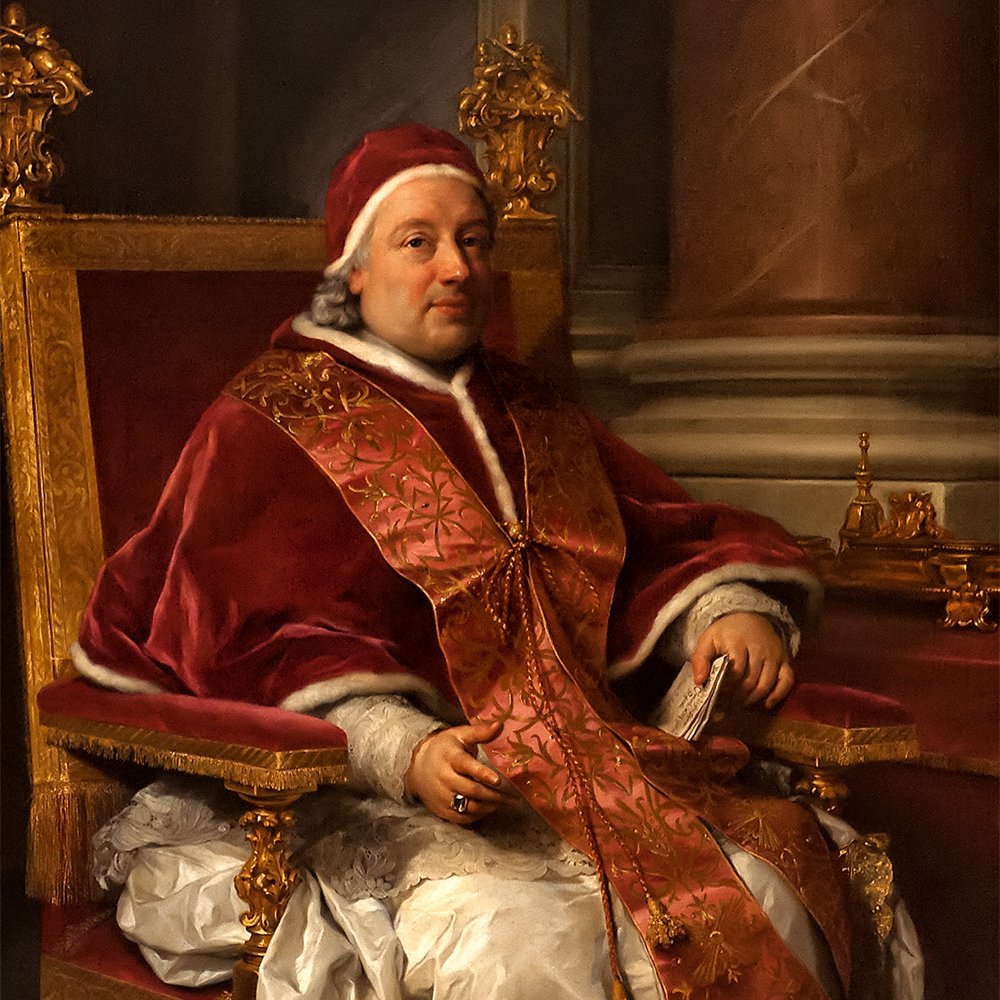
Clement XIII (1758-1769)
BIOGRAPHICAL DATA
First name: Carlo della Torre di Rezzonico
Birth: March 7, 1693, Venice, Republic of Venice (Italy)
Papal election: July 6, 1758
Coronation: July 16, 1758
Pontificate: July 6, 1758 – February 2, 1769 (10 years, 6 months, 27 days)
Death: February 2, 1769, Rome (75 years old)
Burial: St. Peter’s Basilica, Vatican City
Religious order: Secular clergy (did not belong to a religious order)
Papal motto: None officially registered
Last name: “Pope of the Jesuits”, “Defender of the Society”, “Uncompromising Pope”
NOTICE: The last pope to unconditionally defend the Jesuits – he died fighting against the Bourbon monarchies!
RELIGIOUS FORMATION AND LIFE
Aristocratic Origins
Rezzonico Family:
One of the wealthiest patrician families in Venice.
Giambattista Rezzonico: Father, Venetian senator, banker.
Vittoria Barbarigo: mother, Venetian noblewoman
A recently ennobled (17th century) but extremely wealthy family.
Rezzonico Palace: a sumptuous palace on the Grand Canal (now a museum)
Carlo: firstborn son, destined for an ecclesiastical career (aristocratic tradition)
Privileged childhood:
Refined aristocratic education
Private tutors
opulent Venetian palace
Travels through Italy
Contact with Venetian art, music, and culture.
Academic Background
University studies:
University of Padua(controlled by Venice)
Canon law
Civil law
Philosophy
Theology
Distinguished student
Doctorate:in utroque iure(both canon and civil law)
Studies in Bologna:
Theological deepening
Clementino College (Jesuit!)
CRUCIAL: educated by Jesuits – it marked his life.
He developed a deep admiration for the Company.
Friendships with Jesuits lasted a lifetime.
Priestly Ordination:1716 (23 years)
Pre-Cardinal Ecclesiastical Career (1716-1737)
Governor of Rieti (1721-1723):
Papal States, mountainous region
Local administration
He demonstrated administrative competence.
Kindness to the poor (generously distributed alms)
Governor of Fano (1725-1728):
Important Adriatic port
He fought local corruption.
Port infrastructure improved.
Reputation: fair but firm
Auditor of the Roman Rota (1728-1737):
supreme ecclesiastical court
He judged complex canonical cases.
Specialty: matrimonial law, ecclesiastical benefices
He demonstrated legal erudition.
Positions: Orthodox, favorable to papal authority
Features:
Pious, devout
Generous to the poor (spent family fortune on charity)
Lover of the arts (patron)
Diplomatic but firm in principles.
CARDINAL (1737-1758)
Created Cardinal by Clement XII(December 20, 1737):
44 years old
Cardinal-Priest of San Marco
Appointment: partly due to merit, partly due to family wealth (contributed generously)
Bishop of Padua (1743-1758):
Important diocese, university
Diocesan reform:
He visited all the parishes personally.
He reformed the seminary (he entrusted education to the Jesuits!)
He fought against Jansenism (a heresy that denied divine grace).
He promoted traditional devotions.
Legendary generosity:
He used his personal fortune to:
Building hospitals
Orphanages
Schools
Aid to the poor during famines
“Father of the poor of Padua”
Episcopal style:
Accessible, pastoral
He visited the sick personally.
He celebrated Mass in remote parishes.
But: absolute doctrinal firmness
Activity at the Cardinal’s College:
He participated in the 1740 Conclave (election of Benedict XIV).
Congregation of the Holy Office
Congregation of Rites
Reputation:
Orthodox, conservative
Defender of the Jesuits
Distrustful of the Enlightenment
Loyal to the Holy See
Relationship with Pope Benedict XIV (1740-1758):
Benedict XIV: erudite, conciliatory pope, open to dialogue with the Enlightenment.
Rezzonico: I respected him but considered him excessively flexible.
(Private) disagreement over concessions to monarchies
But: he never disobeyed
CONCLAVE OF 1758 – PAPLICAL ELECTION
Pre-Conclave Context
Death of Benedict XIV(May 3, 1758):
A learned, diplomatic Pope
A policy of conciliation with enlightened monarchies.
But: growing tension with Jesuits (pressure from Portugal, France)
Emerging Jesuit Question:
Portugal (1755-1758): The Marquis of Pombal accused the Jesuits of:
Attempted assassination of the king
Excessive independence in missions
Illegal trade
Portuguese pressure: demanded papal condemnation of the Jesuits.
Benedict XIV: He tried to mediate, he did not condemn.
Factions in the Conclave:
Zelanti (“Zealous”): pro-Jesuits, uncompromising with monarchies
“Politicians”: favorable to concessions, dialogue with crowns
Moderate: They wanted peace but without sacrificing principles.
The Conclave
Start:May 15, 1758
Duration:Relatively fast (52 days)
Leading candidates:
Cardinal Cavalchini: zealous, but too old.
Cardinal Archinto: a politician, but distrusted by the zelanti.
Cardinal Rezzonico: unlikely compromise
Rezzonico’s rise:
Initially: not a favorite
Advantages:
Venetian: independent republic (not a subject of a monarch)
Rich: He did not depend on royal favors.
Pastoral: reputation for personal holiness
Firm: proven orthodoxy
Moderately young: 65 years old (healthy)
Influence of the Jesuit Question:
Zelanti: They wanted a pope who would defend the Society.
Rezzonico: educated by Jesuits, publicly loyal
But: not a fanatic (he had a reputation for being reasonable)
Election:July 6, 1758
Chose a name:Clement XIII(in homage to Clement XII, who had made him a cardinal)
Acceptance: reluctant (feared responsibility)
Famous quote: “Forgive me, I am not worthy”
Coronation:July 16, 1758
St. Peter’s Basilica
Splendid ceremony
Initial optimism: holy, generous pope
PONTIFICATE (1758-1769)
Church Government – Early Years (1758-1760)
Secretary of State:
Cardinal Archinto(1758-1759): experienced, moderate
Sudden Death (1759)
Cardinal Torrigiani(1759-1769): conscientious, uncompromising
CRUCIAL: influenced Clement XIII towards confrontation
Style of government:
Pious, devout (daily hours in prayer)
Generous: he continued personal charity on a papal scale.
Administratively: it depended on advisors.
Diplomatically: inflexible (unlike Benedict XIV)
Nominations:
Favored zelanti
He promoted Jesuits to key positions.
He avoided “political” cardinals.
He created 52 cardinals during his pontificate.
Relations with the Papal States:
Administration: conservative
Reforms: minimal (lack of interest due to temporary issues)
Economy: stagnation
But: public works, charity
The Jesuit Question – Beginning of the Crisis (1758-1764)
Portugal – Climbing:
1758: Attempted assassination of King Joseph I
Jesuits accused (without convincing evidence)
Marquis of Pombal: initiated the persecution
1759: Expulsion of all Jesuits from Portugal and its colonies.
Approximately 1,800 Jesuits deported
Confiscated properties
Some prisoners, tortured
Clement XIII’s reply:
He refused to condemn the Jesuits.
Letter to Joseph I: defended the innocence of the Company.
He welcomed Jesuit refugees in Rome.
Pombal: furious, broke off relations with the Holy See.
France – Growing pressure:
1761: The Paris Parliament has launched an investigation into the Jesuits.
Charges: fraudulent bankruptcy, corrupt morals
Jansenists (theological enemies) dominated Parliament.
1762: Parliament abolished the Company in France.
1764: King Louis XV confirmed the suppression (reluctantly, but eventually yielded).
Clement XIII’s reply:
Brief “Apostolicum pascendi munus” (1765):
He passionately defended the Jesuits.
He condemned national suppressions.
He stated: The company was orthodox, useful, and holy.
“To destroy them would be a grave sin”
France: completely ignored
Spain – Devastating blow:
1766: Esquilache Riot (popular uprising in Madrid)
Jesuits accused of inciting (without evidence)
King Charles III (Bourbon): seized the opportunity.
1767 (April 2-3): “Pragmatic Sanction”
Expulsion of ALL Jesuits from Spain and its colonies.
Approximately 5,000 Jesuits deported
Confiscated properties
Military operation: sudden, nocturnal, brutal
Jesuits: taken aboard ships, deported to the Papal States.
Clement XIII:
Horrified
It received thousands of Jesuit refugees in Civitavecchia (papal port).
Huge logistical problem (where to house, where to feed?)
He used papal funds to support them.
He protested formally.
Charles III: ignored
Bourbon Coalition – Siege of the Pope (1767-1769)
Bourbon family coordinated:
Spain(Charles III)
France(Louis XV)
Naples(Fernando IV – son of Carlos III)
Parma(Fernando I – Bourbon)
Portugal(Joseph I – ally)
Family Pact (1761):
Original Bourbon Alliance: against England
Now: used against the Pope!
Ambassadors coordinated anti-Jesuit strategy
Demands made to Clement XIII:
To suppress the Society of Jesus universally.
Condemn Jesuit doctrine (especially regicide – Jesuits falsely accused)
Dissolve the order completely.
Threats:
Invasion of the Papal States
Confiscation of papal property in their territories.
Schism (creation of national churches)
Non-recognition of papal authority
Parma Case (1768) – Acute crisis:
Duchy of Parma (Bourbon): enacted laws limiting ecclesiastical immunities.
Clement XIII: condemned and excommunicated ministers.
Bourbon’s response:
France: occupied Avignon and Venaissin (papal territories in France)
Naples: occupied Benevento and Pontecorvo (papal enclaves)
Spain threatened invasion.
Clement XIII:
He refused to give in.
He strengthened garrisons in Rome.
He appealed to other Catholic monarchies (Austria: neutral, did not help).
He prepared a military defense (ridiculous compared to Bourbon armies).
Unwavering Defense of the Jesuits
Key papal documents:
“Apostolicum pascendi munus” (1765):
Apostolic Brief
Passionate praise of the Jesuits
“Holy, useful, orthodox order”
Condemnation of national suppressions
“Gravissimum” (1769 – not promulgated):
Prepared weeks before death
Convocation of a Consistory
Intention: to solemnly condemn the persecution of the Jesuits.
Never published (Clement XIII died before).
Arguments of Clement XIII:
Theological: The company was orthodox Catholic.
Historical: Immense service to the Church (missions, education, theology)
Canonical: National suppressions violated canon law (only the Pope could suppress universal order).
Morais: Jesuits were persecuted for being loyal to the Pope.
Support for the Jesuits:
Financial: supported thousands of refugees
Diplomatic: constant protests
Spiritual: masses, public prayers
Personal: received Superior General Lorenzo Ricci regularly
Last Months – Tragedy Foretold (1768-1769)
Deteriorating health:
1768: Clement XIII aged rapidly.
Immense stress
Insomnia
Heart problems (likely)
Diplomatic isolation:
All Bourbon monarchies: hostile
Austria (Maria Theresa): neutral (did not want conflict with the Bourbons)
Prussia, Russia: Protestants/Orthodox (indifferent)
Venice (homeland of Clement XIII): could not provide military assistance.
Consistory of January 1769:
Clement XIII: planned a solemn defense of the Jesuits.
He summoned cardinals.
Prepared documents
But…
Sudden death:
Night of February 2nd to 3rd, 1769
Clement XIII: praying in his room
Sudden collapse
Doctors called: too late
He died around midnight.
Cause:probable heart attack or stroke
Mysterious circumstances:
Death: eve of the anti-Bourbon Consistory
Rumors of poisoning:immediate
Bourbons accused
Never proven
Probably false (autopsy: signs of natural death)
But: convenient for the Bourbons (it avoided a final confrontation).
Last words (reported):
“Lord, why have you abandoned your Church?”
Or (another version): “Society of Jesus, for you I die”
OTHER ASPECTS OF THE PONTIFICATE
Ecclesiastical Administration
Consistories:
He created 52 cardinals.
He preferred zelanti
It included: scholars, pastors
He avoided: politicians subservient to crowns.
Congregations:
It maintained its traditional structure.
Holy Office: active against Jansenism, Enlightenment
Index: strict censorship of dangerous books
Bishops:
He appointed Orthodox bishops.
He resisted royal interference in appointments.
Conflicts with monarchies over control of sees
Relationships with Other Issues
Jansenism:
Rigorist heresy (denied sufficient grace for all)
Strong in France, Netherlands
Clement XIII: repeatedly condemned
Jesuits: the main theological adversaries of the Jansenists.
(Ironically, Jansenists allied themselves with Bourbons against Jesuits!)
Enlightenment:
Increasing secularization in Europe
Voltaire, Diderot, Rousseau: they attacked the Church.
Clement XIII condemned the Encyclopedia.
But: largely ineffective (it was an era of unstoppable secularization)
Febronianism:
German doctrine: bishops should have more power than the pope.
Clement XIII: condemned (1764)
Defense of absolute papal primacy
Patron of the Arts
Continuing the papal tradition:
He commissioned works in São Pedro.
Patrons of artists
But: less than Benedict XIV (who spent more on Jesuit refugees).
Canonizations:
Very few (it wasn’t the right time)
The trial of João de Brito (Jesuit martyr!): advanced.
Archeology:
He supported Roman excavations.
Protection of ancient monuments
LEGACY AND HISTORICAL ASSESSMENT
Contemporaries
Defenders (zelanti, Jesuits):
“Martyr Pope” (died defending the truth)
Saint for his intransigence.
Model of papal fidelity
Hero of Orthodoxy
Critics (Bourbons, Jansenists, Enlightenment thinkers):
Stubborn, inflexible
It caused an unnecessary crisis.
He sacrificed the peace of the Church for pride.
I should have negotiated.
Catholic Historiography
19th century (post-Jesuit restoration, 1814):
Rehabilitation of Clement XIII
Seen as: prophet (predicted the evils of suppression)
Compared to: Gregory VII, Innocent III (uncompromising popes)
20th Century:
A more nuanced debate
Recognition: an impossible situation.
But: criticisms regarding the lack of tactical flexibility.
Comparison with his successor Clement XIV (who yielded) – which one did it right?
Evaluation of the Defense of the Jesuits
Arguments in favor of Clement XIII:
Principle: It had theological merit (Jesuits were orthodox).
Courage: He did not give in to the blackmail.
Prophetic: Suppression harmed missions and Catholic education.
Loyalty: defended loyal subjects
Arguments against:
Pragmatism: intransigence worsened the situation.
Result: Jesuits were suppressed anyway (successor yielded)
Cost: It isolated the papacy and weakened the Holy See.
Alternative: could have negotiated reforms within the Company (instead of total suppression)
Historical Impact
Immediate:
Death: paved the way for Clement XIV (pro-suppression)
1773: Jesuits suppressed (4 years later)
Pyrrhic victory of the Bourbons (The French Revolution would soon destroy monarchies)
Long term:
Jesuit Restoration (1814): partial vindication of Clement XIII
Ultramontanism (19th century): A trend that glorified intransigent popes like Clement XIII.
Vatican I (1870): Papal infallibility – an echo of Clement XIII’s defenses of supreme authority.
Jesuit memory:
Revered by the Jesuits
“The last pope who defended us to the death”
Annual Masses for his soul (19th-century Jesuit tradition)
Interesting facts and personal details
Personality
Virtues:
Deep piety: Daily hours in prayer, daily Mass
Generosity: spent a personal fortune on charity.
Humility: He lived simply (for an aristocratic pope)
Courage: not intimidated by threats
Limitations:
Inflexibility: incapable of diplomatic compromise
Dependence: He relied excessively on advisors (Torrigiani)
Political naiveté: underestimated Bourbon determination
Fragile health: recent years marked by illness
Daily Life
Routine:
5 a.m.: Wake up, private prayer.
6 a.m.: Personal Mass
7am-12pm: Hearings, rulings
12:00 PM: Simple lunch
2 PM – 6 PM: More work
6 PM: Rosary
8 PM: Light dinner
9pm-11pm: Spiritual reading, correspondence
11 PM: Curfew
Habits:
Food: frugal (vegetables, fish, little wine)
Clothing: simple white cassock (avoiding luxury)
Exercise: walks in the Vatican gardens
Hobbies: reading (theology, history), sacred music
Personal Relationships
Family:
He maintained contact with Venetian Rezzonicos.
Moderate nepotism (appointed nephew cardinal – Cardinal Rezzonico)
But: less excessive than previous popes.
Jesuits:
Deep friendship with Superior General Lorenzo Ricci
Confessor: Jesuit
Advisors: several Jesuits
“Spiritual family”
Cardinals:
Difficult relationship with “politicians”
Complete trust in zelanti (especially Torrigiani)
Disappointed with cardinals who advised concessions.
Appearance
Portraits (famous: by Mengs):
Thin, ascetic face
Piercing eyes
White beard (maintained Venetian custom)
Posture: dignified but not arrogant
Health:
Fragile constitution from a young age.
Recent years: worsening heart condition
Death: sudden but not entirely unexpected (doctors had been concerned for months)
IMPORTANT DOCUMENTS
Briefs and Encyclicals
“A quo die” (1758): First document – continuity with Benedict XIV
“Apostolicum pascendi munus” (1765): Passionate defense of the Jesuits
“Christianae reipublicae” (1766): Against Febronianism
Index convictions: Encyclopedia, Jansenist works
Consistories
15 consistories during the pontificate
52 cardinals created
Last one (planned, February 1769): cancelled due to death.
SUMMARY CHRONOLOGY
1693: Born in Venice (Rezzonico family)
1716: Priestly ordination
1721-1728: Governor of Rieti, later Fano
1728-1737: Auditor of the Roman Rota
1737: Created cardinal by Clement XII
1743: Bishop of Padua
1758 (July): Papal election
1759: Expulsion of the Jesuits from Portugal – beginning of the crisis
1764: Suppression of the Jesuits in France
1767: Expulsion of Jesuits from Spain – a dramatic escalation
1768: Parma Crisis – occupation of papal territories
1769 (February 2): Sudden death in Rome, on the eve of the anti-Bourbon Consistory.
BURIAL AND MEMORY
Funeral
Ceremony:
February 5, 1769
St. Peter’s Basilica
Assistance: crowds (Romans loved his generosity)
Jesuits: deep mourning
Bourbons: poorly disguised relief
Tomb:
St. Peter’s Basilica
Monument by Antonio Canova (commissioned later)
Famous sculpture: Clement XIII in prayer
Considered one of Canova’s masterpieces.
Inscription: Praise to piety, steadfastness
Beatification?
It never progressed:
Cause proposed by Jesuits (19th century)
Objections:
Politics (still a controversial memory)
Lack of documented miracles
Moderate (but existing) nepotism
Popular veneration: significant but not universal
In Jesuit Memory
Perpetual gratitude:
The last pope who defended them unconditionally.
Annual masses for his soul (until suppression in 1773)
After restoration (1814): renewed veneration
19th century: seen as an indirect martyr of the Jesuit cause.
Pope Clement XIII represents the last effort of the Baroque papacy to resist the rising tide of monarchical absolutism and the Enlightenment. A man of profound piety and admirable courage, he confronted an unprecedented coalition of Catholic monarchies demanding the destruction of the Jesuits.
His intransigence – seen by admirers as heroism, by critics as stubbornness – did not save the Society (his successor suppressed it), but it preserved a crucial principle: the pope should not yield to political blackmail even when the cause seems lost.
He died defending loyal subjects against unjust accusations, in circumstances that seemed almost providential (or sinister, depending on the perspective): on the eve of finally challenging the Bourbons in a solemn consistory.
“Pope of the Jesuits”He couldn’t save them, but he never betrayed them. In the history of the Church, this counts as a moral victory, even in the face of political defeat.
His monument in St. Peter’s – sculpted by Canova decades later – shows him in eternal prayer, knees bent, hands clasped: a perfect image of a pope who preferred to pray and resist rather than negotiate and survive.