Alexander VII
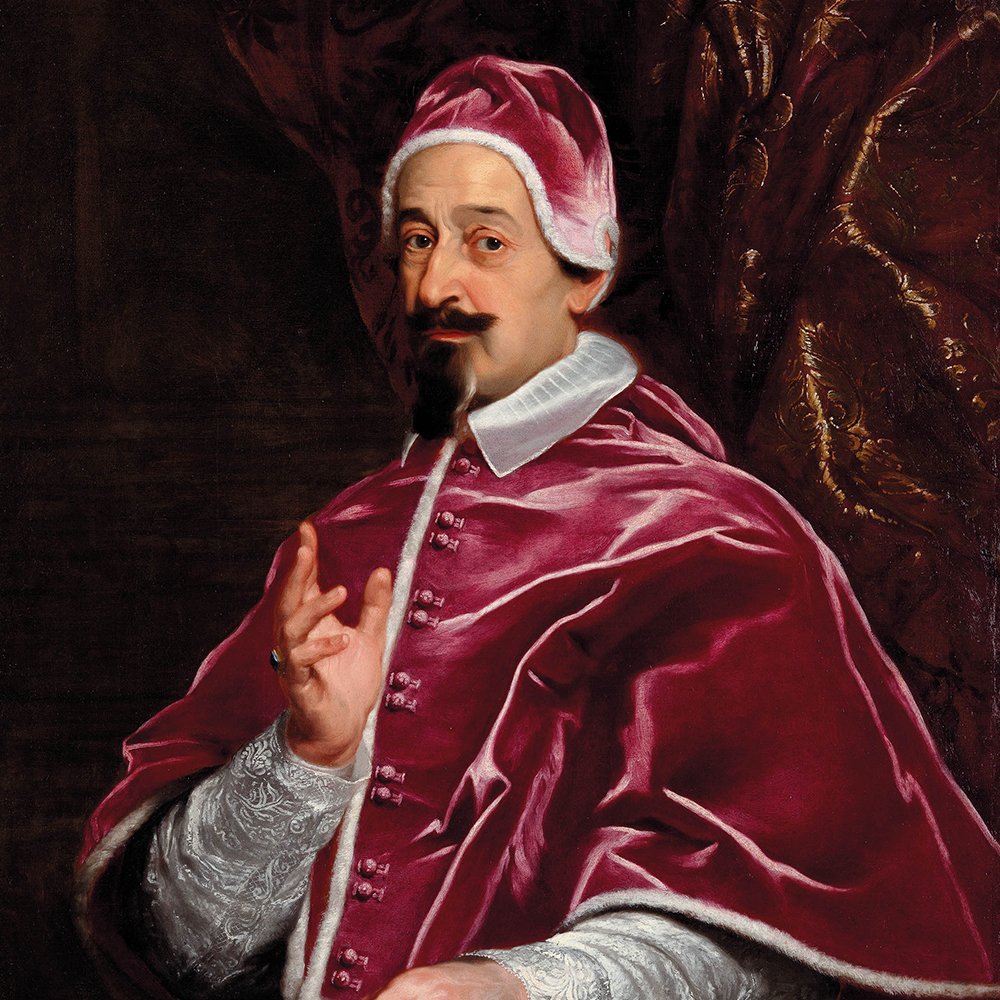
Alexander VII (1655-1667)
BIOGRAPHICAL DATA
Birth name: Fabio Chigi
Birth: February 13, 1599, Siena, Grand Duchy of Tuscany
Papal election: April 7, 1655
Coronation: April 18, 1655
Pontificate: April 7, 1655 – May 22, 1667 (12 years, 1 month, 15 days)
Death: May 22, 1667, Rome, Papal States (68 years old)
Burial: St. Peter’s Basilica, Vatican City (tomb by Gian Lorenzo Bernini)
Religious order: Secular clergy (diocesan priest)
Papal motto: “Montium custos” (Latin for “Guardian of the mountains”) – referring to the six mountains in the Chigi coat of arms
Cognome: “The Chigi Pope,” “Patron of Bernini,” “The Poet Pope,” “The Westphalia Pope,” “The Anti-Nepotist Who Became a Nepotist”
NOTE: His pontificate was marked by the dramatic conversion of Queen Christina of Sweden, the humiliating Treaty of Pisa with France, the condemnation of Jansenism through the bull Ad Sanctam Beati Petri Sedem (1656), the publication of the Index Librorum Prohibitorum Alexandri VII (1664) which definitively condemned heliocentrism, and the transformation of Rome through his patronage of Gian Lorenzo Bernini, including the magnificent colonnade of St. Peter’s Square, the Cathedra Petri, and the Scala Regia.
EARLY LIFE AND FORMATION
The Illustrious Chigi Family
The Chigi of Siena:
- The Chigi of Siena were among the most illustrious and powerful of Italian families
- A family of bankers who had grown wealthy through finance and commerce
- In the Rome of Renaissance times, an ancestor of Alexander VII, Agostino Chigi (1466-1520), was known as the “Magnificent” – a patron of Raphael and one of the wealthiest men in Europe
- Member of the illustrious banking family of Chigi
- A great-nephew of Pope Paul V (1605-1621) through his father’s family connections
Parents:
- Flavio Chigi (1570-1640): father, nephew of Pope Paul V, though not as prosperous as his forebears, he gave his son a suitable training
- Laura Marsigli: mother, a woman of singular power and skill in the formation of youth, to whom Fabio owed much
- The family had declined somewhat from its Renaissance peak but still maintained noble status
Siblings:
- Mario Chigi: elder brother, married Berenice della Ciala, father of two surviving children: Agnes and Flavio (future cardinal)
- Augusto Chigi (1595-1651): brother, married Olimpia della Ciaia, continued the family line
- Onorata Mignanelli: sister, married Firmano Bichi, mother of Antonio Bichi (future cardinal)
Childhood and Education
Early Health Challenges (1599-1610s):
- The youth of Fabio was marked by continued ill-health, consequent upon an attack of apoplexy in infancy
- Unable to attend school due to his frail condition
- This early brush with death shaped his contemplative and scholarly temperament
Education at Home:
- Taught first by his mother, and later by able tutors
- Displayed remarkable precocity and love of reading
- The family’s care in his education overcame the disadvantages of his early years
- Developed fluency in Latin, Greek, and several modern languages
University of Siena (1610s-1626):
- Studied at the University of Siena, receiving a comprehensive education
- In his twenty-seventh year, he obtained the doctorates of philosophy, law, and theology at the University of Siena
- Displayed remarkable intellectual gifts across multiple disciplines
- His thesis defense was described as brilliant by contemporaries
Entry into Ecclesiastical Career
Rome (December 1626):
- In December 1626, he entered upon his ecclesiastical career at Rome
- Age: 27 years old
- Began his apprenticeship in the papal administration under the protection of his great-uncle’s memory
Vice-Legate of Ferrara (1627-1632):
- In 1627 he was appointed by Pope Urban VIII as Vice-Legate of Ferrara
- Served five years under Cardinals Sacchetti and Pallotta
- Their commendations won for him important subsequent posts
- Gained practical experience in temporal governance
Priestly Ordination (December 1634):
- Ordained a priest in Rome in December 1634
- Age: 35 years old
- Celebrated his first Mass in the Church of Santa Maria del Popolo, the Chigi family church
Bishop of Nardò (1635-1652):
- On 8 January 1635, Chigi was named Bishop of Nardò in southern Italy (Apulia)
- Consecrated on 1 July 1635 by Miguel Juan Balaguer Camarasa, Bishop of Malta
- Served as bishop of this diocese for seventeen years, though often absent due to diplomatic duties
- Visited the diocese when possible and maintained correspondence with his vicars
DIPLOMATIC CAREER (1639-1651)
Inquisitor of Malta (1630s)
Appointment:
- On recommendations from two cardinals, he was appointed Inquisitor of Malta
- Important post in the Mediterranean outpost of Christendom
- Gained experience in ecclesiastical justice and diplomacy
- Malta: strategic island fortress against Ottoman expansion
Nuncio in Cologne (1639-1651)
Appointment (June 11, 1639):
- Bishop Chigi was named nuncio in Cologne on 11 June 1639
- Served in this crucial diplomatic post for twelve years (1639-1651)
- Cologne: one of the most important nunciatures in Europe, covering much of Germany
Context – Thirty Years’ War:
- The Thirty Years’ War (1618-1648) was ravaging Germany
- Catholic and Protestant powers locked in conflict
- Papal diplomacy needed to defend Catholic interests
- Chigi worked tirelessly to support Catholic princes and the Emperor
Support for Anti-Jansenist Measures:
- He supported Urban VIII’s condemnation of the heretical book Augustinus by Cornelius Jansen, Bishop of Ypres
- The papal bull In eminenti of 1642 condemned Jansen’s work
- This foreshadowed his later role in the Jansenist controversies as pope
- Maintained correspondence with theologians and bishops throughout Europe
The Peace of Westphalia (1644-1648)
Envoy Extraordinary to Münster (1644):
- In 1644 was made envoy extraordinary of Pope Innocent X to the peace conference at Münster
- Expected to take part in the negotiations which led in 1648 to the Peace of Westphalia
- Arrived with full diplomatic credentials but strict instructions
Refusal to Deliberate with Heretics:
- Though expected to take part in the negotiations, he declined to deliberate with persons whom the Catholic Church considered heretics
- His conscience would not allow him to treat with Protestants as equals
- Negotiations therefore took place in two cities, Osnabrück (Protestant) and Münster (Catholic), with intermediaries travelling back and forth
- He energetically defended papal interests during the negotiations
- Maintained the dignity of the Holy See despite his isolation
Protest Against the Treaties:
- He protested against the treaties when completed
- Chigi protested on behalf of the Papacy against the Treaty of Westphalia once the instruments were finally completed
- Urged the Catholic princes not to sacrifice the rights of the church
- The princes, however, were tired of war and, despite his admonition, yielded to France and the Protestants
- His protest was registered but ignored
Pope Innocent X’s Condemnation:
- Pope Innocent himself stated that the Peace “is null, void, invalid, unjust, damnable, reprobate, inane, empty of meaning and effect for all time”
- The Peace ended the Thirty Years’ War and established the balance of European power that lasted until the French Revolutionary Wars
- It marked the definitive end of any effective papal role in pan-European political settlements
- Chigi’s firm stance earned him the respect of Catholic traditionalists and the enmity of France
CARDINALATE AND SECRETARY OF STATE (1651-1655)
Return to Rome
Recall by Innocent X (1651):
- Innocent X called him to Rome in 1651 to be his secretary of state
- December 1651: Pope Innocent named Cardinal Chigi Secretary of State
- Replaced the powerful Cardinal Panciroli, who had died
Created Cardinal (February 19, 1652):
- In February 1652, made Cardinal by Innocent X
- Created cardinal in the Consistory of 19 February 1652
- On 12 March was granted the title of Cardinal-Priest of Santa Maria del Popolo
- This was the Chigi family church, where Raphael had decorated the Chigi Chapel for Agostino Chigi
Bishop of Imola (1652-1655):
- On 13 May 1652 he was transferred to the Bishopric of Imola
- Retained this see until his election as pope
- Visited the diocese when possible, continued to govern through vicars
Character Before Election
Reputation:
- Known for his sanctity of life, severity of morals, and aversion to luxury
- Seen as strongly opposed to the nepotism then prevalent among the papal court
- A man of learning and literary tastes
- Experienced diplomat who had stood firm against heretics at Westphalia
- Had the confidence of the Spanish faction and the respect of many French cardinals
- His personal austerity was noted by all who met him
CONCLAVE OF 1655 – ELECTION
Context: Death of Innocent X
Death of Innocent X (January 7, 1655):
- Pontificate: 10 years (1644-1655)
- College of Cardinals: approximately 70 electors
- The conclave was famous for its duration of eighty days
- Innocent X’s nephew, Cardinal Camillo Pamphili, led one faction
Political Alignments:
- French faction: hostile to Chigi due to his role at Westphalia and opposition to Cardinal Mazarin
- Spanish faction: favored Chigi as candidate, remembering his support for their interests
- Barberini faction: still influential from Urban VIII’s pontificate
- Independent cardinals: seeking compromise between the great powers
Mazarin’s Opposition:
- The French prime minister, Cardinal Mazarin, had not forgiven the legate who resolutely opposed him at the conferences of Münster and Osnabrück
- During the conclave he had been bitterly hostile to Chigi
- However, he was in the end compelled to accept his election as a compromise when no other candidate could secure two-thirds
The Conclave (January-April 1655)
Duration: 80 days (January 18 – April 7, 1655)
Key Moments:
- First month: various candidates proposed and rejected
- Second month: French and Spanish factions deadlocked
- Third month: exhaustion setting in, pressure from Roman populace
- Cardinal Sacchetti, Cardinal Barberini, Cardinal Farnese all considered
The Turning Point:
- The Spanish ambassador worked tirelessly for Chigi
- Moderate French cardinals began to see him as acceptable
- Mazarin, preoccupied with domestic affairs, gave less attention to the conclave
- Chigi’s reputation for piety and learning attracted undecided votes
The Election (April 7, 1655):
- When Innocent died, Chigi, the candidate favoured by Spain, was elected pope on the 7th of April 1655
- Elected on the eightieth day
- The choice was considered providential by many
A Famous Exchange:
On the morning of his election as he went to celebrate Mass before the final ballot, Chigi was greeted by his friend Luigi Omodei who, knowing that Chigi was soon to be elected, said: “At length that day has come, so desired by me, and so happy for the Church!” Chigi replied to Omodei by reciting Virgil (Aeneid, Book II, line 361) and said: “That day I shall always recollect with grief; with reverence also for the gods so willed it.”
Comment on His Election:
During the final ballot, Chigi had cast his vote for Giulio Cesare Sacchetti while in the accesso casting it for Giovanni Maria Battista Pallotta. Upon his election, one of the cardinals remarked: “What a singular thing! The Spaniards disinterestedly wished you to be pope; the French wished it, though they had at first excluded you; the young men chose a man already aged, and the Barberini a man who was not their own creature!”
Choice of Name:
- Took name: Alexander VII
- In honor of Pope Alexander III (1159-1181), who had stood firm against Emperor Frederick Barbarossa
- Also perhaps in honor of Alexander the Great? (unlikely, but Chigi was a classicist)
Coronation and Possession
Coronation (April 18, 1655):
- Crowned on 18 April 1655 by the Cardinal Protodeacon Gian Giacomo Teodoro Trivulzio
- Age at coronation: 56 years old
- Ceremony held in St. Peter’s Basilica
Possession of St. John Lateran (May 9, 1655):
- Took possession of the Archbasilica of Saint John Lateran on 9 May 1655
- Traditional procession through Rome
- The Lateran is the cathedral of Rome
First Act:
- One of his first acts as pope was to order Olimpia Maidalchini (known popularly as “la papessa” due to her extraordinary influence over Innocent X) to return to her native town of Orvieto
- Maidalchini had been a rival of sorts since Chigi’s office as Secretary of State commanded much power
- This act signaled a new, more austere regime
PONTIFICATE (1655-1667) – THE CHIGI POPE
The Nepotism Dilemma
Initial Anti-Nepotism (1655-1656):
- At a time when churchmen were being forced to realize the deplorable consequences, moral and financial, of nepotism, there was needed a pope who would rule without the aid of relatives
- For a year the hopes of Christendom seemed to be realized
- Alexander forbade his relatives even to come to Rome
- His own sanctity of life, severity of morals, and aversion to luxury made more resplendent his virtues and talents
- He wrote to his brother Mario: “Do not come to Rome, nor allow your sons to come. I desire to owe my salvation to God alone, and not to flesh and blood.”
The Reversal (April 24, 1656):
- In the consistory of April 24, 1656, influenced by those who feared the weakness of a papal court unsustained by ties of family interest, he proposed to bring his brother and nephews to assist him
- When announcing to the cardinals that he would summon his relatives to Rome, the pontiff asked that each cardinal provide his opinion on his suggestion
- The cardinals agreed, but attached several conditions to ensure that nepotism did not run too rampant
- The pressure came from senior cardinals who argued that no pope could govern without trusted family
The Arrival of Relatives:
- The pope eventually received his relatives in an audience; however, the meeting was formal and his relatives were required to kneel for the entirety of the audience as the pope informed them of why they had been summoned and what was expected of them
- With their advent came a marked change in the manner of life of the pontiff
- The administration was given largely into the hands of his relatives
- Nepotic abuses came to weigh as heavily as ever upon the papacy
- The palaces, offices, and benefices flowed to the family
Nephews Appointed:
Nephew | Position | Date | Notes |
Flavio Chigi (1631-1693) | Cardinal-Nephew | April 9, 1657 | Most powerful relative; patron of arts; built Villa Chigi |
Antonio Bichi | Cardinal (in pectore) | April 9, 1657 | Son of sister Onorata; Bishop of Osimo |
Mario Chigi | Commander of Papal Forces | 1656 | Elder brother; married into nobility |
Giovanni Bichi | Admiral of Papal Navy | 1657 | Another nephew |
Agostino Chigi | Prince of Farnese | 1658 | Nephew; married into Borghese family |
Assessment of Nepotism:
- The endeavors of the Chigi to enrich their family were too indulgently regarded by the Pope
- But, ever pious and devout, he was far from having a share in the excesses of his luxury-loving nephews
- His burden being in this way lightened, he passed much of his time in literary pursuits and in the society of the learned
- The family accumulated vast wealth: Flavio Chigi’s income reached 80,000 scudi annually
- Contemporaries noted the irony: the anti-nepotist became a nepotist
Queen Christina of Sweden
The Conversion:
- During his reign occurred the conversion of Queen Christina of Sweden (1626-1689)
- Daughter of Gustavus Adolphus, the great Protestant warrior of the Thirty Years’ War
- Educated as a Lutheran, but secretly converted to Catholicism through study and correspondence with Jesuit scholars
- Abdicated her throne in 1654, converted to Catholicism publicly
- Traveled to Rome, arriving in December 1655
Arrival in Rome (December 1655):
- After her abdication, she came to reside in Rome
- On Christmas Day, 1655, she was confirmed in her baptism by the Pope
- Alexander VII received her with great pomp and ceremony
- She took up residence in the Palazzo Farnese
- In Alexander VII she found a generous friend and benefactor
Significance:
- A major propaganda victory for the Catholic Church
- The conversion of a reigning Protestant monarch (even after abdication) was celebrated throughout Catholic Europe
- Christina became a fixture in Roman cultural life for decades
- She founded the Arcadian Academy and patronized the arts
- Alexander granted her a pension and a place of honor at all ceremonies
Christina’s Influence:
- She became a bridge between Northern and Southern European culture
- Her court attracted scholars, artists, and musicians
- She intervened in papal politics on several occasions
- Her later relationship with the papacy was sometimes strained, but Alexander remained her friend
Relations with France
The French Problem:
- Alexander VII’s pontificate was shadowed by continual difficulties with the young and ill-advised Louis XIV of France, whose representatives were a constant source of annoyance to the Pope
- Cardinal Mazarin, the French prime minister, had not forgiven Chigi for his opposition at Westphalia
- He also resented the papal secretary of state who stood in the way of his anti-Roman policy
- Louis XIV was determined to assert French independence from papal authority
Mazarin’s Revenge:
- He prevented Louis XIV from sending the usual embassy of obedience to Alexander VII
- While he lived, he hindered the appointment of a French ambassador to Rome
- Diplomatic affairs were meantime conducted by cardinal protectors, generally personal enemies of the Pope
- French agents in Rome worked to undermine papal authority
The Créqui Affair (1662):
- In 1662 the equally hostile Duc de Créqui was made ambassador
- By his high-handed abuse of the traditional right of asylum granted to ambassadorial precincts in Rome, he precipitated a quarrel between France and the papacy
- The right of asylum allowed ambassadors to protect fugitives; the French abused it by sheltering criminals
The Corsican Guard Incident (August 20, 1662):
- The Duc de Créqui’s wife was insulted by soldiers of the Corsican Guard (a unit of the papal army)
- The ambassador demanded satisfaction immediately
- When negotiations stalled, Créqui left Rome
- Louis XIV used the incident as a pretext for aggression
French Aggression:
- Louis XIV seized Avignon and the Comtat Venaissin, papal territories in France (September 1662)
- Threatened to invade the Papal States
- French troops massed on the Italian border
- The Pope was forced to accept humiliating terms
Treaty of Pisa (February 12, 1664):
- The Pope’s temporary loss of Avignon and his forced acceptance of the humiliating treaty of Pisa in 1664
- Alexander VII was compelled to accept terms dictated by France
- The Corsican Guard was disbanded permanently
- A pyramid was erected in Rome (in the Piazza del Popolo?) with an inscription admitting papal guilt (later removed by Clement IX)
- The Pope’s nephew, Cardinal Flavio Chigi, was sent to Paris to apologize publicly
- Louis XIV graciously accepted the apology and returned Avignon
Assessment:
- Emboldened by these triumphs, the French Jansenists became insolently assertive
- The papacy suffered a significant diplomatic humiliation
- Alexander’s foreign policy was largely unsuccessful
- The episode demonstrated the power imbalance between the Sun King and the Pope
- It took generations for papal prestige to recover in France
Jansenist Controversy
Background:
- Jansenism: theological movement emphasizing grace, predestination, and human depravity
- Cornelius Jansen’s Augustinus (1640) had been condemned by Urban VIII (1642) and Innocent X (1653)
- French Jansenists professed that the five condemned propositions were not to be found in Jansen’s work, or not in the sense intended
- Alexander VII, who as adviser of Innocent X had vigorously advocated the condemnation of Jansenism, was determined to end the evasion
Bull “Ad Sanctam Beati Petri Sedem” (October 16, 1656):
- Confirmed that the five propositions of Jansen were heretical
- Declared that they were contained in the aforesaid work of Jansen and condemned in the very meaning intended by him
- Mostly concerning grace and the fallen nature of man
- Included the proposition “that Christ died, or shed His blood for all men” (which the Jansenists denied)
- This bull closed the loophole of “right of silence” or respectful silence
The Formulary (1665):
- He sent to France his famous “formulary” (February 1, 1665), to be signed by all the clergy as a means of detecting and extirpating Jansenism
- Required all clergy to condemn the five propositions in the sense intended by Jansen
- This inflamed public opinion in France
- The requirement to sign caused deep divisions in the French Church
Resistance:
- The Jansenists refused to submit
- The nuns of Port-Royal became symbols of resistance
- Pascal’s Provincial Letters (1656-1657) had already mobilized public opinion against the Jesuits and in favor of the Jansenists
- The controversy continued well beyond Alexander’s reign
- The formulary issue would persist through the pontificate of Clement IX (the Clementine Peace of 1669)
Assessment:
- Alexander succeeded in defining the doctrine but failed to impose discipline
- The Jansenist controversy would continue for another century
- His firmness was appreciated in Rome but counterproductive in France
- The controversy weakened papal authority in France
Theological Condemnations
Condemnation of Laxist Propositions (1665-1666):
- Following the controversy on Probabilism (the moral system allowing following probable opinions), he condemned in 1665-66 forty-five Laxist propositions
- Though not condemning the Probabilist system itself
- Important contribution to moral theology
- Supported the more rigorous probabiliorist position
- These propositions included excessive concessions to human weakness
Heliocentrism and the Index of 1664:
- Alexander VII put the final nail in the coffin of the heliocentrism issue for the 17th century
- He published his Index Librorum Prohibitorum Alexandri VII Pontificis Maximi jussu editus (1664)
- Prefaced with the Bull Speculatores Domus Israel (March 25, 1664)
- Explicitly attached all the previous heliocentric decrees and using his Apostolic authority bound the faithful to its contents
- The 1616 decree against Copernicus and the 1633 condemnation of Galileo were reaffirmed
- This remained the official position until 1757
Immaculate Conception:
- He supported the doctrine of the Immaculate Conception (not yet defined as dogma)
- Promoted the feast and devotion
- Commissioned theological studies on the subject
- The Chigi family had special devotion to the Virgin
Relations with Venice and the Turks
Venetian Request for Help (1660s):
- The Venetians called for help in Crete against the Ottoman Turks
- The Turks had gained a foothold in Crete, besieging Candia (modern Heraklion) since 1648
- Venice could not hold out indefinitely without support
- The fall of Crete would mean the loss of the last major Christian outpost in the eastern Mediterranean
Alexander’s Condition:
- Alexander extracted in return a promise that the Jesuits should be permitted back in Venetian territory
- The Jesuits had been expelled from Venice in 1606 during the interdict crisis under Paul V
- Obtained in return the restoration of the Jesuits, exiled from Venice since 1606
- This was a major diplomatic victory for the papacy
Outcome:
- Assisted the Venetians with subsidies and diplomatic support
- The Jesuit order was readmitted to the Republic of Venice (1657)
- Demonstrated Alexander’s support for the Society of Jesus
- The siege of Candia continued; the city would finally fall in 1669 under Clement IX
- Alexander’s aid prolonged the defense but could not save the city
Relations with Portugal and Spain
The Portuguese Question:
- The inimical relations between Spain and Portugal occasioned by the latter’s establishment of independence (1640) were a source of grave trials for Alexander
- As for other popes before and after him
- He favored the Spanish in their claims against Portugal (he was pro-Spanish by inclination and experience)
- The papacy struggled to maintain neutrality while both Catholic powers demanded recognition
- Portugal had established the Braganza dynasty with John IV (1640)
- Spain refused to recognize Portuguese independence
- The papacy could not appoint bishops to Portuguese sees without Spanish cooperation
Resolution:
- Alexander avoided formally recognizing Portuguese independence
- But quietly allowed the appointment of bishops
- The situation remained unresolved until 1668 (after his death)
- His pro-Spanish stance pleased Madrid but alienated Lisbon
Support for the Jesuits
Consistent Favor:
- He favored the Jesuits in all their ventures
- Especially in their conflict with the Jansenists
- Supported their missionary work in China and the Americas
- Granted them privileges and defended them against detractors
Chinese Rites:
- Allowed them to use Chinese rites for their mission work in China
- He issued a decree on March 23, 1656, allowing Chinese Catholics to practice ancestral and Confucian rites, considering them civil rather than religious ceremonies
- This was based on reports from Jesuit missionaries who argued for accommodation
- The decree permitted participation in ceremonies honoring Confucius and ancestors
- This decision was later reversed by Clement XI (1704, 1715)
- Received representatives of the Southern Ming dynasty, including the Jesuit missionary Michal Boym and the Chinese convert Chen Ande
- Wrote a letter to the Yongli Emperor (January 18, 1656), praying that the Southern Ming would overcome its difficulties and expressing hope for the spread of Christianity in China
Readmission to Venice:
- The restoration of the Jesuits to Venice (1657) was a personal triumph
- They had been absent for 51 years
- Their return strengthened Catholic education and preaching in the republic
Canonizations and Beatifications
Canonizations:
Saint | Date | Nationality | Order | Significance |
St. Francis de Sales | April 19, 1665 | French | (Bishop) | Doctor of the Church; great spiritual writer |
St. Thomas of Villanova | November 1, 1658 | Spanish | Augustinian | Archbishop of Valencia; known for charity |
St. Catherine of Siena? | (already canonized 1461) |
St. Francis de Sales (1567-1622):
- Bishop of Geneva (in exile in Annecy)
- Known for his writings: Introduction to the Devout Life, Treatise on the Love of God
- Apostle of gentleness in spirituality
- His canonization was a major event; he was declared a Doctor of the Church in 1877
- Alexander VII had special devotion to him
Beatifications:
- Several beatifications during his pontificate
- Continued the Counter-Reformation promotion of saints
- Supported the cult of recent saints as models for Catholics
Liturgical Decisions
Forbade Translation of Roman Missal (1661):
- Forbade in 1661 the translation of the Roman Missal into French
- Upheld the use of Latin in the liturgy
- Resisted Gallican tendencies toward vernacular worship
- This was a conservative decision maintaining unity of worship
Feast of the Immaculate Conception:
- Extended the feast
- Encouraged devotion
- Supported theological study
Patronage of Arts and Architecture
The Bernini Collaboration:
- Alexander VII encouraged architecture and the general improvement of Rome
- He had the opportunity to be a great patron for Gian Lorenzo Bernini (1598-1680)
- In particular sponsored Bernini’s construction of the beautiful colonnade in the piazza of St. Peter’s Basilica
- His preferred architect was the sculptor and architect Gian Lorenzo Bernini
- They had a close working relationship based on mutual respect
Major Projects:
Project | Description | Years | Significance |
St. Peter’s Square Colonnade | The great embracing colonnade defining the piazza | 1656-1667 | Symbol of the Church embracing the world |
Scala Regia | Grand royal staircase in the Vatican Palace | 1663-1666 | Optical illusion to seem longer; ceremonial entrance |
Cathedra Petri | Chair of St. Peter in the apse of St. Peter’s | 1657-1666 | Reliquary throne; symbol of papal authority |
Chigi Chapel | Santa Maria del Popolo | 1650s | Completion of Raphael’s chapel for Agostino Chigi |
Santa Maria della Pace | Restoration of church and piazza | 1656-1657 | Small teatro; urban intervention |
Palazzo Chigi | Family palace on Piazza SS. Apostoli | 1650s-1660s | Family residence |
Villa Chigi | Country estate at Formello | 1660s | Summer retreat for Cardinal Flavio |
The Teatro Concept:
- Central to Alexander’s urbanism was the idea of teatro or urban theatre
- His urban interventions became the grand settings or showpieces appropriate to the dignity of Rome and the Head of the Catholic Church
- The small Santa Maria della Pace and its piazza are as much a teatro as the imposing monumental colonnade of St. Peter’s Square
- He understood urban space as dramatic setting for ceremonial life
Urban Planning:
- Houses were levelled to make way for straighter streets and broad piazzas
- Such as those of Colonna, and the Collegio Romano
- A number of pontiffs are renowned for their urban planning in the city of Rome, but Alexander VII’s numerous urban interventions were not only diverse in scope and scale but demonstrated a consistent planning and architectural vision
- He personally reviewed plans and made detailed suggestions
- He saw Rome as the stage for the Church’s universal mission
Heraldic Emblems:
- His family heraldic emblems of the mons or mountains (six mounds) with stars and oak leaves appear throughout Roman architecture of his reign
- Adorn Borromini’s church of Sant’Ivo alla Sapienza and many other works
- Alexander took a keen personal interest in his urban and architectural projects
- The Chigi symbols became part of Rome’s visual identity
Documentation:
- The various urban and architectural projects carried out during Alexander’s reign were recorded in engravings by Giovanni Battista Falda
- The first volume was published in 1665 under the title Il Nuovo Teatro delle fabriche et edificij in prospettiva di Roma moderna sotto il felice pontificato di N.S. Alessandro VII
- These engravings spread knowledge of Roman Baroque throughout Europe
Patronage of Learning
The Roman University (Sapienza):
- He modernized the Roman University, known as La Sapienza
- Enriched it with a magnificent library
- Supported its faculty and curriculum
- The university church, Sant’Ivo alla Sapienza, was completed by Borromini during his reign
Vatican Library:
- Made extensive additions to the Vatican library
- Acquired manuscripts and printed books
- Supported scholars and librarians
- His librarian, Leo Allatius, was a renowned scholar
Literary Pursuits:
- Alexander himself disliked business of state, preferring literature and philosophy
- A collection of his Latin poems appeared at Paris in 1656 under the title Philomathi Labores Juveniles
- Wrote poetry throughout his life
- His poetry was admired by contemporaries for its elegance and learning
- He corresponded with scholars throughout Europe
Patronage of Scholars:
- Supported Lucas Holstenius (1596-1661), librarian and antiquarian
- Supported Athanasius Kircher (1602-1680), Jesuit polymath
- Supported the Accademia dei Lincei (revived)
- Rome became a center of learning under his patronage
LAST YEARS AND DEATH
Final Years (1666-1667)
Health Decline:
- By 1666, Alexander’s health was declining
- Suffered from gout and kidney stones
- Continued to govern despite physical difficulties
- Remained active in patronage and theological matters
- His last months were spent overseeing completion of major projects
Final Months (1667):
- His last months were spent in Rome
- Continued to follow architectural projects
- Received diplomats and cardinals
- Made final appointments and decisions
- Blessed the nearly completed colonnade of St. Peter’s Square
Death
May 22, 1667:
- Died at age 68
- Location: Quirinal Palace, Rome
- Cause: complications from gout and kidney stones
- Surrounded by cardinals, family, and servants
- Received Last Rites
Last Words:
- Not recorded precisely
- Likely prayers, commendation of soul
- Possibly expressed hope for the Church he loved
- Some accounts say he asked forgiveness for his faults
Reaction:
- Rome mourned the patron who had transformed the city
- The learned and artistic community lost a great supporter
- The Chigi family lost their patron and protector
- Queen Christina of Sweden wept at his death
Successor:
- Conclave: May 22 – June 20, 1667
- Elected: Pope Clement IX (Giulio Rospigliosi)
- Clement IX reigned from 1667 to 1669
Funeral and Burial
Funeral:
- St. Peter’s Basilica
- Ceremony: standard papal funeral
- Presided by Cardinal Dean
- Eulogies praised his piety, learning, and patronage
Tomb by Bernini:
- His tomb by Bernini (1671-1678) is one of the most beautiful monuments in St. Peter’s
- Located in the basilica
- Features a portrait of the pope in prayer
- Surrounded by allegorical figures of Charity and Truth
- Truth holds the sun (symbol of the Chigi)
- Charity holds a child
- The pope kneels, facing the altar
- Commissioned by his nephew Cardinal Flavio Chigi
- One of the masterpieces of Baroque funerary sculpture
Epitaph:
- The tomb inscription records his achievements:
- Construction of the colonnade
- Support for the Church
- Piety and learning
- In Latin: “Alexandro VII Chisio Pont. Max. / Qui pietate, iustitia, doctrina, / et omnium virtutum genere / insignis / Basilicam Vaticanam / porticu et area / mirifice auxit / Urbem publicis privatisque / aedificiis / exornavit”
- Translation: “To Alexander VII Chigi, Pontifex Maximus, distinguished for piety, justice, learning, and every kind of virtue, who marvelously enlarged the Vatican Basilica with a portico and piazza, adorned the city with public and private buildings…”
Legacy:
- His tomb remains a pilgrimage site for art lovers
- The Chigi symbols appear throughout
- Bernini’s tribute to his greatest patron
LEGACY AND HISTORICAL EVALUATION
Major Achievements
- Transformation of Rome:
- The colonnade of St. Peter’s Square is his greatest visual legacy
- Collaboration with Bernini produced masterpieces of Baroque art
- Urban planning shaped the face of Rome for centuries
- “A consistent planning and architectural vision that the glorification and embellishment of the city, ancient and modern, sacred and secular, should be governed by order and decorum”
- His interventions made Rome a Baroque city
- Patronage of Bernini:
- Supported the greatest artist of the Roman Baroque
- The Cathedra Petri, Scala Regia, and colonnade are among Bernini’s finest works
- Their collaboration defined the look of Baroque Rome
- Bernini called Alexander VII “the greatest pope for the arts since Julius II”
- Condemnation of Jansenism (1656):
- Bull Ad Sanctam Beati Petri Sedem confirmed the condemnation
- The formulary (1665) required subscription from French clergy
- Maintained papal authority in doctrinal matters
- Defined Catholic teaching on grace
- Condemnation of Laxist Propositions (1665-1666):
- Forty-five laxist propositions condemned
- Contributed to clarification of moral theology
- Supported the Probabilist system without endorsing excesses
- Important for seminary education
- Conversion of Queen Christina:
- Major propaganda victory for Catholicism
- Enhanced Rome’s reputation as the center of Christendom
- Christina’s presence enriched Roman cultural life
- Symbol of Catholic renewal
- Support for Jesuits:
- Readmitted them to Venice (1657)
- Supported their missions in China
- Allowed Chinese rites (1656 decree)
- Defended them against Jansenist attacks
- Patronage of Learning:
- Modernized La Sapienza
- Enriched Vatican Library
- Himself a poet and scholar
- Supported Kircher and other polymaths
- Theological Writings:
- His theological writings included discussions of heliocentrism and the Immaculate Conception
- Engaged with the intellectual issues of his day
- Maintained orthodox positions
Failures and Criticisms
- Nepotism Reversal:
- Initial promise of anti-nepotism betrayed
- “The administration was given largely into the hands of his relatives, and nepotism became as luxuriously entrenched as it ever had been in the Baroque Papacy”
- Undermined moral authority
- Contradicted his earlier principles
- The Chigi family enriched themselves scandalously
- Humiliation by France:
- Treaty of Pisa (1664) was deeply humiliating
- Loss of Avignon (temporarily)
- Forced to disband Corsican Guard
- Pyramid inscription admitting papal guilt
- Cardinal nephew forced to apologize in Paris
- Demonstrated papal weakness before Louis XIV
- Jansenist Controversy Unresolved:
- The formulary inflamed rather than settled the controversy
- Resistance continued
- Clement IX had to institute the “Clementine Peace” as a compromise
- His firmness proved counterproductive
- Portuguese-Spanish Conflict:
- Unable to resolve the competing claims of Portugal and Spain
- Pleased neither side
- Papal diplomacy ineffective
- The situation remained unresolved
- Chinese Rites Decision Later Reversed:
- His permission for Chinese rites was reversed by Clement XI
- The controversy continued for centuries
- The 1656 decree became a point of contention
- His accommodationist policy was ultimately rejected
- Financial Management:
- The costs of nepotism and artistic patronage strained finances
- Wars and diplomacy were expensive
- Left financial problems to successors
Historiographical Assessment
Catholic Encyclopedia (1913):
- Balanced assessment: acknowledges nepotism but praises piety and patronage
- “Ever pious and devout, he was far from having a share in the excesses of his luxury-loving nephews”
- Praises his moderation in dogmatic controversies
- Notes his diplomatic failures but attributes them to circumstances
- Emphasizes his personal holiness
Encyclopedia Britannica:
- Notes his refusal to deliberate with heretics at Westphalia
- Documents his reversal on nepotism
- Highlights architectural patronage
- Mentions the humiliation by France
- Balanced but somewhat critical
Modern Scholarship:
- Alexander VII: transitional figure between High Baroque and late 17th-century papacy
- Urban planning: recognized as transformative for Rome
- Nepotism: seen as characteristic of era but disappointing given early promise
- Patronage: universally praised
- Diplomacy: generally viewed as unsuccessful
- Jansenist policy: seen as well-intentioned but counterproductive
- Art history: increasingly recognized as one of the great papal patrons
Comparison with Predecessors:
Alexander VII (1655-67) | Innocent X (1644-55) | Urban VIII (1623-44) |
12-year pontificate | 10-year pontificate | 21-year pontificate |
Moderate nepotism | Pamphili nepotism | Barberini nepotism |
Patron of Bernini | Patron of Borromini | Patron of Bernini |
Humiliated by France | Successful diplomat | Political power |
Scholar pope | Lawyer pope | Poet pope |
Chigi family | Pamphili family | Barberini family |
Comparison with Successors:
Alexander VII (1655-67) | Clement IX (1667-69) | Clement X (1670-76) | Innocent XII (1691-1700) |
12-year pontificate | 2.5-year pontificate | 6-year pontificate | 9-year pontificate |
Moderate nepotism | Anti-nepotist | Altieri nepotism | Abolished nepotism |
Patron of Bernini | Patron of Bernini | Patron of arts | Austere |
French humiliation | Peace of Aachen | Political challenges | Reformer |
Scholar | Poet | Diplomat | Canonist |
The Chigi Pope
Family Legacy:
- The Chigi of Siena were among the most illustrious Italian families
- Alexander VII raised the family to new heights
- Flavio Chigi became a powerful cardinal-nephew
- The Villa Chigi and Palazzo Chigi remain in Rome
- The family continued as Roman nobility for centuries
Heraldic Symbols:
- The six mountains and star of the Chigi coat of arms appear throughout Rome
- On Bernini’s colonnade
- On churches and palaces
- A permanent visual legacy
- The mountains symbolize strength; the star divine guidance
The Poet Pope
Literary Legacy:
- Philomathi Labores Juveniles (Paris, 1656) collected his Latin poems
- Wrote poetry throughout his life
- Combined pastoral care with literary cultivation
- Last pope to be a significant poet before John Paul II
- His poetry reflects classical learning and Christian piety
Intellectual Interests:
- Disliked business of state, preferring literature and philosophy
- Engaged with theological and scientific questions
- Discussed heliocentrism and the Immaculate Conception
- Corresponded with scholars throughout Europe
- Maintained a library of over 5,000 volumes
Epitaph
Bernini’s Monument:
- One of the most beautiful tombs in St. Peter’s
- Shows the pope in prayer, surrounded by allegorical figures
- Captures both his piety and his patronage of the arts
- Truth holds the sun (Chigi symbol)
- Charity holds a child
- The pope kneels eternally before the altar
Implied Epitaph:
“Fabio Chigi of Siena, of the illustrious house of Chigi, great-nephew of Paul V, doctor of laws, philosophy, and theology, nuncio who refused to treat with heretics at Westphalia, secretary of state who served Innocent X, pope who promised to end nepotism but succumbed to its lure. He transformed Rome with Bernini’s genius, welcomed a queen to the Church, condemned Jansen and the laxists, and died humiliated by France but honored by artists. His colonnade embraces the faithful still; his tomb is a masterpiece of the art he loved. Pray for him—the poet pope, the builder pope, the Chigi pope.”
Final Judgment
Pope Alexander VII, Fabio Chigi, reigned for twelve years—one of the longer pontificates of the 17th century. He stands as the great patron of Bernini and Baroque Rome, a man whose artistic vision transformed the Eternal City and gave it the shape it retains to this day. The colonnade of St. Peter’s Square, the Scala Regia, the Cathedra Petri—these are his monuments, as surely as his tomb by Bernini.
His greatest visual legacy is the transformation of Rome. He understood that the Church needed beauty as well as truth, that the city of the popes should reflect the glory of God. His collaboration with Bernini produced some of the finest works of Baroque art. His urban planning—the straightening of streets, the opening of piazzas, the creation of theatrical spaces—gave Rome an order and decorum it had lacked. He was, in the fullest sense, a patron of the arts.
His most complex legacy is the reversal on nepotism. Elected as an anti-nepotist, he forbade his relatives to come to Rome. For a year, hopes were high. Then, in April 1656, he summoned them, and the old abuses returned. Flavio Chigi became cardinal-nephew, enriched himself, and built villas. The administration passed into family hands. The promise was broken. Yet Alexander himself remained pious and devout, far from sharing in the excesses of his luxury-loving nephews. He was weak, not corrupt—a man who needed help and turned to family, as popes had done for centuries.
His diplomatic legacy is one of failure. The Créqui affair and the Treaty of Pisa humiliated the papacy. Louis XIV, the Sun King, forced Alexander to disband his guard, surrender Avignon, and erect a pyramid admitting guilt. French Jansenists grew insolent. The papacy’s political decline, already underway, became unmistakable.
His doctrinal legacy is significant. He confirmed the condemnation of Jansenism, issued the formulary that required subscription, and condemned forty-five laxist propositions. He supported the Jesuits, readmitted them to Venice, and allowed the Chinese rites. He wrote on heliocentrism and the Immaculate Conception. He was a pope who engaged with the intellectual issues of his day.
His conversion of Queen Christina was a propaganda triumph. The daughter of Gustavus Adolphus, the great Protestant warrior, came to Rome, was confirmed by the pope, and became a fixture of Roman intellectual life. It was a moment of Catholic confidence in an age of political difficulty.
In the history of the papacy, Alexander VII occupies a middle place: not among the greatest popes, but far from the worst. He was a man of learning and piety, a patron of genius, a diplomat who failed, a reformer who compromised. He transformed Rome but could not transform the papacy. He gave the Church beauty but could not give it power.
Comparison with Innocent XII is instructive. Innocent XII abolished nepotism by law; Alexander VII promised to end it but reversed course. Innocent XII reformed the Curia; Alexander VII let his family run it. Innocent XII was austere; Alexander VII was a patron of luxury. Innocent XII built little but reformed much; Alexander VII built much but reformed little. Both loved the Church; they loved it in different ways.
Comparison with Clement IX, his successor, is also revealing. Clement IX, also a patron of arts, also a poet, also a man of learning. But Clement IX refused to enrich his family, heard confessions in St. Peter’s, and died of grief when Candia fell. Alexander VII enriched his family, preferred literature to business, and died in his bed. Two models of papacy—one amiable and anti-nepotist, one learned and nepotist—both contributed to the Church.
His tomb by Bernini captures him perfectly: in prayer, surrounded by art, commemorated by the genius he patronized. He kneels before eternity, offering to God the beauty he loved on earth. The truth he sought, the charity he practiced (however imperfectly), and the art he loved—these remain.
Epitaph (expanded):
“Here lies Fabio Chigi of Siena, Alexander VII, who promised to end nepotism and then embraced it; who was humiliated by France but honored by artists; who condemned Jansen but could not silence him; who welcomed a queen and built a colonnade. He gave Rome its shape and Bernini his greatest patron. His failures were of his age; his art transcends all ages. The mountains of his coat of arms still stand throughout Rome; the stars still shine above his tomb. Pray for him—the poet pope, the builder pope, the Chigi pope.”
Alexander VII: the pope who built the embrace of St. Peter’s, who welcomed a queen, who condemned Jansen, who failed with France, who enriched his family, and who left Rome more beautiful than he found it—a man of contradictions, a man of his time, a man whose art still speaks to eternity.