Benedict XIII
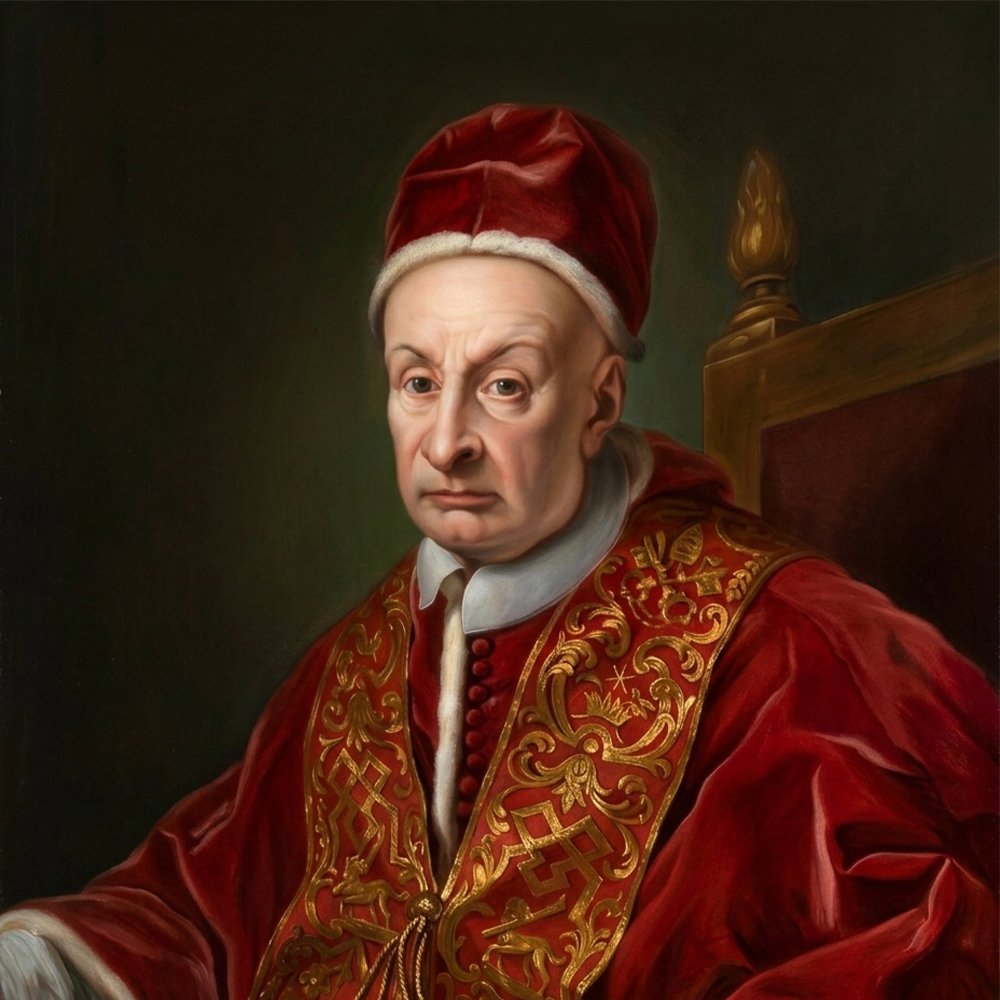
Pope Benedict XIII (1724-1730)
BIOGRAPHICAL DETAILS
Birth Name: Pietro Francesco Orsini
Birth: 2 February 1649, Gravina in Puglia, Kingdom of Naples (Apulia, Italy)
Papal Election: 29 May 1724
Coronation: 4 June 1724
Pontificate: 29 May 1724 – 21 February 1730 (5 years, 8 months, 23 days)
Death: 21 February 1730, Rome (81 years old)
Burial: Basilica of Santa Maria sopra Minerva, Rome
Religious Order: Dominicans (Order of Preachers)
Papal Motto: None officially recorded
Sobriquets: “The Holy Pope”, “The Dominican Pope”, “The Naive Pope”, “Pope of Coscia”
NOTE: Personally holy, but disastrous government – dominated by the most corrupt cardinal of the 18th century!
FORMATION AND RELIGIOUS LIFE
Aristocratic Origins – Orsini Family
Orsini Family:
One of the most ancient and powerful noble families of Rome/Italy
Ferdinando III Orsini: father, 8th Duke of Gravina, Grandee of Spain
Giovanna Frangipane della Tolfa: mother, Roman noblewoman
Family: produced 5 previous popes! (Celestine III, Nicholas III, Benedict XI, others)
Palazzo Orsini: multiple palaces in Rome and southern Italy
Pietro Francesco: firstborn, destined to inherit the duchy
Siblings: several, raised for military/political careers
Aristocratic Childhood (1649-1665):
Ducal palace in Gravina
Princely education: tutors, weapons, riding, dance
Family: deeply Catholic (despite wealth)
Pietro Francesco: pious, serious child
Early interest: religion (not war or politics)
Health: robust (unlike many popes of the time)
Dominican Vocation – Dramatic Rupture
Radical Decision (1665-1668):
16 years old: Pietro Francesco announced his religious vocation
Family: HORRIFIED
Firstborn: was to inherit the duchy!
Aristocratic tradition: second sons to the Church, not heirs
Father: furious, forbade it
Pietro Francesco: insisted (years of family conflict)
1667: Ran away from home (!), took refuge in a Dominican convent
Father: tried to retrieve him (soldiers to the convent)
Dominican Provincial: protected him
Papal Intervention:
1668: The case reached Pope Clement IX
Clement IX: decided in favor of the young man (!)
True vocations: sacred
Even a firstborn: free to choose
Orsini family: yielded (reluctantly)
Duchy: passed to the younger brother
Entry into the Dominican Order (1668):
19 years old – Convent of Santa Sabina, Rome
Religious name: Fra Vincenzo Maria Orsini
Abandoned “Pietro Francesco”
“Vincenzo” (Vincent): homage to St. Vincent Ferrer (Dominican)
Novitiate: rigorous
Accepted austere life (brutal contrast with the ducal palace)
Dominican Formation (1668-1675)
Philosophical and Theological Studies:
Dominican convent of Naples
Curriculum: Thomas Aquinas (scholastic theology)
Student: diligent but not brilliant (contrast with Lambertini/Benedict XIV)
Strong in: prayer, discipline, humility
Weak in: abstract speculation
Priestly Ordination: 1671 (22 years old)
Specialization:
Moral theology
Preaching (Dominican charism)
Pastoral care (care of souls)
Characteristics (1668-1675):
Extreme austerity:
Severe fasts
Hairshirt (belt with thorns – mortification)
Minimal sleep (4-5 hours)
Cell: bare (only crucifix, books)
Ostentatious humility:
Rejected privileges (family tried to favor him)
Manual labor (cleaned latrines – scandalizing confreres!)
Mendicancy (begged alms like an ordinary friar)
Deep piety:
Hours in prayer
Devotion to Our Lady of the Rosary (Dominican)
Daily Mass celebrated with tears
Reputation:
Within the Order: venerated (a living saint)
Family: ashamed (the duke had become a mendicant friar!)
People: loved him (simple preaching, charity)
ARCHBISHOP AND CARDINAL (1675-1724)
Early Episcopal Appointments
Archbishop of Manfredonia (1675):
26 years old! (absurdly young for an archbishop)
Reason: Pope Clement X yielded to pressure from the Orsini family
Family: “If he must be religious, at least let him be a bishop”
Pietro Francesco: RELUCTANT, accepted out of obedience
Diocese: small, southern Italy, poor
Revolutionary Episcopal Style (1675-1680):
Refused the episcopal palace: lived in a Dominican convent
Pastoral visits: walked the entire diocese on foot
Visited ALL parishes (including remote villages)
Slept in peasants’ houses
Regular synods: reformed the local clergy
Preaching: personally in parishes (unusual for an aristocratic bishop)
Extreme charity:
Sold episcopal furniture (distributed to the poor)
Simple food (bread, vegetables)
Clothes: Dominican habit (not luxurious episcopal vestments)
Aristocratic scandal:
Family: mortified (Archbishop Orsini lived like a beggar!)
Other bishops: criticized (a bad example, they said)
People: adored him
Archbishop of Cesena (1680-1686):
Transferred (Innocent XI thought Manfredonia was too small)
Larger diocese, Papal States
Same style: austerity, intense pastoral activity
Reformed the seminary
Fought simony (sale of ecclesiastical offices)
Archbishop of Benevento (1686-1724):
Large, important archdiocese
Benevento: papal enclave within the Kingdom of Naples
38 years as archbishop! (almost a record)
Exemplary governance:
13 diocesan synods (a record!)
Visited the entire diocese 60+ times (!)
Restored clerical discipline
Opened schools, hospitals, orphanages
Founded the Monte di Pietà (bank for the poor – interest-free loans)
Austerity maintained:
Dominican habit always
Episcopal palace: given to the seminary, lived in 2 rooms
Food: black bread, water (occasionally watered wine)
Slept on a board (not a mattress)
Reputation for holiness:
Miracles attributed (healings, multiplication of food – not proven)
People: venerated him as a living saint
Clergy: respected him (though some envied him)
Cardinal (1672-1724)
Created Cardinal by Clement X (22 February 1672):
23 years old! (one of the youngest cardinals in history!)
Reason: pressure from the extremely powerful Orsini family
Cardinal-Priest of San Sisto (Dominican church)
Peculiarity: continued living as a friar!
Did not accept the cardinal’s palace
Resided in a Dominican convent (when in Rome)
Cardinal’s vestments: only for mandatory ceremonies
Rest of the time: white Dominican habit
Activity in the College of Cardinals (1672-1724):
Participated in Conclaves:
1676 (Innocent XI)
1689 (Alexander VIII)
1691 (Innocent XII)
1700 (Clement XI)
1721 (Innocent XIII)
1724 (his own election)
Positions:
Always voted for reforming candidates
Avoided politics
Focused on pastoral issues
Congregations:
Holy Office (Inquisition)
Rites
Bishops
But: attended irregularly (preferred Benevento to Rome)
Characteristics as Cardinal:
Lack of interest in power:
Did no lobbying
Led no factions
Did not aspire to the papacy
Political naivety:
Trusted everyone
Did not see intrigues
Easily manipulable (future problem!)
Recognized holiness:
Universally respected for his personal virtue
But: not seen as papal material (too naive)
CONCLAVE OF 1724 – PAPAL ELECTION
Pre-Conclave Context
Death of Innocent XIII (7 March 1724):
Very short pontificate (3 years)
Sick, ineffective pope
Church needed: strong government, reforms
Situation of the Church (1724):
Jansenism: strong in France
Regalism: monarchies controlling national churches
Enlightenment: growing intellectual threat
Papal States: poorly administered
Finances: problematic
The Conclave – Two Months
Start: 20 March 1724
Duration: 70 days
Factions:
Zelanti: wanted a reforming, holy pope
“Crown”: favorable to concessions to monarchies
“Imperials”: pro-Austria
Orsini: small family faction
Main Candidates:
Cardinal Paolucci: initial favorite (political)
Cardinal Piazza: zelante
Cardinal Albani: experienced
Cardinal Orsini: was NOT a serious candidate!
Impasse:
No candidate: 2/3 majority
Vetoes blocked favorites
Weeks: no progress
Surprising Rise of Orsini:
How did it happen?
Zelanti faction: desperate for a saint
Orsini: universal reputation for holiness
Argument: “The Church needs a saint, not a politician”
But: majority doubted (good bishop = good pope?)
Dramatic Turn (May 1724):
Cardinal Albani: proposed Orsini as a compromise
Zelanti: enthusiastic
“Crown”: accepted (Orsini: naive, manipulable – they thought)
Orsini was in Benevento! (not attending the conclave – ill)
Election: 29 May 1724
Vote: almost unanimous (surprising!)
Orsini absent: notified by messenger
Orsini’s Reaction – Dramatic Refusal:
Messengers arrived in Benevento
Orsini: REFUSED!
“I am unworthy”
“I do not have the skills”
“Let me die as archbishop”
Cardinals: horrified (refusal was canonical but rare)
They sent a delegation:
Cardinals traveled to Benevento
Argued: obedience, will of God
Dominican Provincial: ordered obedience
Reluctant Acceptance:
4 June 1724: Orsini yielded
Tears: abundant
Phrase: “Forgive me, I do not know how to govern”
Chose name: Benedict XIII
Homage to Benedict XI (Dominican pope, 1303-1304)
And to the antipope Benedict XIII (curiously – historical error?)
Coronation: 4 June 1724
St. Peter’s Basilica
Orsini: visibly uncomfortable
Tried to wear the Dominican habit under the papal vestments
Ceremony: solemn, but the pope seemed terrified
PONTIFICATE (1724-1730)
Personal Style – “The Holy Pope”
Austerity Maintained:
Residence: refused the luxurious papal apartments
Simple rooms
Minimal furniture (hard bed, table, chair, crucifix)
Food:
Black bread, vegetables, water
Rigorous fasts (Lent: almost starvation)
Never ate meat (vow)
Vestments:
Dominican habit whenever possible
Papal vestments: only for mandatory ceremonies
Schedule:
3 AM: Rose for Matins (Dominican night prayer)
5 AM: Meditation
6 AM: Mass (celebrated personally, daily)
7 AM – 12 PM: Audiences, dispatches
12 PM: Frugal lunch
1 PM – 3 PM: Pastoral visits in Rome (!)
3 PM – 6 PM: More work
6 PM: Vespers, Rosary
7 PM: Minimal dinner
8 PM – 10 PM: Private prayer
10 PM: Sleep (4-5 hours)
Pastoral Activities:
Visited ALL churches in Rome (more than 400!)
Preached personally in parishes
Sundays: different parishes (rotation)
Sermons: simple, emotional (not erudite)
Visited hospitals, prisons weekly
Washed the feet of the sick
Heard prisoners’ confessions
Distributed alms personally
Taught catechism to children (!)
The pope teaching catechism in poor parishes
Aristocratic scandal: “The pope doing the work of an ordinary priest!”
Personal Holiness:
Miracles attributed (not proven):
Healings by touch
Multiplication of bread
Prophecy
Stigmata (unconfirmed rumor)
Mystical ecstasies during Mass
Roman people: venerated him as a living saint
Disastrous Government – Cardinal Coscia
Niccolò Coscia – The Fatal Favorite:
Who was he?
Neapolitan, from a modest family
Orsini’s secretary in Benevento (since 1718)
Intelligent, ambitious, totally corrupt
Meteoric rise:
Benedict XIII: brought him to Rome
1725: Made him cardinal (!)
1726: Appointed him de facto Secretary of State (not officially, but in practice)
How Coscia Dominated the Pope:
Absolute trust:
Benedict XIII: naive, trusted blindly
Coscia: controlled access to the pope
Documents: Coscia read, explained (manipulated)
Decisions: Coscia “advised” (dictated)
Isolation of the pope:
Benedict XIII: focused on prayer, pastoral work
Politics, administration: totally delegated to Coscia
Cardinals: complained, Benedict XIII did not listen
“Coscia serves me faithfully” (tragic illusion)
Coscia’s Corruption – Monumental Scandal:
Sale of offices (blatant Simony):
Bishoprics: sold to the highest bidder
Curial offices: auctioned off
Benefices: commercialized
Prices: publicly listed (!)
Scandal: even Protestants denounced it
Embezzlement of funds:
Papal treasury: drained
Alms destined for the poor: stolen
Taxes from the Papal States: diverted
Coscia’s personal fortune: grew obscenely
Extreme nepotism:
Coscia family: enriched
Relatives: appointed to offices (incompetent)
Friends: favored in contracts
Corrupted justice:
Sentences: bought
Criminals: freed (bribery)
Innocents: condemned (enemies of Coscia)
Reaction:
Cardinals: furious, powerless
Complained to Benedict XIII
Pope: “Coscia is honest, you are envious”
Some: tried to expose Coscia
Coscia: blocked access to the pope
Rome: revolted
Brutal pasquinades (anonymous satires)
“Benedict holy, Coscia devil”
Threats against Coscia (armed protection needed)
Europe: scandalized
Monarchies: despised Benedict XIII
Diplomats: negotiated with Coscia (they knew who was in charge)
Papal reputation: destroyed
Why Didn’t Benedict XIII See It?
Naivety: believed in universal human goodness
Mystical focus: absorbed in prayer (not administration)
Trust: Coscia had served for years in Benevento (seemed loyal)
Isolation: Coscia filtered information
Holiness ≠ discernment: virtue does not guarantee political prudence
Church Administration
Doctrinal Issues:
Jansenism:
Condemned (Bull, 1727)
But: ineffective (France ignored it)
Coscia: uninterested (not profitable)
Beatifications/Canonizations:
Benedict XIII: great personal interest
Processes: rigorous (inherited standards from predecessors)
Canonizations:
St. Aloysius Gonzaga (1726)
St. Stanislaus Kostka (1726)
Other Jesuit, Dominican saints
Holy Year 1725:
Universal Jubilee
Pilgrims: thousands
Problem: Coscia charged exorbitant fees
Scandal: pilgrims robbed
International Relations:
Terrible (due to Coscia)
Spain: hostile
France: disdainful
Austria: tolerated (controlled Italy)
Portugal: minimal relations
Papal States:
Administration: chaotic
Governors: appointed by Coscia (corrupt or incompetent)
Finances: collapsed
Justice: sold
Banditry: flourished
People: suffered
Public Works:
Minimal (Coscia diverted funds)
Exception: some church restorations (Benedict XIII insisted)
Last Years – Late Awareness?
1728-1729:
Benedict XIII: health deteriorated
79-80 years old
Extreme fatigue (fasts, vigils took their toll)
Rumors: began to distrust Coscia?
Ambiguous evidence
Some reports: the pope questioned expenses
Coscia: reassured him (lies)
1729-1730:
Accelerated illness
Recurring fever
Extreme weakness
Continued pastoral activities (stubbornly)
Preached until weeks before his death
Death
Last Weeks (January-February 1730):
Confined to bed
High fever, occasional delirium
Lucidity preserved at times
Received Last Rites
21 February 1730:
Morning: agony
Noon: peaceful death
81 years old
Cause: probably pneumonia + extreme physical exhaustion (fasts, austerity)
Last Words (reported):
“Forgive… I did not know how to govern…”
Or: “God will judge my innocence…” (?)
Final awareness of the corruption? Historical debate
Immediate Reaction:
Roman people: genuine mourning (loved the holy pope, hated Coscia)
Cardinals: relief (they could finally act against Coscia)
Coscia: terror (had lost his protection)
POST-MORTEM – VENGEANCE AGAINST COSCIA
Funeral
23-25 February 1730:
Basilica of Santa Maria sopra Minerva (Dominican church – Benedict XIII’s wish)
Crowds: venerated the body (touched his habit, asked for miracles)
Cardinals: solemn ceremony but without excess
Dominicans: pride (a holy pope from the order)
Burial:
Simple tomb (Benedict XIII had asked for it)
But: successors built a more dignified monument
Inscription: praises personal holiness (silences disastrous government)
Trial of Coscia – Late Justice
Conclave of 1730:
Before electing a successor: cardinals discussed Coscia
Consensus: HE MUST BE PUNISHED
After the election of Clement XII:
1731: Coscia arrested
Charges:
Simony (sale of offices)
Embezzlement (diversion of funds)
Corruption
Illicit enrichment
Trial:
Evidence: abundant, overwhelming
Defense: impossible
Sentence (1733):
Guilty of all crimes
Fine: 1 million scudi (a fortune!)
Imprisonment: Castel Sant’Angelo (10 years)
Degradation: lost his cardinalate (technically, suspended)
Confiscation: all assets
Coscia’s Imprisonment:
1733-1743: Castel Sant’Angelo
Conditions: harsh (not luxurious)
1743: Freed by Benedict XIV (clemency)
Old, broken
Died shortly after (1755), forgotten
Recovery of Funds:
Part: recovered from Coscia’s fortune
But: most already dissipated
Damage: irreparable
LEGACY AND HISTORICAL EVALUATION
The Paradox of Benedict XIII
Saint vs. Ruler:
Personal life: exemplary, possibly heroic
Government: disastrous, one of the worst
Comparison:
Celestine V (1294): also a saint, also incapable of governing, ABDICATED
Benedict XIII: did not abdicate (should he have?)
Contemporaries
Roman People:
Loved Benedict XIII personally
Venerated him as a saint
But: suffered under the corrupt government
Cardinals:
Respected his holiness
But: furious at his incompetence
Regretted his election (a collective error)
Successor (Clement XII):
Reformed the excesses
Punished Coscia
But: did not publicly denounce Benedict XIII (respect for his memory)
Historiography
18th-19th Centuries:
Hagiographers: emphasized his holiness
Critical historians: emphasized his governmental failure
Debate: naive saint or negligent saint?
20th Century:
More balanced reassessment:
Recognition: genuine personal holiness
But: responsibility for allowing Coscia
“Good intentions are not enough”
21st Century:
Renewed interest:
Studies on Coscia (systemic corruption)
Debate on papal abdication (Benedict XVI, 2013 – precedents)
Lessons: discernment necessary even in saints
Beatification/Canonization
Proposed Cause:
Dominicans: initiated the process (18th century)
Obstacles:
Disastrous government
Responsibility for Coscia
Public scandal
Result: process never advanced
Personal virtues: recognized
But: political prudence: questioned
Still not beatified (unlikely in the future)
Historical Lessons
For the Church:
Holiness ≠ governing ability
Popes need political discernment (not just virtue)
Delegation requires supervision
Naivety can cause immense damage
Comparisons:
Pius V (1566-1572): also austere, but GOVERNED effectively
Pius X (1903-1914): saint AND competent reformer
Benedict XIII: saint but incapable ruler
CURIOSITIES AND PERSONAL DETAILS
Personality
Extreme Virtues:
Humility: genuine, not false modesty
Charity: gave everything to the poor
Piety: constant prayer
Austerity: severe self-mortification
Simplicity: despised pomp
Fatal Deficiencies:
Naivety: trusted blindly
Isolation: absorbed in prayer, blind to politics
Stubbornness: did not listen to advice
Excess: austerity harmed health, judgment
Appearance
Contemporary Descriptions:
Thin (skeletal – from fasts)
Pale
Eyes: deep, intense (mystical)
Beard: white, long (Dominican custom)
Posture: stooped (age + mortifications)
White Dominican habit: always (even as pope)
Attributed Miracles (unproven)
During Life:
Healings of the sick by touch
Multiplication of bread (distributed to the poor – was there always more?)
Bilocation (seen in two places simultaneously – dubious reports)
Prophecy (predicted deaths, events – anecdotal)
Post-Mortem:
Body: temporarily incorrupt (?)
Healings at his tomb
But: never officially verified
Personal Relationships
Dominicans:
Immense pride (a pope from the order)
But: concern (weak government stained the reputation)
Orsini Family:
Late reconciliation
Visited him as pope
But: uncomfortable (aristocratic life vs. religious life)
Cardinal Coscia:
Tragedy: Benedict XIII genuinely loved him (as a spiritual son)
Coscia’s betrayal: he did not realize until death (or realized too late?)
Anecdotes
1. Refusal of the Papacy:
When elected, he locked himself in his room
Cardinals: knocked on the door for hours
Finally: the Dominican Provincial ORDERED acceptance (vow of obedience)
Benedict XIII: obeyed, weeping
2. Dominican Habit:
Tried to wear the white habit under the papal tiara (!)
Masters of ceremonies: horrified
Compromise: papal vestments in public, habit in private
3. Visits to Prisons:
Weekly visited prisoners
Washed their feet (imitating Christ)
Distributed food personally
Prisoners: shocked (the pope doing this!)
4. Preaching in Poor Parishes:
Sunday: the pope preaching in a suburban parish
Simple people: astonished
Sermon: simple, emotional (not erudite)
Wept during the sermon (genuine emotion)
5. Coscia and the Pope:
Anonymous cardinal to Benedict XIII: “Coscia robs Your Holiness”
Benedict XIII: “Impossible, he is devout, honest”
Cardinal: “But the evidence…”
Benedict XIII: “You are envious of his efficiency”
(Reconstructed dialogue, but represents the dynamic)
IMPORTANT DOCUMENTS
Main Bulls
“Pretiosus” (1727):
Against Jansenism
Ineffective but doctrinally necessary
“Apostolici Ministerii” (1723):
Regulation of missions
Continued policies of predecessors
Canonization Decrees:
Several saints (Aloysius Gonzaga, Stanislaus Kostka, others)
Holy Year 1725
Jubilee:
Proclamation bull (1724)
Plenary indulgences
Problem: Coscia charged excessive fees (scandal)
SUMMARY CHRONOLOGY
1649: Birth in Gravina (Orsini family)
1668: Entry into the Dominican Order (ran away from home!)
1671: Priestly ordination
1672: Created cardinal (23 years old!)
1675: Archbishop of Manfredonia (26 years old)
1686: Archbishop of Benevento
1686-1724: 38 years as exemplary archbishop
1724 (May): Papal election (75 years old, reluctant)
1724 (June): Forced acceptance, coronation
1725: Holy Year (Jubilee)
1725: Coscia created cardinal – beginning of the disaster
1726-1730: Government dominated by Coscia (extreme corruption)
1730 (February): Death in Rome, 81 years old
1731-1733: Trial and conviction of Coscia
Pope Benedict XIII personifies the tragedy of holiness without prudence. A man of heroic virtues – austerity that rivaled medieval saints, charity that moved people, humility that scandalized aristocrats – he ascended to the papal throne not by ambition (which he had none), but by the veneration of others.
Elected as a symbol of purity in a corrupt age, he became a victim of his own naivety. Absorbed in prayer, pastoral visits, and mortifications, he delegated government to the most corrupt man of the 18th century: Cardinal Niccolò Coscia, who turned the Vatican into a market of simony.
The paradox is brutal:
A pope who lived like a beggar → a government that sold offices
A pope who washed prisoners’ feet → an administration that sold justice
A pope venerated as a saint → a pontificate that stained the Church
Should he have abdicated? Celestine V did (1294), recognizing his incapacity. Benedict XIII did not – whether from a sense of duty, or from not perceiving the disaster around him.
His reported last words – “Forgive… I did not know how to govern…” – summarize the pathos: a saint who recognized (too late?) that he was not a ruler.
After his death, Coscia was tried, convicted, imprisoned – justice that Benedict XIII, alive, never allowed because he could not see evil (the tragedy of pure souls in a corrupted world).
The Church never beatified him. Personal virtues: undeniable. But prudence – a cardinal virtue that Paul required of bishops – he catastrophically lacked.
Dominicans venerated him. Romans mourned him. Historians lamented him. His legacy is not that of a saint-pope (like Pius V or Pius X), but of a saint who was pope – a cruel but necessary distinction.
Modern Rome, passing by the modest tomb in Santa Maria sopra Minerva, rarely thinks of the Dominican pope who walked barefoot visiting the poor while his favorite cardinal plundered the papal treasury.
Perhaps his epitaph should be not the hagiographic praise inscribed, but the biblical warning: “The serpent was more cunning…” (Genesis 3:1) – for even in the Eden of Benedict XIII’s personal holiness, the Coscia-serpent corrupted the garden.
“Holy Pope, Accursed Government” – a historical oxymoron that defies simple categorizations and reminds us that in the papacy, as Christ taught, one must be not only innocent as doves, but also prudent as serpents (Matthew 10:16).