Benedict XIV
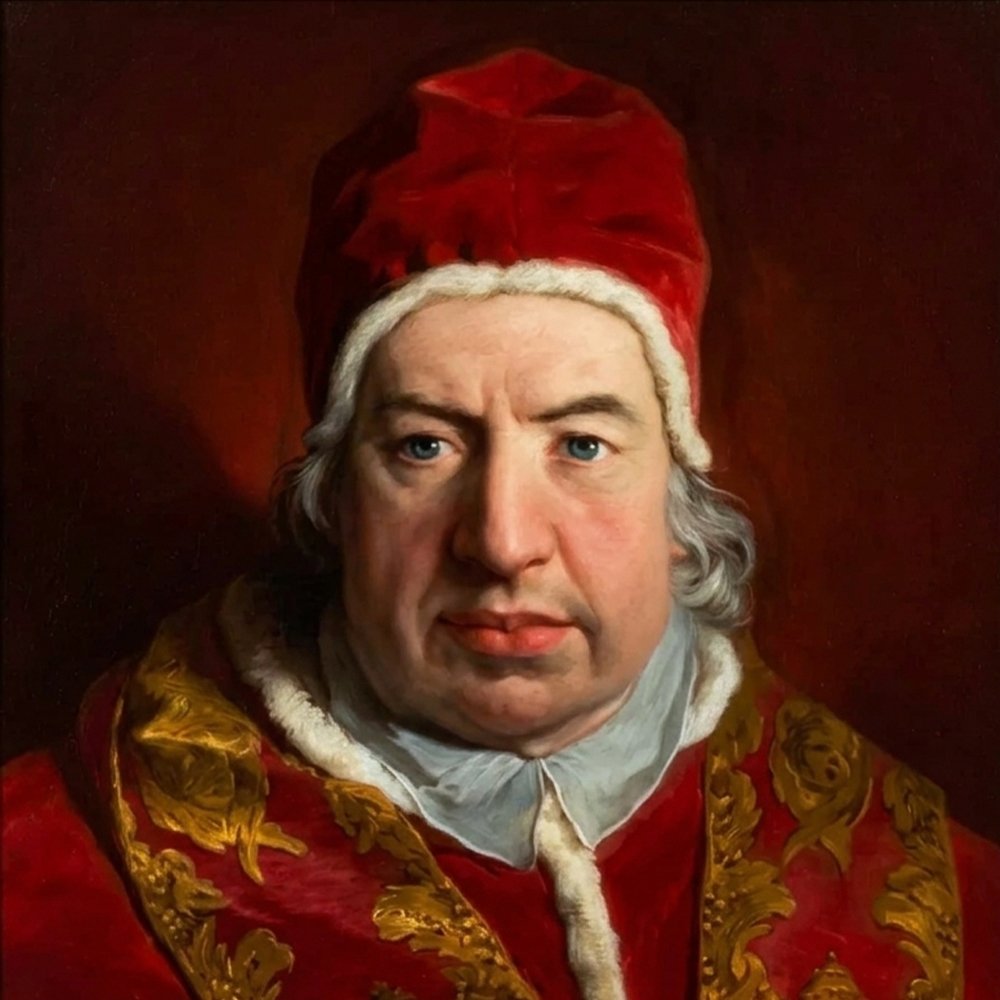
Pope Benedict XIV (1740-1758)
BIOGRAPHICAL DETAILS
Birth Name: Prospero Lorenzo Lambertini
Birth: 31 March 1675, Bologna, Papal States (Emilia-Romagna, Italy)
Papal Election: 17 August 1740
Coronation: 21 August 1740
Pontificate: 17 August 1740 – 3 May 1758 (17 years, 8 months, 16 days)
Death: 3 May 1758, Rome (83 years old)
Burial: St. Peter’s Basilica, Vatican City
Religious Order: Secular clergy (did not belong to a religious order)
Papal Motto: None officially recorded
Sobriquets: “The Erudite Pope”, “Pope of the Enlightenment”, “The Wise Pope”, “Pope of the Intellectuals”
NOTE: Considered the most erudite and intellectually brilliant pope of the 18th century – he corresponded with Voltaire!
FORMATION AND RELIGIOUS LIFE
Aristocratic Origins
Lambertini Family:
Ancient aristocratic Bolognese family
Marcello Lambertini: father, count, senator of Bologna
Lucrezia Bulgarini: mother, Bolognese noblewoman
Family: cultured, prosperous, deeply Catholic
Bologna: university city, papal, intellectually vibrant
Prospero Lorenzo: second child (firstborn destined for a secular career)
Privileged Childhood:
Aristocratic palace in Bologna
Extensive family library
Private tutors
Child prodigy: prodigious memory, insatiable curiosity
Health: robust (unlike many contemporary popes)
Exceptional Academic Formation
Clementine College, Rome (1689-1694):
Elite school for young aristocrats
Rigorous Jesuit education
Curriculum:
Latin, Greek, Hebrew (fluent in all three!)
Rhetoric, scholastic philosophy
Mathematics, natural sciences
Theology
Sapienza University, Rome (1694-1698):
Doctorate in Theology (1694) – 19 years old!
Doctorate in Canon and Civil Law (1696) – 21 years old!
In utroque iure (both laws)
Exceptionally brilliant student
Defended theses: acclaimed for erudition
Professors: recognized his genius
Academic Characteristics:
Photographic memory: could recite entire texts from memory
Polyglot: Latin, Italian, French, Spanish, Greek, Hebrew
Universal curiosity: theology, law, history, science, literature
Method: rigorous, based on primary sources
Priestly Ordination: 1700 (25 years old)
Pre-Cardinalate Ecclesiastical Career (1700-1728)
Consistorial Advocate (1701-1708):
Supreme ecclesiastical tribunal
Defended complex canonical causes
Specialty: beatifications, canonizations
Reputation: brilliant argumentation, intimidating erudition
“Promoter of the Faith” – The Devil’s Advocate (1708-1728):
Crucial role: examined causes of saints
Function: to QUESTION miracles, heroic virtues
Had to find DEFECTS, DOUBTS
Lambertini: revolutionized the office
Scientific method avant la lettre
Rigorous investigations of “miracles”
Discarded hundreds of fraudulent cases
But: when convinced, defended ardently
Monumental Work: “De Servorum Dei Beatificatione et Beatorum Canonizatione” (1734-1738):
4 massive volumes (over 3,000 pages!)
Masterpiece: still an authority in the 21st century
Systematized ALL canonization procedures
Rigorous criteria for:
Verification of miracles
Proof of heroic virtues
Reliable witnesses
Exclusion of fraud
Influence: scientific method applied to the sacred
Voltaire (atheist!) praised it: “Work of genius, even if I disagree”
Consultor of the Holy Office:
Roman Inquisition
But: Lambertini was moderate
Favored dialogue over condemnation (when possible)
Famous case: defended an astronomer against accusations of heresy
Archbishop of Ancona (1727-1731):
First diocese
Personally visited all parishes
Reformed the seminary (more rigorous curriculum)
Fought popular superstitions (but with tact)
Generous with the poor
Popular among clergy and faithful
Archbishop of Bologna (1731-1740):
Prestigious archdiocese, his hometown!
Exemplary Governance:
Systematic pastoral visits
Regular diocesan synods
Reformed local liturgy (restored Roman purity)
Promoted clerical education
Diocesan library: open to lay scholars (!)
Cordial relations with the university (even non-clerical professors)
Prolific Writer:
Erudite pastoral letters
Theological treatises
Correspondence with European intellectuals
Patron:
Supported artists, musicians
Promoted sciences (scientific academies)
Bologna: culturally flourished
CARDINAL (1728-1740)
Created Cardinal by Clement XII (9 December 1726, but published in 1728):
51 years old (already mature)
Cardinal-Priest of Santa Croce in Gerusalemme
Continued as Archbishop of Bologna
Activity in the College of Cardinals:
Participated in the 1730 Conclave (re-election of Clement XII – did not happen, the pope lived)
Congregations:
Holy Office (moderator)
Rites (specialist in liturgy)
Index (book censor – surprisingly moderate)
Consistorial
Reputation: incomparable erudition, but jovial, approachable
Correspondence: with Catholic and non-Catholic intellectuals
Theological Positions:
Firm orthodoxy BUT intellectual openness
Fought Jansenism (rigorist heresy)
But: dialogued with Jansenists (tried to persuade, not just condemn)
Relationship with the Enlightenment: complex
Condemned excesses (atheism, materialism)
But: admired scientific method, reason
Believed: faith and reason compatible
CONCLAVE OF 1740 – PAPAL ELECTION
Pre-Conclave Context
Death of Clement XII (6 February 1740):
Elderly, sick pope, practically blind in his last years
Government: dominated by Cardinal Corsini (nephew)
Excessive nepotism
Church needed: reform, renewal
Situation of the Church (1740):
Doctrinal Conflicts:
Jansenism strong in France, Low Countries
Quietism (excessive mysticism) condemned but persistent
Emergent Febronianism (Germany – episcopalism)
Missionary Issues:
Chinese Rites controversy (still not completely resolved)
Tension between Jesuits vs. other orders
Relations with Monarchies:
Growing royal absolutism
Regalism (state control over the Church)
Enlightenment threatening ecclesiastical influence
Papal States:
Stagnant economy
Corrupt administration
Need for reforms
The Conclave – Six Months!
Start: 18 February 1740
Location: Quirinal Palace, Rome
Duration: 182 days! (one of the longest in history)
Factions:
Zelanti: intransigent orthodox, pro-Jesuit
“Crown”: aligned with Catholic monarchies
“Imperials”: pro-Austria (Holy Empire)
“Spanish”: Bourbon faction
Moderates: wanted a balanced pope
Main Candidates (initially):
Cardinal Aldrovandi: zelante, but old
Cardinal Ruffo: political, supported by Spain
Cardinal Petra: Austrian favorite
Cardinal Lambertini: was not the initial favorite!
Prolonged Impasse:
No candidate: 2/3 majority
Vetoes (exclusivae) blocked favorites
Roman summer: unbearable heat in the Quirinal
Cardinals: exhausted, sick (some died during the conclave!)
External pressure: monarchies demanded a resolution
Lambertini’s Rise:
Initially: few votes (5-10)
But: NO ONE VETOED HIM
He didn’t offend any faction
Reputation: erudition, moderation, personal holiness
Had no powerful enemies
Decisive Moment (August):
French Cardinal Tencin: proposed Lambertini as a compromise
“Gentlemen, if you want a saint, choose Gotti; if you want a politician, choose Aldrovandi; if you want an honest and wise man, choose Lambertini”
Argument: Lambertini uniquely qualified (erudition + pastoral + diplomacy)
Lambertini’s Strategy:
During the conclave: humble, discreet
Did not campaign
But: demonstrated erudition in theological debates
Famous phrase (when votes increased): “If you want me as pope, remember I am 65 and will not live long” (he lived another 18 years!)
Self-awareness: “I am not handsome, but I am intelligent”
Election: 17 August 1740
Final vote: almost unanimous
Acceptance: immediate, joyful
Chose name: Benedict XIV
Homage to Benedict XIII (predecessor, also erudite)
Number XIV: continuity
Iconic Moment:
After the election, Lambertini: “May God forgive you for what you have done!”
Then: “I did not expect this at 65!”
Cardinals: laughed (Lambertini was known for his humor)
Coronation: 21 August 1740
St. Peter’s Basilica
Joyful ceremony (contrast with previous somber conclaves)
Rome: hopeful (new jovial, intelligent pope)
PONTIFICATE (1740-1758)
Style of Government – Revolutionary
Secretaries of State:
Cardinal Valenti Gonzaga (1740-1756): highly competent, ideal partner
Cardinal Archinto (1756-1758): continued policies
Innovative Administrative Methods:
Weekly Public Audiences: ANYONE could request an audience!
Previous popes: inaccessible
Benedict XIV: received artisans, peasants, repentant prostitutes
Personal Correspondence:
Personally answered letters (did not delegate everything)
Hundreds of letters per year
Recipients: kings, cardinals, but also professors, scientists, writers
Humor and Accessibility:
Joked with visitors
Told jokes (some spicy ones!)
Abolished excessive etiquette (maintained dignity but without suffocating pomp)
Simplicity:
Reduced oppressive ceremonies
Dressed simply (for a pope)
Food: modest (loved simple Bolognese cuisine)
Reform of the Roman Curia
Fight Against Corruption:
Investigated Congregations
Dismissed corrupt officials
Systematized procedures (less arbitrariness)
Published clear regulations
Meritocracy:
Appointments: by competence (not just birth)
Promoted humble but talented clergy
Drastically reduced nepotism
Had nephews, but did NOT favor them excessively
Striking contrast with previous popes
Finances:
Reorganized papal economy
Reduced superfluous spending
But: maintained patronage (art, science, charity)
Fiscal balance: improved (didn’t eliminate deficit, but reduced it)
Relations with Monarchies – Pragmatic Diplomacy
Fundamental Principle:
“Peace with all, dignity always”
Benedict XIV: FIRST pope to negotiate modern concordats
Objective: preserve essential rights of the Church, yield on peripheral issues
Main Concordats:
Spain (1753):
King Ferdinand VI demanded control over episcopal appointments
Benedict XIV: partially yielded
King: nominated bishops, pope approved (theoretical veto)
In exchange: Spain protected ecclesiastical property
Criticisms: zelanti furious (pope had “sold out” the Church)
Benedict XIV’s defense: “The alternative was schism”
Naples (1741):
Jurisdictional issues
Benedict XIV: flexible, pragmatic
Avoided conflict with Charles VII (Bourbon)
Piedmont-Sardinia (1741, 1750):
King Charles Emmanuel III (ambitious)
Benedict XIV: granted control over ecclesiastical benefices
Criticism: excessive generosity
Defense: preserved Catholic missions
Portugal:
Initially cordial relations
But: growing tension (Marquis of Pombal, Jansenist, anti-Jesuit)
Benedict XIV: tried to mediate
Did not resolve (problem exploded under Clement XIII)
Austria (Holy Empire):
Empress Maria Theresa: devout but regalist
Benedict XIV: excellent relations (personally)
They exchanged friendly correspondence
But: concessions in episcopal appointments
France:
Louis XV: absolutist, influenced by Jansenists
French Parliaments: hostile to Rome
Benedict XIV: patient diplomacy
Condemned the Encyclopédie (1759) but moderately
Avoided total rupture
Prussia (Protestant!):
Frederick II, the Great: declared atheist, cynical
But: Benedict XIV corresponded with him!
Frederick: respected the pope’s intelligence
Benedict XIV: diplomatically defended Prussian Catholics
Relationship: surprisingly cordial
Doctrinal and Theological Issues
Chinese Rites Controversy – Final Resolution:
Context: Jesuits allowed Chinese Christians to practice ancestral rites (honoring Confucius, ancestors)
Jesuits: “civil rites, not religious”
Dominicans, Franciscans: “idolatry!”
Predecessors: condemned (Clement XI, Benedict XIII)
Benedict XIV (1742, 1744):
Bulls “Ex quo singulari” (1742), “Omnium sollicitudinum” (1744)
Definitively prohibited the rites
Jesuits: obeyed (reluctantly)
Consequence: Chinese mission collapsed
Chinese Emperor: expelled missionaries (1747)
Today: recognized as a mistake (Vatican II reversed it)
But: Benedict XIV acted according to his conscience (feared syncretism)
Jansenism:
Rigorist heresy: denied sufficient grace, rigid predestination
Strong in France, Low Countries (Utrecht)
Benedict XIV:
Condemned the doctrine (renewed the Bull “Unigenitus”)
But: dialogued with moderate Jansenists
Tried persuasion, not just anathema
Failure: Jansenism persisted
Febronianism:
German doctrine (Bishop Hontheim/”Febronius”)
Episcopalism: bishops superior to the pope in local matters
Benedict XIV: condemned it (1764, at the end of his pontificate)
But: without excessive severity
Liturgy and Discipline:
Reformed the Roman Missal (minor corrections)
Regulated religious feasts (reduced excesses)
Promoted healthy devotions, fought superstitions
Beatifications/Canonizations: rigorous (his own method!)
Relationship with the Enlightenment – Fascinating Ambivalence
The Paradox of Benedict XIV:
Pope: defender of orthodoxy
But: admired reason, science, dialogue
Correspondence with Voltaire (!):
Voltaire: militant atheist, fierce critic of the Church
1745: Voltaire dedicated the play “Mahomet” to Benedict XIV
(Play: anti-clerical, satirized religious fanaticism)
Benedict XIV: ACCEPTED the dedication!
Sent a letter praising Voltaire’s literary talent
BUT: admonished him about impiety
Voltaire: published the papal letter (propaganda: “even the pope admires me!”)
Critics: accused Benedict XIV of naivety
Defense: “I can admire talent without approving errors”
Relationship with the Encyclopedists:
Diderot, D’Alembert: edited the Encyclopédie
Benedict XIV: condemned the work (1759)
Reason: theological errors, implicit atheism
But: moderate condemnation (did not excommunicate the authors by name)
Some scientific articles: he admired
Scientific Academies:
Supported the Academy of Bologna (natural sciences)
Allowed scientific experiments in papal territories
Protected astronomers, mathematicians
Reviewed the Galileo case (informally, without reopening)
Did not reverse the condemnation (politically impossible)
But: privately admitted Galileo was right
Index of Prohibited Books:
Maintained the Index (doctrinal obligation)
But: more lenient application
Allowed licenses for scholars to read prohibited books
Criterion: the reader’s intention (study vs. corruption)
Reform of Ecclesiastical Education
Seminaries:
Published regulations for diocesan seminaries
Curriculum: theology, Latin, Greek, history, sciences
Priests: should be EDUCATED (not just pious)
Universities:
Reformed the Sapienza (University of Rome)
Hired professors of merit (not just clerics)
Vatican Library: partially opened to lay scholars
Roman College (Jesuit):
Supported it (despite tensions over the Chinese Rites)
Jesuits: best educators
Benedict XIV: pragmatic (did not allow disagreements to destroy collaboration)
Patron of the Arts and Sciences
Architecture:
Completed works at St. Peter’s
Restored ancient Roman churches
Façade of St. Mary Major (Fuga)
Trevi Fountain: inaugurated (project started earlier)
Painting and Sculpture:
Commissioned works by:
Pietro Bracci
Giovanni Paolo Pannini
Portraits of Benedict XIV: numerous (jovial, intelligent face)
Music:
Reformed sacred music
Promoted Renaissance polyphony (Palestrina)
But: allowed moderate Baroque music
Archaeology:
Personal passion!
Promoted Roman excavations
Protected ancient monuments
Founded the Christian Museum (Vatican)
Collections: coins, manuscripts, artifacts
Sciences:
Supported astronomical studies
Protected Catholic scientists
Corresponded with naturalists
Interest: medicine (studied medical treatises!)
Administration of the Papal States
Economic Reforms:
Reduced oppressive taxes
Encouraged agriculture (drainage of marshes)
Commerce: facilitated (less bureaucracy)
But: resistance from local aristocracy
Justice:
Partial reform of the penal code
Reduced death sentences (did not eliminate)
Courts: more predictable
Public Works:
Roads, aqueducts
Hospitals (expanded Santo Spirito, Rome)
Orphanages
Charity:
Personally generous
Funds for the poor
During famines: grain distribution
Limits:
Papal States: still backward compared to Western Europe
Feudal structure: persisted
Benedict XIV: aware, but change difficult (entrenched resistance)
Canonizations and Beatifications
Applied his own rigorous method:
Canonizations during his pontificate: only 5 (!)
St. Fidelis of Sigmaringen (martyr)
St. Catherine of Bologna
Other minor saints
Beatifications: more numerous but still selective
Process of Canonization:
Medical investigations of “miracles”
Witnesses: rigorously interrogated
Heroic virtues: extensive documentation
Many processes: rejected (fraud, insufficient evidence)
LAST YEARS AND DEATH (1755-1758)
Deteriorating Health
1755-1757:
Benedict XIV: until then surprisingly healthy
At 80 years old: still active, lucid
1756: First symptoms
Fatigue
Difficulty breathing
Pains in legs (probably gout)
1757-1758:
Accelerated deterioration
Continued working (dictated letters from bed)
Humor: intact until the end
Final Concerns
Emergent Jesuit Question:
Portugal (Marquis of Pombal): began anti-Jesuit campaign
Benedict XIV: tried to mediate
Wrote to Joseph I (Portuguese king): moderately defended the Jesuits
But: died before the crisis exploded (successor Clement XIII faced the storm)
Relations with France:
Growing tension
French Parliaments: hostile
Benedict XIV: worried about the future
Succession:
Aware of approaching death
Private conversations with trusted cardinals
Hoped for: moderate, intelligent successor
(Successor was Clement XIII: zelante, less flexible – would Benedict XIV have lamented?)
Death
Last Days:
April 1758: confined to bed
Lucid until the end
Received sacraments
Said goodbye to close cardinals
3 May 1758:
Morning: coma
Afternoon: peaceful death
83 years old
Cause: probably heart/kidney failure
Last Words (reported):
“God, in Your time, not mine”
Or (another version): “I have prepared all my life for this”
Funeral
5-7 May 1758:
St. Peter’s Basilica
Immense crowds
Rome: genuine mourning (beloved pope)
Cardinals: recognized his greatness
Even non-Catholics: paid homage
Voltaire: wrote a eulogy (surprising!)
Frederick II: expressed regret
Burial:
St. Peter’s
Simple tomb (Benedict XIV’s wish)
Inscription: “Benedict XIV, Erudite Pope, Pastor, Friend of Humanity”
LEGACY AND HISTORICAL EVALUATION
Contemporaries
Catholics:
Orthodox: respect (defended doctrine)
Zelanti: distrust (excessive concessions to monarchies)
Moderates: adoration (model of balance)
Ordinary Faithful: love (accessible, charitable)
Enlightenment Thinkers:
Voltaire: “The least pope-like pope of all” (ambiguous praise!)
Montesquieu: admired his wisdom
Encyclopedists: respected his erudition (even when disagreeing)
Monarchies:
Satisfied (obtained concessions)
But: respected him (did not despise him as weak)
Historiography
19th Century:
Ultramontanes: critical (Benedict XIV yielded too much)
Liberal Catholics: hero (dialogue with modernity)
20th Century:
Academic Historians: consensus
Most intellectually distinguished pope of the 18th century
Skilled diplomat (avoided schisms)
But: concessions had a cost (weakened papal authority in the long term)
21st Century:
Growing positive reassessment
Seen as a precursor of:
Vatican II (dialogue with the modern world)
Ecumenism (correspondence with non-Catholics)
Science and faith (compatibility)
Comparison with Other Popes
Gregory the Great (590-604): erudition, reform, pastoral – parallels
Innocent III (1198-1216): authority (but Benedict XIV less imperialistic)
Pius II (1458-1464): humanist, writer – similar spirit
Leo XIII (1878-1903): intellectual, diplomat – 19th-century spiritual successor
John XXIII (1958-1963): accessibility, reform – parallels with Vatican II
Enduring Contributions
Canonizations:
Method: STILL used (with adaptations)
Scientific rigor: revolutionary
Canon Law:
Treatises: authoritative for centuries
Systematization: influenced the 1917 Code
Papal Diplomacy:
Concordats: model for modern Church-State relations
Pragmatism: necessary (but limits debated)
Catholic Intellectualism:
Demonstrated: faith compatible with erudition
Inspired generations of Catholic intellectuals
Persistent Criticisms
Excessive Concessions:
Concordats: weakened the Church in Spain, Portugal?
Eventually: total regalism (19th century)
But: would the alternative have been immediate schism?
Chinese Rites:
Tragic mistake (admitted today)
Chinese mission: did not recover until the 20th century
Benedict XIV: victim of misinformed advisors?
Relationship with the Enlightenment:
Naive? Voltaire used him for propaganda
Or: wise? Dialogue better than blind confrontation?
WRITINGS AND WORKS
Major Works
“De Servorum Dei Beatificatione et Beatorum Canonizatione” (1734-1738):
4 volumes, 3,000+ pages
Definitive masterpiece on canonizations
Still consulted
“De Synodo Dioecesana” (1748):
Manual for diocesan synods
Guide for bishops
13 volumes
Prodigious canonical erudition
“De Sacrificio Missae” (1748):
Treatise on the Holy Mass
Theology, history, liturgy
3 volumes
“Institutiones Ecclesiasticae” (1721-1727):
Manual of ecclesiastical law
Used in seminaries for a century
Letters and Correspondence
Estimated: 10,000+ letters!
Recipients:
Kings, emperors
Cardinals, bishops
Scientists, philosophers (Voltaire, etc.)
Ordinary people
Topics: theology, politics, science, art, jokes
Style: clear, erudite, often amusing
Partially published: “Opera Omnia” (16 volumes, 19th century)
Bulls and Official Documents
Main Ones:
“Ex quo singulari” (1742): Chinese Rites
“Omnium sollicitudinum” (1744): confirmation of the above
“Immensa pastorum” (1741): against Jansenism
Concordats: Spain, Naples, etc.
“Apostolica constitutio” (1749): reform of the liturgical calendar
CURIOSITIES AND PERSONAL DETAILS
Personality
Virtues:
Incomparable Erudition: prodigious memory
Humor: loved to laugh, tell jokes
Accessibility: anyone could speak with him
Charity: generous with the poor
Humility: never arrogant (despite his genius)
Peculiarities:
Talkative: long conversations (cardinals sometimes exhausted!)
Curious: asked visitors EVERYTHING
Gourmet: loved good Bolognese food (but in moderation)
Insomniac: worked until the early morning (read, wrote)
Appearance
Portraits:
Round, jovial face
Lively, intelligent eyes
Frequent smile (rare in papal portraits!)
Figure: corpulent (enjoyed eating)
Vestments: simple (for a pope)
Daily Life
Routine:
6 AM: Wake up, prayer
7 AM: Private Mass
8 AM – 1 PM: Audiences, dispatches
1 PM: Lunch (conversed with guests)
2 PM – 4 PM: Siesta (rarely – preferred to read)
4 PM – 8 PM: More work, correspondence
8 PM: Light dinner
9 PM – 12 AM: Reading, writing
12 AM: Rarely slept before
Habits:
Strong Bolognese coffee (loved it!)
Wine: moderate (Lambrusco from his native region)
Tobacco: didn’t smoke (uncommon at the time)
Exercise: walks in the gardens (conversing with gardeners!)
Personal Relationships
Family:
Maintained contact with the Lambertinis
Minimal nepotism (nephew made cardinal, but deserving)
Visited Bologna as pope (1740) – triumphal reception
Friends:
Erudite cardinals: Querini, Passionei
Scientists: Muratori (historian), Maffei
Correspondents: throughout Europe
Enemies:
Few true ones
Extreme zelanti: distrusted him
Jansenists: hated him (but he tried to dialogue)
Famous Anecdotes
1. Voltaire and “Mahomet”:
When he accepted the dedication: scandal
Response: “I can admire poetry without approving heresy”
2. Audience with a Prostitute:
Woman: asked for forgiveness, help
Benedict XIV: listened to her, offered financial support for a new life
Zelanti: scandalized
Benedict XIV: “Christ dined with sinners”
3. Joke about the Conclave:
When elected after 6 months: “If they wanted a saint, they would have chosen Gotti; if a statesman, Aldrovandi. They chose me, so they don’t know what they want!”
4. Response to Frederick II:
Frederick (atheist): “Your Holiness, do you believe in miracles?”
Benedict XIV: “Yes, Majesty. For example, that you, being so cynical, still correspond with a pope!”
SUMMARY CHRONOLOGY
1675: Birth in Bologna
1694: Doctorate in Theology (19 years old!)
1696: Doctorate in Law (21 years old)
1700: Priestly ordination
1708-1728: “Promoter of the Faith” (Devil’s Advocate)
1727: Archbishop of Ancona
1728: Created cardinal
1731: Archbishop of Bologna
1734-1738: Publishes masterpiece on canonizations
1740 (August): Papal election (6-month conclave)
1741-1753: Concordats with monarchies
1742: Final resolution of Chinese Rites (condemnation)
1745: Correspondence with Voltaire
1740-1758: Pontificate of reforms, dialogue, erudition
1758 (May): Death in Rome, 83 years old
FINAL EVALUATION
Pope Benedict XIV remains the most intellectually brilliant pontiff of the 18th century – and possibly of the entire modern era. An erudite of European stature, he corresponded with Enlightenment minds while defending Catholic orthodoxy. A pragmatic diplomat, he negotiated concordats that preserved the Church at a time of growing royal absolutism, albeit at the cost of concessions that historians debate to this day.
His greatest contribution was demonstrating that Catholicism and erudition, faith and reason, papal authority and intellectual dialogue were not mutually exclusive. In an era of fanaticism on both sides – intransigent ultramontanes vs. anti-clerical Enlightenment thinkers – Benedict XIV occupied a courageous third way: orthodoxy with openness, firmness with flexibility, holiness with humor.
His works on canonizations revolutionized processes that endure to this day. His administrative reforms (partially) modernized the Curia. His accessibility humanized the papacy. His correspondence with Voltaire – scandalizing the zelanti, intriguing historians – symbolizes a fascinating paradox: the pope whom atheists respected.
He erred on the Chinese Rites (admitted today). Did he yield too much to the crowns? Perhaps. But he avoided schisms that would have fragmented Catholicism decades before the French Revolution.
“The Erudite Pope” was not merely that title – he was a pastor, reformer, diplomat, amateur scientist, patron, humorist. He died peacefully at 83, having worked until his last day, leaving the Church intellectually (if not politically) better prepared for the coming storms.
Voltaire, the atheist, wrote his unintended epitaph: “Benedict XIV was a pope who had only one defect: he was pope.” Greater praise, from such a source, is impossible to imagine.