Pius XII
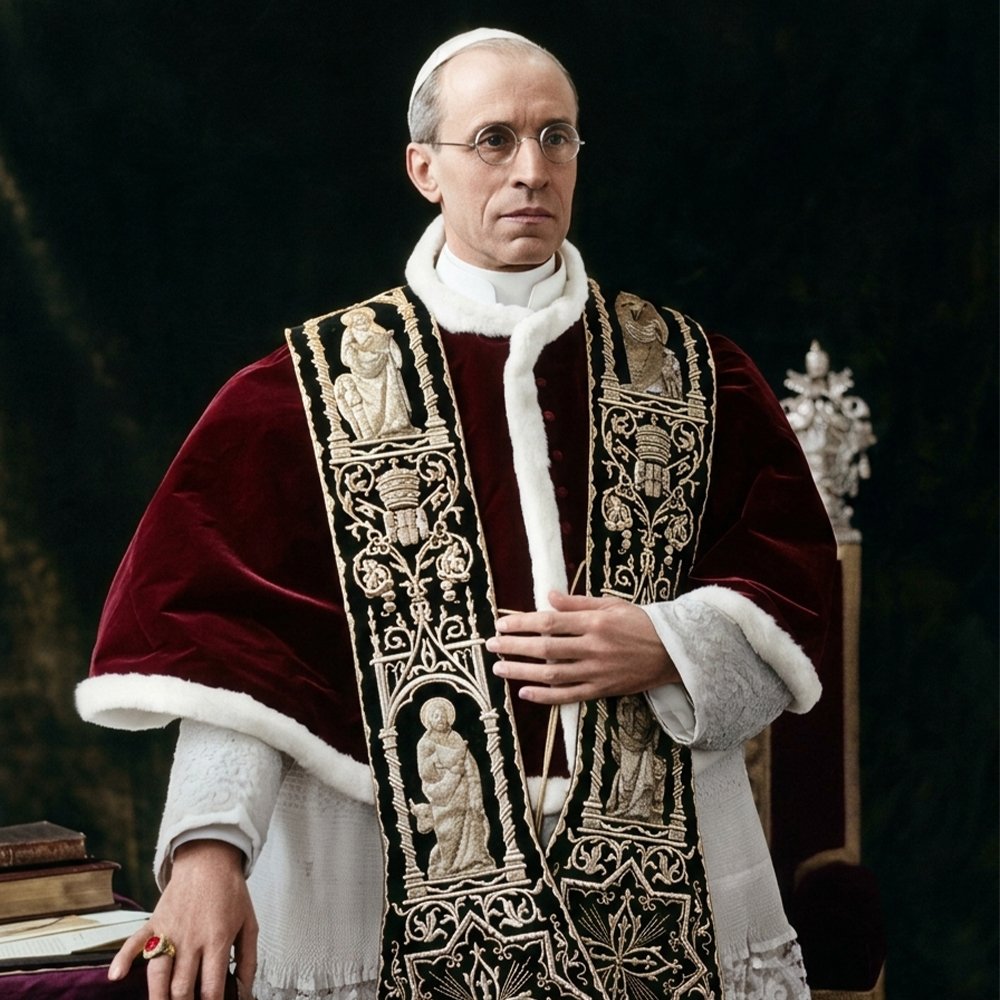
Pope Pius XII (1939-1958)
BIOGRAPHICAL DATA
Birth name: Eugenio Maria Giuseppe Giovanni Pacelli
Birth: March 2, 1876, Rome, Italy
Papal election: March 2, 1939 (his 63rd birthday)
Coronation: March 12, 1939
Pontificate: March 2, 1939 – October 9, 1958 (19 years, 7 months)
Death: October 9, 1958, Castel Gandolfo, Italy (82 years old)
Burial: Vatican Grottoes, St. Peter’s Basilica
FORMATION AND ECCLESIASTICAL CAREER
Family Origins
Born into a Roman aristocratic family with a tradition of papal service. His grandfather, Marcantonio Pacelli, was undersecretary of the Ministry of the Interior of the Papal States. His father, Filippo Pacelli, was a consistorial lawyer and dean of lawyers of the Roman Rota.
Priestly Formation
1894-1899: Studies at the Roman College (Gregorian University) and the Roman Seminary
April 2, 1899: Priestly ordination
1901-1902: Doctorate in Canon Law and Civil Law
Diplomatic Career
1901: Entry into the Vatican Secretariat of State
1904: Became minutante (drafter of official documents)
1911: Undersecretary of the Congregation for Extraordinary Ecclesiastical Affairs
1914: Secretary of the Congregation for Extraordinary Ecclesiastical Affairs
1917: Appointed Apostolic Nuncio to Bavaria (first diplomatic post outside Rome)
1920: First Apostolic Nuncio to Germany (Weimar Republic)
1929: Created Cardinal by Pius XI
1930: Appointed Vatican Secretary of State (under Pius XI)
Decisive Pre-Pontifical Experience
During his 12 years as nuncio in Germany (1917-1929), Pacelli:
Witnessed the communist revolution of 1919 in Munich
Negotiated concordats with German states
Developed profound knowledge of Germanic culture
Learned German fluently (spoke 8 languages)
Observed the rise of Nazism
As Secretary of State (1930-1939):
Negotiated the Concordat with Nazi Germany (1933)
Became the principal advisor to Pius XI
Traveled extensively (only Secretary of State to visit the Americas before becoming Pope)
THE PONTIFICATE (1939-1958)
Election in Wartime
Elected in the fastest conclave of the 20th century (3 ballots, 1 day), on March 2, 1939, on the eve of World War II. He chose the name “Pius” in honor of Pius XI, his predecessor and mentor.
ENCYCLICALS (41 ENCYCLICALS – THE POPE WHO PUBLISHED THE MOST)
1939
1. Summi Pontificatus (October 20, 1939)
“On the Unity of Human Society”
First encyclical, published after the start of World War II. Condemned:
Totalitarianism
Racism
Persecution of the Church
Denial of natural law
Absolutization of the State
1943
2. Mystici Corporis Christi (June 29, 1943)
“On the Mystical Body of Christ”
Masterful ecclesiological exposition:
Defines the Church as the Mystical Body of Christ
Christ is the Head, the faithful are the members
The Holy Spirit is the soul of the Church
One of the most important theological encyclicals of the 20th century
3. Divino Afflante Spiritu (September 30, 1943)
“On Biblical Studies”
Revolutionary for Catholic biblical studies:
Encouraged critical study of Scripture
Authorized the use of historical-critical methods
Encouraged translation from original languages (Hebrew, Greek)
Freed Catholic exegetes for serious scientific research
Called the “Magna Carta” of Catholic biblical studies
1944
4. Orientalis Ecclesiae (April 9, 1944)
Commemoration of the 15th centenary of St. Cyril of Alexandria; promoted union with Eastern Churches.
1945
5. Communium Interpretes Dolorum (April 15, 1945)
Appeal for peace after the war; plea for aid to refugees.
6. Orientales Omnes Ecclesias (December 23, 1945)
On St. Josaphat and the union of Churches.
1946
7. Quemadmodum (January 6, 1946)
Urgent appeal on behalf of starving children after the war.
8. Deiparae Virginis Mariae (May 1, 1946)
On the possibility of defining the Assumption as dogma; consultation with the world episcopate.
1947
9. Fulgens Radiatur (March 21, 1947)
14th centenary of St. Benedict; on monastic life.
10. Mediator Dei (November 20, 1947)
“On the Sacred Liturgy”
Extremely important liturgical encyclical:
First encyclical entirely dedicated to liturgy
Promoted active participation of the faithful
Defended moderate liturgical reform
Condemned excesses of the Liturgical Movement
Theological basis for later reforms
Balanced tradition and renewal
1948
11. Auspicia Quaedam (May 1, 1948)
Prayers for peace and for Palestine.
12. In Multiplicibus Curis (October 24, 1948)
Prayers for the people of Palestine amidst the conflict.
1949
13. Redemptoris Nostri Cruciatus (April 15, 1949)
On the Holy Places; appeal for international protection.
14. Anni Sacri (March 12, 1950)
Preparation for the Holy Year of 1950.
1950
15. Summi Maeroris (July 19, 1950)
Public prayers for peace during the Holy Year.
16. Humani Generis (August 12, 1950)
“On False Opinions Threatening the Foundations of Catholic Doctrine”
Doctrinally crucial encyclical:
Condemned “theological relativism”
Warned against existentialism and historicism
Rejected polygenism (multiple origins of humanity)
Allowed prudent discussion on evolution of the human body
Defended scholastic/Thomistic philosophy
Warned against the “nouvelle théologie”
Reaffirmed the historical origin of original sin
Highly controversial; prepared pre-conciliar orthodoxy
17. Mirabile Illud (December 6, 1950)
Crusade of prayers for peace.
1951
18. Evangelii Praecones (June 2, 1951)
“On the Promotion of Catholic Missions”
Encouraged evangelization; development of native clergy in missions.
19. Sempiternus Rex Christus (September 8, 1951)
15th centenary of the Council of Chalcedon; on orthodox Christology.
20. Ingruentium Malorum (September 15, 1951)
On the Holy Rosary against the evils of the world.
1952
21. Orientales Ecclesias (December 15, 1952)
Persecution of Eastern Churches under communism.
1953
22. Fulgens Corona (September 8, 1953)
Centenary of the definition of the Immaculate Conception; proclamation of the Marian Year.
23. Doctor Mellifluus (May 24, 1953)
8th centenary of St. Bernard of Clairvaux.
1954
24. Sacra Virginitas (March 25, 1954)
“On Consecrated Virginity”
Defense of the superiority of consecrated celibacy over marriage; against theological deviations that diminished virginity.
25. Ad Caeli Reginam (October 11, 1954)
“On the Queenship of Mary”
Instituted the feast of Mary Queen (May 31); biblical and patristic foundation of Marian queenship.
26. Ad Sinarum Gentem (October 7, 1954)
On the Church in China under communist persecution.
1955
27. Musicae Sacrae Disciplina (December 25, 1955)
“On Sacred Music”
Promoted dignity of liturgical music
Defended Gregorian chant as the supreme music of the Church
Allowed moderate use of vernacular music
Established principles for sacred music
28. Pellegrinaggio di Lourdes e Fatima (July 2, 1957)
Marian pilgrimages; importance of Lourdes and Fatima.
1956
29. Haurietis Aquas (May 15, 1956)
“On Devotion to the Sacred Heart of Jesus”
Profound theology of the Sacred Heart:
Biblical and patristic foundation
Defense against critics of the devotion
Three loves of Christ: divine, human spiritual, human sensible
Importance of reparation
30. Laetamur Admodum (November 1, 1956)
Prayers for peace; appeal during the Suez and Hungary crisis.
31. Datis Nuperrime (November 5, 1956)
Urgent plea for Hungary under Soviet invasion.
32. Luctuosissimi Eventus (October 28, 1956)
Lament for the Soviet repression in Hungary.
1957
33. Invicti Athletae Christi (March 6, 1957)
3rd centenary of St. Andrew Bobola, martyr.
34. Fidei Donum (April 21, 1957)
“On the Present Situation of Catholic Missions”
Missionary vision:
Encouraged priests to serve temporarily in African missions
Encouraged lay missionaries
Promoted native African clergy
Prophetic about decolonization
35. Le Pèlerinage de Lourdes (July 2, 1957)
Centenary of the Lourdes apparitions.
36. Laetitiae Sanctae (September 8, 1957)
Encouragement of the Rosary; spiritual remedy for contemporary ills.
1958
37. Miranda Prorsus (September 8, 1957 – promulgated 1958)
“On Cinema, Radio, and Television”
First papal encyclical on modern means of communication:
Recognized positive potential of media
Warned about moral dangers
Established principles for Catholic use of media
Pioneering in Catholic reflection on media
38. Ad Apostolorum Principis (June 29, 1958)
On the oppression of the Church in communist China; condemned the Chinese “Patriotic Church.”
39. Meminisse Iuvat (July 14, 1958)
Prayers for peace and for the persecuted.
40. Ad Petri Cathedram (prepared but not published – he passed away before)
DOGMAS AND DOCTRINAL DEFINITIONS
ASSUMPTION OF MARY (NOVEMBER 1, 1950)
Apostolic Constitution: Munificentissimus Deus
The most solemn magisterial act of Pius XII. Defined as a dogma of faith (ex cathedra – infallible):
Dogmatic definition:
“The Immaculate Mother of God, the ever Virgin Mary, having completed the course of her earthly life, was assumed body and soul into heavenly glory.”
Preparation:
Consultation with all bishops of the world (1946) – 99% favorable
Uninterrupted tradition since the first centuries
Consensus of the Church Fathers
Sensus fidelium (universal belief of the faithful)
Theological significance:
Confirmation of Mary’s unique dignity
Logical consequence of the Immaculate Conception
Anticipation of the universal resurrection
Mary as the eschatological model of the Church
Only person besides Christ with a glorified body in heaven
Historical context:
Defined during the Holy Year of 1950
Proclaimed before 500,000 faithful in St. Peter’s Square
Last Marian dogma defined to date
Last exercise of papal infallibility to the present (2026)
Impact:
Strengthened Catholic Mariology
Generated ecumenical controversy with Protestants and Orthodox
Culmination of the 20th century “golden age” of Marianism
BEATIFICATIONS AND CANONIZATIONS
Pius XII was extraordinarily prolific in elevating saints:
Statistics:
33 canonizations (more saints canonized than any previous pope until then)
More than 1,500 decrees of heroic virtues
Numerous beatifications
Notable Saints Canonized:
1940:
St. Gemma Galgani (Italian mystic, stigmatic)
1943:
St. Henry Morse (English martyr, Jesuit)
1946:
St. Frances Xavier Cabrini (first American citizen canonized)
St. Michael Garicoïts
St. Louis Marie Grignion de Montfort (great Marian devotee)
1947:
St. Nicholas of Flüe (Swiss hermit)
St. Joan of Lestonnac
1949:
St. Joan of Arc (French heroine, patroness of France)
St. Maria Goretti (martyr of purity, 12 years old)
1950 (Holy Year):
St. Maria Goretti
St. Bartholomew Capitanio
St. Anthony Maria Gianelli
St. Vincent Mary Strambi
1951:
St. Mary Domenica Mazzarello (co-foundress of the Salesian Sisters)
St. Pius X (predecessor, canonized rapidly)
1954:
Pope St. Pius X (liturgical reform, combat against modernism)
St. Dominic Savio (young Salesian, 15 years old)
St. Joseph Pignatelli (Spanish Jesuit)
LITURGICAL REFORMS AND INNOVATIONS
Reform of Holy Week (1951-1956)
Ordo Hebdomadae Sanctae Instauratus (1955):
Restored Easter Vigil to the night of Holy Saturday (previously it was morning)
Reformed ceremonies of Holy Thursday, Good Friday, and Holy Saturday
Permitted communion at the evening Mass of Holy Thursday
Restored active participation of the faithful
Reform of the Eucharistic Fast
Apostolic Constitution Christus Dominus (1953):
Reduced Eucharistic fast from midnight to 3 hours
Permitted evening Masses
Facilitated frequent communion
Revolutionary for the time
New Psalter (1945)
Divino Psalterio:
New Latin translation of the Psalms from the original Hebrew
Replaced the Vulgate in the Divine Office
More comprehensible language
Controversial, but prepared future revisions
Simplification of Rubrics (1955)
Reduced number of duplex feasts
Simplified ceremonies
Facilitated liturgical celebration
ACTIONS DURING WORLD WAR II (1939-1945)
The Most Controversial Issue of the Pontificate
Pius XII’s actions during the Holocaust remain the subject of intense historical debate.
Criticisms (mainly post-1963):
Alleged “omission” in publicly condemning the Holocaust
Failure to excommunicate Hitler by name
“Silence” during the genocide of the Jews
Excessively cautious diplomacy
Defenses (supported by historical documentation):
Concrete aid to Jews:
It is estimated that between 700,000 to 860,000 Jews were saved by the Catholic Church during the war
Convents, monasteries, and parishes hid Jews
Network of “papal passports” helped escape
The Vatican itself sheltered about 5,000 Jews
Castel Gandolfo (papal residence) hid Jews
Catholic hospitals issued false certificates
Silent diplomacy:
Pius XII opted for discreet diplomacy rather than public denunciations
Feared massive reprisals against Catholics and Jews
Nazi experience: public protests increased violence (Netherlands 1942)
Maintained formal diplomatic neutrality to preserve influence
Existing pronouncements:
Summi Pontificatus (1939): condemned totalitarianism and racism
Christmas Radio Message of 1942: lamented death of “hundreds of thousands” because of race/nationality (reference to the Holocaust)
Numerous homilies and speeches condemning atrocities (without naming perpetrators)
Contemporary Jewish testimonies:
Golda Meir (future Prime Minister of Israel, 1958): “When the terrible martyrdom came upon our people, the voice of the Pope was raised in favor of the victims”
Isaac Herzog (Chief Rabbi of Israel): personally thanked Pius XII in 1945
Albert Einstein (1940): praised the Church as the only voice against Nazi tyranny
Zolli (Chief Rabbi of Rome): converted to Catholicism (1945) out of admiration for Pius XII
Post-war recognitions:
Jewish organizations officially thanked Pius XII (1945-1958)
Benefit concert by the Israel Philharmonic Orchestra in his honor (1955)
Change in perception:
Controversy began mainly with the play “The Deputy” by Rolf Hochhuth (1963)
Recent historical research has been more favorable to Pius XII
Opening of Vatican archives (2020) revealed more documentation of aid
Other Actions During the War
Humanitarian assistance:
Ufficio Informazioni (Vatican Information Office): processed 11 million requests about prisoners and missing persons
Vatican Radio broadcast messages for separated families
Funds for refugees and displaced persons
Papal hospitals treated wounded from all sides
Protection of Rome:
Negotiated declaration of Rome as an “open city” (1943)
Avoided massive bombing of the city
Mediated between Allies and Axis to protect artistic treasures
Diplomacy for peace:
Tried to mediate peace before the invasion of Poland (1939)
Warned Allies about German invasion of the Netherlands (1940)
Opposed bombing of civilian populations
Worked for negotiated peace (unsuccessfully)
FIGHT AGAINST COMMUNISM
Firm Anti-communism
Pius XII was the most firmly anti-communist pope of the 20th century.
Decree of Excommunication (1949):
Holy Office, July 1, 1949: Declared that Catholics who:
Profess the materialistic and anti-Christian communist doctrine
Defend or propagate such doctrine
Vote for communist parties or support them
Write, distribute, or read communist literature
Are excommunicated latae sententiae (automatically).
Particularly directed against communists in Italy, but universally applicable.
Context:
Escalating Cold War
Strong Italian Communist Party (PCI)
Persecution of the Church in Eastern Europe
Crucial Italian elections (1948)
Defense of Persecuted Churches
Encyclicals on communist persecution:
Orientales Ecclesias (1952) – Eastern Churches
Ad Apostolorum Principis (1958) – China
Ad Sinarum Gentem (1954) – China
Datis Nuperrime (1956) – Hungary
Luctuosissimi Eventus (1956) – Hungary
Specific cases:
Cardinal Mindszenty (Hungary):
Defended the Primate of Hungary, imprisoned and tortured (1948)
Denounced communist show trial
Mindszenty took refuge in the American embassy (1956-1971)
Cardinal Wyszynski (Poland):
Supported Primate of Poland during imprisonment (1953-1956)
Coordinated Polish Catholic resistance
Cardinal Stepinac (Yugoslavia):
Defended Archbishop of Zagreb, imprisoned by Tito (1946)
Elevated him to cardinal in prison (1953) – a gesture of defiance
China:
Condemned Chinese “Patriotic Church” (state-controlled)
Defended religious freedom
Supported underground Church
Soviet Union:
Denounced systematic persecution of Catholics
Supported Ukrainian Greek Catholic Church forced underground
Criticized Marxist state atheism
Prayer Crusade
Promoted massive public prayers against communism:
Consecration of Russia to the Immaculate Heart of Mary
Processions and anti-communist Marian manifestations
Devotion to Our Lady of Fatima (anti-communist message)
THEOLOGICAL AND SCIENTIFIC DEVELOPMENTS
Openness to Modern Science
Pius XII was the most scientifically educated pope of his time.
Cosmology and Evolution:
Address to the Pontifical Academy of Sciences (November 22, 1951):
Accepted Big Bang theory as compatible with divine creation
Recognized scientific evidence for the beginning of the universe
Saw this as confirmation of the doctrine of creation ex nihilo
Humani Generis (1950):
Allowed scientific discussion on evolution of the human body
Condition: preserve divine creation of the human soul
Rejected polygenism (incompatible with original sin)
Nuanced position: neither acceptance nor rejection of evolution
Medicine and Bioethics:
Addresses to doctors and scientists:
On anesthesia in childbirth (1956) – licit, against some traditionalists
On resuscitation (1957) – defined brain death, prepared for transplants
On natural methods of family planning (1951) – allowed “rhythm method”
On genetics (1953) – ethical principles for research
Psychology and Psychoanalysis:
Addresses to psychologists (1953, 1958):
Accepted psychology as a legitimate science
Warned against Freudian pansexualism
Integrated psychology with Catholic anthropology
Opened dialogue between theology and psychology
Moral and Spiritual Theology
Christian perfection for all:
Rejected division between “ordinary Christians” and the “perfect”
Universal call to holiness
Theology of the Body:
Dignity of the human body
Goodness of marriage and conjugal sexuality
Prepared for John Paul II’s “Theology of the Body”
Marian spirituality:
Intensely promoted Marian devotion
Consecration of the world to the Immaculate Heart of Mary (1942)
Instituted feast of Mary Queen (1954)
Marian Year (1954)
ADMINISTRATIVE AND PASTORAL REFORMS
Internationalization of the Curia
Appointed cardinals from all continents
First truly international College of Cardinals
Reduced Italian dominance in the Curia
Prepared for globalization of the Church
Missionary Expansion
Developments:
Established native hierarchies in Africa and Asia
Consecrated first native African bishops (1939)
Promoted local clergy instead of European missionaries
Recognized non-European cultures as valid
First sub-Saharan African episcopal ordination:
Joseph Kiwanuka (Uganda, 1939)
Sign of ecclesiastical decolonization
Code of Oriental Canon Law (1945)
Promulgated legislation for Eastern Catholic Churches
Respected Eastern liturgical traditions
Unified law while preserving diversity
Curial Reorganization
Created new congregations and commissions
Modernized Vatican administration
Prepared structures for post-war Church
COMMUNICATION AND MODERNIZATION
Pioneer in Means of Communication
Radio:
Enormously expanded Vatican Radio
Broadcasts in 40+ languages
Christmas messages transmitted worldwide
Used radio for diplomacy during war
Cinema and Photography:
First pope extensively filmed and photographed
Understood power of images
Miranda Prorsus (1957) – first encyclical on modern media
Papal Audiences:
Multiplied public audiences
Made papacy more accessible and visible
Developed modern papal “cult of personality”
Modernization of the Vatican
Air conditioning installation (1950s)
Modernization of communications
Infrastructure updates
DIPLOMATIC RELATIONS
Expansion of Diplomatic Network
During his pontificate:
Established diplomatic relations with 42 new countries
Elevated status of several nunciatures
Strengthened Vatican presence in international organizations
Countries with new relations:
Japan, India, Pakistan, Indonesia
Various African countries in decolonization
Latin American countries
Concordats
Negotiated concordats with:
Portugal (1940)
Spain (1953) – Franco regime
Dominican Republic (1954)
Several other nations
Support for European Integration
Encouraged foundation of the European Coal and Steel Community
Supported project of a united (Christian) Europe
Influenced Catholic statesmen (De Gasperi, Adenauer, Schuman)
PERSONAL CHARACTERISTICS AND PAPAL STYLE
Personality
Intellectual and Scholar:
Polyglot (8 languages fluently)
Prodigious memory
Prolific writer
Sophisticated theologian
Rigorous Ascetic:
Austere personal life
Frequent fasts
Long hours of prayer
Minimal sleep (4-5 hours/night)
Meticulous Administrator:
Personally controlled many details
Perfectionist
Central in decision-making
Diplomatically Astute:
Decades of diplomatic experience
Skilled negotiator
Cautious and strategic
Governance Style
Centralizer:
Concentrated power in the Secretariat of State
Often unilateral decisions
Little collegiality
Traditionalist in Liturgy:
Loved solemn Tridentine Mass
Promoted Gregorian chant
Moderate and cautious liturgical reforms
Doctrinally Conservative:
Vigilant against theological deviations
Humani Generis warned progressive theologians
Defended neo-Thomism
Pastorally Modernizing:
Open to modern science
Practical liturgical reforms
Use of technology
HEALTH AND DEATH
Health Problems
From 1954 onward:
Chronic hiccups (experimentally treated)
Severe gastritis
Physical exhaustion
Treated by controversial doctors (Riccardo Galeazzi-Lisi)
Last Years
1958:
Health deteriorated rapidly
Continued working intensely
Last public audience: August 1958
Death
October 9, 1958, Castel Gandolfo:
Passed away at 3:52 AM
Cause: heart attack after a stroke
82 years old
19 years and 7 months of pontificate
Post-mortem controversy:
Doctor Galeazzi-Lisi inappropriately photographed the body
Attempted experimental embalming that failed
Body deteriorated rapidly, causing scandal
Galeazzi-Lisi was expelled from the medical profession
Funeral:
October 26, 1958
Buried in the Vatican Grottoes
Massive crowds in Rome
LEGACY AND HISTORICAL IMPACT
Enduring Contributions
Ecclesiology:
Mystici Corporis laid foundation for modern ecclesiology
Mariology:
Assumption dogma – culminating point of Mariology
Intense promotion of Marian devotion
Liturgy:
Mediator Dei – theological basis for liturgical renewal
Restored Holy Week
Biblical Studies:
Divino Afflante Spiritu – liberated Catholic exegesis
Allowed development of Catholic biblical scholarship
Anti-communism:
Catholic leadership against communism in the Cold War
Support for persecuted Churches
Political influence in Italy and Europe
Internationalization:
First truly global Church
Ecclesiastical decolonization
Native clergy in Africa and Asia
Historical Evaluations
Traditional Catholic View:
“Pastor Angelicus” (Angelic Pastor)
Pope of extraordinary holiness and wisdom
Courageous defender of the faith
Saved thousands of Jews
Progressive Criticism:
Excessively conservative
Too centralizing
“Silence” during the Holocaust
Repressor of innovative theologians
Emerging Historical Consensus (based on 2020 opened archives):
Complex and multifaceted figure
Extraordinarily cultured and hardworking
Saved many Jews through silent diplomacy
Problematic governance style (excessively centralized)
Intellectual giant of the modern papacy
Beatification Process
Current status:
Declared Venerable by Benedict XVI (December 19, 2009)
Heroic virtues recognized
Awaiting miracle for beatification
Controversial process due to historical polemics
Divided Jewish support:
Organizations like Pave the Way Foundation support
Other Jewish organizations oppose
Debate continues
PONTIFICATE STATISTICS
Duration: 19 years, 7 months, 7 days
Encyclicals: 41 (historical record)
Consistories: 2
Cardinals created: 56
Canonizations: 33
Beatifications: Numerous
International travels: None (last non-traveling pope)
Countries with established diplomatic relations: 42
Public audiences: Thousands
Speeches and homilies: More than 1000
PRINCIPAL DOCUMENTS (BEYOND ENCYCLICALS)
Apostolic Constitutions:
Munificentissimus Deus (1950) – Assumption Dogma
Christus Dominus (1953) – Eucharistic fast
Sacramentum Ordinis (1947) – Matter/form of Holy Orders
Motu Proprio:
In Cotidianis Precibus (1945) – New Psalter
Decrees:
Excommunication of communists (1949)
Various approvals of religious orders
Radio Messages:
Christmas (annually) – important pronouncements
Especially Christmas 1942 (on war and persecutions)
MEMORABLE QUOTES
“Nothing is lost with peace. Everything may be lost with war.”
(1939, on the eve of World War II)
“The Church is not afraid of the truth.” (On science and faith)
“The Mystical Body of Christ and the Roman Catholic Church are one and the same thing.” (Mystici Corporis, 1943)
“It is better to be a victim of injustice than to commit it.”
“One of the grave evils of the modern era is to have lost the sense of sin.” (1946)
Pius XII was one of the most consequential popes of the 20th century. He governed the Church through World War II, helped save thousands of Jews, defined the last Marian dogma, reformed the liturgy, opened Catholic biblical exegesis to modern scholarship, led Catholic resistance to communism, and truly internationalized the Church.
His legacy remains complex: venerated by traditional Catholics as a model of papal holiness; criticized by progressives as excessively conservative; defended by many saved Jews as a silent hero; criticized by others as silent. Evaluations continue to evolve as new documents are discovered.
He was undeniably:
The most erudite pope of the 20th century
One of the most prolific papal writers in history
A key figure in the transition from the pre-modern to the modern Church
His influence continues to be deeply felt in the Catholic Church to this day.