JERUSALEM
Jerusalem for the Catholic Church
A detailed analysis of the profound significance of Jerusalem for the Catholic faith.
I. THEOLOGICAL FOUNDATION – JERUSALEM IN SCRIPTURE
The Biblical Significance of Jerusalem
Old Testament:
Jerusalem is not just a “geographical city” for Judaism and Christianity. It is a central theological symbol .
Origin of the name:
“Jerusalem” = “Foundation of Peace” (Yer = to found/establish + Salem = peace)
Historical importance:
Divine choice (2 Samuel 5):
After David unified Israel, he chose Jerusalem as its capital:
Neutral city (did not belong to any tribe)
Strategic location in the center
God commanded that a temple be established there.
Temple of God (1 Kings 6-8):
Solomon built the Temple in Jerusalem:
House of God
Center of Jewish religious life
Presence of the Ark of the Covenant
The only legitimate place for sacrifice.
Spiritual meaning:
Psalm 84:1-3 – “How lovely are your dwelling places, Lord Almighty! My soul yearns, even faints, for the courts of the Lord… Blessed are those who dwell in your house; they are ever praising you.”
Psalm 122 – “I rejoiced when they said to me, ‘Let us go to the house of the Lord.’ Our feet are standing within your gates, O Jerusalem!”
Prophetic meaning:
Prophets saw Jerusalem as a symbol of the final restoration .
Isaiah 2:1-4 – “In the last days the mountain of the Lord’s temple will be established as the highest of the mountains… and all nations will stream to it… and he will teach them his ways.”
Jeremiah 3:17 – “At that time Jerusalem will be called the Throne of the Lord.”
New Testament:
Jesus had a deep connection with Jerusalem:
Incarnation and Redemption:
Jesus was born in Bethlehem (near Jerusalem).
Ministry culminated in Jerusalem
Passion, death, resurrection in Jerusalem
Ascent from the Mount of Olives (near Jerusalem)
Teachings of Christ:
Luke 13:33-34 – “Nevertheless, I must go on my way today and tomorrow and the day after, for it is not possible for a prophet to die outside of Jerusalem. Jerusalem, Jerusalem, you who kill the prophets and stone those sent to you! How often I have longed to gather your children together, as a hen gathers her chicks under her wings, but you were not willing!”
Meaning of crying:
Jesus wept over Jerusalem
He laments the rejection of salvation.
Predicts destruction (70 AD)
Despite this, the love
Apocalypse – Heavenly Jerusalem:
Revelation 21:1-4 – “Then I saw a new heaven and a new earth… I saw the new Jerusalem coming down out of heaven from God… I heard a loud voice from the throne saying, ‘Look! God’s dwelling place is now among the people, and he will dwell with them… He will wipe every tear from their eyes.’”
Symbolism:
Heavenly Jerusalem = ultimate goal
New creation = complete redemption
Presence of God = consummation
Jerusalem is the standard/model of salvation.
II. Jerusalem in the Catholic Tradition
Holy Land – Place of Redemption
Catholic theology concerning Jerusalem:
Catechism of the Catholic Church (relevant sections):
Jerusalem is significant because:
Place of the Incarnation
Jesus was born in Bethlehem (nearby).
He grew up in Nazareth.
Ministry in Judea/Jerusalem
Death/Resurrection in Jerusalem
Place of the Paschal Mystery
Passion of Christ
Redemptive death
glorious resurrection
Redemption of humanity
Place of Promises
Where prophets spoke
Where Christ fulfilled his promises.
Where the Church was born (Pentecost)
Where faith was established
The Holy Places
Church of the Holy Sepulchre:
Supreme meaning:
Traditional burial and resurrection site of Christ.
most important church in Christianity
A place of pilgrimage since the 4th century.
Construction:
First built by Constantine (326)
Destroyed and rebuilt multiple times.
Currently maintained by Christian communities.
For Catholics:
It represents the hope of resurrection.
Focal point of faith
Pilgrim destination
A sacred place par excellence.
Via Dolorosa (Way of Sorrows):
The traditional path that Jesus walked:
14 stations
They represent events of the Passion.
Catholics pray along the way.
Reproductions in churches around the world
Meaning:
Meditation on the suffering of Christ
Identification with His death
Path to redemption
Deep popular devotion
Mount of Olives:
Place of Christ’s Ascension
Garden of Gethsemane (where he prayed before the Passion)
Tomb of the Virgin Mary
A place for prayer and contemplation.
Bethlehem – Nativity:
Where Jesus was born
The Basilica of the Nativity is the second most sacred.
The Nativity scene (representation of the birth) is a reflection of this Church.
Meaning of Incarnation
Catholic Pilgrimages
Pilgrimage to Jerusalem:
History of pilgrimages:
Since the 4th century, Christians have been making pilgrimages.
The journey was an act of penance.
Considered a meritorious work
He gave special thanks.
Popes went on pilgrimages:
Pope Paul VI (1964):
First papal visit to Jerusalem in centuries
He met with the Orthodox Patriarch.
He prayed in the Holy Places
It symbolized reconciliation with the East.
Pope John Paul II (2000):
Great pilgrimage to the Jubilee
He visited all the main sites.
He prayed in the Holy Places
He asked for forgiveness for Christian persecutions.
Contemporary meaning:
Pilgrimages continue:
Thousands of Catholics visit annually.
Spiritual retreats in Jerusalem
Tour of monasteries and churches
A transformative experience for the faithful.
III. Jerusalem in Medieval Catholic Cosmology
Jerusalem as the Center of the World
Medieval map (World Map):
Geographical concept:
Medieval maps depicted:
Jerusalem at the CENTER of the world
Above: north
Below: South
Right: East
Left: west
Meaning:
It wasn’t merely geographical.
It was theological.
Jerusalem = Spiritual Center = Physical Center
It indicated a focus on salvation.
Historical example:
Map of Hereford (1285):
English medieval map
Jerusalem is represented in the center.
Church of the Holy Sepulchre clearly marked
Jerusalem’s primacy is evident.
Theological influence:
Medieval theologians viewed this as:
Expression of theological truth
Jerusalem is the heart of creation.
Where did Redemption begin?
Where the world converges
Christendom Oriented Toward Jerusalem
Cosmological structure:
Medieval Christendom had a literal orientation :
Ad Orientem (towards the East):
Churches were built with an altar in the East.
The celebrant faced east.
Prayers were recited facing Jerusalem.
Universal practice before Vatican II
Meaning:
East = Jerusalem (symbolically)
Resurrection of the sun = Resurrection of Christ
East = hope
Every Church pointed towards Jerusalem.
Architectural results:
Every cathedral had a clear orientation.
Processions moved eastward.
Even cemeteries were oriented.
Cosmology expressed in stone
Loss after Vatican II:
Many post-Vatican II churches:
Altars facing west (facing the people)
Loss of direction towards Jerusalem
Profound cosmological shift
Lost symbolism
IV. Jerusalem in Catholic Eschatology
Heavenly Jerusalem – The End Times
Doctrine of the New Jerusalem:
Revelation 21 describes:
New Jerusalem descending from Heaven:
Perfect city
Where God dwells with men
No more death/suffering
The culmination of all history.
Theological interpretation:
Symbolic meaning:
Historical Jerusalem = prefiguration
Heavenly Jerusalem = true reality
Holy Land = shadow of eternal reality
Land pilgrimage = preparation
Theology of Saint Thomas:
“Historical Jerusalem was a figure of heavenly Jerusalem. What Christ did in material Jerusalem (dying and rising again) is a sacrament of what he will do for all creation – a perfect transformation where God will be all in all.”
Eschatological hope:
For Catholics:
Heavenly Jerusalem is hope.
The end of the story.
Complete redemption
Eternal rest
Prophesied Restoration
Catholic prophecy about Jerusalem:
Our Lady of Fatima:
Mary’s messages include promises about:
Restoration of Christendom
Conversion of Russia
Implicitly: Jerusalem as a spiritual center again.
Our Lady of La Salette:
“Rome will lose the Faith… Jerusalem will be desecrated… BUT a great restorer will come… who will re-establish truth.”
Catholic interpretation:
Some view prophecy as:
Future Catholic triumph
Restoration of Jerusalem as Christian
Return of faith to the world
Spiritual center once again in Jerusalem
V. JERUSALEM IN CATHOLIC HISTORY
The Popes and Jerusalem
Historical papal interest:
Papacy of the first centuries:
Pilgrim priests went to Jerusalem.
Bishops of Jerusalem were honored.
Constant connection maintained
Despite the distance
Middle Ages:
Popes promoted pilgrimages.
Crusades to defend Jerusalem
Permanent ecclesiastical interest
Symbolism never lost
Modern Papacy:
Pope Pio IX (1846-1878):
It lost temporal power.
Investment was made in spirituality.
He valued Jerusalem.
He supported pilgrimages.
Pope Leo XIII (1878-1903):
He sent delegates to Jerusalem.
He supported Christian archaeology.
He promoted Marian devotions there.
He restored churches.
The Catholic Presence in Jerusalem
Catholic communities:
Although Jerusalem is primarily:
Islamic
Judaica
Orthodox
There is a Catholic presence:
Roman Catholic Church:
Jerusalem Parish
Resident Bishops/Parents
Caretakers of the Holy Places
Continuous presence since medieval times.
Custody of the Holy Land:
An organization that:
It maintains Catholic churches.
Protects Christian heritage
Serves pilgrims
Preserve tradition
Monasteries:
Monastery of Saint Isabel
Convent of the Priory of Sion
Several contemplative communities
Continuous prayer
VI. JERUSALEM AND MARY – CATHOLIC DEVOTION
The Mother of Jesus in Jerusalem
Mary in Jerusalem:
Mary’s life in Jerusalem:
Catholic tradition teaches:
Mary remained in Jerusalem after the Ascension.
He lived in Saint John’s house.
It was the center of the apostolic community.
He died in Jerusalem (assumed into Heaven).
Places of Mary:
Tomb of Mary:
Located in the Cedar Valley
Near Gethsemane
Tradition says that Mary was resurrected by angels.
The body was glorified.
Mary’s House:
Tradition says the house was in Jerusalem.
Some believe in Ephesus (in Türkiye)
A place of devotion for pilgrims.
A tribute to the Mother of Jesus.
Marian Devotion Connected to Jerusalem
Rosary and Jerusalem:
Mysteries of the Rosary:
Many events in the life of Mary/Jesus took place in Jerusalem:
Presentation at the Temple
Death and Assumption of Mary
Pentecost (Mary was present)
Praying the Rosary:
Catholics meditate on these events while praying:
Special connection to Jerusalem
They imagine Mary in sacred places.
They participate spiritually.
They enter into community with saints.
Marian Pilgrimages:
Visits to the Tomb of Mary
Veneration of relics
Processions on feast days
Strong popular devotion
VII. CONTEMPORARY MEANING
Divided Jerusalem – The Political Reality
Current situation:
Jerusalem is divided between:
Israel – Controls most of it, including the Old City.
Palestine – Claims Jerusalem as capital
Christian communities – They coexist precariously.
Catholic access:
Catholics can visit
Complex diplomatic relations
Religious freedom is limited but respected.
Pilgrimages continue
Position of the Catholic Church – Political Neutrality
Official papal position:
Pope Francis (2013-present):
He affirmed the rights of Catholics in Jerusalem.
He requested freedom of access to the Holy Places.
He did not take a specific political side.
Emphasis on peace and coexistence.
The Vatican as a neutral actor:
It is not a political state in the region.
It seeks to protect religious rights.
Committed to interreligious dialogue.
Maintains diplomatic relations.
Pilgrims’ rights:
The Vatican insists on:
Freedom of access to the Holy Places
Right to worship
Protection of Catholic churches
Security for priests/pilgrims
Spiritual Importance vs. Politics
Traditionalist Catholic perspective:
Jerusalem is primarily:
Sacred (not political)
Spiritual (non-territorial)
Theological (not geopolitical)
Mysticism (non-military)
Argumentation:
“Although nations wage war over Jerusalem, the true Jerusalem is that of the spirit. It is not about who controls land, but who controls souls. For Christianity, Jerusalem signifies the place where Christ redeemed humanity. This is eternal, while political conflicts are temporary.”
VIII. LOSS AND RESTORATION
Progressive Loss
Jerusalem as a symbol of modern apostasy:
Sedevacantists argue:
The loss of Catholic control of Jerusalem reflects:
Weakening of Christendom
Previously: Catholics controlled Jerusalem (Crusades)
Now: Marginalized
It symbolizes a loss of religious power.
Orientation clearance
Churches have stopped pointing towards Jerusalem (ad orientem).
Vatican II destroyed cosmology.
Loss of spiritual meaning
Abandonment of eschatology
Modern Catholicism has lost eschatological hope.
Don’t expect Heavenly Jerusalem
Focused on the mundane “here and now”.
Reduced attendance
The Catholic community has shrunk.
Closed monasteries
Priests reduced
Increasingly marginal presence
Expected Restoration
Traditionalist hope:
For the future, traditionalists hope:
Guidance feedback
Churches will once again point to Jerusalem.
Ad orientem será restaurado
Christian cosmology will reappear.
Spiritual meaning will return.
Increase in Catholic presence
More priests/monks in Jerusalem
Monasteries will rise again.
Pilgrims will multiply.
Catholic influence will grow.
Eschatology restored
Hope in Heavenly Jerusalem
To live for an eternal goal.
Rejection of worldliness
Prophetic faith will reappear.
Position restored
Catholicism viewed as the true faith
Jerusalem recognized as Christian
Papacy respected globally
Salvation offered to the world
IX. JERUSALEM IN THE CATHOLIC LITURGY
Liturgical Memorial
References to Jerusalem in the liturgy:
Divine Office:
Many of the psalms we pray make reference to:
Psalm 122: “I rejoiced when they said to me, ‘Let us go to the house of the Lord… our feet are standing within your gates, O Jerusalem!’”
Regularly sung:
Catholics pray this daily.
Perpetual connection to Jerusalem
Keep the devotion alive.
Unbroken tradition
Special Masses:
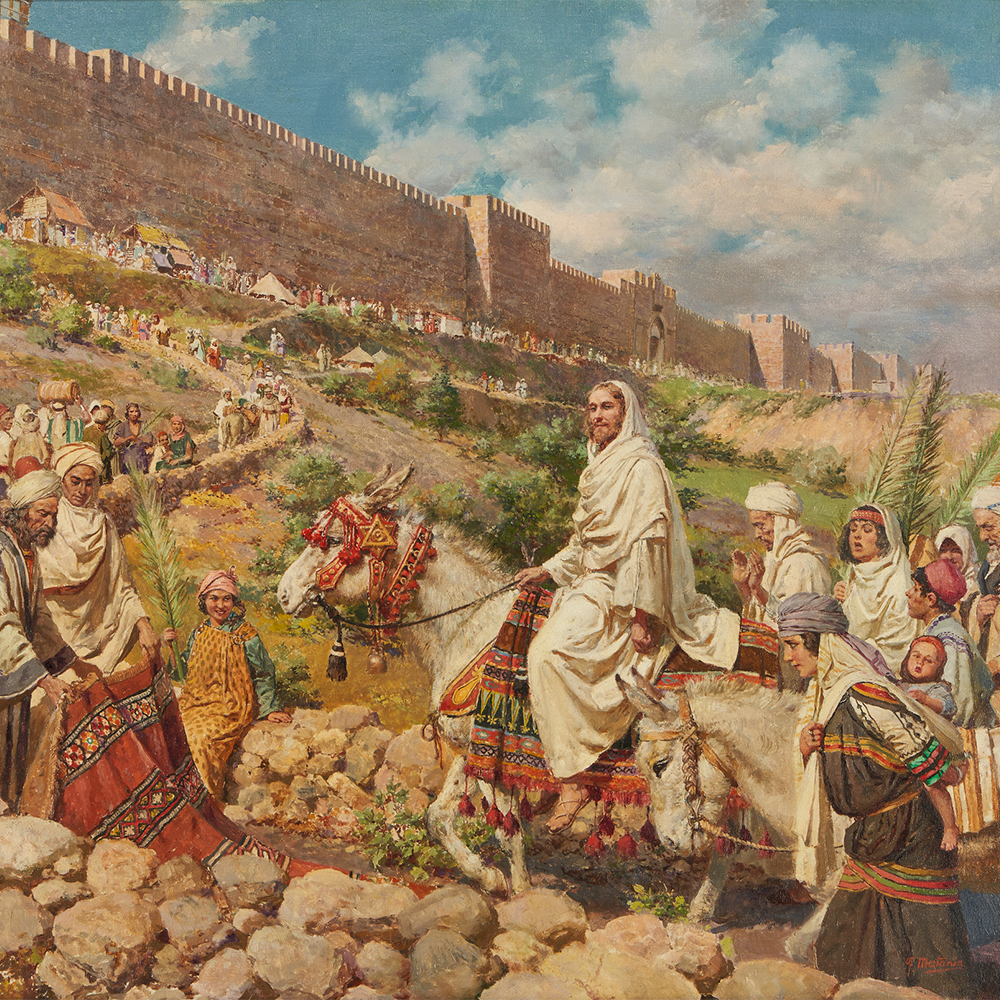
Palm Sunday:
Commemoration of Jesus’ entry into Jerusalem.
Celebration of the coming of the King
Palm Sunday procession
Annual link to Jerusalem
Holy Thursday:
Commemoration of the Last Supper in Jerusalem
Ordination of the apostles
Institution of the Eucharist
Foot washing
Good Friday:
The Passion of Christ in Jerusalem
Meditated Via Dolorosa
Redemptive death
Salvation achieved
Easter:
Resurrection in Jerusalem
Victory over death
Promise of eternal life
Hope in Heavenly Jerusalem
Liturgical Architecture
How churches reflect Jerusalem:
Guidance:
Altars in the east (towards Jerusalem)
Congregation faces east
Processions move eastward.
Embodied cosmology
Symbolism:
Nave = Via Dolorosa (Way of the Cross)
Presbytery = Mount Calvary
Tabernacle = Holy Sepulchre
Ambo = Pulpit in Jerusalem
Structure:
The Church is “Jerusalem in miniature”
It reproduces the layout of churches there.
Faithful experience a “pilgrimage” at every Mass.
Mystical connection to Jerusalem
X. TRADITIONAL ANALYSIS – PROFOUND MEANING
Jerusalem as Christian Truth
The traditionalist perspective resumes:
Jerusalem means to Christendom:
1. Theological Center
Where Christ redeemed the world
Where did the Church originate?
From where did the hope of salvation emanate?
Where God chose to dwell.
2. Spiritual Center
Place of greatest spiritual power.
Where God has fully revealed himself.
From where grace flows to the faithful.
Where the sky meets the earth
3. COSMOLOGICAL CENTER
Ship of the medieval world
From where did cosmology radiate?
Center of creation
Axis of the world
4. ESCHATOLOGICAL CENTER
Prefiguration of Heavenly Jerusalem
Christian hope
Final goal of the story
Consummation of everything
5. IDENTITY CENTER
Define who are Catholics
Connection to the Incarnation
Participation in Redemption
Member of the body of Christ
Loss of Jerusalem = Loss of Identity
Sedevacantist argument:
The progressive loss of Jerusalem’s centrality in the Catholic faith reflects:
Loss of comprehension:
Moderns don’t understand Jerusalem.
They see it as a “historical topic”
Not as a living center of faith
Spiritual detachment
Loss of orientation:
Churches stopped pointing to Jerusalem.
Ad orientem was lost
Cosmology has been reversed.
Man has become the center (instead of God).
Loss of hope:
Eschatology has been abandoned.
Focus on the “here and now”
No hope in Heavenly Jerusalem
Resulting existential vacuum
Existential outcome:
Modern Catholics:
They don’t know why Jerusalem matters.
They see it as a “tourist spot”.
They do not experience a mystical connection.
Lost without a spiritual center
Restoration would imply
To recover true faith:
Catholics should:
1. Restore Literal Orientation
Churches pointing towards Jerusalem
To the east I restore
Catholic cosmology will reappear.
Spiritual meaning will return.
2. Restore Eschatology
Waiting for Heavenly Jerusalem
To live for an eternal goal.
Reject worldliness
Prophetic faith will reappear.
3. Restore Mystical Connection
Significant pilgrimages
Meditation on events there
Spiritual participation
Experience of the sacred
4. Restore Simple Faith
Understanding why Jerusalem is a center
To pass on to generations
Keeping the tradition alive
Perpetuate meaning
What Jerusalem Means
For the Catholic Church, Jerusalem is:
Historically – The place where Christ lived, died, and was resurrected.
Theologically – Center of Redemption, axis of salvation history.
Spiritually – A place of greater grace, divine presence.
Eschatologically – Prefiguration of the Heavenly Jerusalem, the ultimate hope.
Identity-wise – Defines who is Christian, the basis of faith.
Cosmologically – Center of the medieval world, world axis
Liturgically – Constant reference in prayer and sacrament.
Mystically – Connection between earth and sky, temporal and eternal.
In a nutshell:
Jerusalem is the heart of Christianity. . It is the place where God entered history, redeemed humanity, and offered salvation to all. It is the spiritual, theological, cosmological, and eschatological center of everything Catholics believe. It is the historical reality that prefigures the eternal reality. Without Jerusalem, there is no Christianity. With Jerusalem, we have everything – a redeeming past, a sacramental present, a glorious future.
Quote summarizing:
“Jerusalem is the eternal city of God, where His eternal Son became man, suffered, died, and rose again for our salvation. There, on the cross, humanity’s accounts were settled. There, in the resurrection, our liberation was guaranteed. And from there, in His glorious return, Christ will come to judge the living and the dead, taking the whole Church to the Heavenly Jerusalem where we will dwell with God forever. This is why Jerusalem is the heart of Christianity – past, present, and future converge in this sacred city.”