TRINITY
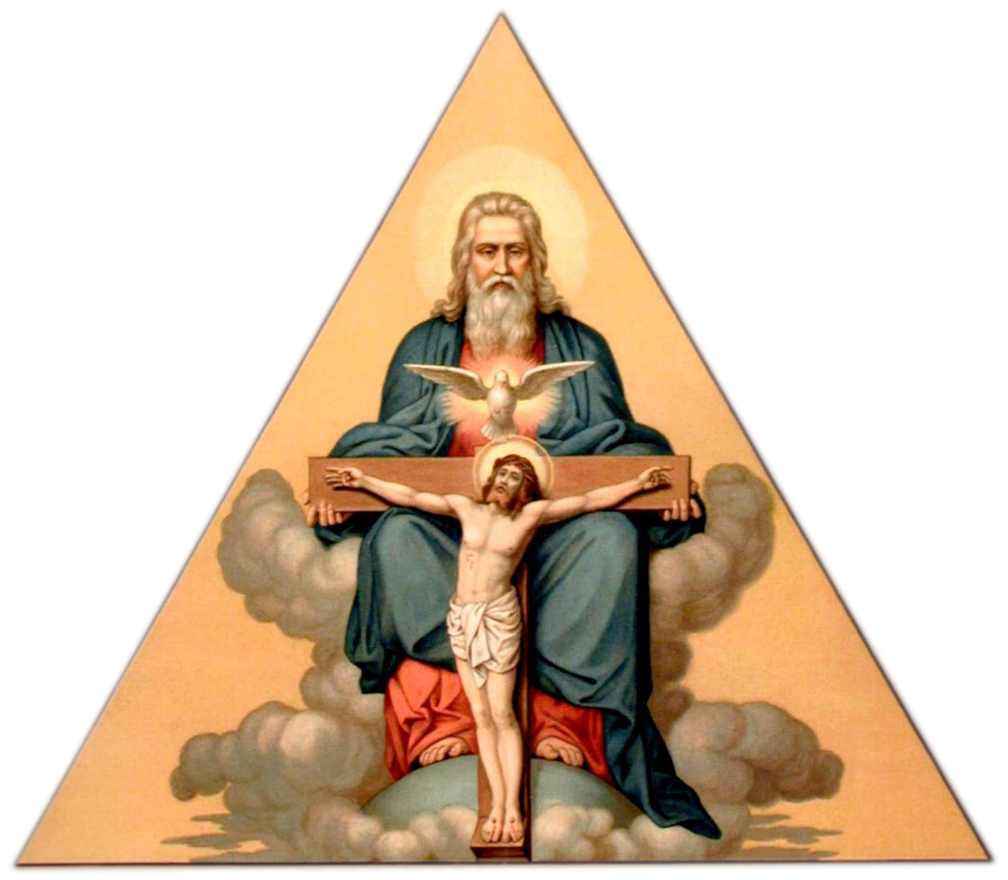
THE HOLY TRINITY
The Mystery of One God in Three Persons
The Trinity is the deepest and most incomprehensible mystery of the Catholic faith: there is only one God, but this one God exists eternally in three distinct Persons – the Father, the Son, and the Holy Spirit. They are not three gods, but one true God. Each Person is fully God, possessing all divinity, but they are three truly distinct Persons.
This mystery is absolutely beyond human reason – no created intelligence, not even angels, can fully comprehend it. We only know it because God himself revealed it. Reason alone could never discover it, but once revealed, reason can meditate on it without contradicting itself, although it can never exhaust it.
God the Father – The First Person
The Father is the first Person of the Holy Trinity. He is the principle without beginning, the one who proceeds from no one. From all eternity, the Father begets the Son – not as creation, but as eternal generation. The Father contemplates Himself, and this infinite contemplation generates a perfect Word, a living Thought, which is the Son.
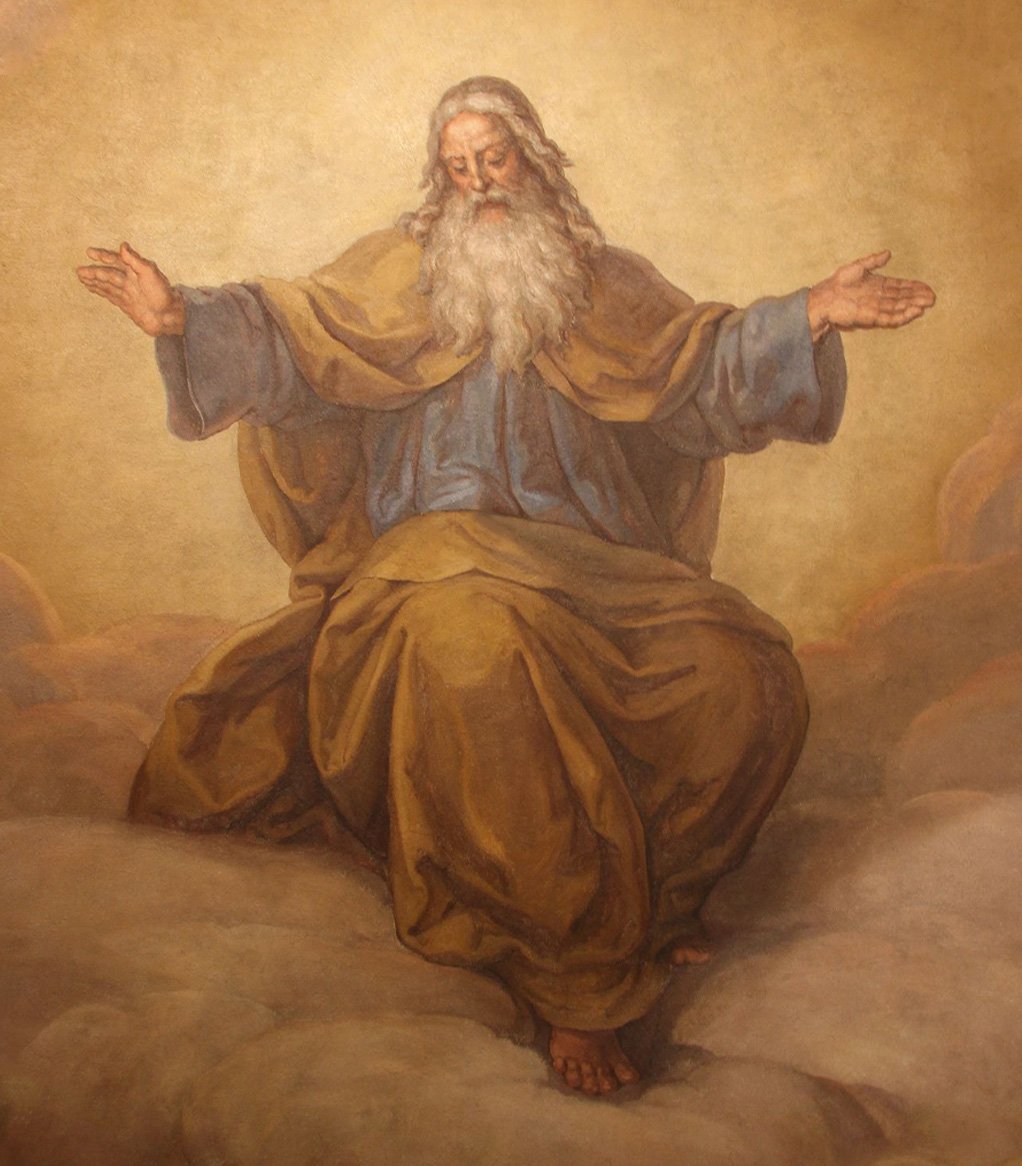
The Father is the Creator of heaven and earth, the Almighty, omniscient, and omnipresent One. He governs all things with His divine Providence. It is He who sent His Only Begotten Son into the world to save us, moved by infinite love for fallen humanity. The Father has no body; He is pure spirit, although He is sometimes symbolically represented as a venerable elder to indicate His fatherhood and eternity.
The Father loves the Son with infinite love, and this mutual love between Father and Son is so real, so substantial, that it is also a Person – the Holy Spirit. The Father is the source and origin of the other two divine Persons, but He is not “greater” or “older” than them, for everything in the Trinity is eternal and co-equal.
God the Son – The Second Person
The Son is the Second Person of the Holy Trinity, also called the Word (Logos) or Word of God. He is eternally begotten by the Father – there was no moment when the Son did not exist, for this generation takes place outside of time, in eternity. The Son is the perfect image of the Father, the radiance of his glory, consubstantial (of the same substance) with Him.
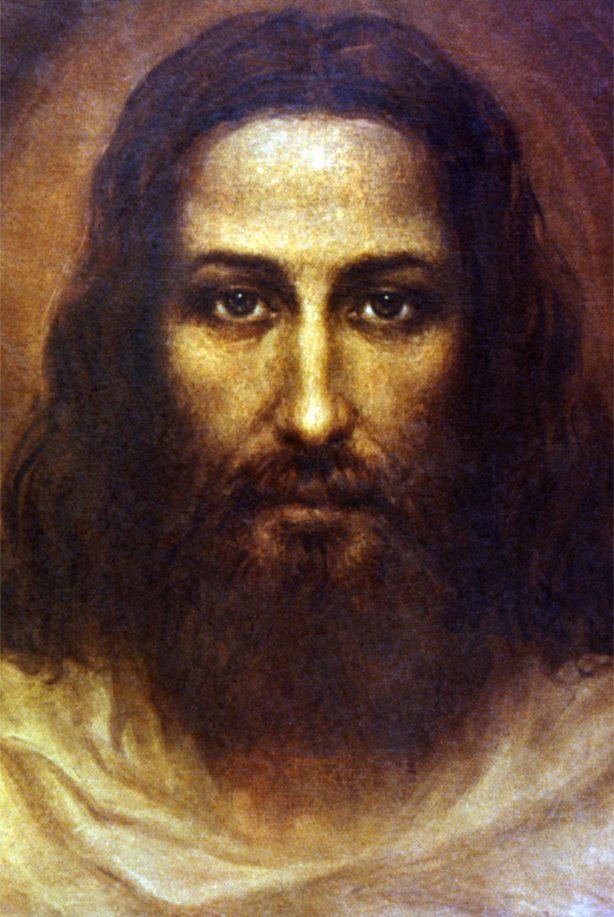
The Son is Jesus Christ, who was incarnated in the womb of the Virgin Mary two thousand years ago. Herein lies the mystery: the Second Person of the Trinity assumed human nature without ceasing to be God. Jesus Christ is one (divine) Person with two natures – divine and human. As God, He is eternal, omnipotent, and omniscient. As a man, He was born, grew up, suffered, died, and resurrected.
The Son is called “the Word” because just as our outward words express our inner thoughts, so the Son perfectly expresses the Father. He is the eternal Wisdom of God. Through Him all things were created – “all things were made through Him, and without Him nothing was made that was made.” He is the Redeemer of humanity, the one who offered the perfect sacrifice on the Cross to reconcile man with God.
God the Holy Spirit – The Third Person
The Holy Spirit is the Third Person of the Holy Trinity. He proceeds from the Father and the Son as from a single principle, in a single breath of love. The Holy Spirit is the substantial Love between the Father and the Son; it is the bond of love that unites them. This love is so real that it constitutes a distinct Person.
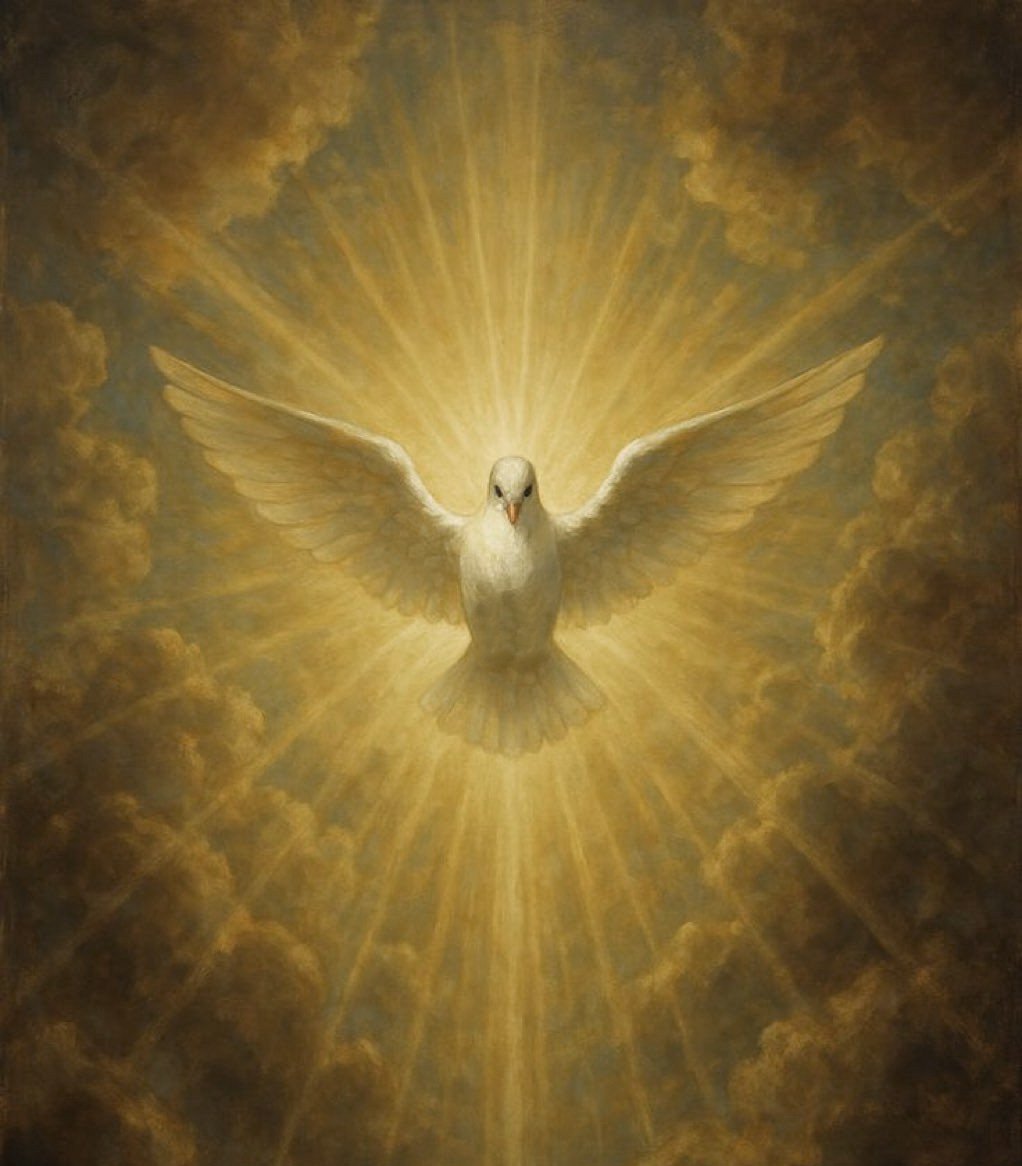
The Holy Spirit is called by various names: Paraclete (Comforter), Spirit of Truth, Sanctifier, Life-Giver. He is symbolically represented as a dove (at the Baptism of Christ), as tongues of fire (at Pentecost), as a rushing wind, as living water. These symbols attempt to express his invisible but most powerful action.
The Holy Spirit is the one who sanctifies souls. He dwells in the hearts of the righteous, transforming them into living temples of God. He is the one who distributes gifts and charisms in the Church, who inspires the prophets, who moves the saints to great works. He is called the “Finger of God” because through his action God touches and transforms souls.
It was the Holy Spirit who overshadowed Mary, accomplishing the mystery of the Incarnation. It is He who transforms the bread and wine into the Body and Blood of Christ in the Holy Mass. It is He who forgives sins in the Sacrament of Confession. It is He who seals the Christian in Confirmation, giving him strength to witness to the faith.
The Relationships Between the Three People
The three divine Persons are absolutely equal in power, glory, eternity, and majesty. None is greater or lesser, older or younger, more important or less important. The difference lies only in their relations of origin: the Father begets, the Son is begotten, the Holy Spirit proceeds from the Father and the Son.
Everything the Father does, the Son and the Holy Spirit also do – the external works of the Trinity are indivisible. When God creates, the three Persons create. When God redeems, the three Persons redeem. When God sanctifies, the three Persons sanctify. Although we can “attribute” certain works to each Person (creation to the Father, redemption to the Son, sanctification to the Spirit), in reality they all always act together.
The three Persons dwell within one another in a mutual penetration called “circumcision” or “perichoresis.” The Father is completely in the Son and the Holy Spirit. The Son is completely in the Father and the Holy Spirit. The Holy Spirit is completely in the Father and the Son. It is a communion of love so perfect that it constitutes the very essence of God.
The Mystery Gradually Revealed
In the Old Testament, God revealed himself primarily as the one and only Father and creator, emphasizing monotheism against pagan idolatry. There were only veiled hints of the Trinity – mysterious references to the “Angel of the Lord,” to personified “Wisdom,” to the “Spirit of God.”
In the New Testament, the mystery was fully revealed. At the Baptism of Jesus, the three Persons manifest themselves simultaneously: the Father speaks from heaven, the Son is in the Jordan, the Holy Spirit descends in the form of a dove. Christ commands to baptize “in the name of the Father, and of the Son, and of the Holy Spirit.” Saint Paul constantly mentions the three Persons in his epistles.
The Trinity and Our Salvation
The Father chose us from all eternity and predestined us for adoption as sons. The Son came down from heaven, became incarnate, suffered, and died to redeem us. The Holy Spirit was sent to dwell in us and conform us to Christ. All our salvation is a Trinitarian work – we were chosen by the Father, redeemed by the Son, and sanctified by the Holy Spirit.
The Christian life is essentially Trinitarian. We are baptized in the name of the three Persons. We make the sign of the cross invoking them. We pray to the Father, through Christ, in the Holy Spirit. Sanctifying grace enables us to participate in the very Trinitarian life – we become adopted children of the Father, brothers and sisters of Christ, temples of the Holy Spirit.
Heaven as a Vision of the Trinity
Eternal blessedness consists essentially in the beatific vision of the Holy Trinity. The saints in heaven contemplate the Father, the Son, and the Holy Spirit face to face. They see the eternal generation of the Son by the Father, the procession of the Holy Spirit, the circulation of infinite love among the three Persons. This vision fills them with indescribable joy and completely satisfies them, for they see the very essence of God.
Imperfect Analogies
Theologians have proposed various analogies to help understand (always imperfectly) this mystery. Saint Augustine compared the Trinity to the human mind: the lover (Father), the beloved (Son), and the love between them (Holy Spirit). Or again: memory (Father), intelligence (Son), and will (Holy Spirit).
Others have compared it to the sun: the solar disk (Father), the light that emanates from it (Son), and the heat that proceeds from both (Holy Spirit). Or to water, which can exist in three states – liquid, solid, and gaseous – although this analogy is flawed because the divine Persons exist simultaneously, not alternately.
But all these analogies fail because God is infinitely superior to any creature. The Trinity remains an adorable mystery that will only be fully understood in the beatific vision. For now, we believe what God has revealed, we worship with humility, and we seek to live in communion with the three divine Persons.
FATHER
The Principle Without Principle
God the Father is the First Person of the Holy Trinity, the one who proceeds from no one, who has no origin in another. He is the absolute principle, the source of all divinity. While the Son is begotten by the Father and the Holy Spirit proceeds from the Father and the Son, the Father proceeds from no one – He simply IS, from all eternity.
This does not mean that the Father is “prior” to the Son or the Holy Spirit, for in eternity there is no temporal succession. It simply means that, in the order of divine relations, the Father is the origin. He is called “Father” precisely because He eternally begets the Son. This fatherhood is not metaphorical – it is the most real fatherhood that exists, of which all earthly fatherhood is only a pale image.
The Eternal Generator of the Word
From all eternity – without beginning, without end, in an eternal present – the Father contemplates Himself. This divine self-contemplation is so perfect, so full, so infinite, that it generates a living Word, a substantial Thought that is the Son, the Logos.
This generation is completely different from the human generation. It is not physical, it does not involve division or diminution. The Father loses nothing in begetting the Son. It is a purely spiritual, intellectual, eternal generation. The Father communicates his entire divine nature to the Son – his whole being, his whole essence, all his attributes. The Son receives everything from the Father, except the property of being Father.
We can say that the Father “speaks” from all eternity, and this Word that He pronounces is so perfect that it is God equal to Him – the Son. The Father expresses Himself fully in the Son. All that the Father is, the Son also is. All that the Father knows, the Son also knows. All that the Father can do, the Son also can do.
Creator of Heaven and Earth
Although creation is the common work of the three divine Persons, it is traditionally “attributed” to the Father because He is the principle and origin. The Father decided to create the universe from nothing – not out of necessity, not out of loneliness, not out of need, but out of pure love and goodness.
Before creation, the Father already possessed infinite happiness in communion with the Son and the Holy Spirit. He did not need creatures. But He freely chose to call into existence beings who could share in His blessedness. He wanted to have adopted children who would share the joy that the natural Son has possessed from all eternity.
The Father created everything through the Son (the Word through whom all things were made) and in the Holy Spirit (who hovered over the waters in the beginning). He created the angels – pure intelligences destined to contemplate Him eternally. He created the material universe – billions of galaxies, stars, and planets. He created the Earth and everything in it. And as the crowning glory of creation, He created man in His own image and likeness.
The Father of All Providence
After creating, the Father did not abandon his creatures to chance. He governs all things with his divine Providence – there is no atom in the universe, no moment in history, no thought in any mind that escapes his knowledge and governance.
The Father’s Providence is loving and wise, even when mysterious. He permits evil (because He respects free will) but knows how to bring good out of evil. He permits suffering (a consequence of sin) but uses it for purification and sanctification. Nothing happens without the Father’s permission or will – and everything He permits has a meaning within His eternal plan.
The Father knows every creature intimately. He counts the hairs on our heads. Not a single sparrow falls to the ground without His knowledge. He sees in secret, knows hearts, discerns thoughts. But this knowledge is not cold or distant – it is paternal, loving, solicitous knowledge.
The Father Who Cares and Provides
Jesus taught us to call God “Our Father” – a revolutionary expression in the Jewish context, where God was primarily a distant and fearsome Lord. Christ revealed that the Almighty Creator is a Father who cares for his children with maternal tenderness.
The Father feeds the birds of the air that neither sow nor reap. He clothes the lilies of the field with greater splendor than Solomon. He makes the sun rise on the good and the bad, and send rain on the just and the unjust. If He cares for irrational and temporary creatures in this way, how much more will He care for humankind, created in His image for eternal life?
The Father knows our needs even before we ask. But He wants us to ask – not because He needs our prayers, but because we need the practice of prayer. He is the Father who gives good gifts to those who ask Him, who never gives a stone to someone who asks for bread, nor a snake to someone who asks for fish.
The Father Offended by Sin
When Adam sinned, it was the Father whom he primarily offended. All sin is essentially disobedience to the Father, a rejection of his paternal will, a refusal of his loving authority. Sin is saying “no” to the Father who created us, who loves us, who wants our happiness.
Original sin introduced a separation between the Father and humanity. Man, who had been created as God’s adopted son, became a slave to sin and the devil. Access to the Father was blocked. Intimacy was lost. Man came to fear the Father as a defendant fears a judge.
But God’s paternal love did not fade. He did not abandon humanity to perdition. Immediately after the Fall, He promised a Redeemer – the seed of the woman who would crush the serpent’s head. And for millennia, He patiently prepared for the coming of this Savior.
The Father Who Sends the Son
The greatest act of paternal love was sending the Son into the world. “For God so loved the world that he gave his one and only Son, that whoever believes in him shall not perish but have eternal life.” This “giving” of the Son means allowing Him to become incarnate, suffer, and die.
The Father could have redeemed humanity in countless other ways. He could have simply forgiven sins by an act of his will. He could have sent an angel. He could have accepted any human sacrifice, however small. But he chose the most costly path – to give his own Son.
Imagine the Father’s pain at seeing his beloved Son, equal to Him in divinity, assume human flesh, be born in a stable, live in poverty, be rejected by men, be betrayed, scourged, crowned with thorns, crucified like a criminal. The Father, who could have destroyed the executioners with a thought, restrained himself out of love for humanity.
The Father in Gethsemane
In the Garden of Olives, Jesus prayed: “Father, if it is possible, take this cup from me… yet not my will, but yours be done.” This prayer reveals the relationship between the Father and the incarnate Son. The Son, in his human nature, experienced anguish and terror before the approaching Passion. But his human will was perfectly submissive to the divine will of the Father.
The Father did not take the cup away. The salvation of humanity demanded the sacrifice of the Son. It was the Father who “did not spare his own Son, but gave him up for us all.” This “giving” does not mean cruel abandonment, but allowing divine justice to be satisfied and mercy to triumph.
When Jesus cried out on the cross, “My God, my God, why have you forsaken me?”, there was no true abandonment on the part of the Father – it was the human experience of desolation that the Son chose to experience in order to redeem our own experience of abandonment caused by sin. The Father never stopped loving the Son, not for a single instant.
The Father Who Raises the Son
Although Christ was resurrected by his own divine power, the Scriptures frequently attribute the resurrection to the Father: “God raised Jesus from the dead.” The Father glorified the Son who humbled himself even to death on a cross. He gave him a name above every name. He seated him at his right hand in glory.
The resurrection is the Father’s definitive “yes” to the Son’s sacrifice. It is the declaration that the sacrifice has been accepted, that redemption is complete, that victory over sin and death has been achieved. The Father validates the Son’s work by gloriously raising him from the dead.
The Father Who Adopts Children
Through the redemptive work of the Son, the Father adopts us as his children. This is not a fictitious legal adoption – it is a real ontological transformation. Through sanctifying grace, we truly participate in the divine sonship of the Son. We become children in the Son.
The Father loves us with the same love with which He loves the Son – not to the same degree (for we are creatures), but with the same quality. He looks at us and sees the image of Christ. He calls us by name. He knows us intimately. He rejoices with us. He corrects us when we err. He awaits our return when we stray.
This adoption entitles us to the eternal inheritance. We are co-heirs with Christ. Everything that belongs to the Son by nature belongs to us by adoption. Heaven, the beatific vision, participation in the Trinitarian life – all this has been destined for us by God’s paternal love.
The Father in the Mystery of the Eucharist
In the Holy Mass, the sacrifice is primarily offered to the Father. The priest prays: “Through Christ, with Christ, in Christ, to you, God the Father almighty, in the unity of the Holy Spirit, all honor and glory.” The Mass is essentially the offering of the Son to the Father for the glory of the Father and the salvation of the world.
The Father accepts this Eucharistic sacrifice as He accepted the sacrifice of Calvary. And in response, He sends the Holy Spirit to transform the bread and wine into the Body and Blood of the Son. Thus, the Mass is a Trinitarian dialogue: the Son offers himself to the Father, the Father accepts and sends the Spirit, the Spirit consecrates and sanctifies.
When we receive Communion, we receive the Son who leads us to the Father. The Eucharist unites us to the Son and, through Him, to the Father. That is why Jesus said: “Whoever eats my flesh and drinks my blood remains in me, and I in him… just as the living Father sent me and I live because of the Father, so the one who feeds on me will live because of me.”
The Merciful Father
The parable of the Prodigal Son reveals God’s paternal heart like no other. The son who squandered his inheritance in dissolute living, who descended to the misery of tending pigs, who decided to return home expecting only to be treated as a servant – this son was seen by his father even from afar.
The father didn’t wait for his son to arrive. He ran to meet him – something unworthy of an Eastern patriarch, but paternal love cares no matter how dignified. He embraced him, kissed him, and didn’t let him finish his prepared speech of repentance. He ordered that the best robe, the ring, and the sandals be brought – symbols of complete restoration to sonship. He killed the fattened calf and held a feast.
This is our Heavenly Father. No matter how far we have gone, how deep we have fallen, how grievously we have sinned – if we return repentant, He runs to meet us. His mercy is infinitely greater than our sins. His fatherly love never tires of forgiving.
The Father Who Waits
The Father does not force anyone to love Him. He created us free and absolutely respects our freedom. He invites, attracts, inspires, offers grace – but never violates anyone’s will. He patiently waits for us to reciprocate His love.
How many souls the Father awaits! He awaits the sinner who has strayed. He awaits the lukewarm who live in mediocrity. He awaits the good who could be saints. He waits with tireless patience, giving time, opportunities, grace. But time is not infinite – there is a final moment, a death, a judgment. The Father’s patience is great, but not eternal in this life.
The Righteous Father
Although infinitely merciful, the Father is also perfectly just. He cannot deny Himself. He cannot call evil good, nor good evil. He cannot force into heaven those who freely chose hell. He cannot grant eternal blessedness to those who died in unrepentant mortal sin.
The Father’s judgment is perfectly just because He knows everything – not only outward actions, but the intentions of the heart, mitigating or aggravating circumstances, and the use we have made of the grace we have received. No one will be unjustly condemned. No one will be unjustly saved. Each will receive exactly what they deserve.
But the Father’s justice is always tempered by mercy. He wants to save everyone. He takes no pleasure in the death of the sinner, but rather that he may convert and live. He offers abundant grace. He multiplies opportunities for conversion. He only condemns those who definitively reject Him.
The Incomprehensible Father
Despite all that has been revealed about the Father, He remains infinitely beyond our comprehension. No created mind can encompass the divine essence. No word can adequately describe Him. No image can faithfully represent Him.
The Father “dwells in unapproachable light.” He is “the Invisible One,” “the Most High,” “the Incomprehensible One.” His thoughts are not our thoughts, His ways are not our ways. As the heavens are far from the earth, so are His ways far from our ways.
Even in heaven, when we will see Him face to face in the beatific vision, we will continue to eternally discover new depths in His infinite essence. Eternal blessedness will consist precisely in this endless exploration of the Father’s unfathomable riches.
Our Relationship with Our Father
We are called to live as conscious children of the Father. This means trusting Him as children trust their earthly father – knowing that He cares, that He provides, that He protects. It means obeying Him with love, not out of servile fear, but out of filial love. It means seeking to please Him in everything, as a child seeks the approval of a beloved father.
We should pray to the Father constantly. Jesus taught us the Lord’s Prayer – the perfect prayer that acknowledges God’s fatherhood, hallows his name, asks for his kingdom, submits to his will, trusts in his provision, implores his forgiveness and protection.
We must imitate the Father: “Be perfect, therefore, as your heavenly Father is perfect.” This means loving as He loves—including our enemies. Forgiving as He forgives—seventy times seven. Giving without expecting anything in return, as He gives the sun and the rain to the just and the unjust.
And we should long to see Him. Our true homeland is the Father’s house, where He has prepared dwelling places for us. There we will see Him as He is, face to face, and this vision will completely satisfy us. Until then, we live as exiles yearning for our homeland, children far from their father’s house, awaiting the day of eternal reunion.
SON
The Eternal Word Begotten by the Father
The Son is the Second Person of the Holy Trinity, also called the Word (Logos in Greek), the Word of God, or Eternal Wisdom. He is begotten of the Father from all eternity – not created, not made, but begotten. This distinction is absolutely crucial: to create is to make something out of nothing; to beget is to communicate one’s own nature.
When we say that the Father “begets” the Son, we are not speaking of an event that happened in the past. This generation is eternal, it happens in an eternal present without beginning or end. The Father never existed without the Son. There was no “before” the Son, because before the creation of time there is no “before” or “after.” The Father is eternally begetting the Son, and the Son is eternally being begotten.
This generation is purely spiritual and intellectual. The Father knows Himself perfectly, and this infinite knowledge produces a perfect Image of Himself – the Son. Just as our thought produces an inner “mental word,” so the Father produces a living Word which is the Son. But while our inner word is merely an accident, a quality of our mind, the Father’s Word is substantial – it is a divine Person.
Consubstantial with the Father
The Son is “consubstantial” with the Father – a technical term meaning “of the same substance.” Everything the Father is, the Son also is. Everything the Father possesses, the Son also possesses. The only exception is the personal property of being the Father – for the Son does not beget, but is begotten.
The Son possesses all divinity, fully and completely. He is Almighty as the Father is Almighty. He is Eternal as the Father is Eternal. He is Infinite as the Father is Infinite. He is Omniscient, Omnipresent, Immutable, Perfect. He is not a “lesser god” or “demigod” – He is true God of true God, Light of Light.
However, the Son receives everything from the Father. He possesses nothing that He has not received from the Father. But He receives everything – all the divine essence, all the attributes, all the glory. This “dependence” of the Son on the Father does not imply inferiority, but only order of origin. The Son loves the Father with infinite love because He recognizes that He receives everything from Him.
The Son in Creation
Although creation is the common work of the three divine Persons, the Scriptures clearly state that everything was made “through” the Son. “In the beginning was the Word… and all things were made through Him, and without Him nothing was made that was made.” The Son is the model, the exemplar, the exemplary cause of all creation.
This means that when the Father created the universe, He created it with the Son as the model. All the perfections we see scattered throughout creation – beauty, order, harmony, intelligence – are pale reflections of the Son’s infinite perfection. The entire universe is like a stammered word trying to express the perfect Word that is the Son.
Angels were created in the image of the Son as pure intelligences. Men were created in the image of the Son as rational and free beings. Every rational creature bears a likeness, however distant, to the Son of God. And this likeness is destined to grow until perfect conformity – the ultimate goal of creation is that all things may be recapitulated in Christ.
Eternal Wisdom
The Son is called the Wisdom of God. In the Old Testament, Wisdom is personified: “The Lord possessed me in the beginning of his ways… Before the mountains were settled in place, before the hills, I was brought forth… When He established the heavens, I was there.” This personified Wisdom is the Word, the eternal Son.
All true wisdom comes from the Son. All scientific, philosophical, and theological truth is participation in the Truth that is the Son. When a mathematician discovers a theorem, he discovers something that was in the eternal mind of the Word. When a philosopher attains a metaphysical truth, he touches eternal Wisdom. All true knowledge is, in some way, knowledge of the Son.
Therefore, the first Christian theologians did not fear Greek philosophy or science – they knew that all genuine truth comes from the Word, even if discovered by pagans. The Word is “the true light that enlightens every man who comes into the world.” Even before the Incarnation, the Word was already at work in human minds, inspiring the search for truth.
The Decision of the Incarnation
From all eternity, in the unfathomable depths of Trinitarian life, it was decided that the Son would be incarnate. This was not a “plan B” after Adam sinned – it was an eternal decree. Some theologians argue that the Son would have been incarnate even without sin, to be the supreme union between Creator and creature. Others argue that the Incarnation was decided in anticipation of sin, as a redemptive remedy.
In any case, the fact is that the Son, and not the Father or the Holy Spirit, was the one who became incarnate. Only the Second Person assumed human nature. The Father did not become incarnate. The Holy Spirit did not become incarnate. Only the Son “descended from heaven.”
Why the Son specifically? Because it was fitting that He who is the Image of the Father should restore in us the image disfigured by sin. It was fitting that He who is Wisdom should be incarnate to teach us. It was fitting that He who is eternally begotten should be born temporally. There is a perfect fit between being the Son of God by nature and becoming the Son of Man by adoption.
The Incarnation – Supreme Mystery
“And the Word became flesh and dwelt among us.” This is the most astonishing statement in human history. He by whom all things were made became part of creation. He who is immeasurable confined himself to a small body. He who is eternal entered time. He who sustains the universe with a word was sustained in the arms of a virgin.
The Incarnation was not a mere “appearance” or “manifestation.” The Son truly assumed human flesh. He became truly man, without ceasing to be God. There was no mixing of the two natures, no confusion, no transformation. The divine nature remained divine. The human nature remained human. But both were united in a single Person – the divine Person of the Son.
This union is called the “hypostatic union”—union in the person (hypostasis). Jesus Christ is not a human person who was adopted by God or inhabited by God. He is the very divine Person of the Son who assumed a complete human nature (body and soul). Therefore, we can say that God was born, that God wept, that God died—not in his divine nature (which is impassible), but in his human nature.
Jesus Christ – True God and True Man
As God, Jesus is omnipotent, omniscient, eternal, immutable, and infinite. As a man, Jesus is limited, grows in wisdom, is born and dies, suffers, and experiences hunger and thirst. These two seemingly contradictory sets of statements are both true because they refer to different natures in the same Person.
Jesus possessed two wills – one divine and one human – but they were perfectly harmonized. His human will was always perfectly submissive to his divine will. In Gethsemane, when he said, “Yet not my will, but yours be done,” he spoke as a man, and his human will freely chose to conform to the divine will.
Jesus possessed two intelligences – one divine and one human. As God, He knew all things from all eternity. As a man, He “grew in wisdom and stature, and in favor with God and man.” His human knowledge was limited (for example, He says He does not know the day of Judgment), but His divine intelligence remained omniscient.
The Hidden Life in Nazareth
For thirty years, the Son of God lived an ordinary life in Nazareth. He obeyed Joseph and Mary. He worked as a carpenter. He participated in synagogue life. He observed the Sabbath and Jewish festivals. He lived in obscurity, unknown to the world.
These thirty years of hidden life have immense significance. The Son of God sanctified manual labor, family life, filial obedience, and ordinary life. He showed that holiness does not necessarily require great outward works, but can be found in faithfulness to small things, in a hidden life known only to God.
During these years, Jesus was already redeeming the world – not through miracles or preaching (which he had not yet begun), but through the perfect conformity of his human will to the will of the Father. Every hammer he struck, every board he sawed, every prayer he offered was an act of infinite value because it was the act of a divine Person.
The Prophet and Teacher
At the age of thirty, Jesus began his public life. He presented himself as a prophet, but a unique prophet – he did not speak in the name of God, he spoke as God. “It was said to the ancients… but I tell you.” No prophet before had dared to speak like that. The prophets said, “Thus says the Lord.” Jesus said, “I tell you.”
He taught with unparalleled authority. The crowds marveled “because he taught them as one who had authority, and not as their teachers of the law.” The guards sent to arrest him returned saying, “No one ever spoke like this man.” His words had transformative power – they touched hearts, converted sinners, and confounded hypocrites.
Jesus revealed mysteries that no previous prophet had known. He revealed the Trinity – he spoke of the Father as no one ever had, he promised the Holy Spirit. He revealed eternal life, the resurrection of the body, the final judgment. He taught about loving one’s enemies, the blessedness of the poor, the need to be born again. He brought definitive light to the meaning of human life.
The Divine Thaumaturge
Jesus performed countless miracles – healing the blind, deaf, mute, paralytics, and lepers; casting out demons; raising the dead; multiplying loaves of bread; calming storms; walking on water. These miracles were not tricks or illusions – they were real demonstrations of his divine power over nature.
The miracles had multiple purposes. They proved his divine mission – “If I do not do the works of my Father, do not believe me.” They manifested his compassion for the suffering – He had “compassion for the multitudes.” They symbolized deeper spiritual realities – the healing of the blind man represented spiritual enlightenment, the resurrection of Lazarus foreshadowed the final resurrection.
But the greatest miracle was not any external healing – it was the inner transformation of souls. Jesus converted sinners, transformed tax collectors into apostles, prostitutes into saints, persecutors into martyrs. This power to change hearts, to forgive sins, to renew souls was the supreme demonstration of his divinity.
The Priest and the Victim
Jesus is simultaneously priest and victim – the one who offers and that which is offered. He is the High Priest according to the order of Melchizedek, who offers not animal sacrifices, but the sacrifice of Himself. He is the Lamb of God who takes away the sin of the world, prefigured by the Passover lamb of the Jews.
Jesus’ entire life was priestly, but especially his Passion and Death. From Gethsemane to Calvary, He was the Lamb led to the slaughter. The agony in the garden, Judas’ betrayal, Peter’s denial, the apostles’ abandonment, the unjust tribunals, the scourging, the crowning with thorns, the way to Calvary carrying the cross, the crucifixion – all this constituted the redemptive sacrifice.
On the Cross, the Son offered to the Father a sacrifice of infinite value. Because He was God, His sufferings had infinite dignity. A single drop of His blood would have been enough to redeem millions of worlds. But He chose to suffer completely, to experience every aspect of human pain, so that none of our suffering would remain unredeemed.
The Redeemer of Humankind
What exactly did Jesus accomplish on the Cross? He satisfied divine justice, offended by sin. Sin, being an offense against the infinite God, required infinite satisfaction—which no creature could offer. But the Son, being God-man, was able to offer infinite reparation in human nature.
He defeated Satan, destroying “him who has the power of death, that is, the devil.” The devil had lost his rights over humanity. Slavery to sin was broken. The gates of heaven, closed since Adam, were reopened. The righteous of the Old Testament, who waited in Limbo, were able to enter into glory.
He reconciled man with God. The enmity caused by sin was eliminated. Filial adoption was restored. Sanctifying grace, lost by Adam, was recovered. Access to the Father was reopened. Friendship with God became possible again.
He merited all graces for all humanity. Every grace we receive – in conversion, in the sacraments, in prayer, in trials – was merited by the blood of Christ. There is no salvation outside of Christ. Even those who lived before Him or never heard of Him are saved by the merits of the Cross applied to them.
The Descent into Hell
After dying on the Cross, while his body lay in the tomb, the soul of Jesus (still united with his divinity) descended to the Limbo of the Patriarchs – not to the hell of the damned, but to the place where the righteous souls awaited the Redeemer. There He announced the victory won, freed the captives, and led them to glory.
Imagine the joy of Abraham, Isaac, Jacob, Moses, David, the prophets, all the righteous of the Old Testament, when they finally saw the promised Messiah! They had awaited Him for millennia, living by faith and hope. Now they saw face to face the One they had always longed to see. The wait was over. Redemption was complete.
The Glorious Resurrected One
On the third day, Jesus rose from the dead by his own divine power. His body, which had been martyred and killed, returned to life – but not to ordinary life, but to glorious, immortal, impassible life. It was the same body (it still bore the wounds), but transformed, glorified.
The Resurrection is the ultimate proof of Christ’s divinity. He had predicted: “Destroy this temple, and in three days I will raise it up.” He fulfilled it exactly. No impostor could resurrect himself. No previous prophet had done so. Even those whom Jesus resurrected (Lazarus, the widow’s son of Nain, Jairus’ daughter) returned to mortal life and eventually died again. Jesus resurrected never to die again.
For forty days, Jesus appeared repeatedly to the disciples. He ate with them to prove he was not a ghost. He allowed Thomas to touch his wounds. He taught them the Scriptures. He prepared them for their mission. He founded the Church upon Peter. He instituted the ecclesiastical hierarchy. He gave them the power to forgive sins.
The Ascent to the Glory of the Father
Forty days after the Resurrection, Jesus ascended to heaven before the eyes of the apostles. Not out of necessity (he could have gone instantly), but to visually confirm his departure. He ascended in body and soul, taking with him our glorified human nature.
The Son returned to the Father – but now not only as God (for as God He never left the Father), but also as man. For the first time in eternity, a human nature entered the heavenly sanctuary. Jesus opened the way for us – He is the firstborn from the dead, the firstfruits of those who will rise again.
Seated at the right hand of the Father, Jesus reigns over the entire universe. All power in heaven and on earth has been given to Him. He is Lord of the living and the dead, King of kings, Lord of lords. The angels worship Him. The saints contemplate Him. Every creature will bow down to His name.
The Eternal High Priest
Even glorified in heaven, Jesus continues his priesthood. He perpetually intercedes for us before the Father. He displays his glorious wounds as an eternal memorial of his sacrifice. He continually presents himself as our Advocate, our Mediator, our Intercessor.
This heavenly intercession becomes present in every Holy Mass. When the priest consecrates the bread and wine, he does not create a new sacrifice – he makes sacramentally present the one sacrifice of the Cross. The earthly altar and the heavenly altar become one. Jesus offers himself again to the Father, not in a new bloody immolation, but in an unbloody renewal of the same sacrifice.
The Bridegroom of the Church
Jesus is the mystical Bridegroom of the Church, his Bride. He loved her and gave himself up for her. He purified her in baptism. He continually sanctifies her with the sacraments. He nourishes her with his Body and Blood. He governs her through the Holy Spirit. He adorns her with virtues and gifts.
The Church is not merely a human organization – it is the Mystical Body of Christ. Jesus is the Head, we are the members. He lives in the Church and through the Church. When the Church baptizes, it is Christ who baptizes. When the Church forgives, it is Christ who forgives. When the Church teaches infallibly, it is Christ who teaches.
This spousal relationship will reach its fullness in heaven, at the “wedding of the Lamb,” when the Church, finally purified of all stain, will be presented to Christ in perfect beauty. Then the union between Christ and his Church will be perfectly fulfilled.
The Judge of the Living and the Dead
The Son is the Judge appointed by the Father. “The Father judges no one, but has entrusted all judgment to the Son.” At the end of time, Jesus will return in glory to judge all of humanity. Every person who has ever lived will appear before his judgment seat.
It will be a perfectly just judgment because the Judge knows everything – not only outward acts, but secret intentions, hidden circumstances, temptations suffered, graces received or rejected. Nothing will escape His penetrating gaze. And all will recognize the justice of the sentence.
The righteous will enter the eternal glory prepared for them from the foundation of the world. The wicked will go to the eternal fire prepared for the devil and his angels. And Christ will reign eternally over his kingdom – a kingdom where there will be no more death, nor mourning, nor crying, nor pain, because the former things will have passed away.
Our Relationship with Our Son
We are called to know the Son – not just intellectually, but intimately. “This is eternal life: that they know you, the only true God, and Jesus Christ, whom you have sent.” To know Christ is salvation. To not know Him is damnation.
We are called to imitate the Son. “Learn from me, for I am gentle and humble in heart.” “If anyone would come after me, let him deny himself and take up his cross and follow me.” Christ is the perfect model of all virtue – obedience, humility, charity, chastity, poverty, patience, meekness.
We are called to receive the Son – especially in the Eucharist. “Whoever eats my flesh and drinks my blood remains in me, and I in him.” Communion is intimate union with Christ, progressive transformation in Christ, growth in the life of Christ.
We are called to live in Christ. Saint Paul continually repeats: “in Christ,” “with Christ,” “through Christ.” We were baptized in Christ. We were buried with Christ. We rose with Christ. We live in Christ. It is no longer I who live, but Christ who lives in me.
And one day, if we are faithful, we will see Him face to face. We will contemplate His glorified humanity. We will see the radiant wounds that redeemed us. We will hear His voice say: “Come, you who are blessed by my Father; take your inheritance, the kingdom prepared for you since the creation of the world.” And this vision, this union, this happiness will never end.
HOLY SPIRIT
The Substantial Love between the Father and the Son
The Holy Spirit is the Third Person of the Holy Trinity, and to understand Him, one must first understand where He proceeds from. The Father contemplates Himself and begets the Son – this is the eternal generation of the Word. But the Father and the Son contemplate each other with infinite love, and this mutual love is so perfect, so real, so substantial, that it is not merely a feeling or quality – it is a living Person. The Holy Spirit is this eternal Love between the Father and the Son, subsisting as a distinct divine Person.
This is the fundamental difference between the Son and the Holy Spirit within the Trinity. The Son proceeds from the Father by way of intelligence – He is the Word, the Thought, the Knowledge that the Father has of Himself. The Holy Spirit proceeds from the Father and the Son by way of love – He is the Love, the Gift, the Bond that unites the Father to the Son and the Son to the Father.
Just as the Son receives everything from the Father when He is begotten, the Holy Spirit receives everything from the Father and the Son when He proceeds from both. He possesses the whole divine nature, the whole essence of God, all the divine attributes. He is fully God – not an intermediary being, not an impersonal force, not a powerful angel. He is the Third Person of the Holy Trinity, equal to the Father and the Son in power, glory, majesty, and eternity.
The Mystery of the Name
The name “Holy Spirit” already reveals something of His nature. “Spirit” indicates that He is purely spiritual, immaterial, invisible – more so than the Father and the Son, who manifested themselves in visible forms (the Father in the theophanies of the Old Testament, the Son in the Incarnation). The Holy Spirit never assumed human nature, never made Himself permanently visible.
“Holy” indicates that He is the very Holiness of God – not only that He possesses holiness, but that He is subsistent Holiness. All holiness in creatures is participation in His holiness. Every holy thought, every good desire, every virtue practiced by man is the work of the Holy Spirit in the soul.
Other names reveal other aspects of His person and mission. He is called Paraclete – a Greek word that simultaneously means Comforter, Advocate, Intercessor, Strengthener. He is called the Spirit of Truth – because He leads to the fullness of truth. Spirit of Wisdom and Understanding. Spirit of Counsel and Fortitude. Spirit of Knowledge and Piety. Spirit of the Fear of the Lord. Finger of God. Living Water. Fire. Wind. Gift of God.
The Symbols of the Holy Spirit
God revealed the Holy Spirit through symbols that, each in its own way, express aspects of His nature and action.
The dove appeared at Jesus’ Baptism, descending upon Him. The dove is a symbol of peace, purity, gentleness, and love. The Holy Spirit brings peace to souls – not the superficial peace of the world, but the profound peace that surpasses all understanding. It acts with gentleness, without violence, always respecting human freedom. It is love personified that dwells in pure hearts.
Fire descended upon the apostles at Pentecost in the form of tongues of flame. Fire illuminates, warms, purifies, transforms, and consumes. The Holy Spirit illuminates minds with supernatural light. It warms cold hearts with divine fervor. It purifies souls of imperfections. It transforms the natural man into a spiritual man. It consumes everything that is not of God in the soul.
The rushing wind that filled the house on the day of Pentecost. The wind is invisible but real – its effects are seen, but the wind itself is not. The Holy Spirit acts invisibly in souls, but its effects are visible: conversions, virtues, miracles, holiness. The wind is free, it blows where it wills – so the Spirit distributes its gifts as and to whom it wills.
The living water promised by Jesus to the Samaritan woman. Water purifies, refreshes, quenches, gives life. Without water the body dies. Without the Holy Spirit the soul dies spiritually. He is the water that springs up to eternal life, that definitively quenches the thirst of the soul, which no earthly water can extinguish.
The Anointing Oil – present in Confirmation and Extreme Unction. The oil penetrates, strengthens, heals, and consecrates. The Holy Spirit penetrates the depths of the soul, strengthens the Christian for spiritual combat, heals the wounds of sin, and consecrates the soul as a temple of God.
The Holy Spirit in the Old Testament
Although the Holy Spirit was not yet fully revealed in the Old Testament, He was already at work powerfully. “In the beginning, the Spirit of God was hovering over the waters”—the Holy Spirit was present from the very first moment of creation, animating, giving life, and ordering the chaos.
He inspired the prophets. “Holy men of God spoke as they were moved by the Holy Spirit.” Isaiah, Jeremiah, Ezekiel, Daniel, the twelve minor prophets—all spoke not on their own initiative, but moved by the Spirit. Their prophecies about the Messiah were the words of the Holy Spirit himself through them.
He filled the Temple artisans with extraordinary skill. God told Moses that He had filled Bezalel “with the Spirit of God, with wisdom, understanding, and skill” to build the Tabernacle. All artistic talent, all high technical skill is a presence of the Spirit.
He strengthened the judges and warriors of Israel. The Spirit of the Lord came upon Samson and gave him extraordinary strength. It came upon Gideon and made him courageous. It came upon the judges and empowered them to deliver Israel.
He inspired the psalmists. The Psalms – especially the most spiritually elevated ones – are prayers of the Holy Spirit through David and others. When we pray the Psalms, we pray with the words that the Holy Spirit himself inspired.
The Holy Spirit and the Incarnation
The role of the Holy Spirit in the Incarnation is absolutely central and unique. When the angel Gabriel announced to Mary that she would conceive the Son of God, he said: “The Holy Spirit will come upon you, and the power of the Most High will overshadow you.” The conception of Jesus in Mary’s womb was the specific work of the Holy Spirit.
This does not mean that the Holy Spirit is the “biological father” of Jesus – Jesus has no human father, and his conception completely transcends biological generation. It means that the Holy Spirit, as the love of the Father and the Son, was the divine principle by which the human nature of Jesus was formed in the womb of Mary.
Mary is called “Spouse of the Holy Spirit” because this divine operation of the Incarnation involved an absolutely unique spiritual union between the Holy Spirit and the Virgin of Nazareth. This “spousal” is not physical, but spiritual – the Holy Spirit worked in Mary in a way that no other creature has experienced.
The Holy Spirit in the Baptism of Christ
When Jesus was baptized by John in the Jordan, the Holy Spirit descended upon Him in the form of a dove – visible, real, not merely symbolic. This manifestation had multiple meanings. It was the messianic “anointing” of Jesus as Christ (meaning “Anointed”). It publicly revealed His mission. It manifested the three Persons of the Trinity simultaneously for the first time.
Jesus did not need the Holy Spirit for Himself – as God, He already possessed the Spirit fully. But by being anointed by the Spirit in His humanity, He consecrated all of humanity to receive the same Spirit. Jesus was filled with the Holy Spirit to give us the Holy Spirit.
The Holy Spirit in the Public Life of Jesus
The Gospel of Luke especially highlights the role of the Holy Spirit in the life of Jesus. “Jesus, full of the Holy Spirit, left the Jordan and was led by the Spirit into the wilderness.” The Spirit guided Jesus into the wilderness to be tempted by the devil – not so that He might fall, but so that He might defeat the tempter on our behalf.
“Jesus returned to Galilee in the power of the Spirit.” Jesus’ entire public life was lived in the fullness of the Holy Spirit. His miracles were performed in the Spirit. His teaching was inspired by the Spirit. His prayer was in the Spirit. In the synagogue in Nazareth, Jesus read: “The Spirit of the Lord is upon me, because he has anointed me to proclaim good news to the poor.”
On the Cross, Jesus “gave up his spirit”—he gave the Holy Spirit to the Father as the ultimate and supreme act of love. Jesus’ death was simultaneously the surrender of his own human spirit and the offering of the supreme Gift to the Father. Some theologians meditate that the Church was born from this gesture, just as Eve was born from the side of the sleeping Adam.
Pentecost – The Outpouring of Blood Upon the Church
Fifty days after the Resurrection, the apostles were gathered with Mary in the Upper Room when “suddenly a sound like the blowing of a violent wind came from heaven and filled the whole house where they were sitting. They saw what seemed to be tongues of fire that separated and came to rest on each of them. All of them were filled with the Holy Spirit.”
Pentecost is the “birth” of the Church – not that the Church didn’t exist before, but that it was now receiving the Spirit that would animate it forever. The apostles, who had cowardly fled days before, suddenly went out preaching boldly in all languages. Peter, who had denied Jesus three times, preached to the people with such power that three thousand were converted in one day.
The transformation was total and instantaneous. The Holy Spirit not only gave courage – He transformed the apostles inwardly. He illuminated their minds to understand the Scriptures. He inflamed their hearts with ardent love for Christ. He strengthened their wills for martyrdom. He opened their mouths with divine eloquence.
The Holy Spirit and the Church
The Holy Spirit is the soul of the Church. Just as the human soul animates the human body, giving it life, unity, and vital functions, the Holy Spirit animates the Mystical Body of Christ, giving it supernatural life, unity in faith, and the many charisms and ministries.
Without the Holy Spirit, the Church would be merely a human institution – with its history, its laws, its traditions, but without supernatural life. With the Holy Spirit, it is a living organism that transcends the human, that perseveres through the centuries despite the sins of its members, that preserves incorrupt the faith deposited by the apostles.
The Holy Spirit guarantees the infallibility of the Church. When the Pope solemnly defines a dogma of faith or morals, the Holy Spirit preserves it from error. This is not a personal quality of the Pope – it is the protection of the Spirit given to the Church. The Holy Spirit does not reveal new doctrines, but assists the Church so that it may faithfully preserve, deepen, and proclaim the Revelation delivered by the apostles.
The Holy Spirit distributes charisms in the Church. As Saint Paul states: some receive the gift of wisdom, others of knowledge, others of heroic faith, others of healings, others of miracles, others of prophecy, others of discerning of spirits, others of tongues, others of interpretation of tongues. These gifts are not for personal glory, but for the edification of the Church.
The Holy Spirit and the Sacraments
The Holy Spirit acts powerfully in each sacrament. In Baptism, it is He who regenerates the soul, washing away original sin and infusing sanctifying grace, making the baptized person a child of God and a living temple. “No one can enter the kingdom of God unless they are born of water and the Spirit.”
In Confirmation, the Holy Spirit is poured out in a special way upon the Christian, bestowing upon him His seven gifts so that he may live and witness to the faith as a spiritual adult. Confirmation is the “personal Pentecost” of each Christian – the same Spirit that descended upon the apostles has descended upon each confirmed person.
In the Eucharist, it is the Holy Spirit who transforms the bread and wine into the Body and Blood of Christ. The epiclesis – the prayer invoking the Holy Spirit upon the gifts – is an essential part of the consecration. The Holy Spirit works transubstantiation, the greatest miracle that takes place daily on altars throughout the world.
In Confession, it is the Holy Spirit who forgives sins through the priest. Jesus breathed on the apostles and said, “Receive the Holy Spirit. If you forgive anyone’s sins, their sins are forgiven.” This breath was an infusion of the Holy Spirit for the exercise of the power to forgive.
In Holy Orders, it is the Holy Spirit who configures the ordinand to Christ the Priest. The laying on of hands by the bishop, with the ordination prayer, invokes the Holy Spirit who imprints the indelible priestly character on the soul and confers priestly powers.
The Seven Gifts of the Holy Spirit
The prophet Isaiah lists seven gifts that the Spirit would bestow upon the Messiah, and which Christ communicates to the Church. These gifts are permanent supernatural dispositions that make the soul docile to the promptings of the Holy Spirit.
The Gift of Wisdom is the highest – it confers a taste for and experience of divine things. The wise person in the spiritual sense is not merely the learned, but one who “tastes” God, who judges things from a divine perspective, who possesses a spiritual palate attuned to eternity. Saint John of the Cross, for example, possessed this gift to an eminent degree.
The Gift of Intelligence (or Understanding) illuminates the intellect to penetrate deeply into revealed truths. It is not natural intelligence – it is supernatural light that allows one to see depths in the truths of faith that reason alone could never reach. Saint Thomas Aquinas was extraordinarily gifted with this ability.
The Gift of Knowledge enables us to judge creatures and created realities in relation to God – to see the world with supernatural eyes, to discern what leads to God and what leads away, to evaluate the vanity of temporal things in the light of eternity.
The Gift of Counsel perfects the virtue of prudence, enlightening the soul about what to do in concrete situations – especially in difficult decisions where natural reason falters. Great spiritual directors are especially gifted with this ability.
The Gift of Fortitude (or Strong Piety) gives supernatural courage to face obstacles on the path to salvation – especially martyrdom. The martyrs who died singing, who endured torture with joy, who forgave their tormentors – visibly manifested this gift.
The Gift of Piety perfects the virtue of religion, giving the soul a spontaneous filial affection for God as Father, and for all that pertains to God. The pious person in the spiritual sense naturally loves prayer, the sacraments, and sacred things – not out of obligation, but out of supernatural inclination.
The Gift of Fear of the Lord – often misunderstood – is not servile fear of punishment, but filial fear of displeasing the beloved God. It is horror of sin not because it condemns us, but because it offends the Father who loves us. This gift preserves the soul from presumption and spiritual negligence.
The Fruits of the Holy Spirit
Saint Paul lists the fruits of the Holy Spirit – virtuous acts that spring naturally from a soul inhabited and moved by the Spirit: charity, joy, peace, patience, kindness, goodness, longsuffering, gentleness, faithfulness, modesty, continence, chastity.
These fruits are the “spiritual thermometer” of the soul. Where the Holy Spirit reigns, there is profound peace even in suffering. There is joy that does not depend on external circumstances. There is charity that loves even enemies. There is patience that does not become exasperated by adversity. There is meekness that is not easily irritated. These fruits are not the result of purely human effort – they are works of the Spirit in a docile soul.
The Holy Spirit and Sanctification
This is the specific mission of the Holy Spirit: to sanctify souls. The Father creates, the Son redeems, the Holy Spirit sanctifies. All holiness that exists in any creature – in angels, in saints, in every soul in grace – is the work of the Holy Spirit.
The Holy Spirit dwells in souls in a state of grace. It is not a metaphorical presence – it is a real, substantial, personal presence. The Holy Spirit dwells in us as in his temple. That is why Saint Paul exclaims: “Do you not know that you are temples of the Holy Spirit?” This presence is what is called sanctifying grace – the real participation in the Trinitarian divine life.
This indwelling of the Holy Spirit progressively transforms the soul. He acts like a potter molding clay – with patience, constancy, but irresistible power when He finds a docile soul. He eliminates vices, infuses virtues, conforms the soul to Christ, and elevates the Christian to an ever deeper participation in the Trinitarian life.
The Holy Spirit and Prayer
The Holy Spirit is the Master of prayer. “We do not know what to pray for as we ought, but the Spirit himself intercedes for us with groanings too deep for words.” Every true prayer is inspired and sustained by the Holy Spirit. When we pray fervently, when we feel drawn to contemplation, when we find it difficult to put down prayer – it is the Holy Spirit at work.
The highest forms of prayer – contemplation, quiet prayer, mystical unions – are essentially works of the Holy Spirit in the soul. The mystic does not contemplate through his own effort – he is led by the Spirit to depths that human activity could never reach. Saint Teresa of Ávila and Saint John of the Cross describe these experiences as fundamentally passive – the soul receives, it does not act.
Even the simplest prayer – an attentive Our Father, a spontaneous act of love, a short prayer in the midst of work – is the work of the Holy Spirit. “No one can say ‘Jesus is Lord’ except by the Holy Spirit.” Every true invocation of Christ is a fruit of the Spirit.
The Holy Spirit and Sacred Scripture
All of Sacred Scripture was inspired by the Holy Spirit. “All Scripture is divinely inspired.” The sacred authors wrote freely, with their own style, vocabulary, and personality – but moved inwardly by the Holy Spirit who preserved them from any error in matters of faith and morals.
This does not mean that God mechanically dictated the words as if the authors were typewriters. The Holy Spirit illuminated their minds, moved their wills, guided their hands – fully respecting their humanity and freedom. Therefore, each book has its own style, but all of Scripture has God as its principal author.
The same Holy Spirit who inspired Scripture is necessary for its correct interpretation. Therefore, the Tradition and Magisterium of the Church – assisted by the Holy Spirit – are necessary for an authentic interpretation. Without the Holy Spirit, Scripture becomes dead letter that can be twisted in any direction.
The Holy Spirit and the Saints
All holiness is the work of the Holy Spirit. The saints did not become saints through their own efforts – they were transformed by the Holy Spirit who acted in them with power proportionate to their docility.
Saint Francis of Assisi was an ordinary man who became “another Christ” because he completely abandoned himself to the Holy Spirit. Saint Thérèse of Lisieux, a young Carmelite nun who died at the age of twenty-four, reached extraordinary mystical depths because she allowed herself to be completely guided by the Spirit. Saint John Vianney, a mediocre seminarian who barely learned Latin, became the greatest confessor in modern history because the Holy Spirit transformed him from within.
Stigmata, bilocations, prophecies, healings, miracles of the saints – all are works of the Holy Spirit through completely surrendered human instruments. The Holy Spirit did not act despite their human weakness, but through it – showing that supernatural power comes from God, not from man.
The Holy Spirit and Marian Apparitions
There is a special relationship between the Holy Spirit and the apparitions of Our Lady. Mary, as the Spouse of the Holy Spirit, always acts in intimate union with Him. When she appears in Lourdes, Fatima, Guadalupe – she comes with the Holy Spirit, bringing His graces and His calls for conversion.
The extraordinary conversions that take place in these sanctuaries are works of the Holy Spirit. The miracles of healing are works of the Holy Spirit. The peace, the joy, the tears of repentance that the pilgrims experience are fruits of the Holy Spirit. Mary always leads to the Son, and the Son leads to the Spirit, and the Spirit leads to the Father.
The Sin against the Holy Spirit
Jesus said something terrible: “Every sin and blasphemy will be forgiven men, but the blasphemy against the Holy Spirit will not be forgiven.” This is the only sin that tradition calls “unforgivable.”
But it is necessary to understand correctly. It is not that God’s mercy is insufficient to forgive this sin. It is that this sin, by its very nature, closes the soul to repentance. The sin against the Holy Spirit is essentially the final and definitive resistance to divine grace – the obstinate, deliberate, and final refusal to accept God’s merciful love.
Theologians identify six forms: presuming on God’s mercy while sinning without repentance; despairing of salvation; fighting against known truth; envying divine grace in others; hardening one’s heart to penance; dying in mortal sin without repentance. In all cases, what makes sin unforgivable is not the gravity of the act itself, but the refusal of the mercy offered by the Holy Spirit.
The Holy Spirit and the End Times
Spiritual tradition speaks of a “Reign of the Holy Spirit” that will precede or coincide with the end times – an extraordinary outpouring of the Spirit upon humanity, a new universal Pentecost. Some saints and mystics predicted that before the end of the world the Holy Spirit would be poured out in an unprecedented way.
Our Lady of Fatima promised that “in the end, my Immaculate Heart will triumph.” Many theologians interpret this triumph as the full reign of the Holy Spirit in the Church and in the world – an era of holiness, peace, and universal conversion before the final return of Christ.
The Relationship with the Holy Spirit
The great spiritual drama of the Christian life is the relationship with the Holy Spirit. He is always present, always acting, always offering grace. But He can be resisted, stifled, grieved, quenched. Saint Paul exhorts: “Do not grieve the Holy Spirit of God.” “Do not quench the Spirit.”
The spiritual life is essentially learning to be docile to the Holy Spirit – recognizing His promptings, responding to His graces, following His inspirations, submitting the intellect to His light, and surrendering the will to His direction. The saint is precisely the one who has attained this perfect docility.
Our Lady is the supreme model of this docility. She never resisted the Holy Spirit, never contradicted His promptings, never stifled His graces. For this reason, she was His masterpiece – the creature most perfectly transformed by the Holy Spirit, the most faithful mirror of Trinitarian love.
The Holy Spirit in Heaven
In heaven, eternal beatitude is essentially dwelling in the love of the Father and the Son – and the Holy Spirit is this love. The saints in heaven are immersed in the Holy Spirit as in an infinite ocean of divine love. They contemplate the Father and the Son in the Holy Spirit. They are divinized by the Holy Spirit. They love with the very divine love that is the Holy Spirit.
Eternal life is not a static and immobile existence – it is participation in the very life of the Trinity, in this eternal circulation of love between the Father, the Son, and the Holy Spirit. The saints do not contemplate this life from the outside – they are introduced into it, they become participants in this eternal dance of love that is the intimate life of the Trinity.
And this introduction into Trinitarian life is precisely the work of the Holy Spirit – He who adopted us in Baptism, who sanctified us in the sacraments, who prayed in us throughout our lives, finally leads us to the bosom of the Father, presenting us purified and conformed to Christ, so that we may eternally participate in the life of love that is God.