Democratia
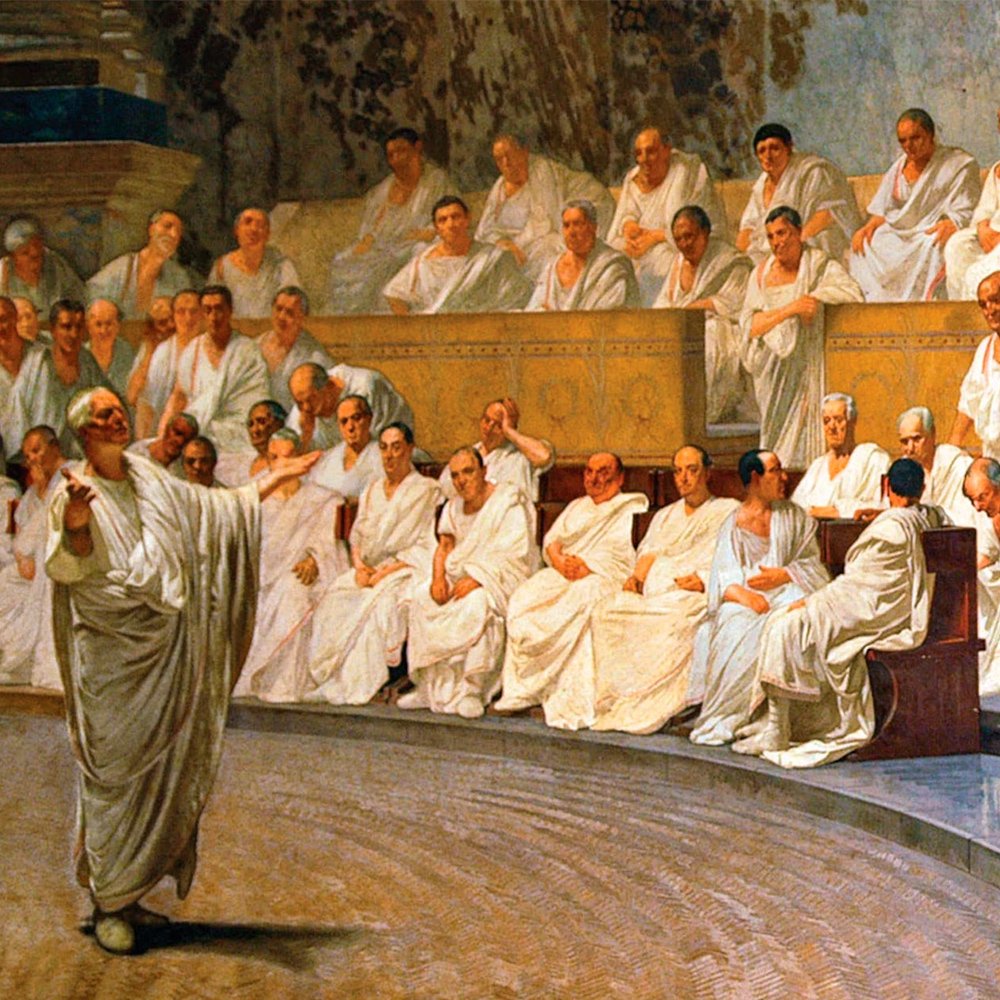
The Trap of Democracy
Do you think democracy is freedom? It’s exactly the opposite – it’s a trap. When you say “the people are sovereign,” you are denying that God is sovereign. You are placing the will of the multitude above Divine Law and Natural Law. And what is this multitude? They are people without education, without virtue, without knowledge of the Truth revealed by Christ.
In ancient Greece, only educated citizens, property owners, with knowledge of philosophy and rhetoric participated in democracy. They were few, well-educated, and capable of reasoning. Today? Anyone can vote. The ignorant worker, the uneducated housewife, the young person indoctrinated by leftist media – all have the same voting power as a wise person. This is not justice, it is leveling down.
The Great Revolutionary Conspiracy
We, traditionalist Catholics, see a deliberate plan that began in the 18th century with Freemasonry and the Enlightenment. This is no coincidence – it is an organized conspiracy against Christendom. The French Revolution of 1789 was the initial blow: they guillotined the God-anointed king, desecrated churches, massacred priests and nuns. That was not a spontaneous movement of the people – it was orchestrated by Masonic lodges to destroy the Christian order that had flourished for a thousand years in Europe.
The Inevitable Descent
We clearly see the three stages of the Revolution:
First stage – Liberalism (1789-1848): They destroy the Catholic monarchy, separate Church and State, proclaim “freedom of conscience” – which in reality means freedom to err. They say that all religions are equal, that everyone can believe what they want. This destroys the unity of Christendom. They create constitutions, parliaments, political parties – all this to make the people believe they are in control, when in reality it is always the same Masonic elites who control everything behind the scenes.
Second stage – Socialism (1848-1917): Liberalism promised freedom but brought misery. Liberal capitalism exploits the worker without the moderation that the Church imposed on medieval lords. Then the socialists emerge saying: “Look! Freedom doesn’t work! We need equality!” They begin to preach against private property, against the traditional family, against any natural hierarchy. They want to level everything – absolute equality between man and woman, between father and son, between boss and employee.
Third stage – Communism (1917 onwards): The Bolshevik Revolution completes the process. Now it is no longer just theory – it is total destruction. They kill the Tsar and his family (another anointed king!), confiscate all property, close the churches, shoot thousands of priests, and prohibit religious education for children. Communism is the final, ripe and rotten fruit of the tree planted in 1789.
Why Don’t People Understand?
Because modern people don’t think – they only feel. People today haven’t been educated in logic, grammar, rhetoric, or scholastic philosophy. They don’t know Saint Thomas Aquinas, they haven’t read the Church Fathers. Their education comes from television, social media, and leftist professors in universities.
So what happens? Demagogues manipulate emotions:
They promise “social justice” to arouse envy among the rich.
They promise “equality” to foster resentment against all legitimate authority.
They promise endless “rights” without ever mentioning duties.
They use emotional propaganda, shocking images, and simplistic slogans.
The people, lacking intellectual and spiritual formation, without the armor of the Catholic Faith, are easily seduced. They vote for whoever promises more benefits, more “freedom” (which is actually licentiousness), more “rights” (which in reality destroy the natural order).
The Role of Freemasonry
We are not conspiracy theorists – there are documents! The papal encyclicals of the 19th century (before Vatican II betrayed Tradition) repeatedly denounced Freemasonry. Leo XIII in “Humanum Genus” clearly stated: Freemasonry works to destroy the Church and establish a natural, humanist religion, without Christ.
They infiltrated parliaments, universities, the media, and tragically, even the Church itself after the Second Vatican Council. They promote ecumenism (all religions are equal), religious freedom (error has the same rights as Truth), and democracy (human will above divine will).
The Traditional Solution
The only true solution is to restore Christendom: a confessionally Catholic state, where the Church guides the laws according to Natural and Divine Law. A Catholic king or prince, educated in virtue, aware that his power comes from God and that he will answer to God. A hierarchical society where everyone knows their place in the order created by God – not through oppression, but through organic harmony.
The patriarchal family, the guilds, subsidiarity, private property moderated by pre-conciliar Catholic social doctrine – all of this functioned for centuries in medieval Christendom. It was only when the Revolution destroyed this order that the horrors of the modern world emerged: world wars, genocides, mass abortion, the destruction of the family.
The Metaphysical Nature of Revolution
We traditionalists do not see Revolution as a mere political or social phenomenon – it is a metaphysical rebellion against the very order of Being established by God. When Lucifer said “Non serviam” (I will not serve), he inaugurated the first revolution. When our first parents ate the forbidden fruit, they wanted to be “like gods,” determining good and evil for themselves – this is the second revolution. The French Revolution is merely the historical manifestation of this same ontological pride: man rejecting his nature as a creature and wanting to be autonomous, self-legislating, the source of his own truth.
Saint Thomas Aquinas teaches that all legitimate authority descends from God: “Non est potestas nisi a Deo” (There is no authority except from God – Romans 13:1). The Catholic monarchy reflected this truth: the king received his authority from God through episcopal consecration, becoming a sacramental figure, an earthly icon of Christ’s kingship. When the Revolution guillotined Louis XVI on January 21, 1793, it was not merely killing a man – it was committing symbolic deicide, murdering the image of Christ the King on earth.
The Diabolical Architecture of Masonic Democracy
Look at the symbols: the Declaration of the Rights of Man of 1789, in its illustrated version, has on its frontispiece two angels holding not the Cross of Christ, but an eye within a triangle – the Masonic symbol of the “Great Architect of the Universe,” their false Gnostic god. It is not the Triune God revealed by Jesus Christ, but a deistic abstraction, compatible with any belief or disbelief.
The three revolutionary principles – Liberty, Equality, Fraternity – are demonic parodies of the theological virtues:
Freedom (against Faith): They say that each man is free to determine his own truth. This destroys Faith, which is adherence to the objective Truth revealed by God. In Christendom, man was free within the Truth – as a fish is free in water, not outside of it. Revolutionary “freedom” is freedom for error, for sin, for heresy. That is why, after the French Revolution, Protestant sects, Kardecist Spiritism, occultism, and apostasy multiplied. Saint Paul warns us: “You will know the truth, and the truth will set you free” (John 8:32) – not “each one has his own truth”.
Equality (against Hope): Christian Hope teaches us that, although there are legitimate hierarchies on earth (parents and children, masters and disciples, kings and subjects), we are all equal in dignity before God and all have been redeemed by the same Blood of Christ. Our essential equality does not negate accidental differences in function, talent, and vocation. But revolutionary “equality” is metaphysical envy – it seeks to destroy all hierarchy, all merit, all excellence. It begins by equating king and subject, then man and woman, then father and son, then man and animal, and today we have reached the absurdity of wanting to equate men and women biologically through gender ideology.
Fraternity (against Charity): Christian Charity is supernatural love that flows from God, through Christ, to us, and from us to our brothers and sisters. It is vertical first, then horizontal. Masonic “fraternity” is horizontal, humanistic, naturalistic – as if all men were brothers simply by virtue of being human, regardless of their relationship with God. This produces a sentimental humanitarianism that weeps for the “poor” while promoting abortion, that speaks of “human rights” while persecuting Christians.
Democracy as the Government of Mediocrity
Plato already warned in the Republic: democracy degenerates into tyranny because the people, incapable of governing themselves through reason, eventually hand over power to a demagogue who promises to solve everything. History proves us right:
Example 1 – The Weimar Republic (1919-1933): After the First World War, Germany had the most advanced democratic constitution in Europe. Total freedom of speech, freedom of the press, universal suffrage, perfect proportional representation. And what happened? The people, humiliated by defeat, impoverished by hyperinflation, and resentful of the injustices of the Treaty of Versailles, democratically voted for Adolf Hitler. In 1932, the National Socialist German Workers’ Party (note: “socialist” and “workers” – left-wing language!) obtained 37% of the vote, becoming the largest party in the Reichstag. Hitler came to power through democracy, not against it.
And note: Nazism is not right-wing, as leftists lie. It was socialist, statist, collectivist, and anti-Christian. Hitler admired Bolshevism for its efficiency in destroying religion. The difference was that National Socialism based collectivism on race, while International Socialism based it on class – but both denied the primacy of the human person created in the image of God.
Example 2 – The Bolshevik Revolution (1917): Russia in 1917 had just overthrown the Tsar and established a democratic provisional government under Kerensky. There was freedom of the press, multiple parties, and parliamentary debates. And what did the Bolsheviks do? They used this democratic freedom to conduct revolutionary propaganda, infiltrate the soviets (councils) of workers and soldiers, and in November they staged the coup. Lenin openly despised bourgeois democracy as a “dictatorship of the bourgeoisie” and promised to replace it with a “dictatorship of the proletariat”—which in practice was a dictatorship of the Party over all.
Example 3 – Salvador Allende in Chile (1970-1973): A democratically elected Marxist who immediately began nationalizing companies, confiscating property, arming popular militias, and destroying the economy. Democracy brought communism peacefully. A military coup was necessary to prevent Chile from becoming a second Cuba.
Example 4 – Hugo Chávez in Venezuela (1998): Democratically elected with populist promises of wealth redistribution and “21st-century socialism.” He used democracy to destroy democracy – he changed the constitution, eliminated checks and balances, controlled the judiciary, and persecuted the opposition. Venezuela went from being the most prosperous country in South America to absolute misery, with millions fleeing. It all began with democratic votes manipulated by emotion and resentment.
Why Modern People Are Incompetent to Govern
Here is the crucial argument that we need to understand deeply:
A) The Destruction of Classical Education:
In medieval Christendom and up until the 19th century, education was based on the Trivium (Grammar, Logic, Rhetoric) and the Quadrivium (Arithmetic, Geometry, Music, Astronomy). A young person first learned to think correctly before learning content. They studied Aristotelian syllogisms, scholastic disputations, classical Latin and Greek. They read Plato, Aristotle, Cicero, and the Church Fathers.
Today? Education is pragmatic, utilitarian, relativistic. They teach that “there is no absolute truth,” that “everyone has their own opinion,” that “everything is a social construct.” A young person leaves university without knowing how to construct a valid syllogism, without distinguishing cause and effect, without recognizing a logical fallacy. But they are full of “critical thinking” (which in practice means criticizing everything that is traditional) and “autonomous thought” (which in practice means following the latest ideological trend).
B) The Dominance of Emotional Rhetoric Over Rational Dialectic:
Aristotle distinguished three types of argumentation:
- Dialectics: the pursuit of truth through rigorous logical arguments.
- Rhetoric: seeks to persuade through plausible arguments adapted to the audience.
- Sophistry: seeks to win the debate by any means, including fallacies.
Modern democracy operates entirely on a rhetorical and sophistical level, never on a dialectical one. Look at election campaigns:
- They use images of crying children to promote social policies (appealing to emotion).
- They call their opponents “fascists” or “communists” to avoid debating ideas (ad hominem attacks).
- They say “most experts agree” without presenting the arguments (appeal to authority).
- They promise benefits without explaining the costs (suppression of evidence).
- They simplify complex issues into three-word slogans (oversimplification).
The average voter, lacking logical training, is incapable of detecting these manipulations. They vote with their stomach (who promises more benefits?), with fear (who promises more security?), with envy (who will punish the rich?), with tribalism (which candidate is “from my community”?). They never vote with reason, asking: which political program is most in accordance with Natural Law and the Common Good as defined by the Social Doctrine of the Church?
C) The Fragmentation of Consciousness by Mass Media:
Neil Postman, in “Amusing Ourselves to Death” (even though he was a Protestant, his analysis was spot-on), showed how television destroyed rational discourse. Before TV, political debates lasted for hours – Lincoln and Douglas debated for 7 hours straight, with the public watching attentively. Today, a televised “debate” allows 2 minutes per answer, interrupted by commercials. The medium doesn’t allow for complex argumentation, only emotional soundbites.
Social media has worsened exponentially. Twitter (now X) limits users to 280 characters – making it impossible to develop a serious syllogistic argument. Instagram and TikTok are pure visual-emotional stimulation. Facebook’s engagement algorithms prioritize content that generates anger, fear, and outrage – precisely the passions that destroy rational judgment.
The result? A population with a goldfish mentality, incapable of sustained concentration, addicted to the dopamine of likes and shares, with opinions formed by memes and 15-second videos. And these people vote with the same weight as a wise person!
The Logical Progression: Democracy → Socialism → Communism
Now let’s see how the internal dynamics of democracy necessarily lead to socialism:
Phase 1 – Initial Demagoguery: In any democracy, politicians quickly discover that they can buy votes by promising benefits paid for by others. “Vote for me and I will tax the rich to give to you!” This is irresistible to the majority who are not wealthy. Alexis de Tocqueville already warned in 1835: “The American republic will perish when politicians discover that they can bribe the electorate with their own money.”
Phase 2 – The Growing Welfare State: Each election becomes an auction of promises: free education, free healthcare, subsidized housing, unemployment insurance, universal retirement. None of this is free – it’s paid for with increasing taxes. But the average voter doesn’t connect the dots: they receive benefits today, the bill comes diffusely in hidden taxes and public debt for future generations.
In Christendom, charity was the function of the Church and families. It operated through the supernatural virtue of Charity, not through state coercion. Religious orders maintained hospitals, orphanages, schools – all voluntarily, financed by donations. This created personal bonds, gratitude, and reciprocity. The modern state has transformed charity into a “right,” destroying both the virtue of those who help (who are now forced by taxes) and those who receive (who now demand it as a right, without gratitude).
Phase 3 – The Erosion of Private Property: Leo XIII, in “Rerum Novarum” (1891), defended private property as a natural right, but warned against ruthless liberal capitalism. Democratic socialism begins by taxing “only the super-rich” (wealth tax), then “only inheritances” (inheritance tax), then “only excessive profits” (price controls), until gradually all property becomes conditioned on the “social interest” defined by the State.
Look at Brazil: the 1988 Constitution guarantees private property, but conditions it on a “social function.” Who defines social function? The State. So you “own” property, but you can’t use it as you wish, you can’t sell it for whatever price you want, you must accept MST (Landless Workers’ Movement) invasions while waiting years for a court decision, and if you don’t “produce adequately” you can suffer expropriation. It’s only nominal property – in substance it’s already socialism.
Phase 4 – Social Engineering: The democratic-socialist state is not content with controlling the economy – it wants to control consciences. It begins in schools: mandatory sex education teaching gender ideology to children against the will of their parents. “Combating prejudice” which in practice is Marxist indoctrination. History revised to present Christianity as oppressive and revolutions as liberating.
Progress is being made for companies: racial and gender quotas, endless labor regulations, suffocating bureaucracy. If you publicly disagree, you’re canceled, you lose your job, you’re prosecuted for “hate speech.”
It infiltrates the churches: they pressure them to accept gay marriage, women’s ordination, and abortion as a “right.” Liberal Protestant denominations have already capitulated completely. In the Catholic Church, after Vatican II, we have bishops and cardinals promoting a leftist agenda, Marxist liberation theology disguised as a “preferential option for the poor.”
Phase 5 – Total Communism: The logical endpoint is communism: the total abolition of private property, the family, religion, and all natural hierarchy. It is absolute, mechanical, forced equality – the complete egalitarianism that Plinio Corrêa de Oliveira denounced in “Revolution and Counter-Revolution”.
Not necessarily through violent Bolshevik-style revolution (although it could be). It could be Gramscism: Antonio Gramsci’s strategy of seizing power culturally before seizing it politically. Dominating universities, media, entertainment, language, until communism seems natural, inevitable, desirable.
Look at the European Union today: unelected bureaucracies in Brussels imposing policies on entire nations. Internet censorship called “combating disinformation.” Mass migration destroying Christian national identities. Criminalization of Christian positions on sexuality and family. It’s not called “communism”—it’s called “advanced democracy,” “European values,” “human rights.” But in essence, it’s totalitarian socialism.
The Fundamental Error: Denying the Fall
Here lies the root metaphysical problem: modern democracy presupposes the natural goodness of man. If the people are sovereign, they must be good, wise, and capable of virtuous self-determination. This negates Original Sin!
The Catholic Faith teaches that man was created good, but fell. Our nature was wounded by Original Sin – the intellect was obscured (we do not see the truth clearly), the will was weakened (we do not do the good we know), the passions were disordered (they draw us to evil). Therefore, we need three things to order ourselves:
- Supernatural Grace: which comes from the Sacraments of the Church
- Divine Law: revealed in Scripture and Tradition
- Legitimate Authority: that which applies Divine Law to specific circumstances.
Liberal democracy negates all three! It separates Church and State (denies that Grace should inform politics). It proclaims individual moral autonomy (denies objective Divine Law). It says that the people are sovereign (denies that we need authority that comes from above).
The inevitable result is the moral chaos we see: 60 million abortions a year worldwide, ubiquitous pornography destroying souls, divorce dissolving families, euthanasia killing the elderly and sick, transgenderism mutilating confused children. All democratically legalized, all presented as “progress” and “rights.”
Why does the Masonic elite want this?
One might ask: if democracy leads to this horror, why does the elite promote it? Answer: because it serves their purposes.
The Ultimate Masonic Goal: It is not simply political power or material wealth – that is what any tyrant seeks. The goal is metaphysical, spiritual: to build a New World Order without Christ. A universal syncretic religion where all beliefs are valid (except traditional Catholicism, which claims to be the only truth). A world government that replaces the Heavenly Jerusalem with the earthly Babel.
Albert Pike, Sovereign Grand Commander of the Ancient and Accepted Scottish Rite (33rd degree, the highest in regular Freemasonry), wrote in “Morals and Dogma” (1871): “Lucifer, the Light-Bearer! Strange and mysterious name for the Spirit of Darkness! Lucifer, the Son of the Morning! Is he the one who brings the Light?” – an explicit admission of Luciferianism.
The French Revolution chanted: “We want neither God nor Lord!” In the Paris Commune (1871) they desecrated churches, dressed a prostitute as Our Lady in the Cathedral, and guillotined priests. In the Mexican Revolution (1910-1929) the Cristeros were martyred by the thousands for refusing to accept state-controlled churches. In the Spanish Revolution (1936-1939) they murdered 13 bishops, 4,184 diocesan priests, 2,365 religious and 283 nuns – executed simply for being Catholic.
Look at the pattern: every “democratic” revolution culminates in bloody persecution of the Church. Why? Because Christ said, “My kingdom is not of this world” (John 18:36), and that is intolerable for anyone who wants to build an autonomous earthly kingdom separate from God.
The Response of the Pre-Conciliar Popes
Before the modernist betrayal of Vatican II, the Popes clearly condemned these errors:
Pius VI – “Quod Aliquantum” (1791): Condemned the French Civil Constitution of the Clergy and the “rights of man” as contrary to Catholic doctrine.
Gregory XVI – “Mirari Vos” (1832): Condemned liberalism, freedom of conscience (“delirium”), freedom of the press (“never sufficiently execrated and detested”), and the separation of Church and State.
Blessed Pius IX – “Quanta Cura” and the “Syllabus Errorum” (1864): He condemned 80 modern propositions, including: that the Church should not use temporal force; that in conflict between Church and State, the State prevails; that it is lawful to refuse obedience to the Church; that each man is free to embrace and profess the religion he deems true. The last error condemned (#80) is especially revealing: “The Roman Pontiff can and must reconcile and harmonize with progress, with liberalism and with modern civilization.” Pius IX said: NO!
Leo XIII – “Humanum Genus” (1884): On Freemasonry: “In these our times, the perpetrators of evil seem to conspire together and fight with united vehemence, guided or aided by that strongly organized and widespread society called the Freemasons.” He outlined their objectives: to destroy all Christian order, to establish natural morality without reference to God, and to promote religious indifference.
Leo XIII – “Immortale Dei” (1885): On the Christian State: “Since it is necessary to profess a religion in society, it must be the only true one, which is easily recognized, especially in Catholic countries, by the signs of truth that shine forth in it.” He clearly defended the idea that the State should be confessionally Catholic.
Saint Pius X – “Notre Charge Apostolique” (1910): He condemned the French Christian Democratic movement Le Sillon for subordinating religion to democracy: “Far be it from us that Catholicism should adapt itself to the modern world; it is the modern world that must convert to Catholicism.”
Pius XI – “Quas Primas” (1925): He instituted the feast of Christ the King precisely to reaffirm that Christ must reign not only in individual hearts but over nations and their governments.
Pius XI – “Divini Redemptoris” (1937): On communism: “For the first time in history we are witnessing a coldly planned and carefully prepared struggle of man against all that is divine.” He condemned not only communism but also its precursors: “The adversaries of the Church, eager to exploit this situation, have skillfully shrouded it [communism] in a veil of apparent humanitarianism and philanthropy, thus deceiving the unwary and the well-intentioned.”
Concrete Examples of Democratic Manipulation Today
Allow me to be brutally specific about how emotional manipulation works in practice today:
Case 1 – Brexit Referendum (2016): The globalist elite (EU, international media, Obama) campaigned massively for “Remain” using fear: “The economy will collapse! There will be a recession! You will lose your jobs!” Pure emotional manipulation. The British people, especially outside the cosmopolitan urban bubbles, voted “Leave” – and the elite still refuses to accept it, trying to reverse or sabotage it. See: when democracy produces a result the elite doesn’t want, they ignore it or try a new vote until they get the “correct” result.
Case 2 – Legalization of Abortion in Ireland (2018): A country that was 90% Catholic just a generation ago. But decades of school indoctrination, progressive media, celebrity propaganda, exploited emotional cases (Savita Halappanavar), multi-million dollar advertising campaigns funded by Soros and other international organizations – the result: 66% voted to legalize killing babies. Emotional appeal won: “women should choose,” “my body, my rules,” images of women crying. No one showed images of babies dismembered by abortion – that would be “inappropriate.” Pure manipulation.
Case 3 – Gay “Marriage”: In 2008, Obama and Hillary Clinton publicly declared that marriage is between a man and a woman. In 2012, they completely changed their stance. What happened? It wasn’t new philosophical or theological evidence – it was political calculation. The media waged a massive campaign: TV series with sympathetic gay characters, celebrities “coming out of the closet,” emotional cases of denied gay “love.” Anyone who opposed them was canceled as “homophobic,” “intolerant,” “on the wrong side of history.”
In 2015, the U.S. Supreme Court (Obergefell v. Hodges) invented a constitutional right to gay “marriage” that the Framers of the Constitution never imagined. Five unelected justices imposed a radical redefinition of a millennia-old institution on 320 million Americans. Is this democracy? No – it’s judicial oligarchy.
And observe the progression: first it was “just tolerance” – leave us alone. Then “acceptance” – approve of our lifestyle. Then “celebration” – you must applaud or you will be punished. Now “childhood transgenderism” – we must allow children to change sex and parents who refuse lose custody. Exactly as we predicted: the revolutionary logic never stops, it always advances towards more egalitarianism, more destruction of the natural order.
Case 4 – COVID-19 and Sanitary Tyranny: Perhaps the most revealing example. Using fear (images of overcrowded hospitals, 24/7 death counters, catastrophic predictions), democratic governments implemented:
- Lockdowns destroying businesses and freedoms.
- Mask mandates even without evidence of effectiveness.
- Vaccination passports creating medical apartheid.
- Censorship of doctors and scientists who questioned the official narrative.
- Churches closed (!) while liquor stores remained open.
In Australia, people were arrested for posting criticisms of the lockdown on Facebook. In Canada, Trudeau invoked the Emergencies Act against peaceful truck drivers who were protesting. In France, Macron said he was going to “emmerder” (annoy/make life difficult for) the unvaccinated. All democratically!
And most revealingly: the WHO and globalist institutions are already planning the next “pandemic treaty,” giving them supranational authority to implement health measures over sovereign countries. Building a world government while the distracted public watches TikTok.
The Question of Virtue
Saint Thomas Aquinas explains that good government depends on the virtue of both rulers and the ruled. In the Catholic monarchy, the king was educated from childhood in the cardinal virtues (Prudence, Justice, Fortitude, Temperance) and theological virtues (Faith, Hope, Charity). He was advised by bishops and wise men. He knew he would be accountable to God.
But more importantly, the population was also educated in virtue through the Church. Every Sunday, the sermon taught moral doctrine. Children learned catechism. The guilds had patron saints and religious practices. Civil life was imbued with sacredness – processions, liturgical festivals, public blessings.
This created what Aristotle called a “virtuous polis”—a community ordered for the common good, where people knew their duties, respected legitimate hierarchies, and practiced moderation.
In modern liberal democracy? Zero virtuous education. Schools teach moral relativism. The media glorifies vices: pornography is just a click away, popular music exalts promiscuity and violence, “influencers” teach narcissism and materialism. The church has been expelled from public squares – even praying before a football game is controversial!
How can a people without virtue choose good rulers? How can they resist demagogues who promise to satisfy their vices? They cannot. That is why modern democracy is government not of the people, but of the instincts and passions of the masses manipulated by elites who despise both God and the people themselves.
The Necessary Counter-Revolution
The solution is not to reform democracy – it is to abandon it completely and restore Christendom. This means:
- Doctrinal Restoration: Reject Vatican II and its errors (religious freedom, ecumenism, episcopal collegiality that weakens the papacy). Return to the Tridentine Mass, to traditional catechisms, to Thomistic scholasticism, and to the infallible pronouncements of the pre-conciliar Popes.
- Political Restoration: To work for the restoration of Catholic monarchies or, where impossible, explicitly Catholic confessional governments. The State must recognize Christ the King, prioritize the true religion, protect the Church, and legislate according to Natural Law.
- Social Restoration: Rebuilding an organic society: large patriarchal families, craft guilds, subsidiarity (decisions made at the most local level possible), widespread private property but subordinated to the common good, charity exercised by intermediary bodies (Church, families, associations) not by the State.
- Cultural Restoration: Reject degenerate modern culture. Return to sacred art, Gregorian and polyphonic music, architecture that elevates the soul to God, literature that exalts virtue and beauty. Abandon worldly entertainment – Hollywood cinema, pop music, social media – which are tools of manipulation and spiritual brutalization.
- Separation from the Modern World: While we await full restoration, we must create separate communities. Homeschooling or genuinely Catholic schools, not the modernist ones approved by the novus ordo bishops. Business among traditional Catholics. Arranged marriages or marriages supervised by pious parents, not this modern “dating” which is preparatory fornication. Living as much as possible outside the corrupt system.
Responding to Modern Objections
Invariably, modernists raise objections. Let me anticipate and refute them:
Objection 1: “But monarchies also had tyrannical and corrupt kings!”
Answer: Yes, because kings are human and sinners. But three crucial points:
First, a bad king is less harmful than a bad democracy. The tyrannical king at least has physical limits – he rules as long as he lives; a man cannot be everywhere. Tyrannical democracy (which is all democracy eventually) is worse because tyranny is systematized, bureaucratized, inescapable. The American IRS, the Brazilian Federal Revenue Service, regulatory agencies – these bureaucracies are immortal and omnipresent in ways that no king ever was.
Secondly, in Christendom there were checks and balances on royal power that do not exist in democracy. The king was subject to the Law of God as interpreted by the Church – if he seriously violated it, the Pope could excommunicate him or even depose him (as Gregory VII did with Henry IV at Canossa, 1077). There were also the fundamental laws of the kingdom, the privileges of the corporations, the customary rights that not even the king could arbitrarily violate. In modern democracy? If 51% vote, they can violate any right – as we have seen with abortion, euthanasia, and confiscation of property.
Third, hereditary monarchical succession, though imperfect, is superior to electoral chaos. A prince is educated from birth to govern – he learns history, strategy, diplomacy, royal virtues. A democratic politician learns to lie beautifully, to manipulate polls, to sell himself to campaign financiers. And note: in stable monarchies (England before parliamentarism, France before 1789, Habsburg Spain), there was continuity, dynastic peace, national identity. In democracies there is perpetual division, each election is a non-violent (or sometimes violent) civil war, half the country hates the other half.
Objection 2: “But the Church supported fascist dictators like Franco, Salazar, and Pinochet!”
Answer: First, let’s correct the terms. Franco and Salazar were not “fascists”—they were national-Catholics, corporatists, inspired by pre-conciliar Catholic social doctrine. Mussolini was a fascist (and the Church signed the Concordat with him pragmatically, as it did with many imperfect governments). Hitler was a national-socialist (and Pius XI explicitly condemned him in “Mit Brennender Sorge,” 1937).
Secondly, yes, the Church supported these regimes – and rightly so! Let’s look at each case:
Franco’s Spain (1939-1975): The alternative was a Republic dominated by communists, anarchists, and Freemasons who, in three years (1936-1939), murdered 13 bishops, thousands of priests and religious, burned churches, desecrated the Blessed Sacrament, and raped nuns. The Spanish Civil War was literally a defensive crusade of Christendom against atheistic communism. Franco saved Spain from becoming a second Soviet Russia.
During the Franco regime, Spain experienced peace, economic prosperity (“the Spanish miracle” of the 1960s), a flourishing of religious vocations, and large, stable families. Yes, there was repression of enemies of the regime – but compare: Franco executed approximately 50,000 people in 36 years (mostly in the early post-war years). Lenin and Stalin, in similar decades, killed tens of millions. There is no moral comparison.
And note: Franco preserved the monarchy, educated Juan Carlos in the Catholic faith, and voluntarily initiated the transition to a constitutional monarchy. He died peacefully in his bed, receiving sacraments. Where is the “tyranny” compared to the communist dictators who died paranoid, surrounded by bodyguards?
Salazar’s Portugal (1932-1968): Another magnificent example. Salazar was a Catholic economics professor, practically a lay monk, who lived in extreme personal austerity. His regime, the Estado Novo (New State), was explicitly based on Catholic social doctrine – corporatism, subsidiarity, the family as the basic unit, and “God, Fatherland, Family” as its motto.
Portugal under Salazar went from bankruptcy to stability, maintained neutrality in the Second World War (saving Jews, incidentally), preserved its overseas empire until the 1960s, and had an orderly and Catholic society. Was there censorship? Yes – and thank God! Censorship against pornography, blasphemy, and communist propaganda. That’s healthy, not tyrannical.
When Portugal abandoned Salazarism after 1974, what happened? The Carnation Revolution, dominated by communists, near-civil war, loss of colonies in bloody chaos (Angola and Mozambique became slaughterhouses), and today Portugal is an aging, denatalized, secularized country, slowly dying. Which was better?
Pinochet’s Chile (1973-1990): Here the case is more complex because Pinochet was not a devout traditional Catholic like Franco and Salazar. But let’s consider this: he overthrew Allende, who was transforming Chile into a communist dictatorship. The Chilean Christian Democracy initially supported the coup because it recognized that Allende was destroying the country.
Were there excesses? Yes, especially in the early years. Pinochet made serious mistakes, extrajudicial executions, torture. This cannot be defended. But two points: first, the alternative was worse (a permanent communist dictatorship like Cuba). Second, Pinochet at least implemented liberal economic reforms (Chicago Boys) that saved the Chilean economy, and voluntarily called a plebiscite in 1988, lost, and handed over power peacefully. Compare that to Castro in Cuba – 60 years of dictatorship, never a free election, a miserable country.
The Church supported these regimes not because it loved dictatorships per se, but because it recognized that they defended Christian principles against infinitely worse alternatives. It is an application of the Thomistic principle of choosing the lesser evil when there is no perfectly good option available.
Objection 3: “But democracy brought prosperity, rights, the end of slavery, universal education!”
Answer: Each point is either false or distorted:
Prosperity: It came from the industrial revolution and technological advancement, not from democracy. Imperial Germany (monarchy) was more prosperous than the Weimar Republic. Singapore under Lee Kuan Yew (enlightened authoritarianism) is more prosperous than corrupt democracies in Latin America. The prosperity-democracy correlation is spurious; both correlate with underlying factors (rule of law, traditional Protestant or Catholic work ethic, social capital).
Rights: The notion of inalienable natural rights comes from Christianity and was articulated by Catholic scholastics centuries before the Enlightenment. Francisco de Vitoria (1483-1546) defended the rights of Native Americans based on their dignity as the image of God. Francisco Suárez (1548-1617) developed a theory of natural rights prior to Locke.
What liberal democracy has done is pervert genuine rights (life, property, family) into fictitious “rights” (abortion, gay “marriage,” gender reassignment) that contradict Natural Law.
The end of slavery: It was a Christian movement! William Wilberforce in England was a fervent evangelical. The Catholic Church consistently condemned slavery – Pope Eugene IV in 1435 (“Sicut Dudum”), Paul III in 1537 (“Sublimis Deus”), Urban VIII in 1639, Benedict XIV in 1741, Gregory XVI in 1839 (“In Supremo Apostolatus”), Leo XIII in 1888 (“In Plurimis”).
The slaveholding Confederate states of the American South were democrats! The Civil War wasn’t democracy versus tyranny – it was Republic versus Republic, with the moral difference being that the North (eventually) applied Christian principles regarding human dignity.
And note: modern slavery (sex trafficking, forced labor) thrives in liberal democracies that have legalized pornography and prostitution. An estimated 40 million slaves exist in the world today – more than at any other time in history. Democracy hasn’t solved this.
Universal education: In Christendom, the Church operated a vast network of parish schools, cathedrals, and universities (all founded by the Church – Bologna, Paris, Oxford, Salamanca). Education was excellent: Latin, logic, rhetoric, theology.
The democratic “universal education” of the 20th century produced mass functional illiteracy. American students cannot locate countries on a map, do not know basic history, and do not read books. But they were educated in “self-esteem” and “critical thinking” (which means criticizing tradition). It was preferable when a few were deeply educated than when many were superficially educated.
Objection 4: “You want to go back to the Dark Ages! Women without rights, oppressed serfs, the Inquisition burning people!”
Answer: Each element is a malicious caricature.
“Dark Ages”: A term invented by Enlightenment propagandists. The Middle Ages (which we should call the “Age of Faith”) was an era of extraordinary flourishing: Gothic cathedrals that we still cannot replicate today, invented universities, a scientific method developed by monks (Roger Bacon), the foundations of international law (Vitoria, Suárez), sublime art, philosophy (scholasticism), poetry (Dante), and holiness (Francis, Dominic, Catherine, Thomas).
It was the era of “Christendom”—a Europe united in faith, under the authority of the Pope, with kings who recognized a higher moral law. Were there wars? Yes—fewer and less destructive than modern wars (First and Second World Wars, Napoleonic Wars). Was there poverty? Yes—but with networks of solidarity (guilds, parishes, monasteries) that provided support. And everyone, rich and poor, had something that the modern rich do not have: hope of Heaven, sacramental life, a transcendent meaning.
Women: In Christendom, women were honored as wives and mothers – very high vocations. Saint Hildegard of Bingen was an advisor to popes and emperors. Saint Catherine of Siena reprimanded the Pope to return from Avignon to Rome. Queens like Isabella of Castile and Blanche of Castile ruled kingdoms. Abbesses commanded monasteries for both men and women.
What medieval women didn’t do was work in coal mines or textile factories 14 hours a day – that came with liberal industrial capitalism! Modern “liberation” for women forced women into the workforce, destroyed motherhood, collapsed birth rates, and now modern women are more unhappy than ever (all the positive psychology data shows this). They traded the dignity of motherhood for corporate slavery.
Serfs: Serfdom was not slavery. The serf had rights: he could not be sold separately from his family, he had access to communal land, protection from the lord, and established limits on his work. And there was mobility: many serfs bought their freedom, or fled to cities (which granted freedom after a year and a day), or entered monasteries.
Compare this to the “free” modern worker: owing 30% or more in taxes to the state, enslaved by credit card and mortgage debt, liable to be fired without notice, without security, without a stable community. Who is freer? The medieval serf with land, family, community, local lord with reciprocal obligations? Or the modern proletarian alone in the big city, anonymous, disposable?
Inquisition: Another myth. The Spanish Inquisition (the most famous) executed approximately 3,000-5,000 people over 350 years. Terrible? Yes, every human life is sacred. But compare:
- French Revolution: 40,000 guillotined in a few years (Reign of Terror)
- Vendée: 200,000-450,000 Catholics massacred by French revolutionaries.
- Paris Commune: thousands summarily executed
- Bolshevik Revolution: 20+ million dead
- Nazism: 11 million+ in the Holocaust
- Maoism: 45+ million in the Great Leap Forward
- Khmer Rouge: 25% of Cambodia’s population exterminated
Modern “democratic” and socialist revolutions have killed more people in years than the Inquisition did in centuries. And the Inquisition at least had judicial procedures (very often acquitting the accused), while communists carried out summary mass executions.
Furthermore, the Inquisition protected against heresies that would eternally destroy souls – the supreme good. Modern doctors mutilate transgender children to “protect their temporary mental health” – the Church protected immortal souls from deadly heresies. Which concern is more serious?
The Structure of the Ideal Traditional Society
Let me be constructive and describe what a restored traditional Catholic society would look like:
At the Top – The Church: The Pope in Rome as the Vicar of Christ on earth, supreme head of the Universal Church. Bishops in their dioceses with full authority over spiritual matters and ecclesiastical discipline. Parish priests in their parishes as direct shepherds of souls.
The Church would have jurisdiction over:
- All sacraments (religious marriage would be the only legally valid one)
- Education (compulsory Catholic schools or homeschooling supervised by a parish priest)
- Censorship of immoral materials (books, images, nowadays the internet)
- Questions of faith and morals (defining what can be legally taught and practiced)
- Universities (which would return to their medieval origins as centers of theology, philosophy, and canon law)
Temporal Power – The King: A Catholic monarch, ideally hereditary, consecrated by a bishop in a sacramental ceremony. He receives authority from God to govern the temporal realm in subordination to the spiritual.
The King would govern with the advice of:
- Princes of the Church (Cardinal Primate, principal bishops)
- Nobles (ancient families with a tradition of service)
- Representatives of the corporations (but not elected by universal suffrage – appointed by the guilds themselves)
Laws would be based on:
- Divine Law (Scripture, Tradition, Magisterium)
- Natural Law (rational principles accessible to all)
- Customary Law (legitimate traditions of the people)
- Positive Law (royal decrees in accordance with the previous ones)
No positive law could contradict the superior ones. If the king tried, bishops would warn him; if he persisted, the Pope could excommunicate him, and the subjects would be released from their obligation to obey.
The Organic Society – Corporations: Not atomized individuals, but intermediary bodies:
- Families: Patriarchal, large (without artificial contraception). Father as head, mother as heart, numerous children. Inalienable family property (entailed estates for nobles, workshops and lands for commoners). Marriages arranged or supervised by parents, with the consent of the betrothed, but priority given to objective suitability (faith, virtue, ability to provide for the family) over sentimental romanticism.
- Parishes: The center of community life. Daily Mass available, regular confessions, constant catechesis. Liturgical feasts as national holidays. Public Corpus Christi processions. Blessing of crops, homes, and tools. The sacred permeating daily life.
- Guilds: Carpenters, blacksmiths, weavers, merchants – each profession organized into a guild with:
- Quality regulation (poor products tarnish the corporation’s reputation)
- Limiting predatory competition (fair prices, not underselling to destroy competitors)
- Training of apprentices (master teaches apprentice for years, transmitting not only technique but also professional ethics)
- Mutual welfare (corporation provides support for sick members, widows, and orphans)
- Heavenly patron saint (Saint Joseph for carpenters, Saint Crispin for shoemakers, etc.)
- Private chapel, corporate masses, annual procession.
- Religious Orders: Benedictines preserving knowledge and cultivating land. Franciscans preaching and serving the poor. Dominicans combating heresies intellectually. Jesuits educating youth. Carmelites and Carthusians in continuous contemplation sustaining the world with prayer.
Economics – Distributism: Not liberal capitalism (concentration of capital in the hands of a few), nor socialism (state ownership), but distributism: widely disseminated ownership.
Principles:
- Private property: A natural right, but with duties. The owner is a steward of God’s goods.
- Subsidiarity: Economic decisions made at the most local level possible. Families produce what they can, buy from the community what they cannot, and resort to distant markets only for what is not locally available.
- Universal destination of goods: Property exists for the good of all, not just the owner. A landowner who leaves productive land idle while neighbors go hungry sins against justice.
- Fair price and fair wage: Price must cover production costs plus a decent living for the producer. Not “what the market can bear” (that’s psychological usury). Wages must allow the worker to support their family with dignity.
- Prohibition of usury: Lending money at interest (beyond compensation for actual risk and administrative costs) is a grave sin. Medieval charity banks lent money without interest or at minimal interest for emergencies.
- Prohibition of speculation: Buying a product not for personal use but for resale at a higher price is parasitism. Saint Thomas Aquinas only permitted it when there was added labor (transport, storage) or genuine risk.
Result: A broad middle class of small landowners (farmers, artisans, merchants), not proletarian masses dependent on megacorporations or the State.
Education – Holistic Development:
- Ages 0-7: Home education by the mother. Prayers, basic catechism, respect, obedience, first letters.
- Ages 7-14: Parish or home education. Catechism of Trent (complete). Basic Latin. Arithmetic. Sacred history and history of Christianity. Lives of the Saints. Sacred music. For boys, preparation for the father’s trade; for girls, domestic arts (sewing, cooking, home economics).
- Ages 14-18: For those who show intellectual aptitude, study of the Trivium (Grammar, Logic, Rhetoric) with classical texts. For artisans, formal apprenticeship in the guild. For nobles, training in arms, courtesy, and land management.
- 18+: University for future clergy, doctors, and lawyers – focused on theology, Thomistic philosophy, canon and civil law, and Hippocratic medicine. No “gender studies,” Marxist sociology, or other modern pseudo-sciences.
Culture – Sacralized:
- Art: Only sacred art or art that celebrates goodness, truth, and beauty. Paintings of the Annunciation, the Crucifixion, and Saints. Sculptures that uplift. Nothing of degenerate modern “art” (Manzoni selling his canned feces, Serrano photographing a crucifix in urine).
- Music: Gregorian chant, Palestrina polyphony, Bach, Mozart, Beethoven. No rock, rap, or hypersexualized pop.
- Literature: Lives of Saints, Summa Theologica, Divine Comedy, Imitation of Christ, chivalric romances that exalt virtue. Strict censorship of pornography, blasphemy, and the glorification of vices.
- Entertainment: Liturgical festivals, medieval mysteries (religious theatrical plays), tournaments and jousts for nobles, chaste folk dances for commoners. No Hollywood movies, television, or social media – these technologies are demonic instruments of mind control.
The Fallacy of “Popular Participation”
A common argument is that democracy is good because it allows for “popular participation.” But this is an illusion:
In modern democracy, the average citizen “participates” in this way:
- Once every 2-4 years, you go to a booth and press buttons on an electronic voting machine (which can be rigged).
- Choose from candidates pre-selected by parties controlled by elites.
- Candidates lie during the campaign and do the opposite once elected.
- Between elections, the citizen has zero influence – corporate lobbyists and globalist NGOs write the laws.
- If he tries to protest (like Canadian truckers), he is violently repressed.
- If he criticizes on Twitter, he gets censored or canceled.
- He cannot impeach a bad ruler before the end of his term.
- Even when voting for change, the permanent bureaucracy (deep state) sabotages it.
In traditional Christianity, the subject “participated” in this way:
- He participated in his corporation, which had representation on the royal council.
- He participated in the parish assembly that decided local issues.
- He participated in festivals, processions, and neighborhood assemblies.
- I had direct access to the local gentleman (who lived in the same region, not in the distant capital).
- They had customary rights that not even the king could violate.
- The Church was seen as a defender against abuses – any subject could appeal to the bishop against injustice.
- There was stability – laws changed slowly, after consultation and consensus, not with every election.
Which is more genuine participation? The illusory act of periodic voting or organic integration into concrete communities with effective power over their lives?
The Final Destiny of Democracy
Every liberal democracy will end in one of three ways:
- Communism (most likely): Through Gramscianism and the socialist progression already described. The current West is rapidly moving towards this – the World Economic Forum’s Great Reset, corporate ESG scores, central bank digital currency that will allow total control of transactions, Chinese-style social credit, digital censorship disguised as “combating disinformation”.
- Islamic Caliphate (possible in Europe): Secularized Europe does not reproduce – fertility rate 1.3-1.5 children per woman. Muslims migrate by the millions and have 3-4 children per family. Simple math: in 2-3 generations, Europe will be predominantly Muslim. And Muslims do not accept mosque-state separation – they will establish Sharia law. Ironically, democratic liberalism commits suicide by allowing the entry of an ideology that will destroy it. As Erdogan said: “The mosques are our barracks, the domes our helmets, the minarets our bayonets, and the faithful our soldiers.”
- Restoration by miracle (hopeful but humanly improbable): Extraordinary divine intervention, perhaps through the promises of Fatima when the Pope and bishops properly consecrate Russia to the Immaculate Heart of Mary. Our Lady promised: “In the end, my Immaculate Heart will triumph.”
We traditionalists don’t know what scenario will unfold, but we know that the current system is unsustainable. A bad tree cannot bear good fruit. Liberal democracy, being a product of the anti-Christian Revolution, can only produce spiritual death and eventual social collapse.
Our Posture While We Wait
We shouldn’t participate in the corrupt system except to limit harm. If there’s a vote between a leftist candidate who promotes abortion and an imperfect conservative candidate, we vote for the latter as the lesser evil. But let’s not be under any illusions – we don’t expect to save democracy, only to delay its decay.
Primarily, we must:
- Preserve the Faith: Attend only Tridentine Mass (the traditional Mass). Reject the Novus Ordo as a Protestantization of the liturgy. Study pre-conciliar doctrine.
- Forming large families: Having many children (6, 8, 10+), raising them strictly in the Faith, protecting them from the poison of modern culture.
- Creating communities: Living near other traditional Catholics, supporting each other, marrying children within these families, creating a parallel economy.
- Pray for conversion: Especially through the daily Holy Rosary. Our Lady has always defeated heresies through the Rosary (Albigensians, Turks at Lepanto, Communism eventually).
- Awaiting Triumph: Without despair. History is governed by Divine Providence, not by blind forces. Christ has conquered, is conquering, and will conquer. “Portae inferi non praevalebunt” – the gates of hell will not prevail against the Church.