Size guide (Clothing)
Measure Yourself Accurately
Bust/Chest: Measure around the fullest part of your bust/chest.
Waist: Measure around the narrowest part of your waist.
Hips: Measure around the fullest part of your hips.
Inseam: Measure from the top of your inner thigh to the bottom of your ankle.
Shoulder Width: Measure from the tip of one shoulder to the tip of the other.
Check Size Charts
Always refer to the size chart provided by the seller.
Chinese clothing sizes can vary significantly from Western sizes.
Look for specific measurements in centimeters or inches rather than relying on generalized sizes like S, M, L, etc.
Consider Sizing Up
Chinese sizes often run smaller than American or European sizes.
It might be wise to order one or two sizes up from your usual size.
Check if the item has stretch or if it’s made from a non-stretch fabric, as this can impact fit.
Look for Detailed Product Descriptions
Pay attention to the fabric type, as it can affect the fit and comfort of the clothing.
Check for any notes on the fit (e.g., slim fit, regular fit, loose fit).
Understand Return Policies
Check the return and exchange policies before purchasing, as returning items internationally can be costly and complicated.
Ensure you can return or exchange items if they don’t fit.
Use a Conversion Chart
Keep a size conversion chart handy to convert Chinese sizes to your local sizing.
This is particularly useful for shoes and accessories, as they can have different sizing systems.
Consider the Type of Clothing
Different types of clothing (e.g., outerwear, underwear, swimwear) may have different sizing nuances.
Make sure to check the specific size recommendations for each category.
Be Aware of Sizing Inconsistencies
Even within the same brand, sizing can vary. Always double-check measurements for each item.
If you find a brand that fits well, take note of their sizing and use it as a reference for future purchases.
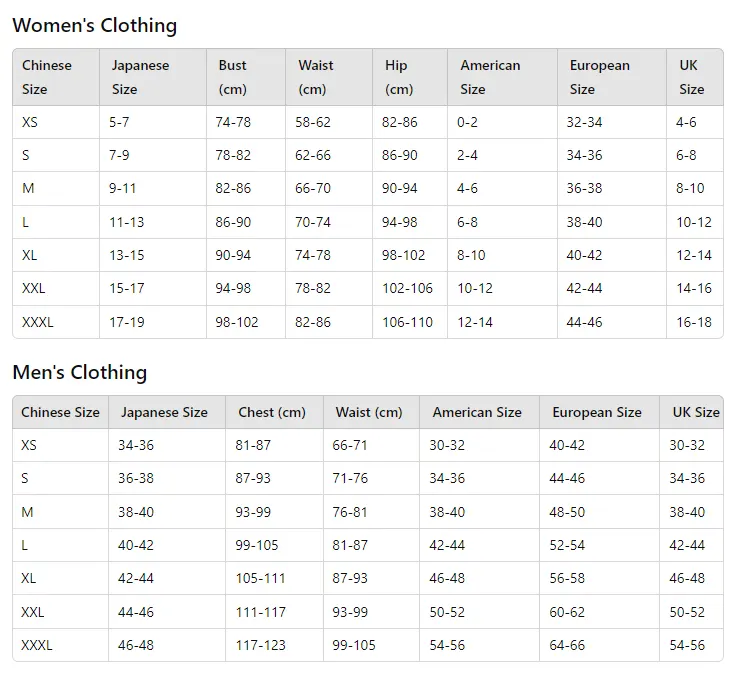
CLOTHING SIZE TIPS
Women’s Clothing
Chinese to American Sizes: Typically, a Chinese size is about 1-2 sizes smaller. For example, a Chinese M might be equivalent to an American XS or S.
Chinese to European Sizes: A Chinese size is roughly 1 size smaller. For example, a Chinese M might be a European 34-36.
Chinese to UK Sizes: A Chinese size is about 1-2 sizes smaller. For example, a Chinese M might be a UK 6-8.
Chinese to Japanese Sizes: Chinese and Japanese sizes are quite similar, often matching directly. For example, a Chinese M is usually a Japanese M (9-11).
Men’s Clothing
Chinese to American Sizes: Generally, a Chinese size is about 1-2 sizes smaller. For example, a Chinese L might be an American M.
Chinese to European Sizes: A Chinese size is about 1 size smaller. For example, a Chinese L might be a European 48.
Chinese to UK Sizes: A Chinese size is about 1-2 sizes smaller. For example, a Chinese L might be a UK 40-42.
Chinese to Japanese Sizes: Chinese and Japanese sizes are quite similar, often matching directly. For example, a Chinese L is usually a Japanese L (40-42).
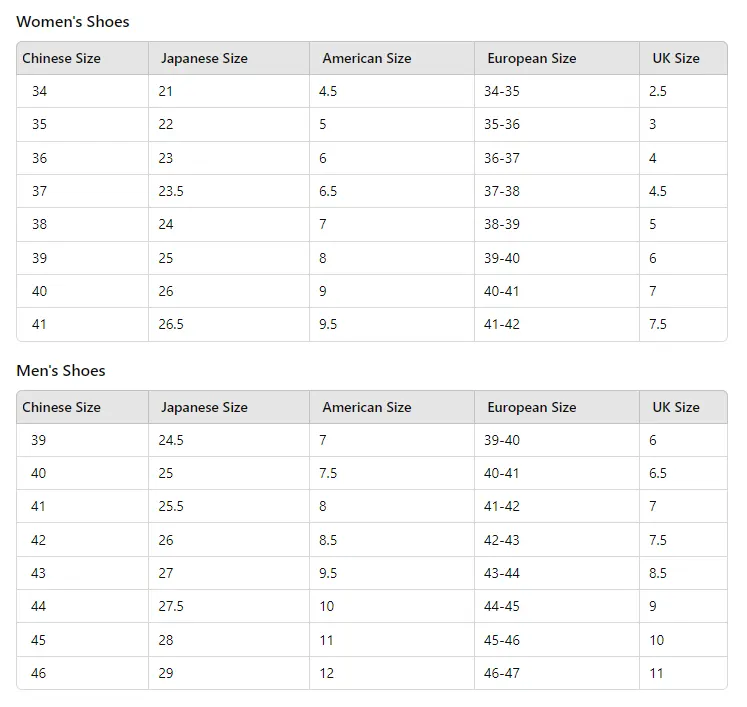
SHOE SIZE TIPS
Women’s Shoes
Chinese to American Sizes: Chinese shoe sizes are typically about 1.5-2 sizes smaller. For example, a Chinese 38 might be an American 7.
Chinese to European Sizes: Chinese shoe sizes closely match European sizes but are usually half a size smaller. For example, a Chinese 38 might be a European 37.5.
Chinese to UK Sizes: Chinese sizes are about 2 sizes smaller. For example, a Chinese 38 might be a UK 5.
Chinese to Japanese Sizes: Chinese shoe sizes are similar to Japanese sizes, often matching directly or being half a size different. For example, a Chinese 38 is usually a Japanese 24.
Men’s Shoes
Chinese to American Sizes: Chinese sizes are usually about 1 size smaller. For example, a Chinese 42 might be an American 8.5.
Chinese to European Sizes: Chinese sizes are similar but slightly smaller, by about half a size. For example, a Chinese 42 might be a European 41.5.
Chinese to UK Sizes: Chinese sizes are roughly 1 size smaller. For example, a Chinese 42 might be a UK 7.5.
Chinese to Japanese Sizes: Chinese shoe sizes are similar to Japanese sizes, often matching directly or being half a size different. For example, a Chinese 42 is usually a Japanese 26.