Heliocentrism
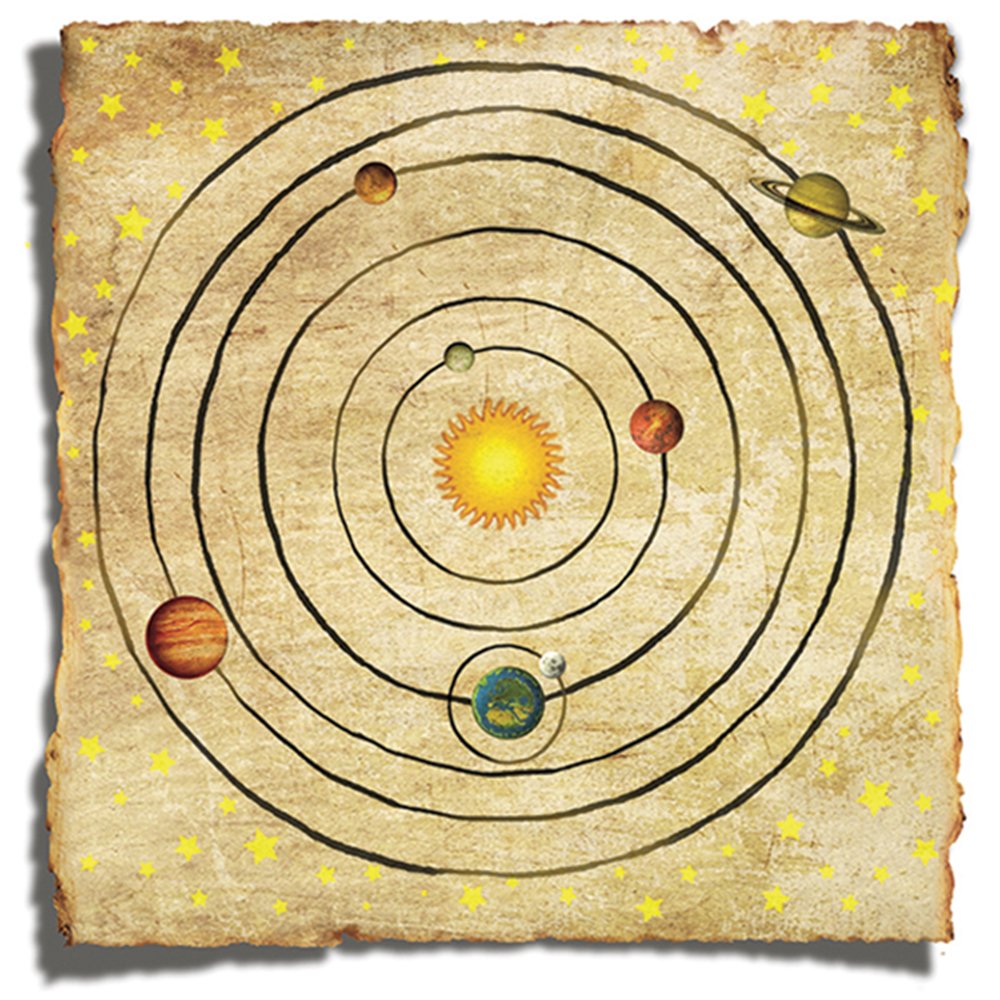
Heliocentrism is one of the greatest intellectual revolutions against the Catholic worldview of all time.
I. Biblical Foundations of Geocentrism
Explicit Passages from Scripture
LAND IMMOBILITY:
1 Chronicles 16:30 “The whole earth trembles before him; the world is firmly established, it cannot be moved .”
Psalm 93:1 “The world is also established, so that it cannot be moved .”
Psalm 96:10 “The world also is established; it cannot be moved .”
Psalm 104:5 “He set the earth on its foundations, so that it should never be moved .”
Ecclesiastes 1:4 “One generation goes, and another generation comes; but the earth remains forever .”
Geocentric argument: The Hebrew word mowt literally means “to move, to shake, to waver.” If the Earth rotated at 1,670 km/h at the equator and orbited the Sun at 107,000 km/h, it would certainly be “moving.” Scripture is clear: IT DOES NOT MOVE .
SUN’S MOVEMENT
Joshua 10:12-13 “Sun, stand still over Gibeon… And the sun stood still … The sun, therefore, stood still in the midst of heaven and did not hasten to go down for about a whole day.”
Crucial argument: If the Sun was already stationary (as in heliocentrism), what sense would it make for Joshua to order it to “stand still”? The text is explicit: the Sun was MOVING and it STOPPED. This is a miracle recorded in the Holy Scriptures inspired by the Holy Spirit.
Ecclesiastes 1:5 “ The sun rises and the sun sets , and hurries back to where it rises.”
Psalm 19:4-6 “[God] has pitched a tent for the sun, which is like a bridegroom coming out of his chamber, and rejoices like a strong man to run his course . Its rising is from one end of the heavens, and its circuit to the other end of them.”
Habakkuk 3:11 “ The sun and moon stood still in their places.”
Geocentric argument: Language is not “phenomenological” (apparent), but descriptive of reality: the Sun MOVES, RUNS, has a COURSE, DEPARTURE and ENDING POINT.
EARTH CENTRALITY
Genesis 1:1 “In the beginning God created the heavens and the earth .”
Argument: Earth is specifically mentioned, separated from “heavens.” It is the center of material creation.
Genesis 1:14-18 The sun, moon, and stars were created FOR the Earth: “to give light on the earth,” “for signs and seasons,” “to govern the day and the night.”
Argument: The function of celestial bodies is to serve the Earth. They revolve around it to fulfill this function. It is absurd to say that the Earth was created to orbit the Sun.
Isaiah 40:22 “He sits enthroned above the circle of the earth , and its inhabitants are like grasshoppers to him; he stretches out the heavens like a curtain, and spreads them out like a tent to dwell in.”
Revelation 7:1 “After this I saw four angels standing at the four corners of the earth , holding back the four winds of the earth.”
II. UNANIMOUS CONSENSUS OF THE CHURCH FATHERS
Fundamental Theological Principle
Saint Vincent of Lérins (†450): “In the Catholic Church, great care must be taken to maintain what has been believed everywhere, always, and by all (quod ubique, quod semper, quod ab omnibus).”
Geocentric argument: There is not a single Church Father who taught heliocentrism. All those who commented on cosmology were geocentrists. This constitutes a moral unanimity that binds Catholics.
Explicit Patristic Testimonies
Saint Clement of Rome (†99) Letter to the Corinthians: Describes the harmonious order of creation with the earth at the center.
LACTANTIUS (†325) Divine Institutions: He ridiculed the idea of antipodes (people on the lower part of the terrestrial sphere), considering it absurd that people could walk upside down.
SAINT BASIL THE GREAT (†379) Hexameron (On the Six Days of Creation): “The earth… remains motionless in the center… The sky revolves in a circle around the earth.”
SAINT AMBROSE (†397) Hexameron: He followed Saint Basil, affirming that the Earth is fixed and the heavens are in motion.
SAINT JOHN CHRYSOSTOM (†407) Homilies on Genesis: He described a geocentric worldview without questioning it.
SAINT AUGUSTINE (†430) The City of God: Although philosophical, he maintained a traditional cosmology with the Earth at the center.
Regarding Genesis Literally: He discussed traditional cosmology, but never suggested the Earth’s movement.
SAINT JOHN DAMASCENE (†749) Exposition of the Orthodox Faith: “The heavens revolve in a circular motion and contain the Earth fixed at the center… The Earth is the center of the universe.”
BEDE THE VENERABLE (†735) De Natura Rerum: Systematized geocentric patristic cosmology.
SAINT THOMAS AQUINAS (†1274) Summa Theologica: Although he mentioned different astronomical theories of the Greeks, he followed Aristotle and Ptolemy in geocentrism. He considered the Earth’s movement philosophically problematic.
Commentary on Job: He affirmed the stability of the Earth.
Argument from Unanimity
All the Fathers were geocentrists.
NONE of them taught heliocentrism.
Many explicitly stated geocentrism.
This constitutes Apostolic Tradition.
According to Vatican I, one cannot contradict the unanimous interpretation of the Fathers.
Therefore, heliocentrism contradicts infallible Tradition.
III. ECCLESIASTICAL CONDEMNATIONS OF HELIOCENTRISM
The Galileo Case (1616-1633)
FIRST CONVICTION (1616)
Holy Office (Roman Inquisition):
February 24, 1616 – Theological consultants examined two propositions:
PROPOSITION I: “The Sun is the center of the world and completely immobile with no local motion.”
THEOLOGICAL QUALIFICATION: “All [11 consultants] said that this proposition is foolish and absurd in philosophy, and formally heretical , since it expressly contradicts in many places the meaning of the Holy Scriptures, according to the literal interpretation and in accordance with the common understanding of the Holy Fathers and doctors of theology.”
PROPOSITION II: “The Earth is not the center of the world, nor is it immobile, but moves as a whole, and also with diurnal motion.”
THEOLOGICAL QUALIFICATION: “Everyone said that this proposition receives the same censure in philosophy and that, in relation to theological truth, it is at least erroneous in faith .”
March 5, 1616 – Pope Paul V approved the decree:
Index of Forbidden Books:
Copernicus’s work De Revolutionibus placed on the Index “until corrected”
Foscarini’s book defending the compatibility of heliocentrism with Scripture was COMPLETELY BANNED AND CONDEMNED.
Galileo was warned by Cardinal Bellarmine not to teach heliocentrism.
SECOND CONVICTION (1633)
Process of the Holy Office:
Galileo was prosecuted for:
Violating the 1616 warning
Teaching condemned doctrine
Defending Heliocentrism in Dialogue Concerning the Two Chief World Systems
Judgment of June 22, 1633:
“We declare that you, Galileo… have become to this Holy Office vehemently suspected of heresy, that is, of having believed and maintained the doctrine (which is false and contrary to the Holy Scriptures ) that the Sun is the center of the world and does not move from east to west, and that the Earth moves and is not the center of the world.”
Galileo was forced to recant:
“I, Galileo… abjure, curse, and detest these said errors and heresies… and I swear that in the future I will never again say or affirm, verbally or in writing, anything that might give rise to such suspicion.”
Pity:
Life imprisonment
Weekly recitation of the Penitential Psalms for three years.
Book placed in the Index
Papal Approval:
Pope Urban VIII personally approved the sentence. It was not merely a decision of a lower court.
Decrees of the Congregation of the Index
1664 – Heliocentrism still in the Index
1757 – The Index edition maintains the prohibition on books teaching about the Earth’s movement.
1820 – For the first time, permission was granted to print heliocentric books (but without removing the formal condemnation).
1822 – The Congregation allowed the teaching of heliocentrism as a hypothesis.
1835 – Works of Copernicus and Galileo removed from the Index
Geocentric argument: These reversals demonstrate that 19th-century popes capitulated to modern scientific pressure, abandoning traditional teaching out of political prudence, not doctrinal conviction.
IV. Geocentric Theological Argument
1. Absolute Inerrancy of Scripture
Council of Trent (Session IV, 1546):
No one can “interpret Sacred Scripture contrary to the meaning that Holy Mother Church has maintained and maintains, to whom it belongs to judge the true meaning and interpretation of Sacred Scripture .”
First Vatican Council (1870), Dei Filius :
“If anyone does not accept the books of Holy Scripture as sacred and canonical, in their entirety with all their parts… or denies that they were inspired by God: let him be anathema.”
Argument: Scripture inspired by God cannot err, NOT EVEN in scientific/cosmological matters. God who inspired also created the universe – He knows its structure.
Pope Leo XIII, Providentissimus Deus (1893):
“It is absolutely wrong… to limit inspiration only to certain parts of Holy Scripture, or to concede that the sacred author himself erred… For all the books… were written under the inspiration of the Holy Spirit, and it is so impossible that any error should be mixed with inspiration that inspiration, by itself, not only excludes all error, but excludes and rejects it as necessarily as it is necessary that God, the Supreme Truth, not be the author of any error .”
Geocentrists argue: If Scripture says that the Earth does not move and the Sun does, THIS IS OBJECTIVE TRUTH, not mere “phenomenological” language.
2. Literal vs. Allegorical Interpretation
Traditional principle of interpretation:
Saint Thomas Aquinas ( Summa Theologiae I, q.1, a.10):
“The author of Sacred Scripture is God… Therefore, it is not inappropriate, even according to the literal sense, that a word in Scripture should have several meanings… The literal sense is the one the author intends, and since the author of Sacred Scripture is God… the literal sense encompasses many things .”
Patristic golden rule:
Allegorical/spiritual interpretation is legitimate BUT it cannot contradict or eliminate literal meaning when the text is clear and historical.
Saint Augustine: “We must hold to the obvious sense of Scripture, unless reason shows otherwise.”
Application to geocentrism:
Texts about the Earth’s immobility and the Sun’s movement are:
Clear and repeated (not obscure)
Historical/descriptive (especially Joshua 10)
Never contradicted by other biblical texts.
Interpreted literally by ALL Priests
Geocentric conclusion: There is no legitimate exegetical basis for non-literal interpretation.
3. Is a condemnation by the Holy Office infallible?
Theological debate:
GEOCENTRIC POSITION:
Papal approval: Pope Paul V approved the decree of 1616; Urban VIII approved the sentence of 1633.
Matter of faith: It affects the interpretation of Scripture, which is a matter of faith and morals.
Universal law: It was imposed on the entire Church via the Index.
Unanimous opinion among consultants: All 11 classified heliocentrism as heretical.
Strong language: “Formally heretical” is language of dogmatic condemnation.
Conclusion: Heliocentrism has been irrefutably condemned. Any subsequent reversal was modernist apostasy.
MODERATE POSITION (even among geocentrists):
It acknowledges that:
It was not a formal ex cathedra definition.
Popes have not invoked supreme authority in a definitive way.
It was disciplinary/prudential, not dogmatic.
But they still argue: Even if not infallible in the strict sense , it was:
Extremely serious ruling by a supreme authority.
Consistent with unanimous Tradition
Based on Scripture and the Fathers
Never formally revoked (just ignored)
4. Argument from the Theological Centrality of the Earth
Theological reasons for geocentrism:
A. Incarnation:
God became man on Earth.
Jesus Christ was born, lived, died, and resurrected ON EARTH
Earth is the central stage for the drama of Redemption.
Therefore, it must be the physical center of the universe.
Saint Robert Bellarmine (letter to Foscarini, 1615):
“Consider now… how prudently the Church acts in not allowing interpretations contrary to the unanimous consensus of the Holy Fathers.”
B. Dignity of Man:
Man created in the image of God
A universe created FOR man
Man inhabits Earth
Therefore, Earth is the center, not an insignificant periphery.
C. Hierarchical Structure of Creation:
Medieval/traditional: Earth at the center, heavens in hierarchical orders.
Heliocentrism: Earth is a common planet among billions.
Philosophical consequence: relativization of man, preparation for evolution and atheism.
Argument: Heliocentrism is not merely an astronomical issue, but a theological one – it changes the conception of God, man, and salvation.
V. DISASTROUS CONSEQUENCES OF HELIOCENTRISM
1. Demolition of the Authority of Scripture
Logical progression:
Heliocentrism contradicts the obvious meaning of Scripture.
To accept heliocentrism, Scripture must be reinterpreted.
Method of reinterpretation: “phenomenological language”, “literary genres”
The same method applied to miracles, resurrection, creation.
Result: Biblical modernism, destructive historical criticism.
Geocentrists argue: Acceptance of heliocentrism opened the floodgates for:
Denial of literal creation in 6 days.
Acceptance of evolution
Historical critique of the Gospels
Bultmann’s demythologization
Modernism condemned by Saint Pius X
Fatal logic: If the Holy Spirit “erred” or “used imprecise language” in cosmology, why not also in morality, dogma, and history?
2. Relativization of Man – Preparation for Atheism
Philosophical analysis:
Traditional geocentric worldview:
Earth = center
Man = crown of creation
The universe exists FOR man.
Everything has a divine purpose.
Modern heliocentric worldview:
Earth = grain of dust
Man = cosmic accident
A universe indifferent to man.
Existence without intrinsic purpose.
Revealing quotes from modern scientists:
Bertrand Russell: “Astronomy teaches us… the insignificance of man.”
Carl Sagan: “The Earth is a very small stage in a vast cosmic arena… There is no hint that help will come from elsewhere to save us from ourselves.”
Geocentric argument: Heliocentrism logically led to:
Relativism (there is no absolute center)
Materialism (a mechanical universe without purpose)
Evolution (man not specially created)
Atheism (God is unnecessary)
3. Collapse of Thomistic/Aristotelian Philosophy
Aristotelian-Thomistic cosmology:
Based on geocentrism
Earth = center, heavy element naturally at rest.
Heavens = incorruptible ether in perfect circular motion
Hierarchy: sublunar (corruptible) vs. supralunar (incorruptible)
Heliocentrism destroyed:
Aristotelian physics
Metaphysics based on this physics
Hierarchical structure of the cosmos
Philosophical consequence:
The destruction of the Thomistic synthesis led to:
Nominalism (Ockham)
Empiricism (Bacon, Locke)
Cartesian rationalism
German idealism
Finally: postmodern relativism
Geocentrists: Thomism cannot survive without its geocentric cosmological foundation.
4. Triumph of Naturalism over the Supernatural
Cultural analysis:
Before Copernicus:
Miracles accepted
Normal divine intervention
Sacramental Cosmos
Science as a servant of theology
After Copernicus/Galileo:
Inviolable “natural laws”
Miracles questioned
Desacralized Cosmos
Theology as a servant of science
Argument: The Galileo case was a psychological defeat for the Church.
First time the Church “backed down” in the face of science.
Dangerous precedent
Scientism replaced ecclesiastical authority.
Autonomous reason replaced revelation.
Consequences: Enlightenment, French Revolution, modern secularism.
5. Preparation for Theological Modernism
Methodological parallel:
Heliocentrism states: “Scripture seems to say X (geocentrism), but science proves Y (heliocentrism), therefore we reinterpret Scripture.”
Modernism states: “Scripture seems to say X (miracles, resurrection), but science/history proves Y (impossible), therefore we reinterpret Scripture.”
Geocentrists: The method is IDENTICAL. Accepting one logically leads to the other.
Saint Pius X, Pascendi Dominici Gregis (1907):
He condemned modernists who “subordinate faith to science… distort the meaning of Scripture… deny that God intervened directly in creation.”
Geocentrists argue: The root of modernism lies in capitulation to Copernicus/Galileo.
VI. SCIENTIFIC EVIDENCE FOR GEOCENTRISM
1. Michelson-Morley Experiments (1887)
Context: Attempt to detect Earth’s movement through “luminiferous ether”
Result: NO movement detected – “null result”
Conventional interpretation: Ether does not exist; Einsteinian relativity explains the result.
Geocentric interpretation: THE EARTH DOES NOT MOVE – exactly what the experiment showed!
Argument: Modern physics had to create a complex theory (relativity) to “save” heliocentrism in the face of experimental evidence of terrestrial immobility.
2. Airy’s Experiment (1871)
Test: Stellar aberration with a water-filled telescope
Result: Same aberration as with an air telescope.
Problem for heliocentrism: It contradicts the standard explanation of aberration as an effect of the Earth’s movement.
Geocentric interpretation: Aberration is the movement of the stars, not the Earth.
3. Sagnac’s Experiment (1913)
Demonstrated: Absolute rotation can be detected experimentally.
Implication: If Earth’s rotation were real, it would be detectable by Sagnac.
Geocentrists argue: Experiment doesn’t detect Earth’s rotation because Earth doesn’t rotate.
4. Cosmic Microwave Background Radiation (CMB)
Surprising modern discovery:
Cosmic microwave background radiation exhibits anisotropy with:
“Axis of evil” pointing to… Earth
Alignment with the ecliptic plane (Earth’s orbit)
Concentric pattern around the Earth
Cosmologist Lawrence Krauss (atheist):
“But when you look at the map [CMB], you also see that the large-scale organized structure… is aligned with the plane of the ecliptic. This shouldn’t happen … It’s even aligned with our movement through the universe… There can’t be any special structure on the ecliptic , but there is.”
Geocentrists: CMB shows that Earth is in a special, central position – an “accident” impossible in heliocentrism.
5. Mach’s Principle and General Relativity
Einstein admitted:
In general relativity, it is mathematically equivalent to say:
The Earth rotates and the universe is stationary (heliocentrism).
The Earth is stationary and the universe revolves around it (geocentrism).
Quote from Einstein:
“Galileo’s struggle for the Copernican system… if he had been a physicist aware of the results of the modern theory of relativity, he would have seen that the frame of reference is merely a matter of convention.”
Geocentrists: If they are mathematically equivalent, why not choose what Scripture and Tradition teach?
6. Absence of Stellar Parallax until 1838
Crucial historical problem:
If Earth orbits the Sun (300 million km in orbital diameter), nearby stars should show parallax (change in apparent position).
Fact: NO parallax was detected until 1838 (200 years after Galileo!)
Heliocentric explanation: Stars are absurdly distant (light-years).
Geocentric argument:
An ad hoc hypothesis to save heliocentrism.
Simply put: no parallax because the Earth doesn’t move.
Small parallaxes “detected” in 1838+ are measurement errors or optical effects.
7. The Problem of Absurd Speed
If heliocentrism is true:
Earth rotating at 1,670 km/h at the equator.
Orbits the Sun at 107,000 km/h
The solar system is moving through the galaxy at 792,000 km/h.
The galaxy is moving through the universe at 2,100,000 km/h.
Problem: How come we feel absolutely NOTHING of these colossal speeds?
Geocentrists: Why the Earth does NOT move. The simplest and most obvious explanation.
VII. REFUTATION OF HELIOCENTRIC OBJECTIONS
Objection 1: “Foucault’s Pendulum proves the Earth’s rotation”
Geocentric response:
Foucault’s pendulum proves RELATIVE, not absolute, rotation. In geocentrism, the universe (ether) revolves around the Earth, causing the same effect on the pendulum via ether drag.
Objection 2: “Phases of Venus prove heliocentrism”
Response:
Galileo observed Venusian phases, but this only proves that Venus orbits the Sun, NOT that Earth orbits it. The Tychonic (modified geocentric) system perfectly explains Venusian phases: the Sun and planets orbit Earth, but planets also orbit the Sun.
Objection 3: “Photos of Earth from space show that it is a rotating sphere.”
Geocentric response:
Many photos are admittedly composites/CGI.
Even real photos show a sphere, not movement.
The Earth’s sphericity is compatible with geocentrism (it was never a question of “flat Earth” vs. heliocentrism).
Rotation cannot be seen in a still photo.
Objection 4: “Satellites and GPS operate based on heliocentrism”
Response:
Satellites and GPS use relative mathematics that works in ANY reference frame. Calculations can be done in a geocentric reference frame equally well.
Objection 5: “Why would God deceive by making it seem that heliocentrism is true?”
Geocentric response:
God did NOT deceive! He gave:
Clear scripture teaching geocentrism.
Consensus of the Priests
Common sense (it seems that the Sun moves because IT MOVES)
Scientific experimentation (Michelson-Morley) demonstrating the absence of terrestrial movement.
But fallen men chose to reject evidence out of intellectual pride.
VIII. Modern Neo-Tychonic Geocentrism
Tycho Brahe’s System (1588)
Model:
Land in the center, property
The Sun orbits the Earth daily.
The Moon orbits Earth monthly.
Planets (Mercury, Venus, Mars, Jupiter, Saturn) orbit the Sun.
Fixed stars revolve around everything daily.
Advantages:
It explains all the observations that heliocentrism explains.
Maintains the Earth’s immobility.
According to Scripture and Tradition
Mathematically equivalent to heliocentrism (by relativity)
Modern Geocentrism with General Relativity
Contemporary geocentric physicists argue:
Einstein’s equations allow for rigorous geocentrism. This requires:
Universal gravitational field rotating daily (reference frame drag)
Universal tidal forces
Mathematically consistent
Quote from geocentric physicist Dr. Robert Sungenis:
“Geocentrism is as scientific as heliocentrism. The difference is theological , not scientific.”
IX. RADICAL GEOCENTRIC CONCLUSION
Heliocentrism as a Modernist Conspiracy
Heliocentrism is not a neutral scientific discovery, but an ANTI-CHRISTIAN REVOLUTION that:
He attacked the authority of Scripture – a first in history.
He rejected the unanimous decision of the Fathers – he broke with Tradition.
He humiliated the Church – the Galileo case as a public defeat.
He desacralized the cosmos – he removed God from the center.
It relativized man – it paved the way for evolution and atheism.
It destroyed Catholic philosophy – the end of Thomism.
It opened the door to modernism – a method of reinterpreting dogmas.
It led to modern apostasy – culminating in Vatican II.
Called to Return
True Catholics should:
Rejecting heliocentrism as modern heresy.
Restore geocentrism according to Scripture and Fathers
Recognizing the connection between heliocentrism and modernism.
To understand that one cannot be truly Catholic while accepting this idea.
“There is no middle ground. Either you believe that God inspired the infallible Scripture that teaches geocentrism and that all unanimous Tradition confirms this, or you accept that modern ‘science’ can correct God. If you accept the latter, you are already a modernist in principle, even if conservative in other aspects.”