The Cross
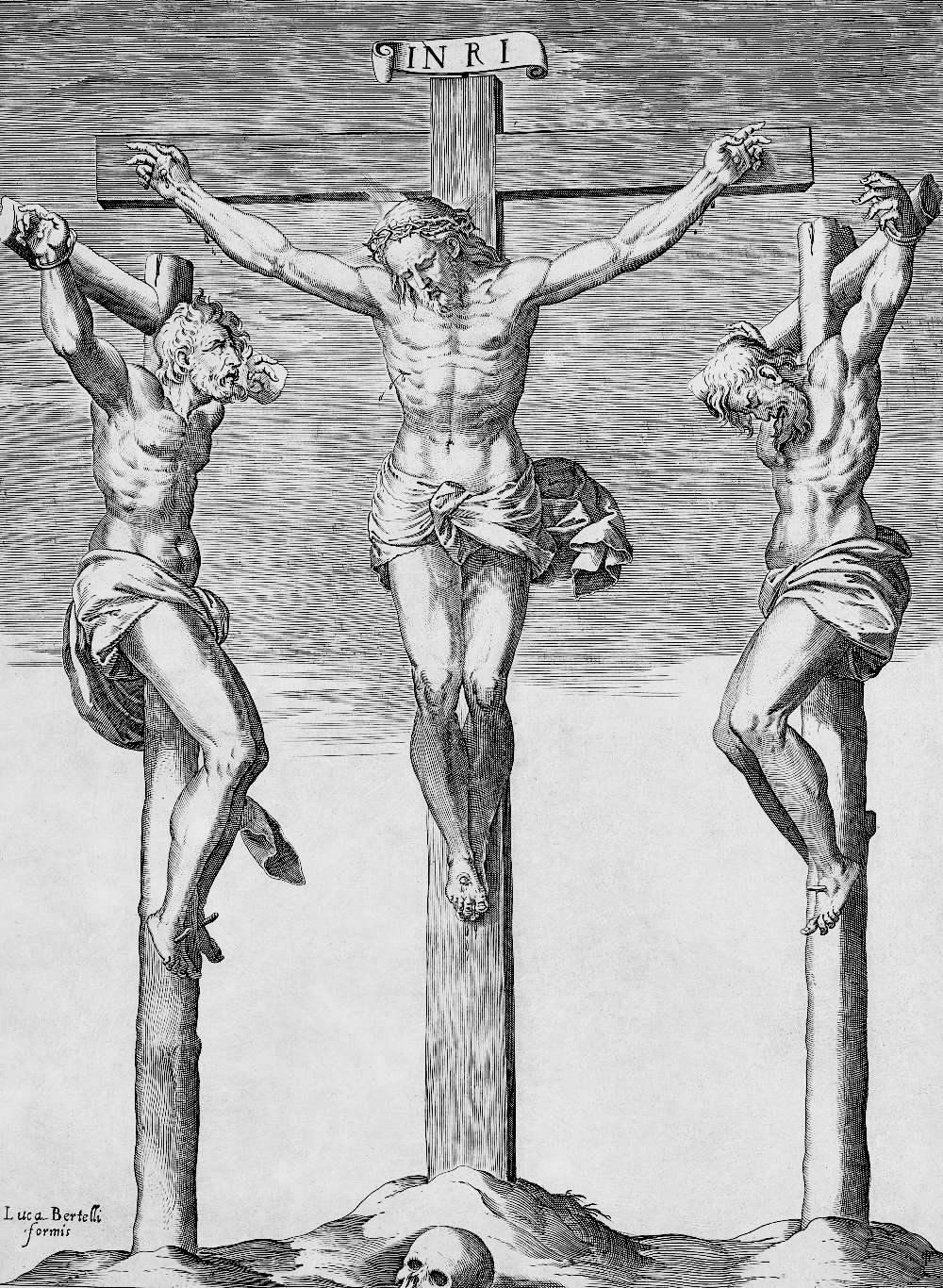
The Cross is the absolute center of all created and redeemed reality. It is not a symbol among others, not a religious emblem arbitrarily chosen to represent a tradition, not a poetic metaphor for the human condition. It is the axis around which the entire history of the universe turns, the point of intersection between eternity and time, between the infinite majesty of God and the most absolute misery of sinful man, between divine justice and divine mercy, between death and life, between the old creation wounded by sin and the new creation restored by grace. To understand the Cross in its full depth is to understand everything that Christianity is, everything that God is, and everything that man is called to be.
The eternal plan and the necessity of the Cross
To grasp the meaning of the Crucifixion it is necessary to begin not in Jerusalem in the year thirty-three but in eternity itself, in the interior life of the Most Holy Trinity before any creature existed. The Cross was not an improvisation, not a divine response to an unforeseen catastrophe, not a plan devised after the Fall of Adam when God found himself confronted with an unexpected situation. The Cross was decreed from all eternity in the counsel of the Most Holy Trinity. Saint Peter in his first epistle calls Christ the Lamb foreknown before the foundation of the world. The Book of Revelation speaks of the Lamb slain from the foundation of the world. The entire tradition of Catholic theology, drawing on these and innumerable other scriptural passages, teaches that the Incarnation and the Redemption through the Cross were part of the eternal plan of God, known and willed by the Father, the Son and the Holy Spirit before time began.
This means that every sacrifice offered by Abel, by Abraham, by the priests of Israel in the Temple of Jerusalem, every lamb whose throat was cut on the altar of holocausts, every drop of animal blood sprinkled on the mercy seat of the Ark of the Covenant, was a prefiguration, a shadow cast backward in time by the one true sacrifice that was coming. The entire sacrificial system of the Old Testament was not a series of independent religious acts with their own intrinsic value but a vast prophetic pantomime, a divine pedagogy of blood and fire and incense and sacrifice that was preparing the human race across millennia to recognize and receive the one Sacrifice toward which all history was moving.
The necessity of the Cross flows from two realities that must be held together without diminishing either: the infinite gravity of sin and the infinite justice of God. Sin, in the Catholic theological tradition, is not merely a mistake, a failure of virtue, a psychological dysfunction, or a social problem. Sin is a real and objective offense against the infinite majesty of God, a turning of the rational creature away from its last end, a preferring of the creature to the Creator, a rebellion against the order that God established in creating the world and in revealing his law. Because God is infinite, an offense against him has in a certain sense an infinite gravity that no finite creature could repair. Man owed a debt he could not pay. Justice demanded satisfaction. Mercy desired to give it. The only solution that honored both justice and mercy simultaneously was for God himself to become man and to offer, in the name of the entire human race, the satisfaction that the human race owed but could not render.
This is the doctrine of satisfaction developed most precisely by Saint Anselm of Canterbury in his treatise Cur Deus Homo, Why God Became Man, written in the eleventh century. Anselm’s argument is that the honor of God, which is another name for the objective moral order that God established and that corresponds to his own nature, was infinitely offended by sin and required an infinite satisfaction. No creature, however perfect, could offer an infinite satisfaction because every creature is finite. Only God could offer a satisfaction of infinite value. But justice required that the satisfaction be offered by man, since it was man who had sinned. The solution that divine wisdom and love devised was the Incarnation: God became man so that the God-man, possessing both divine and human nature, could offer in his human nature and on behalf of the human race a satisfaction of infinite value because it was the act of a divine Person.
This theological framework is not a cold juridical calculation imposed on the warmth of the Gospel. It is the attempt of the human intellect, assisted by grace, to understand the dimensions of what God did out of love. The Cross is simultaneously the most terrible demonstration of the gravity of sin, because it required the death of the Son of God to repair the damage sin had done, and the most overwhelming demonstration of the love of God, because God freely chose to pay this price rather than leave his creature in the ruin into which sin had cast it.
The Person of Christ and what he brought to the Cross
To understand what happened on Calvary it is necessary to understand who it was that hung upon the Cross, and this requires the full weight of the Christological definitions of the great Councils, Nicaea, Constantinople, Ephesus and Chalcedon, which the Catholic Church received and guards as the most precise human formulations of the mystery of the Person of Christ that the Holy Spirit has given to the Church.
Jesus Christ is one divine Person subsisting in two complete natures, the divine nature which he has from all eternity as the second Person of the Most Holy Trinity, and the human nature which he assumed at the Incarnation in the womb of the Virgin Mary. These two natures are united in the one divine Person without confusion, without change, without division and without separation, as the Council of Chalcedon defined in 451. The properties of each nature are preserved intact in the union, so that Christ truly suffers in his human nature as any man suffers, while remaining impassible in his divine nature.
This means that the Person who hung upon the Cross is the same Person through whom all things were made, the eternal Word of God through whom the Father spoke the universe into existence, the second Person of the Trinity in whose divine intellect subsist the ideas of all created things. The infinite dignity of the Person who suffers gives to the suffering an infinite redemptive value that no suffering of a merely human person could possess. When the flesh of Christ bleeds upon the Cross, it is the flesh of the Son of God. When the human nature of Christ endures the agony of crucifixion, the Person who endures it through that nature is the Person who is consubstantial with the Father and the Holy Spirit from all eternity.
Saint Thomas Aquinas, following the tradition of the Fathers, teaches that the smallest act of Christ, the smallest drop of his Precious Blood, the smallest moment of his Passion, possessed a redemptive value that was in itself superabundantly sufficient to redeem not one fallen humanity but infinite numbers of fallen humanities, because of the infinite dignity of the Person who performed the act and shed the blood. The totality of what Christ suffered and offered was not required by the demands of strict justice but was the expression of the infinite generosity of God, who chose to do infinitely more than the minimum that justice strictly required.
Christ came to the Cross with a human body and a human soul of extraordinary perfection. His human intellect, illumined by the beatific vision from the first moment of his existence, possessed a perfect knowledge of every human being for whom he was suffering, every sin for which he was making reparation, every soul that would be saved by his Passion across all of human history. He knew every one of them by name. He saw every sin in its particular ugliness and gravity. He embraced the Cross with perfect human freedom, not as a passive victim overwhelmed by superior force but as the eternal Priest offering himself as the eternal Victim in an act of infinite obedience and infinite love.
The obedience of Christ on the Cross is the theological counterpoint to the disobedience of Adam in the Garden. Where Adam, confronted with the command of God, chose his own will over the divine will and brought death into the world, Christ in the Garden of Gethsemane, his human will recoiling before the abyss of suffering that lay before him, chose the will of the Father with a perfect and unconditional act of obedience, saying not my will but thine be done, and brought life out of death. Saint Paul in the letter to the Romans expresses this parallel with lapidary precision: as by the disobedience of one man many were made sinners, so by the obedience of one man many will be made righteous. The Cross is the obedience of the new Adam reversing the disobedience of the old Adam, the perfect yes of the Son to the Father repairing the catastrophic no of man to God.
The physical reality of the Crucifixion
Catholic piety and theology have always insisted on confronting the physical reality of what the Crucifixion entailed, without aestheticizing it into something beautiful or spiritualizing it into something merely symbolic. The suffering of Christ was real, was immense, was chosen freely, and has redemptive significance in its very physical dimension because it was the suffering of the body of the Word of God and because it was the concrete form in which the infinite reparation for sin was offered.
The Passion began in the Garden of Gethsemane, where Christ’s human soul, confronting in its full clarity the totality of human sin across all of history and the abyss of abandonment and suffering that lay before him, experienced an agony so intense that the evangelist Luke records that his sweat became as drops of blood falling to the ground, a phenomenon known to medicine as hematidrosis, which occurs under conditions of extreme psychological stress when capillaries in the sweat glands rupture and the blood mingles with the sweat. This was not yet the physical Passion but the beginning of the interior suffering of the soul of Christ, which the mystical tradition has always identified as in certain respects more terrible than the physical suffering that followed, because it was in his soul that Christ experienced most directly the weight of sin and the spiritual desolation that is sin’s consequence.
The scourging at the pillar, which preceded the crucifixion according to the custom of Roman execution that reserved the worst torture for those condemned to death, was performed with the Roman flagrum, a short whip with multiple leather thongs tipped with pieces of metal or bone that tore the flesh with each blow. Roman law did not specify the number of blows, leaving it to the discretion of the executioners, and historical and medical studies of the Shroud of Turin, which the tradition of the Church has venerated as the burial cloth of Christ and which bears remarkable physical evidence consistent with the Gospel accounts of the Passion, suggest an extraordinarily severe scourging that left the back, the chest and the legs covered with lacerations.
The crowning with thorns, performed by the soldiers as a mock coronation of the King of the Jews, used thorns of the species that grows abundantly in Palestine, with spines of several centimeters in length, woven into a cap or helmet shape and pressed down onto the skull. The scalp is one of the most richly vascularized areas of the human body, and the wounds inflicted by the thorns would have bled profusely. The nerves of the face and skull, compressed and irritated by the thorns, would have caused a pain radiating through the entire head that medical authors have compared to the constant agony of trigeminal neuralgia.
The carrying of the cross through the streets of Jerusalem, the Via Dolorosa, covered perhaps six hundred meters but under conditions of extreme physical weakness. Christ had been without sleep since the night before, had suffered the agony of Gethsemane, had been scourged, crowned with thorns, and had lost substantial quantities of blood. The crossbeam, the patibulum, which the condemned man carried while the upright post remained fixed at the place of execution, weighed perhaps forty kilograms. The three falls recorded in the devotion of the Stations of the Cross, though not explicitly mentioned in the canonical Gospels, are consistent with the physical condition of the condemned man and with the ancient tradition of the Church.
Crucifixion was a form of execution developed by the Persians and perfected by the Romans as the most humiliating, most painful and most prolonged method of killing available to ancient civilization. Cicero called it the most cruel and hideous of tortures. It was reserved for slaves and for the lowest criminals, never for Roman citizens. Its mechanism of death, extensively studied by modern medicine, was essentially asphyxiation: the position of the arms stretched above and to the sides caused the chest muscles to be fixed in a position of permanent inhalation, so that the condemned man could inhale but could only exhale by pushing up on the nail through his feet, thus momentarily relieving the tension on the chest muscles at the cost of unbearable pain in the feet and legs. This process was repeated with each breath, for hours and sometimes for days, until the victim could no longer push up and died of asphyxiation combined with circulatory collapse, dehydration and the shock caused by the cumulative trauma.
The nails were driven through the wrists rather than the palms, as modern studies of Roman crucifixion practice and examination of the Shroud of Turin have confirmed, because the palms do not contain structures capable of supporting the weight of the body. The wrists contain the median nerve, one of the principal nerves of the hand, and the nail passing through or near this nerve would have caused a pain of extraordinary intensity radiating up the arms with every movement. The nail through the feet, placed between the second and third metatarsal bones or through the heel, similarly damaged the nerves of the foot with every movement necessary to breathe.
Christ hung on the Cross for approximately three hours, from the sixth to the ninth hour by the Jewish reckoning, that is from midday to three in the afternoon. During those three hours he spoke seven times, and each of the seven words from the Cross is a theological revelation of the first order that the Catholic tradition has contemplated and expounded across two thousand years.
The Seven Last Words
The first word was the prayer of intercession for his executioners: Father, forgive them, for they know not what they do. In this prayer, offered at the very moment of the greatest crime in human history, Christ reveals the innermost disposition of his heart, which is not revenge, not condemnation, not even justice in the strict sense, but mercy. He offers an excuse for his murderers, ignorance, that the moral theology of the tradition would recognize as a mitigating but not fully exculpating circumstance. The prayer reveals that the entire Passion is an act of priestly intercession, that the Victim and the Priest are the same Person, and that the purpose of the sacrifice is not the condemnation of sinners but their forgiveness.
The second word was spoken to the good thief who hung beside him: Truly I say to you, today you will be with me in Paradise. This word reveals that the Cross is already the beginning of the Kingdom, that the saving power of the sacrifice is effective even before it is complete, and that the only requirement for receiving its fruits is the humble recognition of one’s own sin and the simple act of turning to Christ. The good thief’s conversion, effected in the hours he hung beside the dying Christ, is one of the most theologically significant moments of the entire Passion narrative because it shows the Cross already radiating saving power, already drawing souls into the Paradise that the sacrifice is opening.
The third word was addressed to the Virgin Mary and to the beloved disciple John, who stood at the foot of the Cross together: Woman, behold your son. Then he said to the disciple, behold your mother. The Catholic tradition has always understood this word as having a significance that extends far beyond the domestic arrangement being made for the care of Mary after her Son’s death. It is a constitutive act, a new creation. Mary, addressed as Woman in the same way that she was addressed at Cana, a title that evokes the Woman of Genesis whose offspring would crush the head of the serpent, is given to John as his mother, and John receives her as his own. In John, the Catholic tradition sees the representative of all the beloved disciples of Christ, of all those whom his grace has made friends of God, and the word from the Cross is therefore the solemn declaration that Mary is the Mother of the Church, the Mother of all the redeemed, the new Eve who stands beside the new Adam at the moment of the new creation just as the first Eve stood beside the first Adam.
The fourth word is the most terrible and the most theologically profound of all: My God, my God, why have you forsaken me? These are the opening words of Psalm twenty-one, and Christ the perfect Jew who knew the Psalms by heart was praying that Psalm in the moment of his greatest agony. The Psalm begins in desolation and ends in triumph, moving from the cry of abandonment to the proclamation of God’s sovereignty and the conversion of all nations, and the Catholic tradition understands that Christ was praying the whole Psalm and not merely expressing the despair of its opening verse. But the desolation expressed in the opening verse was not merely rhetorical. It was real. The soul of Christ, in his human nature, experienced in that moment what the mystical tradition calls the dark night in its most absolute form, the complete withdrawal of all consolation, all sensible experience of the divine presence, all felt support from the Father. He experienced, not the reality but the felt sense, of what sin deserves, which is the absolute separation from God. He took upon himself the spiritual consequences of sin so completely that he experienced in his humanity the desolation that sin causes, in order to free sinners from that desolation forever.
The fifth word, I thirst, is at one level the expression of the extreme physical dehydration of a man who had lost enormous quantities of blood and fluid over many hours. At another level it is the expression of the infinite thirst of the divine love for souls, the thirst that drove the eternal Son of God from the bosom of the Father into the darkness of human sin and suffering. Saint Teresa of Calcutta placed these words at the center of her spirituality and had them written in every chapel of her congregation, understanding them as Christ’s permanent declaration of his desire for every human soul, his infinite longing for the love and the salvation of the creature he had made.
The sixth word was a single word in the original Greek of the Gospel, Tetelestai, which the Latin Vulgate renders as Consummatum est, and the English tradition as It is finished or It is consummated. This is not the despairing word of a man who knows he is dying and whose life is over. It is the triumphant declaration of the eternal Priest who knows that the sacrifice is complete, that the work entrusted to him by the Father has been accomplished, that the debt has been paid, the ransom offered, the reparation made. The word used in Greek, tetelestai, was used in commercial documents of the period to indicate that a debt had been paid in full. It was also used to describe the completion of a work of art, the moment when the artist stands back from the finished work and pronounces it done. Both meanings resonate theologically: the debt of sin has been paid in full, and the new creation, the masterpiece of divine love and mercy, has been completed.
The seventh and final word was the prayer of total surrender: Father, into your hands I commend my spirit. This prayer, taken from Psalm thirty, was the traditional Jewish evening prayer, the prayer with which pious Jews committed themselves to God’s care before sleep each night. Christ died as he had lived, in perfect prayer, in perfect abandonment to the Father, in perfect peace that was not the peace of resignation but the peace of one who has accomplished everything he came to do and who returns in triumph to the One who sent him.
At the moment of his death, the Gospels record a series of extraordinary signs: the veil of the Temple, the heavy curtain that separated the Holy of Holies from the rest of the sanctuary and that symbolized the barrier between God and sinful man, was torn from top to bottom, indicating that the barrier had been removed from above, by God himself, through the sacrifice of Christ. The earth shook. Rocks were split. Tombs were opened and bodies of holy people who had died rose and appeared in Jerusalem after the Resurrection. The sun had darkened for three hours. These signs are not merely dramatic embellishments of a literary narrative but theological statements in the language of cosmic event: the old order has ended, the new creation has begun, the curtain between heaven and earth has been removed, the power of death has been broken at its root.
The theology of the Precious Blood
When the soldier Longinus pierced the side of the dead Christ with his spear to certify his death, there came out blood and water, a detail that the evangelist John records with special emphasis, insisting that he who saw it has borne witness and his witness is true, and he knows that he tells the truth, that you also may believe. The Catholic tradition has always seen in this detail a theological significance of the first order. The Fathers of the Church, and after them the great medieval theologians, interpreted the blood and water flowing from the pierced side of Christ as the source of the sacraments, specifically of Baptism and the Eucharist, and more broadly as the birth of the Church from the side of the new Adam, just as the first Eve was born from the side of the sleeping Adam in the garden of creation.
The theology of the Precious Blood is one of the richest and most specifically Catholic elements of the devotional and theological tradition. Every drop of the Blood of Christ, shed in Gethsemane with the bloody sweat, shed under the scourges, shed under the thorns, shed in the wounds of the nails and the spear, is the Blood of the Son of God and possesses therefore a redemptive value that is infinite. The Catholic liturgical tradition has surrounded the Precious Blood with the most profound reverence, expressed in the extraordinary care with which the chalice is handled at Mass, in the purification of the sacred vessels, in the rules about what happens to any drop of the Precious Blood that might fall, in the great feasts and devotions dedicated to the Precious Blood that the Church has promoted across the centuries.
The devotion to the Five Holy Wounds, the wounds of the hands, the feet and the side of Christ, has been one of the central expressions of Catholic Passion piety from the early Middle Ages to the present. Saint Francis of Assisi received the stigmata, the physical reproduction of the wounds of Christ in his own body, in 1224, two years before his death, and was the first stigmatic of whom we have reliable historical documentation. After him, hundreds of saints and mystics across the centuries received various forms of the stigmata, and the Church has consistently seen in this phenomenon, when authenticated, a special divine favor by which the mystic is configured to the Crucified in the most intimate and physical way possible.
The Cross as the tree of life
The Catholic theological and liturgical tradition developed with extraordinary richness the typological reading of the Cross, understanding the Cross as the fulfillment of Old Testament types and figures in a way that reveals the entire Scripture as a unified narrative moving toward Calvary.
The tree of knowledge of good and evil in the Garden of Eden, from which Adam and Eve ate in defiance of God’s command and through which death entered the world, finds its antitype in the tree of the Cross, from which Christ offers himself as food and through which life returns to the world. The early Fathers loved this parallel: as death came through a tree, so life comes through a tree. As the first Adam stretched out his hand to take the forbidden fruit and brought ruin, so the new Adam stretched out his hands on the wood of the Cross and restored all things.
The sacrifice of Isaac by Abraham on Mount Moriah, which God stopped at the last moment and replaced with a ram caught in a thicket by its horns, is one of the most transparent prefigurations of the Passion in all the Old Testament. Isaac carries the wood of his own sacrifice up the mountain, as Christ carries his cross. Isaac is the beloved and only son, as Christ is the beloved and only-begotten Son. The ram caught by its horns in the thicket is Christ crowned with thorns. The mountain of Moriah is identified by the tradition with Jerusalem, within whose walls Calvary stands. And unlike Abraham, who received his son back alive at the last moment, the Father does not withhold the sacrifice but allows it to proceed to its completion, because what Abraham’s sacrifice prefigured in sign the Father’s sacrifice accomplishes in reality.
The brazen serpent that Moses lifted up on a pole in the desert, at which the Israelites bitten by fiery serpents had to look to be healed, is explicitly interpreted by Christ himself in the Gospel of John as a prefiguration of his own lifting up on the Cross. As the serpent of bronze bore the form of the thing that was killing the people but had no poison in itself, so Christ bore in his flesh the form of sinful flesh, as Saint Paul says, but had no sin in himself, and by being lifted up drew to himself all the poison of sin and rendered it powerless.
The Passover lamb, whose blood sprinkled on the doorposts of the houses of Israel caused the angel of death to pass over and spared the firstborn, is the most central of all the Old Testament prefigurations of Christ. Saint John the Baptist’s greeting of Christ at the Jordan, behold the Lamb of God who takes away the sin of the world, explicitly identifies Christ as the true Passover Lamb. The timing of the crucifixion, at the hour when the Passover lambs were being slaughtered in the Temple, is not coincidental but providential. The bones of Christ were not broken, fulfilling the prescription that no bone of the Passover lamb should be broken. The blood of the true Lamb, sprinkled upon the doorposts of the soul through the sacraments, causes the second death, the eternal separation from God, to pass over those who are marked with it.
The Cross in the Mass
The most important thing to understand about the relationship between the Cross and the Mass in the Catholic theological tradition is that they are not two events but one. The Mass is not a repetition of the Sacrifice of Calvary, not a new sacrifice alongside it, and not merely a commemorative ceremony that recalls a past event. The Mass is the Sacrifice of Calvary made present across time, the same sacrifice of the same Victim offered by the same eternal Priest, Jesus Christ, through the ministry of his ordained priests.
This doctrine, defined with precision by the Council of Trent against the Protestant reformers who denied the sacrificial character of the Mass, rests on the theological understanding that the sacrifice of Christ, offered once in history on Calvary, has an eternal and trans-temporal value. The Risen Christ, now glorified at the right hand of the Father, lives forever as the eternal High Priest who ever intercedes for us, as the letter to the Hebrews says, bearing the marks of his Passion in his glorified body, perpetually presenting to the Father the sacrifice he offered on the Cross. The Mass is the sacramental re-presentation of this eternal priestly act, the making present here and now of what Christ offered once on Calvary and offers eternally in heaven.
This is why the traditional priest celebrates Mass facing the altar and the crucifix, oriented toward the Cross and not toward the congregation, because the Mass is primarily an act directed to God, an offering of the eternal sacrifice to the Father, and not a performance directed at an audience. The crucifix placed at the center of the altar, which the traditional Roman rite requires to be visible during the celebration of Mass, is not a decoration but the theological statement of what the Mass is: the re-presentation of the sacrifice of the Crucified.
The Canon of the Mass, the ancient and unchanging prayer of consecration that is the heart of the traditional Roman rite, contains at its center the words of consecration through which the bread and wine become the Body and Blood of Christ, the same Body that was nailed to the Cross and the same Blood that was shed for the remission of sins. When the priest pronounces these words in persona Christi, in the person of Christ, the Crucified becomes present on the altar under the appearances of bread and wine, not by descending again from heaven but because the Mass sacramentally makes present what he offered once on Calvary and offers eternally in heaven.
The Cross and the theology of suffering
One of the most profound and most specifically Catholic dimensions of the theology of the Cross is the meaning it gives to human suffering. The Cross does not explain suffering in the sense of offering a philosophical argument that makes suffering rationally comprehensible and therefore emotionally acceptable. The Cross transforms suffering by inserting it into the redemptive action of Christ and giving it a salvific value that no purely natural philosophy could give it.
Saint Paul’s extraordinary statement in the letter to the Colossians, I complete in my flesh what is lacking in the afflictions of Christ for the sake of his body, which is the Church, has puzzled readers across the centuries because it seems to suggest that there is something lacking in the sufferings of Christ, which is theologically impossible given the infinite redemptive value of those sufferings. The tradition interprets the passage to mean not that the sufferings of Christ are in themselves insufficient but that Christ chose to associate the sufferings of his members with his own suffering, to allow the members of his Body to participate in the redemptive work of the Head, so that human suffering accepted and offered in union with the Passion of Christ becomes truly redemptive, truly co-redemptive in a participated and subordinate sense that does not diminish but presupposes the absolute primacy of Christ’s own sacrifice.
This theology of redemptive suffering, developed by the great mystics and doctors of the Church, is one of the most counter-cultural elements of traditional Catholicism in the modern world, which regards suffering as a pure evil to be eliminated as rapidly and completely as possible and which has progressively extended this logic to justify euthanasia and assisted suicide as the ultimate expressions of compassion. The Catholic tradition does not romanticize suffering or pretend that it is not genuinely evil in itself. It is evil in itself because it is a consequence of sin and of the disorder that sin introduced into creation. But it is capable of being elevated, through union with the suffering of Christ, into something that participates in the greatest act of love in history, and this elevation does not eliminate the pain but gives it a meaning and a fruitfulness that transforms its character entirely.
The lives of the great saints, especially the great contemplatives and mystics, are inexplicable apart from this theology. Saint John of the Cross, whose writings on the dark night of the soul describe with extraordinary precision and depth the spiritual suffering through which God purifies the soul and draws it into union with himself, understood this suffering as participation in the desolation of Christ on the Cross, the desolation expressed in the fourth word from the Cross. Saint Therese of Lisieux, the Little Flower, who suffered tuberculosis and a profound spiritual aridity during the last eighteen months of her life, described her suffering in her autobiography as her participation in the night of faith that she believed was the experience of many souls in the modern world, and offered it for those souls in union with the Passion of Christ. Blessed Miguel Pro, the Mexican Jesuit who was executed by firing squad in 1927 with his arms outstretched in the form of a cross, dying with the cry of Viva Cristo Rey on his lips, embodied in the most literal way the theology of the Cross as participation in the sacrifice of Christ.
The victory of the Cross
Everything that has been said about the gravity of the Cross, about the horror of the suffering, about the infinite weight of sin that pressed upon the soul of Christ in those three hours, must be understood within the framework of the absolute and definitive victory that the Cross represents. The Cross is not a tragedy with a happy ending. It is the supreme strategy of divine wisdom and love, the way by which God chose to destroy the power of sin and death not by power from outside but by entering into them from within and blowing them apart from the inside.
Death, which had entered the world through sin and which had reigned over all generations since Adam, met in Christ something it had never encountered before: a human being who was absolutely sinless, who had no debt to death, against whom death had no legitimate claim. When death seized Christ, it overreached itself. It claimed a Victim to whom it had no right. And in the Resurrection, which is the necessary completion of the Cross and cannot be separated from it, the overreach of death was punished by its own destruction. Christ did not merely escape from death as Lazarus had escaped, only to die again later. He destroyed death from within, passed through it and came out the other side in a bodily life that is no longer subject to death, a glorified bodily life that is the pledge and the firstfruits of what awaits all those who are joined to him through faith and the sacraments.
The exsultet, the great proclamation sung by the deacon at the Easter Vigil in the traditional Roman rite, captures the paradox of the Cross and the Resurrection in language of incomparable beauty: O felix culpa quae talem ac tantum meruit habere Redemptorem, O happy fault that merited such and so great a Redeemer. The fall of Adam, the catastrophe that the Cross was necessary to repair, is called a happy fault not because sin is good or because evil is something to be desired but because the response of God to the catastrophe of sin was so overwhelmingly generous, so inconceivably loving, that the redeemed creation is more glorious than the unfallen creation would have been. God drew from the greatest evil the greatest good. The Cross is the supreme proof that there is no depth of human sin and no abyss of human misery that the love of God cannot reach, cannot enter, and cannot transform into glory.
The Cross and the Christian life
Christ said to his disciples, if any man would come after me, let him deny himself and take up his cross daily and follow me. These words are not a counsel for the especially heroic but the description of the normal Christian life as Christ himself defined it. The Cross is not an accident that happened to Christ and that Christians are called to admire from a distance. It is the form of the Christian life itself, the pattern according to which every disciple is called to shape his existence.
The traditional Catholic understanding of the Christian life as a progressive configuration to the Crucified, a dying to self that opens the space for the life of Christ to grow within, is expressed in the baptismal theology that Saint Paul develops in the sixth chapter of the letter to the Romans, where he teaches that baptism is a death and a burial with Christ, after which the baptized rises to walk in newness of life. The entire sacramental life of the Church is a participation in the death and resurrection of Christ: confession is a death to sin and a resurrection to grace, the Eucharist is the reception of the Body and Blood of the Crucified who is now Risen, the anointing of the sick conforms the suffering Christian to the suffering Christ and prepares him for the final passage through death to the resurrection.
The crucifix, the image of Christ crucified that is central to Catholic piety and that the traditional rite requires to be present at the center of every altar, is not a morbid dwelling on death. It is the proclamation of the mystery at the heart of all Christian existence: that life comes through death, that glory comes through humiliation, that love is proved not by words but by the absolute gift of self. Every Catholic who genuflects before the crucifix, who kisses the feet of the Crucified on Good Friday, who prays the Stations of the Cross, who wears the crucifix as a devotional object, is making an act of faith in the theology the Cross embodies: that God so loved the world that he gave his only-begotten Son, and that the giving was total, unconditional, to the last drop of blood, to the last breath, to the darkest moment of desolation, and beyond.
The Cross is therefore not the symbol of a defeated God but the throne of a victorious King. The traditional Catholic crucifix, especially in the Byzantine tradition, sometimes depicts Christ reigning from the Cross with open eyes and a posture of majesty rather than the physical agony that the Western tradition more commonly emphasizes, and this iconographic choice expresses a profound theological truth: the Crucified is simultaneously the Victim and the King, the one who suffers and the one who reigns, the one who appears defeated and the one who is definitively victorious. He reigns from the wood as he will reign from the throne of his glory, and the two thrones are the same throne, because the love that drove him to the Cross is the same love that constitutes the inner life of the Most Holy Trinity from all eternity and that will be the atmosphere of the Kingdom of Heaven forever.