The Apostles
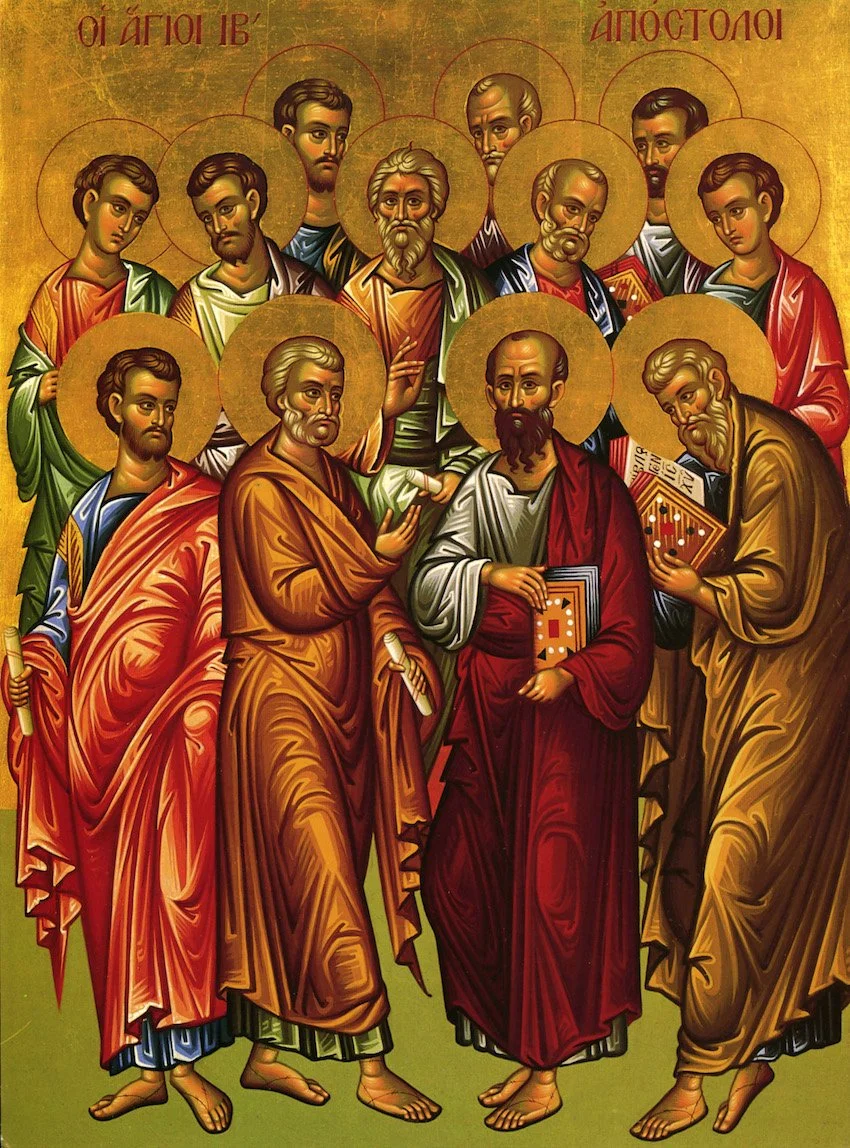
The 12 Apostles of Jesus Christ
1. Simon Peter (Saint Peter)
Origin and calling: Born in Bethsaida, in Galilee, Peter was a fisherman along with his brother Andrew. His original name was Simon bar-Jonas (son of Jonah). Jesus renamed him Peter (Cephas in Aramaic), which means “stone” or “rock,” saying, “You are Peter, and on this rock I will build my church.”
Personality and role: Peter was impetuous, emotional, and passionate. He was the one who confessed Jesus as the Messiah in Caesarea Philippi. He was part of Jesus’ inner circle, along with James and John, witnessing special events such as the Transfiguration, the resurrection of Jairus’ daughter, and the agony in Gethsemane. Despite his fervent faith, he denied Jesus three times on the night of his arrest, but after the resurrection he was restored when Jesus asked him three times, “Do you love me?” and entrusted him with the command, “Feed my sheep.”
Ministry: He became the recognized leader of the apostles after Pentecost. He was the first to preach publicly (Acts 2), performed the first apostolic miracle (healing the lame man at the Temple gate), had the vision that opened the Church to the Gentiles (vision of the sheet with unclean animals), and was instrumental in the early Church councils. According to tradition, he led the Christian community in Rome.
Martyrdom and Legacy: He died a martyr in Rome during Nero’s persecution, around 64-67 AD. Tradition says he asked to be crucified upside down, as he did not consider himself worthy to die in the same way as Christ. He is considered by the Catholic Church to be the first Pope and the founder of the Roman See. St. Peter’s Basilica in the Vatican was built over his supposed tomb. He is celebrated on June 29th.
2. André
Origin and calling: Brother of Peter, also a fisherman from Bethsaida. He was originally a disciple of John the Baptist. When John pointed out Jesus saying, “Behold the Lamb of God,” Andrew was one of the first to follow Jesus, becoming the “Protocletes” (first called). He immediately went to find his brother Simon, saying, “We have found the Messiah.”
Personality and ministry with Jesus: Andrew had a “connector” personality, always bringing people to Jesus. He was the one who introduced Peter to the Master. In the episode of the multiplication of the loaves, it was Andrew who found the boy with five loaves and two fish. When some Greeks wanted to see Jesus, they first sought out Philip, who went with Andrew to take the request to the Master.
Apostolic mission: According to ancient traditions, after Pentecost he initially preached in the region of Scythia (present-day Ukraine and southern Russia), then in Greece, particularly in Achaia. He founded the See of Byzantium (future Constantinople), which is why he is the patron saint of the Patriarchate of Constantinople and the Orthodox Church.
Martyrdom: He was martyred in Patras, Greece, around 60 AD. The Roman proconsul Aegeas ordered his crucifixion. According to tradition, he was tied (not nailed) to an X-shaped cross, where he remained for two days before dying. This cross became known as the “Cross of Saint Andrew” and appears on the flags of Scotland and other symbols. He is celebrated on November 30th.
3. James the Greater (James, son of Zebedee)
Origin and calling: Son of Zebedee and Salome (probably sister of Mary, mother of Jesus, making James a cousin of Jesus), brother of John the Evangelist. He was a fisherman on the Sea of Galilee. Jesus called them while they were mending their nets with their father, and both immediately left everything to follow him.
Personality: James and John were called “Boanerges” (sons of thunder) by Jesus, indicating a strong and zealous temperament. This is evident when they wanted to call down fire from heaven on a Samaritan village that rejected Jesus. Their mother Salome even asked Jesus that her sons sit at his right and left in the Kingdom, demonstrating ambition (or faith in Jesus’ messiahship).
Inner circle: Along with Peter and John, he formed Jesus’ closest circle, being a privileged witness to the Transfiguration on Mount Tabor, the resurrection of Jairus’ daughter, and the agony in Gethsemane. This closeness suggests that Jesus saw in them special qualities of leadership and faith.
Martyrdom: He was the first of the twelve apostles to be martyred and the only one whose martyrdom is recorded in the New Testament (Acts 12:1-2). Around 44 AD, King Herod Agrippa I, wanting to please the Jewish leaders, ordered him to be killed by the sword (decapitation). According to a later tradition of Clement of Alexandria, his accuser converted upon seeing him face death and was beheaded along with him.
Legacy: Spanish tradition states that he preached in the Iberian Peninsula before returning to Jerusalem. His remains were supposedly transferred to Santiago de Compostela, in Galicia, which became one of the main centers of Christian pilgrimage (the Way of St. James). He is the patron saint of Spain. Celebrated on July 25th.
4. John (the Evangelist)
Origin and calling: Younger brother of James the Greater, son of Zebedee and Salome, a Galilean fisherman. He was probably the youngest of the twelve. He was possibly also a disciple of John the Baptist before following Jesus.
“The beloved disciple”: John is identified by scholars as “the disciple whom Jesus loved,” mentioned in the fourth Gospel. This designation does not indicate favoritism, but a relationship of special intimacy. He was the only apostle present at the crucifixion, at which time Jesus entrusted his mother Mary to his care, saying, “Here is your mother,” and to Mary, “Here is your son.”
Personality and transformation: Despite being a “son of thunder” in his youth, John transformed into the “apostle of love.” His later writings are permeated by the message of divine love: “God is love” and “Beloved, let us love one another.”
Literary works: John is credited with: the Gospel of John (the most theological of the four), three Epistles (1, 2, and 3 John), and the Book of Revelation. His Gospel was written around 90-100 AD, being the last of the canonical gospels, with an emphasis on the divinity of Christ.
Later ministry: After Pentecost, he worked in Jerusalem, being recognized as a “pillar” of the Church along with Peter and James (the Lord’s brother). He later settled in Ephesus, in Asia Minor, where he led the churches of the region. During the persecution of Domitian (around 95 AD), he was exiled to the island of Patmos, where he wrote Revelation.
Death: He was the only apostle who did not die a martyr’s death, living to a very advanced age in Ephesus, where he died of natural causes around 100 AD. Tradition says that, already very old and unable to preach long sermons, he constantly repeated: “Little children, love one another.” Commemorated on December 27th.
5. Philip
Origin and calling: A native of Bethsaida, the same city as Peter and Andrew. He was one of the first disciples called by Jesus, right after Andrew and Peter. The Gospel of John recounts that Jesus met him and simply said, “Follow me.” Philip immediately went to find Nathanael (Bartholomew), saying, “We have found the one Moses and the prophets wrote about.”
Practical personality: Philip had a practical and literal mind. In the episode of the multiplication of the loaves, when Jesus asked where they would buy bread for the multitude, Philip calculated that “two hundred denarii worth of bread would not be enough.” At the Last Supper, when Jesus spoke of the Father, Philip asked: “Lord, show us the Father,” to which Jesus replied: “Have I been with you so long, and you still do not know me, Philip? Whoever has seen me has seen the Father.”
Mediating role: Like Andrew, Philip had an intermediary role. When Greeks (Gentiles) wanted to see Jesus during Passover, they sought out Philip, probably because his name was Greek and he could speak the language. Philip, in turn, consulted Andrew before taking the request to Jesus.
Apostolic ministry: According to traditions of the early Church, he preached in Phrygia (present-day central Turkey) and Scythia. There are accounts that, accompanied by his family (he had daughters who were prophetesses), he established a vibrant Christian community. Eusebius of Caesarea, a 4th-century historian, mentions that Philip’s daughters were known for their wisdom and prophetic gifts.
Martyrdom: The most widely accepted tradition states that he was martyred in Hierapolis, Phrygia (present-day Pamukkale, Turkey), around 80 AD. According to accounts, he was crucified upside down or stoned. Some apocryphal texts describe that he converted the wife of the Roman proconsul, which led to his execution. His supposed relics were found in Hierapolis in 2011. Celebrated on May 3 (or November 14 in the traditional calendar).
6. Bartholomew (Nathanael)
Identity: Although called Bartholomew in the Synoptic Gospels (Matthew, Mark, Luke) and in Acts, he is identified as Nathanael in the Gospel of John. “Bar-Tolomeu” means “son of Tolomeu” in Aramaic, probably a patronymic, while Nathanael was his given name. He was from Cana of Galilee.
First encounter with Jesus: Philip brought him to Jesus, announcing that he had found the Messiah. Nathanael was skeptical, asking, “Can anything good come out of Nazareth?” When Jesus saw him, he declared, “Here is a true Israelite, in whom there is no deceit.” Nathanael asked how Jesus knew him, and Jesus replied, “Before Philip called you, when you were under the fig tree, I saw you.” This answer provoked a profound confession of faith: “Rabbi, you are the Son of God, you are the King of Israel!”
Personality: He was a sincere, straightforward man, a scholar of the Scriptures. The fact that he was “under the fig tree” suggests that he was meditating or praying, as this was a common place for study and prayer among the Jews. His initial skeptical response shows someone who does not accept things easily, but who, once convinced, surrenders completely.
Apostolic ministry: Traditions regarding their missionary work vary, but converge in some regions:
He preached in Armenia (where he is considered a national patron saint along with Judas Thaddeus).
He took the Gospel to India, possibly accompanying Thomas.
He worked in Mesopotamia and Persia.
Some traditions mention Arabia Felix (present-day Yemen).
Martyrdom: The best-known tradition recounts a brutal martyrdom: he was allegedly skinned alive (his skin removed) and then crucified or beheaded in Albanopolis, Armenia, by order of King Astyages, around 71 AD. Therefore, in Christian art, Bartholomew is frequently depicted holding his own skin or a flaying knife. Michelangelo portrayed him this way in the Last Judgment in the Sistine Chapel. Celebrated on August 24th.
7. Thomas (Didymus)
Name and origin: Thomas (from the Aramaic “Ta’oma”) and Didymus (from the Greek) both mean “twin,” but we don’t know who his twin brother was. He was Galilean, but little else is known about his origins.
Personality and defining moments: Thomas was realistic, loyal, but also melancholic and questioning. Three episodes in the Gospels reveal his character:
Loyalty: When Jesus decided to go to Judea after Lazarus’ death, despite the danger, Thomas said to the other disciples, “Let us also go, that we may die with him” (John 11:16), demonstrating courage and loyalty.
Intellectual honesty: At the Last Supper, when Jesus said, “You know the way to where I am going,” Thomas honestly replied, “Lord, we don’t know where you are going, so how can we know the way?” This question provoked one of Jesus’ most profound revelations: “I am the way, the truth, and the life.”
Doubt and Faith: He was absent when Jesus appeared to the disciples after the resurrection. When they told him, he declared: “Unless I see the nail marks in his hands and put my finger where the nails were, and put my hand into his side, I will not believe.” A week later, Jesus appeared again and invited Thomas: “Put your finger here; see my hands. Reach out your hand and put it into my side. Stop doubting and believe.” Thomas then made the most complete profession of faith: “My Lord and my God!”
“Doubting Thomas”: Although known as “the doubter,” Thomas actually represents the honesty of those who seek evidence before believing. Jesus did not condemn him, but accommodated him, later stating: “Blessed are those who have not seen and yet have believed.”
Apostolic Ministry: The strongest and oldest tradition states that Thomas evangelized Parthia (Persia/Iran) and reached India. The Syro-Malabar Church in Kerala, southern India, claims to have been founded by Thomas in 52 AD. There is historical evidence of very ancient Christian communities in this region, known as “Christians of St. Thomas.” The “Acts of Thomas,” an apocryphal text from the 3rd century, details his mission in India.
Martyrdom: According to tradition, he was martyred near Madras (present-day Chennai, India) around 72 AD, killed with spears by soldiers at the behest of a local king, possibly for having converted members of the royal family. A hill near Chennai is called “Mount St. Thomas”. His relics were later transferred to Edessa (present-day Turkey) and then to Ortona, Italy. Celebrated on July 3rd.
8. Matthew (Levi)
Origin and calling: Matthew, also called Levi (probably his original name), was a tax collector (publican) in Capernaum. This profession was despised by the Jews because: (1) they worked for the occupying Romans, (2) they frequently overcharged for personal gain, (3) they dealt with Gentiles, becoming ritually impure, and (4) they were seen as traitors to the nation. Matthew worked at customs, collecting taxes on goods.
The radical call: Jesus saw him sitting at the tax collector’s booth and simply said, “Follow me.” Matthew “got up and followed him,” leaving a lucrative profession. This was one of the most surprising calls, for Jesus chose someone from the most hated class. Immediately, Matthew offered a great banquet at his house for Jesus, inviting his fellow tax collectors and “sinners.” When the Pharisees criticized, Jesus replied, “I have not come to call the righteous, but sinners to repentance.”
A symbol of transformation: Matthew represents God’s mercy that reaches everyone. From explorer to evangelist, from hated to sacred author. His personal experience of forgiveness and acceptance permeates his Gospel.
The Gospel of Matthew: He wrote the first Gospel of the New Testament (in canonical order), probably between 70-90 AD. Special characteristics:
Aimed primarily at Jews, emphasizing Jesus as the promised Messiah.
It contains more quotations from the Old Testament than any other Gospel.
Organized into five major discourses (parallel to the five books of Moses)
Includes the complete Sermon on the Mount.
The only one to explicitly mention the Church (ekklesia).
It emphasizes the Kingdom of Heaven.
His experience as a tax collector is evident in his attention to numbers and methodical organization.
Apostolic ministry: According to tradition, after some years preaching in Judea among the Jews, he took the Gospel beyond:
Ethiopia (not the current one, but the Nubian region)
Persia (modern-day Iran)
Syria
Macedonia
Martyrdom and death: Traditions surrounding his death vary significantly. Some sources claim he was martyred in Ethiopia, killed by soldiers or stoned. Others suggest he died of natural causes. The most widely accepted tradition is that he was martyred, possibly burned or beheaded. His relics are said to be in the Cathedral of Salerno, Italy. He is the patron saint of accountants, bankers, and tax collectors. Celebrated on September 21st.
9. James the Less (James, son of Alphaeus)
Identity: Called “the lesser” (or “the little one”) to distinguish him from James the Greater, son of Zebedee. This nickname may refer to his physical stature, younger age, or his later calling to the apostleship. Son of Alphaeus (also called Clopas) and Mary (one of the women who were at the foot of the cross).
Relationship with Jesus: There is theological debate about whether this James is the same “James, the Lord’s brother” mentioned by Paul (Galatians 1:19). In Catholic tradition, “brother” means cousin or close relative, since Mary remained a virgin. Many scholars identify James the Less with James, the leader of the Church of Jerusalem. Mark 6:3 mentions that Jesus had “brothers” named James, Joseph, Judas, and Simon.
Personality and role: Little is mentioned about him specifically in the Gospels. He was present at all the important moments: the election of the twelve, Jesus’ ministry, the crucifixion (his mother Mary was there), the resurrection, and Pentecost.
Leadership in Jerusalem (if it is the same James): If identified with James, the Lord’s brother:
He became the leader of the mother church in Jerusalem after Peter’s departure.
The resurrected Jesus appeared especially to him (1 Corinthians 15:7)
He presided over the Council of Jerusalem (Acts 15), deciding on the circumcision of Gentiles.
Paul visited him and recognized him as a “pillar” of the Church.
Known for his wisdom and extreme piety.
He wrote the Epistle of James, emphasizing faith manifested in works.
He was so respected that the Jews called him “James the Just.”
Martyrdom: According to Flavius Josephus and Hegesippus (a 2nd-century Christian historian), he was martyred in Jerusalem around 62 AD. The high priest Annas II, taking advantage of the interval between two Roman procurators, accused James of violating the Law. According to tradition:
He was taken to the pinnacle of the Temple and urged to renounce Christ.
Instead, he proclaimed Jesus as the Messiah.
It was thrown from the top of the Temple (about 30 meters).
He survived the fall and began to pray for his attackers.
He was stoned by the crowd.
A fuller (a worker who trod on the fabric) delivered the final blow to his head with his stick.
Legacy: His death caused outrage even among non-Christian Jews, contributing to the deposition of the high priest. He is celebrated on May 3rd along with Philip (or May 11th in the Byzantine rite).
10. Judas Thaddeus (Lebbaeus)
Names and identity: Known by several names: Judas, Thaddeus (from the Aramaic “courageous”), Lebbaeus (from the Hebrew “heart”). He was the son of Alphaeus (or Clopas) and Mary, possibly the brother of James the Less, therefore a cousin of Jesus. He is called “Judas, not Iscariot” in the Gospel of John, to distinguish him from the traitor.
Significant moment: At the Last Supper, Judas Thaddeus asked Jesus an important question: “Lord, why will you reveal yourself to us and not to the world?” (John 14:22). Jesus responded by speaking about the dwelling place of the Father and the Son in those who keep his Word, explaining the difference between outward and inward revelation.
Personality: What little we know suggests someone reflective, who sought to understand the divine plan. His question reveals someone who wanted more people to know Jesus.
The Epistle of Jude: He is the author of the Epistle of Jude, a short but powerful letter that warns against false teachers and exhorts believers to “contend for the faith that was once for all entrusted to the saints.” The letter mentions Jewish traditions and even apocryphal books (Enoch, Assumption of Moses), demonstrating his knowledge of the scriptures.
Apostolic ministry: According to the traditions of the early Church:
He preached in Judea, Samaria, Idumea, and Syria.
He worked in Mesopotamia (modern-day Iraq).
He evangelized Persia (modern-day Iran), possibly together with Simon the Zealot.
He arrived in Armenia, where he is co-patron saint of the nation with Bartholomew.
Armenian tradition strongly associates him with the evangelization of the country.
Martyrdom: The most widely accepted tradition is that he was martyred in Persia along with Simon the Zealot, around 65-70 AD. According to accounts:
He faced strong opposition from pagan priests.
He refused to sacrifice to idols.
He was killed with blows from an axe or club.
Other versions mention that he was shot with arrows until he died.
Patron saint of impossible causes: In the Catholic tradition, Saint Jude Thaddeus is invoked as the patron saint of difficult and desperate causes. This devotion originated in the Middle Ages and is based on several reasons:
His name being similar to that of Judas Iscariot meant he was rarely invoked, so he became the patron saint of the “forgotten.”
Your letter speaks of faith in the midst of adversity.
Tradition attributes many miracles to him in impossible situations.
Iconography: He is usually depicted with a medal or image of Jesus on his chest (referring to the legend that he brought the Holy Shroud to King Abgar of Edessa) and holding a club or axe (the instrument of his martyrdom). Celebrated on October 28th.
11. Simon the Zealot (or Canaanite)
Surnames and meaning: Called “Zealot” in Luke and Acts, and “Canaanite” in Matthew and Mark. Both terms have the same meaning: “Canaanite” is the transliteration of the Aramaic “qan’ana” which means “zealous,” translated into Greek as “zealots.”
The Zealots: This term can indicate that:
He belonged to the Zealot political-religious party, a radical Jewish group that violently opposed the Roman occupation and collaboration with Gentiles. They were revolutionaries prepared for armed struggle for the liberation of Israel.
Or simply that he was “zealous” for Jewish Law, without necessarily belonging to the organized party.
Simon’s choice of Jesus is significant: if he was a revolutionary zealot, it represents a radical transformation, since he was in the group with Matthew, who had worked for the Romans. The Gospel unites the revolutionary and the collaborator under the leadership of Christ.
Silence in the Gospels: Simon is mentioned only in the lists of the twelve apostles. There is no specific episode, question, or action attributed to him in the canonical Gospels. This silence has generated much speculation and diverse traditions about his life.
Transformation: If he was a political zealot, his transformation would be dramatic: from someone who sought to overthrow Rome by the sword to someone who followed the path of love for enemies and non-violence of Christ. It represents the conversion of violent political zeal into spiritual zeal for the truth of the Gospel.
Apostolic ministry: Traditions regarding their work vary considerably.
He preached in Egypt, bringing the Gospel to North Africa.
He worked in Cyrenaica (present-day Libya).
He went to Mauritania (north of west Africa)
According to some traditions, he evangelized Britain (England) along with Joseph of Arimathea.
The strongest tradition places him in Persia, along with Judas Thaddeus.
He possibly preached in Armenia.
Martyrdom: The most widely accepted tradition is that he was martyred in Persia along with Judas Thaddeus, around 65-70 AD. According to accounts:
He confronted Persian magicians and pagan priests.
He refused to sacrifice to the sun god.
He was killed by being sawn in half (which is why he is represented with a saw in iconography).
Other versions mention crucifixion.
Legacy: Despite limited biblical records, Simon represents:
The ability of the Gospel to transform political extremism.
The union of people of opposing backgrounds and ideologies in Christ.
Zeal directed toward spiritual, non-violent ends.
Celebrated on October 28th, along with Judas Thaddeus, due to the tradition that they worked and died together.
12. Matias
Historical context: Matthias is unique among the twelve because he was chosen after the resurrection and ascension of Jesus, not during his earthly ministry. His election is recorded in Acts of the Apostles 1:15-26.
The need for choice: After the betrayal and death of Judas Iscariot, the number of apostles was incomplete. The number twelve had profound symbolic meaning:
It represented the twelve tribes of Israel.
It symbolized the restoration of Israel.
It was the foundation of the New Jerusalem (Revelation 21:14)
Jesus promised that the twelve would sit on twelve thrones, judging the twelve tribes (Matthew 19:28).
Peter and the selection process: Peter, assuming leadership, gathered about 120 disciples in the Upper Room in Jerusalem and proposed the selection of a successor. He cited prophecies from the Psalms that foretold the betrayal and the need to replace the traitor.
Strict criteria: The requirements were specific and demanding.
He should have accompanied Jesus and the apostles from the baptism of John the Baptist.
Having been present throughout Jesus’ public ministry (approximately three years)
To be an eyewitness to the resurrection.
To have remained faithful until the ascension.
These criteria ensured that the new apostle had complete knowledge of the life, teachings, death, and resurrection of Jesus.
The candidates: Two men met these strict requirements:
Joseph, called Barsabbas (also known as Justus) – His double name suggests Jewish origin with a Roman name, common in Hellenized Jewish families.
Matthias – Little is known about his background, but he was among the closest disciples.
The method of selection: After presenting the candidates, the community prayed: “You, Lord, who know the hearts of all, show us which of these two you have chosen to take part in this ministry and apostleship, from which Judas turned aside to go to his own place.”
Then they “cast lots” (probably using marked stones or dice). This method may seem strange today, but it was common practice in the Old Testament to discern God’s will (Proverbs 16:33: “The lot is cast into the lap, but its every decision is from the Lord”). The priests’ Urim and Thummim functioned similarly. It was understood as letting God decide, not chance.
The lot fell on Matthias: He was then “numbered with the eleven apostles,” restoring the symbolic number of twelve before Pentecost.
A privileged witness: Although he was not part of Jesus’ inner circle during his ministry, Matthias was:
Witness to all of Jesus’ public teachings
Present in miracles and healings
Eyewitness to the crucifixion
One of the people to whom the resurrected Jesus appeared.
Present at the ascent of the Mount of Olives
In the Upper Room when the Holy Spirit descended at Pentecost
Pentecost and the beginning of his ministry: Ten days after his election, Matthias was in the Upper Room when the Holy Spirit descended in tongues of fire upon the apostles. He participated in Peter’s first public preaching, when three thousand people were converted. He was a fundamental part of the early Church in Jerusalem during the critical early years.
Apostolic ministry: Since the New Testament records no longer mention specific activities of Matthias, we rely on traditions from the early Church, which vary:
Tradition 1 – Judea and Ethiopia:
He initially preached among the Jews in Judea.
He took the Gospel to Ethiopia (the region of Nubia/Sudan, not present-day Ethiopia).
He worked in Colchis (a region of the Caucasus, present-day Georgia).
Some sources mention significant conversions.
Tradition 2 – Cappadocia:
He evangelized Cappadocia (central present-day Türkiye).
He established Christian communities in the region.
This tradition is mentioned by Nicephorus Callistus in the 14th century.
Tradition 3 – Macedonia:
Some texts place his work in Macedonia.
He is believed to have worked in regions near Greece.
Characteristics of his ministry: According to tradition, Matthias was known for:
Asceticism and a life of prayer
Mastery of the Jewish Scriptures
Preaching focused on the resurrection of Christ.
Emphasis on the continuity between the Old and New Testaments.
Martyrdom – Version 1 (most accepted): The most widespread tradition states that he was martyred in Jerusalem around 63-64 AD.
He was accused of blasphemy by the Sanhedrin.
Stoned by the crowd (Jewish method of execution)
While being stoned, he fell to his knees praying for his executioners.
A final blow with an axe or halberd completed his death.
That is why he is represented in art with an axe or halberd.
Martyrdom – Version 2: Another tradition states:
He was crucified, following the example of Christ.
This version is less documented.
Natural death – Version 3: Some texts suggest:
He lived to an advanced age.
He died of natural causes.
This is the least accepted tradition.
Relics: His supposed relics have had an eventful history:
Initially buried in Jerusalem
Brought to Rome by Saint Helena (mother of Constantine) in the 4th century.
Placed in the Basilica of Santa Maria Maggiore
Part of the relics are in Trier, Germany.
Other parts in Padua, Italy
Theological and spiritual legacy:
Apostolic continuity: Matthias represents the principle that the apostolic ministry must continue. The Church cannot remain incomplete. This principle underlies apostolic succession in the Catholic and Orthodox Churches.
The importance of testimony: Only those who were eyewitnesses of the resurrected Jesus could be apostles. Christianity is based on historical testimony, not on myths or legends.
The role of the community: The choice involved the entire community of disciples (120 people); it was not an isolated decision by Peter. This demonstrates the communal nature of important decisions in the early Church.
Spiritual discernment: The process included intense prayer, clear criteria, and trust in divine providence.
Faithfulness rewarded: Matthias was not among the original twelve, but his faithfulness and perseverance throughout Jesus’ ministry made him worthy. He represents all the “anonymous” disciples who faithfully followed Jesus.
Theological question – Paul vs. Matthias: Some scholars have questioned whether Matthias was truly God’s chosen apostle, arguing that Paul was the “true twelfth apostle.” Arguments:
Paul had a direct calling from the resurrected Christ.
He had a more extensive and documented ministry.
He wrote a large part of the New Testament.
Traditional Catholic response:
Matthias met the apostolic criteria (witness since the baptism of John).
Paul himself considered himself “born out of due time” (1 Corinthians 15:8).
Paul was an “apostle to the Gentiles,” not to the Jews.
There is no opposition: there were apostles besides the twelve (Barnabas, James the Lord’s brother).
The Book of Revelation speaks of twelve foundations with the names of the twelve apostles (21:14), a number that is now complete.
Patrons and devotions: Matthias is the patron saint of:
Engineers and carpenters (due to the axe/tool)
Recovering alcoholics (Germanic tradition)
Those who seek perseverance in faith.
People who feel like “substitutes” or “second choices”
Liturgical celebration:
May 14th in the Roman calendar (formerly February 24th)
August 9th in the Byzantine calendar
February 24th in some local traditions
Spiritual message from Matthias: His life teaches:
Silent loyalty is rewarded.
You don’t need to always be in the spotlight to be important.
God chooses at the right time.
Consistent witness is worth more than spectacular moments.
The Church always finds ways to continue its mission.
Small seeds of faithfulness produce great fruit.
Representation in art: It is generally represented as:
Mature, bearded man
Holding an axe or halberd (instrument of martyrdom)
With a book or parchment (Gospel)
Sometimes with stones (stoning)
In scenes with the other apostles, especially at Pentecost
Matthias, though little known, is an essential part of apostolic history, representing the continuity, persevering fidelity, and divine providence that guides his Church through all crises and transitions.