Evolutionism
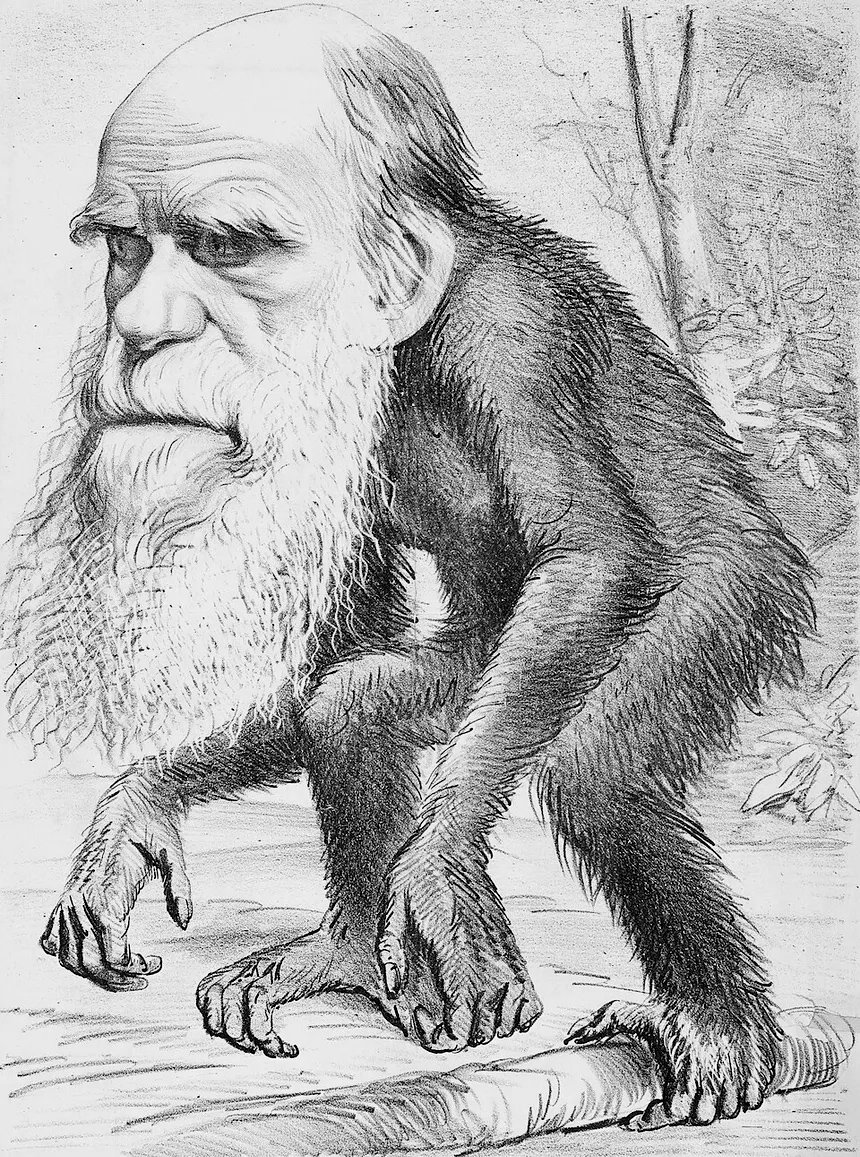
The theory of evolution as formulated by Charles Darwin in 1859 in On the Origin of Species, and as developed by his successors into what became known as the Modern Synthesis in the twentieth century, represents one of the most consequential intellectual events in the history of Western civilization, not merely because of its scientific claims but because of the philosophical, theological and moral framework within which it was received, promoted and institutionalized. To understand its consequences for Christian faith it is necessary to examine not only what Darwin actually proposed but what the theory became in the hands of those who used it as an instrument for purposes that went far beyond natural science.
What Darwin actually claimed and what was added to it
Darwin’s original proposal was a biological hypothesis about the mechanism by which species change over time through the process of natural selection acting upon random variations. Darwin himself was cautious, sometimes contradictory, and personally uncomfortable with some of the philosophical conclusions that his supporters drew from his theory. In his private correspondence he described himself as agnostic rather than atheist, and expressed uncertainty about whether his theory was compatible with theism. He acknowledged that the origin of life itself, the question of how the first living cell came to exist, was outside the scope of his theory.
What happened in the decades following the publication of On the Origin of Species was that the biological hypothesis was rapidly transformed into a comprehensive philosophical worldview, a total explanation of reality that claimed to render superfluous any reference to God, to creation, to the soul, or to any transcendent order of meaning. This transformation was not a logical necessity of the biological theory itself but a philosophical choice made by men who wished to use the prestige of natural science to advance a materialist and anti-Christian programme that had existed long before Darwin provided them with a biological argument.
Thomas Huxley, Darwin’s most aggressive public defender and self-described bulldog, was explicit that his enthusiasm for Darwin’s theory was inseparable from his desire to destroy the intellectual authority of the clergy and of the Church. Herbert Spencer, who coined the phrase survival of the fittest that is commonly but incorrectly attributed to Darwin, used evolutionary ideas to construct a social philosophy of ruthless competition that Darwin himself found distasteful. Ernst Haeckel in Germany built upon Darwin a comprehensive materialist philosophy called monism that explicitly denied the existence of God, the soul and free will, and whose influence on German intellectual and political culture was enormous and deeply troubling in its ultimate consequences.
The pattern was therefore established early: the biological theory served as the scientific credential for a philosophical package that included materialism, atheism, the denial of human exceptionalism, the rejection of moral absolutes, and the delegitimization of religious authority. One could in principle accept some version of biological evolution and remain a Christian theist, as many theologians and scientists attempted to do, but the dominant cultural use of Darwinism was as a weapon against the Christian understanding of God, man and the world.
The specific errors of the theory
From the perspective of traditional Christian philosophy and theology, the Darwinian framework contains several fundamental errors that must be distinguished carefully because they operate at different levels.
The first and most fundamental error is metaphysical rather than scientific. The Darwinian framework as culturally deployed assumes that matter in motion, operating through purely mechanical processes of random variation and natural selection, is a sufficient explanation for the entire complexity of the living world including human consciousness, rationality, morality and religious experience. This assumption is not a scientific conclusion derived from evidence but a philosophical presupposition brought to the evidence before the investigation begins. It is a modern form of the ancient error of materialism, the reduction of all reality to its material substrate, which Aristotle refuted in antiquity and which Thomas Aquinas demonstrated to be philosophically incoherent on multiple grounds.
The fundamental problem with materialism as a comprehensive explanation of reality is that it cannot account for itself. The very capacity for rational thought, for following logical arguments, for distinguishing truth from falsehood, for making moral judgments, cannot be derived from the blind mechanical processes that materialism invokes to explain everything. If the human mind is merely the product of millions of years of random mutation and natural selection, then it was shaped entirely by survival pressures and not by any orientation toward truth as such. As C.S. Lewis argued with devastating clarity, if my thoughts are determined entirely by the electrochemical processes in my brain, which were in turn shaped by evolutionary pressures for survival and not for truth, then I have no reason to trust my thoughts about evolution or about anything else. Darwinian materialism, carried to its logical conclusion, destroys the epistemological foundation upon which science itself depends.
The second error concerns the specific question of the origin of life, which Darwinian evolution does not and cannot address. The theory assumes the existence of the first self-replicating molecule or cell and then explains how subsequent diversity developed from that origin. But the question of how matter organized itself into the first living system capable of reproduction, metabolism and information storage is one that modern biology has not answered and that appears philosophically to require an explanation that transcends purely material causation. The information encoded in DNA, which determines the structure and function of every living organism, has the character of meaningful information rather than mere physical complexity, and information of this kind has never been observed to arise from purely material processes without an intelligent cause.
The third error concerns the specific question of human nature. Darwin and his successors applied the evolutionary framework to the human being in a way that systematically eroded the distinction between man and animal, between rational soul and merely sensitive soul, that has been fundamental to the Christian and more broadly the Western philosophical understanding of the human person. The Christian tradition, drawing on both biblical revelation and on the philosophy of Aristotle as interpreted by the scholastics, understands the human being as a creature who participates in both the material and the spiritual orders, endowed with an immortal rational soul that is directly created by God and that gives man a unique dignity, a unique moral responsibility, and a unique destiny that no other earthly creature possesses.
Darwinian theory, as culturally received, replaced this understanding with a view of man as a particularly complex animal whose mental and moral life is entirely explicable in terms of evolutionary pressures, whose sense of dignity and uniqueness is an illusion generated by the same blind processes that generated the peacock’s tail, and whose religious impulses are survival mechanisms that served a useful function in earlier stages of evolution but that have no cognitive value in terms of actually grasping a transcendent reality. This degradation of man from the image of God to the sophisticated animal has had consequences that extended far beyond academic philosophy into every domain of culture, law, politics and social organization.
The consequences for Scripture and for theology
The reception of Darwinian evolution within Protestant Christianity in the nineteenth and early twentieth centuries produced what became known as modernist theology, which attempted to reconcile Christian faith with the Darwinian framework by systematically reinterpreting or abandoning the doctrines that the new scientific consensus appeared to contradict. This process of accommodation, which seemed to its practitioners to be intellectually honest and pastorally necessary, was in fact a progressive dissolution of the substance of Christian faith that emptied the Gospel of its saving content while retaining its vocabulary.
The first casualty was the historical and literal truth of the early chapters of Genesis. If evolution was true, then the account of creation in six days, the direct formation of Adam from the dust of the earth and of Eve from Adam’s rib, and the historical fall of the first human pair through a specific act of disobedience could not be taken as describing actual historical events. The modernist solution was to reinterpret these narratives as myths, symbols, or poetic expressions of spiritual truths that had no necessary historical referent. Adam and Eve became symbols of humanity in general rather than historical individuals. The Fall became a metaphor for the human tendency toward sin rather than a specific historical event with specific metaphysical consequences.
The problem with this approach, which traditional theology immediately identified, was that the entire structure of Christian redemption depends upon the historical reality of what Genesis describes. Saint Paul’s theology of redemption in the letter to the Romans explicitly parallels the sin of Adam with the redemption of Christ, arguing that as through one man sin entered the world and through sin death, so through one man came the justification of life. If Adam is not a historical individual who committed a specific historical act with specific consequences for all his descendants, then the entire Pauline theology of original sin, of the need for redemption, and of Christ as the new Adam who reverses the consequences of the first Adam’s fall, collapses. One cannot have a historical redeemer whose redemption is cosmically significant while maintaining a merely symbolic original sin whose significance is purely psychological or moral in the individual sense.
The progressive unraveling of scriptural authority under the pressure of evolutionary and wider modernist presuppositions did not stop with Genesis. The historical-critical method of biblical interpretation, which was shaped in its formative period by the same rationalist and materialist assumptions as Darwinian evolution, applied to the entire Bible a hermeneutic of suspicion that progressively dismantled the historical credibility of the Gospels, denied the supernatural character of the miracles, reinterpreted the Resurrection as a psychological experience of the disciples rather than a historical event, and reduced Christ himself from the eternal Son of God to a religious genius or prophetic figure whose significance was moral rather than ontological.
The consequences of this modernist dissolution were clear and measurable. The Protestant denominations that most enthusiastically embraced modernist theology in the late nineteenth and early twentieth centuries have experienced the most dramatic declines in membership, commitment and cultural influence in the century that followed. The Episcopal Church in the United States, the mainline Presbyterian and Methodist denominations, the Church of England, the mainline Lutheran bodies in Scandinavia and Germany, all followed variations of the modernist path and all experienced catastrophic collapses in attendance, in vocations, in moral coherence and in any identifiable doctrinal content that distinguished them from secular liberal humanism. The correlation is not coincidental but structural: a Christianity that has accommodated itself to the spirit of the age has no reason for existence that the age itself cannot provide more efficiently.
The Catholic response and its divisions
The Catholic Church’s response to Darwinism and to modernism was initially vigorous and clear. Pope Pius IX’s Syllabus of Errors in 1864 and the First Vatican Council’s constitution Dei Filius in 1870 affirmed the capacity of human reason to know God from creation, the reality of divine revelation, the supernatural character of faith, and the authority of Scripture as the inspired word of God. These affirmations were directed against the rationalist and materialist currents of which Darwinism was a part.
Pope Saint Pius X’s condemnation of modernism in the decree Lamentabili and the encyclical Pascendi Dominici Gregis in 1907 was the most systematic and penetrating ecclesiastical analysis of the modernist error ever produced. Pius X identified the root of modernism as agnosticism, the philosophical position that human reason cannot reach any certain knowledge of God or of the supernatural, combined with a doctrine of vital immanence that reduced religious experience to a purely subjective psychological phenomenon with no objective referent. He showed how from these roots grew all the specific errors of modernist scripture scholarship, modernist theology, and modernist church reform, and he demonstrated the internal coherence of the modernist system as a comprehensive alternative to Catholic orthodoxy rather than a mere set of isolated errors.
The anti-modernist oath required of all Catholic clergy, seminary professors and theological teachers from 1910 until 1967 was a practical instrument for protecting the seminaries and theological faculties from the infiltration of modernist ideas. Its suppression in 1967 removed a barrier whose importance became clear in the decades that followed, when exactly the ideas that the oath had been designed to exclude flooded into Catholic seminaries and theological faculties with consequences that are still unfolding.
The question of biological evolution as such was treated by the Church with more nuance than is often recognized. Pope Pius XII’s encyclical Humani Generis in 1950 acknowledged that evolution as a biological hypothesis about the development of the human body was a legitimate subject of scientific inquiry that Catholics could discuss and investigate, while insisting with absolute firmness on two points that could not be compromised. First, that the human soul is directly created by God and cannot be the product of material evolutionary processes. Second, that the doctrine of original sin as defined by the Council of Trent, involving the sin of a historical individual named Adam with consequences transmitted to all his descendants through generation, must be maintained and cannot be reinterpreted in ways that dissolve its historical and doctrinal substance. These two points were and remain the non-negotiable boundaries within which any Catholic discussion of evolution must remain.
The social and moral consequences
The consequences of the Darwinian worldview for social organization and for moral philosophy were not incidental byproducts of the theory but followed with some logical consistency from its central premises, and these consequences were among the most destructive in the history of Western civilization.
Social Darwinism, the application of the concepts of natural selection and survival of the fittest to human societies, was not a perversion of Darwin’s theory by irresponsible popularizers but a development that Darwin himself partly endorsed and that his closest associates promoted. Francis Galton, Darwin’s cousin, founded the eugenics movement on explicitly Darwinian grounds, arguing that the human race should deliberately apply the principles of selective breeding to itself to improve its genetic stock. Darwin expressed sympathy for Galton’s ideas in his own writings, particularly in The Descent of Man. The eugenics movement swept through the intellectual establishments of Britain, the United States and Germany in the early twentieth century, attracting support from figures across the political spectrum and leading to forced sterilization programs in the United States that targeted the poor, the mentally ill, immigrants and racial minorities.
The connection between Darwinian ideas and the catastrophe of National Socialism in Germany is not a polemical exaggeration but a historical fact documented by the ideological writings of the Nazi movement itself. The Nazi ideology of racial hierarchy, of the struggle for survival between races, of the biological inferiority of certain human groups, and of the right of the stronger to eliminate the weaker was explicitly framed in Darwinian terms by its proponents. This does not mean that Darwin was responsible for Hitler, and the logical gap between biological evolution and racial genocide is vast and cannot be bridged without importing additional premises of a specifically evil character. But it does mean that the Darwinian framework of purely material causation, the denial of any transcendent moral order, the reduction of man to a biological organism without intrinsic dignity, and the concept of life as a competitive struggle for survival, provided the intellectual atmosphere within which such ideologies could germinate and grow in ways that the Christian moral framework, precisely because it affirmed the absolute dignity of every human being created in the image of God, made much more difficult.
The moral consequences of Darwinian materialism at the individual level have been equally destructive. If man is not created in the image of God, if he has no immortal soul and no eternal destiny, if his moral intuitions are merely evolved survival mechanisms with no objective referent in a transcendent moral order, then there is no rational basis for any absolute moral prohibition. The entire edifice of natural law ethics, which the Catholic tradition had built upon the twin foundations of divine creation and human rationality, collapses if the human being is merely a biological organism shaped by blind evolutionary forces. The sexual revolution, the culture of abortion, the progressive dissolution of the family, the normalization of euthanasia, and the general collapse of moral absolutes that characterized Western culture in the second half of the twentieth century are not coincidentally contemporary with the final triumph of the Darwinian worldview in the educational institutions and cultural organs of Western societies. They are its fruits.
Apostasy and the destruction of faith
The word apostasy, the formal abandonment of Christian faith, describes something that has occurred on a civilizational scale in the Western world over the past century and a half, and the Darwinian framework has been one of the most powerful instruments of this apostasy even when it was not its ultimate cause.
Surveys of the reasons why people abandon Christian faith in Western countries consistently place intellectual doubts related to science, and specifically to evolution and cosmology, among the leading causes. Young people educated in secular institutions that present the Darwinian framework as the only rational understanding of human origins leave the faith in enormous numbers, not necessarily because they have thought deeply about the philosophical issues involved but because they have absorbed the cultural message that science has disproved religion, that educated people do not believe in creation, and that faith is incompatible with the modern understanding of the world.
This apostasy is particularly devastating because it strikes at the roots of faith rather than at its branches. A person who loses faith because of moral failure or personal disappointment may return when circumstances change. A person who has been intellectually convinced that the entire framework of Christian belief is incompatible with what science has established faces a much more fundamental obstacle to return, because he believes not merely that he has failed to live up to the faith but that the faith itself is false.
The traditional Christian faith of all ages affirmed a specific and irreducible set of beliefs about the nature of reality: that the universe was created by a personal God who transcends it, that man was specially created in God’s image with a rational soul and a unique dignity, that the first human pair fell through a specific historical act of disobedience with consequences that affect all their descendants, that God became man in Jesus Christ to repair this damage and to restore the relationship between God and man that sin had broken, that Christ rose bodily from the dead and that the bodily resurrection of all the dead at the end of time is the destiny of the human race. These beliefs form an interconnected whole in which each element presupposes and supports the others, and the Darwinian framework as culturally deployed attacks this whole at its foundation by denying the historical reality of creation, of the special status of man, and of the Fall.
The response of authentic Catholic tradition to this attack has been and must be not accommodation but resistance grounded in a confident assertion of the capacity of human reason to know the truth about God and about man, and in the recognition that the modernist attempt to reconcile Christianity with the spirit of the age is not a pastoral strategy but a capitulation that destroys what it claims to save. The faith that survives by abandoning its content is not the faith of the apostles, of the martyrs, of the councils, and of the saints of all ages. It is a comfortable cultural residue that offers nothing that secular humanism does not offer more honestly and more efficiently, and that therefore has no future except progressive dissolution into the surrounding secular culture from which it can no longer be distinguished.
The recovery of authentic Christian faith in the face of the Darwinian challenge requires not a retreat from reason but a deeper engagement with it, a confidence that the philosophical tradition of the Church, from Augustine to Aquinas to the present, possesses the intellectual resources to meet this challenge without either surrendering to it or ignoring it. The truth that man is created in the image of God, that he is endowed with a rational soul, that he has an eternal destiny, and that he was redeemed by the Son of God who became man and rose from the dead, is not a truth that any scientific theory can refute, because it belongs to a different order of knowledge than natural science addresses, an order that natural science presupposes but cannot itself provide.