Missae
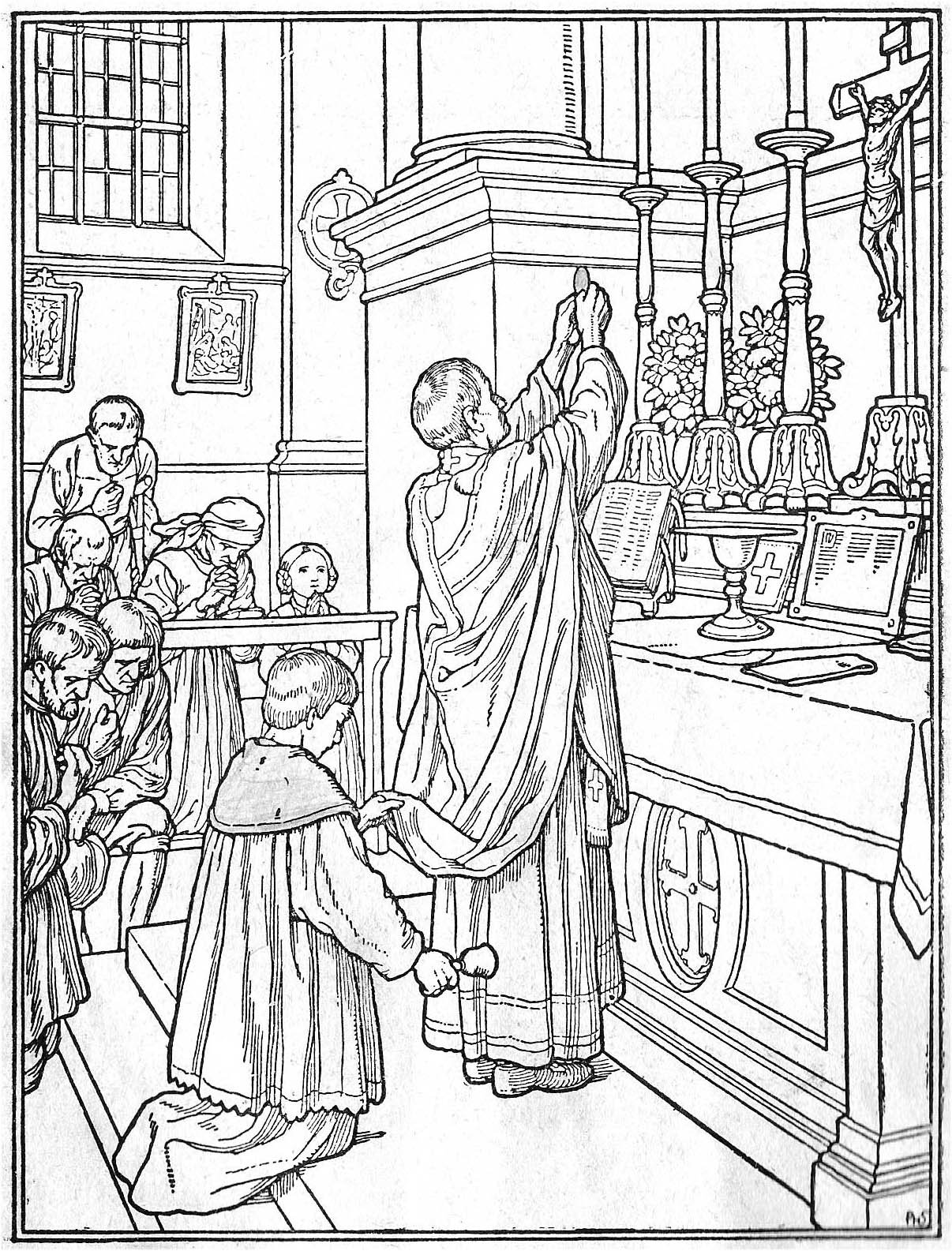
The Holy Mass, is the unbloody re-presentation of the one perfect Sacrifice of Jesus Christ on Calvary.
It is not a mere commemoration, not a symbolic remembrance, and not simply a gathering of the faithful to read Scripture and share a meal. It is a true and proper sacrifice, the same sacrifice of the Cross made present again on the altar, with the same Victim and the same High Priest, Jesus Christ Himself, now acting through the ministry of the ordained priest.
This understanding rests on a fundamental theological principle: Christ’s sacrifice on Calvary was offered once in history, but its value is eternal and infinite, transcending time. The Mass does not repeat that sacrifice, because what is perfect cannot be improved upon and what is eternal cannot be multiplied. Rather, the Mass makes that single sacrifice present across all times and all places, so that the faithful of every age can participate in the very act of Redemption. The Council of Trent defined this with great precision, stating that the Mass is a truly propitiatory sacrifice, and that through it God is appeased, grants grace and the gift of penitence, and forgives sins when we approach with a sincere and contrite heart.
The traditional Mass, known as the Tridentine Mass or the Mass of All Ages, codified by Pope Saint Pius V in 1570 following the Council of Trent, is celebrated in Latin, which is not merely a historical accident but a theological statement. Latin is a dead language, meaning it does not evolve, does not shift in meaning over time, and does not belong to any single people or nation. It is the sacred language of the Western Church, uniting Catholics across centuries and continents in a single voice. When a Catholic assists at the traditional Mass in Rome, in Tokyo, in Buenos Aires or in Lagos, he hears the same words, the same chants, and participates in the same sacred action. This universality is itself an expression of the catholicity of the Church.
The structure of the traditional Mass reflects a profound theological architecture. It is divided into two principal parts: the Mass of the Catechumens and the Mass of the Faithful. The first part, corresponding roughly to what later theology would call the Liturgy of the Word, was historically the portion which unbaptized candidates for baptism were permitted to attend before being dismissed. It consists of prayers at the foot of the altar, the Introit, the Kyrie, the Gloria, the Collect, the Epistle, the Gradual, the Gospel, and the Sermon when given. The second part, the Mass of the Faithful, is the sacrificial heart of the rite, encompassing the Offertory, the Canon, and the Communion.
The Canon of the Mass deserves particular attention. It is the ancient, unchanging prayer of consecration at the center of the rite, prayed by the priest in a low voice, often silently, with the congregation kneeling in adoration. This silence is not an exclusion of the faithful but an invitation to interior participation in a mystery that surpasses words. The Canon contains the words of consecration, through which the bread and wine are transformed into the Body and Blood of Christ. This transformation is called transubstantiation, meaning that the entire substance of the bread becomes the Body of Christ and the entire substance of the wine becomes the Blood of Christ, while only the appearances of bread and wine remain. What is on the altar after the consecration is not bread and wine that symbolize Christ, nor bread and wine alongside Christ, but Christ Himself, truly, really and substantially present under the eucharistic species.
The role of the priest in the traditional Mass is understood in strict terms of sacrifice and mediation. The priest does not preside over an assembly as a chairman presides over a meeting. He acts in persona Christi, in the person of Christ, offering the sacrifice to God the Father on behalf of the whole Church. This is why the traditional priest faces the altar and the tabernacle, rather than the congregation, for the greater part of the Mass. He is not performing for an audience. He is leading the people toward God, oriented together with them toward the divine, offering the sacrifice in their name and for their benefit. This orientation, called ad orientem, expresses visibly the vertical dimension of the liturgy, its character as an act addressed to God rather than a horizontal exchange between priest and people.
The traditional Mass also possesses a profound sense of sacred awe, what the theologians call the sense of the numinous, the experience of standing before the Holy. The use of incense, the chanting of Gregorian chant, the multiple genuflections, the careful and deliberate gestures of the priest, the silent Canon, the ringing of bells at the consecration, the communion rail where the faithful kneel to receive the Body of Christ on the tongue from the hand of the priest — all of these elements are not decorative additions but theological statements in gesture and symbol. They communicate what words alone cannot fully express: that something of infinite importance is taking place, that God Himself is present, and that the appropriate response of the creature before the Creator is adoration, silence, and humility.
The Mass is also understood as a cosmic and hierarchical act. It is not the prayer of one congregation in one place at one time. Every Mass is united to every other Mass ever celebrated and to the eternal liturgy of Heaven described in the Book of Revelation, where the Lamb that was slain stands before the throne of God and the angels and saints offer perpetual worship. The earthly liturgy participates in the heavenly liturgy. The priest at the altar joins his voice to the choir of angels. The faithful kneeling in the pew are united, across the veil of death, to all the saints who have gone before them.
The fruits of the Mass are traditionally enumerated as fourfold. The Mass is offered first as an act of adoration, giving to God the worship that is His due as Creator and Lord. Second, it is offered as an act of thanksgiving for all the benefits, natural and supernatural, that God has bestowed upon humanity. Third, it is offered as an act of propitiation, appeasing the divine justice for the sins of the living and the dead, including the souls in Purgatory who can themselves no longer merit but can benefit from the satisfactory value of the sacrifice offered on their behalf. Fourth, it is offered as an act of petition, asking God for the graces needed by the Church, by individuals, and by the world.
This fourfold purpose explains why the traditional understanding of the Mass insists so strongly on its sacrificial character. A mere communal meal or a service of scripture reading can inspire, instruct, and build community, but it cannot propitiate, it cannot satisfy divine justice, it cannot offer the infinite reparation that infinite Love required in response to human sin. Only the sacrifice of Christ has that power, and the Mass makes that sacrifice present precisely so that its infinite merits can be applied to the needs of the Church and of souls throughout history.
The faithful who assist at the traditional Mass are not passive spectators. Though they do not speak the words of the Canon and do not stand at the altar, their interior participation is essential. They are called to unite their own sacrifices, their sufferings, their works, their entire lives, to the sacrifice of Christ being offered on the altar. The Mass is the source and summit of the Christian life not because it is a pleasant or uplifting ceremony, but because in it the Christian encounters directly and substantially the act that redeemed him, and is given the grace to conform his own life increasingly to the pattern of the Crucified.