The Crusades
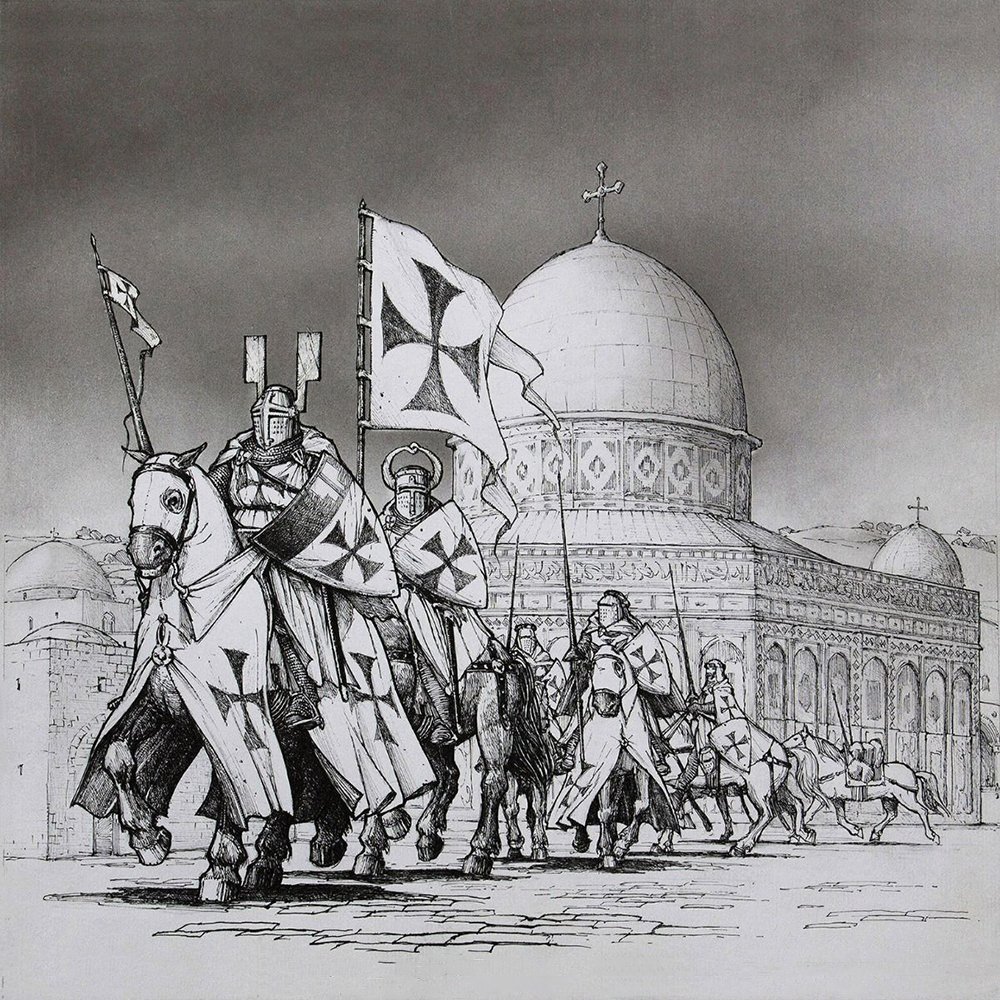
A detailed history of the Crusades, the religious military campaigns that defined the late Middle Ages,
presenting both the medieval perspective and modern critical analyses.
THEOLOGICAL FOUNDATIONS OF THE CRUSADES
The Concept of Holy War
Important medieval distinction:
Christendom was not pacifist. There was a concept of just war ( bellum justum). ) developed by Saint Augustine and Saint Thomas Aquinas.
Criteria for just war:
Legitimate authority – Only a king/pope can declare war.
Just cause – Defense, restitution, punishment of injustice.
Right intention – Not out of greed/hatred, but for the common good.
Last resort – Other solutions have been tried.
Distinction of combatants – Do not deliberately kill innocents.
Probability of success – No futile war
What made a war a “Crusade”:
In addition to the criteria above, a specific Crusade had:
Papal authorization – Pope declared war as a way to defend the faith.
RELIGIOUS PURPOSE – To recover Christian lands OR convert heretics
SACRED VOW – Crusaders swore an oath before God.
PLENARY INDULGENCE – Complete forgiveness of sins.
SYMBOL OF THE CROSS – Nailed to the chest/shield (hence “Crusade”)
The Situation in the Holy Land – Motivation
11th century context:
Christian lands conquered (634-638):
Muslims conquer:
Palestine (Holy Land)
Egypt
Syria
Jerusalem (638)
Result:
Eastern Christians (Orthodox, Syrians) fall under Islamic rule.
Christian pilgrimages to the Holy Land continue (with difficulty).
Some acts of persecution against Christians
Situation in the 11th century – The Crisis:
Islamic dynasties change:
Abbasids (who previously tolerated Christians) weakened
Turkish Seljuks conquer the Holy Land (1070s)
Turks are intolerant. towards Christians.
Pilgrimages are prevented/charge exorbitant fees.
Reports of harassment are increasing.
Byzantine Emperor in Panic:
Constantine IX Monomachos (who died):
Successor Alexius I Komnenos (1081-1118) faces crisis:
Situation of the Byzantine Empire:
Lost lands in Asia Minor to the Seljuk Turks.
Weakened army
Constantinople, the capital, is under threat.
Need urgent help?
Alexis’s request to the Pope:
1095 – Alexius sends a delegation to Pope Urban II:
“The Christian Empire is collapsing. The Muslim Turks are advancing. I ask the Holy Father to summon warriors from Western Christendom to help their sister Church.”
Aleixo’s objective:
Recover territories in Asia Minor
Reaffirm Byzantine authority
To have Western mercenaries under control (he hoped).
Papal Response – Urban II Convokes
Pope Urban II (1035-1099):
Pope Urban II was a reformer who had:
Fought against investiture (the king’s power over bishops)
Restored moral standing of the clergy
Centralized papal authority
Synod of Clermont (November 1095):
Pope Urban II gathers French bishops in Clermont-Ferrand for Synod (council).
The Speech (as recorded):
[Note: We do not have the original speech, only later accounts from chroniclers]
According to Fulcher of Chartres (a present-day chronicler):
The Pope said approximately:
‘O people of Christendom! A terrible calamity afflicts Eastern Christendom. Christian brothers in the lands of Asia are being trampled by the infidels. The Holy Land – the place where Christ walked – is under Muslim rule.’
You who are Christian warriors, knights of Christ – you who commit acts of violence – why not direct them in favor of God? You who kill one another for secular territories – why not fight for the Holy Land?
Who will go with my blessing and liberate Jerusalem? Who will take a sacred vow to carry the Cross of Christ to the Holy Land?
To those who go, I promise: PLENARY INDULGENCE – complete forgiveness of all past, present, and future sins. Your armed pilgrimage to the Holy Land will be a full remission.”
Audience reaction:
The chronicler reports: “Hearing this, the entire crowd responded with a shout: ‘God wills it! God wills it!’ The Pope said: ‘If you respect this cry and make it your own, let no one say that it was not God’s will, for it was He Himself who inspired it.’”
Meaning of “God wills it” (Deus vult):
The phrase became the battle cry of the Crusades.
“Deus Vult!” = “God wills it!”
Soldiers engraved on their weapons/shields
He reaffirmed that war had divine sanction.
FIRST CRUSADE (1096-1099)
Preparation and Engagement
Massive response:
News of the Crusade spread throughout Western Christendom:
Who got involved:
Main nobles:
Godfredo of Bouillon (Duke of Lorraine)
most important military leader
Sold/pawned properties to finance
Promise: “I will go to Jerusalem with my sword”
Bohemund of Taranto (Prince of Taranto, Italy)
Ambitious adventurer
He hoped to conquer lands for himself.
Charismatic leader
Raymond of Toulouse (Count of Toulouse)
Important nobleman
More pious than others
He brought a priest along as an advisor.
Robert of Normandy (son of William the Conqueror)
Brother of the King of England
He sold ducal rights for money for the crusade.
Stephen of Blois (Count)
Married to the daughter of Guilherme Conquistador
He was accompanied by the army.
Ordinary soldiers:
Tens of thousands got involved:
Knights (noble warriors)
Squires (trained soldiers)
Infantry (common people with pikes/swords)
Priests (chaplains for sacramental administration)
Mixed motivations:
Religious – They truly believed in holy war.
Adventure – Young nobles sought glory
Material gain – They hoped to conquer land/wealth.
Leak – Some were fleeing problems in Europe.
Penance – Grave acts (murder) could be “redeemed” by the crusade.
Crusade Vow:
Each crusader took a solemn vow:
“Before God and His Church, I swear that I will go to the Holy Land with my weapon and my body to liberate it from the dominion of the infidels. I swear to fight until death or until Jerusalem is liberated. May God help me, and may God condemn me if I fail in this vow.”
Symbol of the Cross:
Each crusader received a cloth cross (sewn onto the chest/shoulder).
Usually red on a white background.
He identified him as a warrior of the Church.
Removing the cross meant betrayal/desertion
The March – A Two-Year Walk
Lot:
The Crusaders traveled by land (there was no unified fleet):
Western Europe
↓ (1096-1097)
Eastern Europe (Hungary, Balkans)
↓
CONSTANTINOPLE (April 1097)
↓
ASIA MINOR
↓
SYRIA
↓
PALESTINE/JERUSALEM (July 1099)
Problems along the way:
People’s Crusade (Initial Disaster):
Before the nobles arrived, Preacher Peter (“Peter the Hermit”) recruited 40,000 ordinary people:
Poor people seeking the promised land
No military training
Led by a fanatical clergyman
Destination:
March for Hungary = conflicts with locals
They arrived in Constantinople (1096)
Alexius sent them to Asia Minor.
COMPLETE MASSACRE Seljuk Turkish hairs
Only a few survived.
Lesson: A Crusade was a military expedition, not a religious pilgrimage.
Relations with Byssantinos:
When nobles arrived in Constantinople:
Aleixo was suspicious of them.
He feared they would conquer lands for themselves (not for Byzantium).
He demanded an oath: “Conquered lands will return to the Empire.”
Nobles hesitated but swore (under pressure)
Voltage:
The Crusaders saw themselves as defenders of Christendom.
Byzantines saw themselves as the true Orthodox Church.
Mutual distrust persisted.
Asia Minor Journey:
The Crusaders entered Asia Minor (modern-day Türkiye):
Territory controlled by the Seljuk Turks
Hot, desert climate
Hunger and thirst
Constant battles
Main battles:
Nicomedia (1097) – First victory
Dorylea (July 1097) – Crucial victory against a large Turkish force.
March through the Syrian desert
Hunger and despair
Testimony of a crusader (Fulcher of Chartres):
“Hunger consumed us. We ate horse and camel meat. Some, in desperation, ate human flesh (of dead Turks). The heat was unbearable. Many fell dead. But we continued, for we knew that God was calling us to Jerusalem.”
Siege of Antioch (October 1097 – June 1098):
First major Muslim city discovered:
High walls, well defended
Occupied by large Turkish/Syrian force
The Crusaders were unable to penetrate.
Strategy:
Prolonged siege (8 months)
Famine in the Crusader camps
The desert of Asia Minor did not produce food.
Morale is falling
Betrayal/Strategy:
The Crusaders managed to enter through:
Bribe to local guard (30,000 gold)
Night infiltration
Surprise within the city
Massacre:
When the city fell:
Massacred population
Chroniclers speak of “streets flowing with blood”
Spoils (wealth) distributed among leaders
Bohemund claimed Antioch for himself (violating his oath to return it to Byzantium).
March to Jerusalem – The True Crusade
From Antioch to Jerusalem (1098-1099):
The final leg of the journey, approximately 600 km, took about 10 months.
Difficulties:
The march continued through the Syrian desert.
Scarce supplies
Intense heat
Reduced troop numbers (many died on the march)
Approximately 60,000 left Europe; only about 12,000 arrived in Jerusalem.
Villages conquered:
Maara (1098) – Massacre of the population
Tripoli (1099) – Refuses to surrender, suffers siege.
Jaffa (1099) – Coastal port, conquered
Growing religious climate:
As they drew closer to the Holy Land:
Religious climate intensified
The priests reminded them that they were treading on land where Christ had walked.
Penance and confession before battles
Solemn processions
Siege and Conquest of Jerusalem (June-July 1099)
Approximation:
Crusaders arrived, view of the city (June 1099):
Crusaders’ reaction:
The chronicler recounts: “When we sighted Jerusalem, everyone fell to their knees and wept with joy. Many kissed the ground. ‘Jerusalem! Jerusalem!’ they cried. We knew that God had guided us.”
Defense of Jerusalem:
City occupied by an Islamic garrison.
High and well-defended walls
Population: ~20,000
Armament of the Crusaders:
Catapults (built on site)
Siege towers (for scaling walls)
Rams (ready to batter down gates)
Archers (covered infantry)
Siege tactics:
Initial problems:
Water shortage – Christendom besieging Jerusalem without sufficient water.
Islamic defenses – Muslims burned wells
Climate – Extreme heat, illness
Breakthrough (July 14-15):
The Crusaders discovered:
The wall had a weak point (southeast).
They built a siege tower.
They placed a platform against the wall.
Knights climbed inside.
The columnist describes:
“The wall gave way. Our men shouted ‘God wills it!’ and ran inside. The infidels fled in panic. We entered the Holy City.”
The Jerusalem Massacre (July 15-16, 1099):
What happened:
After penetrating the walls:
The entire population was massacred.
Muslims, Jews, even some local Christians.
It lasted approximately 24 hours.
Chroniclers speak of “rivers of blood”
Description of Fulcher of Chartres:
“No one was spared. Women and children were killed along with warriors. Blood flowed through the streets. Solomon’s Temple was desecrated with blood. It was said that 70,000 were killed, though perhaps that is an exaggeration.”
Disputed numbers:
Modern estimates: ~3,000-15,000 died (not 70,000)
Medieval chroniclers exaggerated the numbers.
The violence was extreme nonetheless.
Medieval justification:
Retaliation – They remembered persecuted Christians.
War – Rules of medieval warfare: if a city resisted, its population could be killed.
Religious cleansing – Removal of “infidels” from the Holy Land
Christian reaction:
After the massacre:
The Crusaders went straight to the Church of the Holy Sepulchre.
Solemn procession around the temple
Celebration of Mass
Tears of joy
Chronicler:
“Their hearts overflowed with joy. They were in Jerusalem, the place where Jesus had risen from the dead. Their struggle, their suffering, thousands of deaths – it was all justified. They had liberated the Holy Land.”
III. KINGDOM OF JERUSALEM (1099-1187)
Establishment of a New State
Organization of the new kingdom:
Victorious crusaders had to govern:
Political structure:
KING OF JERUSALEM
Prince of Antioch (Bohemund and successors)
├─ COUNTY OF TRIPOLI
├─ EDESSA COUNTY
Several BARONS (lords of castles)
First King:
Godfrey of Bouillon was chosen as leader:
He refused the title “King” (he thought it was sacrilegious).
He accepted the title “Advocate of the Church of the Holy Sepulchre”.
He effectively ruled as a monarch.
Successors:
Baudouin I (cousin of Godfrey) – First to accept the title “King”
Baudouin II
Fulco of Anjou (king of Italy who married into the lineage)
William of Tyre (later King)
Kingdom Characteristics
Feudal structure:
The Kingdom of Jerusalem functioned like a European feudal kingdom.
King on top
Great nobles as vassals
Little knights
Local population (Christians, Muslims, Jews)
Population:
European Crusaders:
Approximately 200,000 non-peak
Most people owned property.
Christian sites:
Syrian/Greek Christians who were already living there
Converted over time
Main occupation (agriculture, trade)
Muslims:
Majority of the population
Some fled after the conquest.
Others remained as “dhimmis” (protected population).
They paid special taxes.
Jews:
Minority presence
Some fled to Islamic communities.
Some remained under protection.
Business:
The kingdom became prosperous through:
Silk Road (East-West trade)
Ports (Jaffa, Beirut, Sidon)
Oriental spices
European products
Military Orders – Guardians of the Kingdom
Templars:
An organization formed to protect pilgrims:
Function:
Forts in strategic castles
Military elite
Guardians of treasures/relics
Guardians of “banks” for pilgrims
Structure:
Each Templar commander controlled important castles:
Krak des Chevaliers (Syria) – Most famous castle
Château Pèlerin (Palestinian coast)
Multiple castles in Syria
Hospitals:
Similar organization focused on health:
Function:
Hospitals for wounded crusaders
Patient care
Military defense as well
Meaning:
Two orders together = strengthening of the kingdom
Permanently trained combatants
Well-defended castles
Communion with Europe maintained
Life in the Kingdom of Jerusalem
How the crusaders lived:
First-generation nobleman:
A knight who came from Europe:
Received land grant (fief)
He built a castle using local stone.
He married the daughter of a local nobleman (frequent).
He became a “Frankish” (as all European crusaders were called).
Cultural adaptation:
The Crusaders became increasingly “orientalized”:
They learned Arabic to negotiate.
They ate local food.
They wore lighter clothing (hot weather).
They adopted local customs.
Conflict between generations:
First generation (1099-1120) = very religious, warlike
Second generation (1120-1140) = born in the Holy Land, less religious.
Clergymen complained that they were becoming “worldly”.
Example of medieval lettering (William of Tyre):
“The young men born in this land do not know the chastity of their parents. They are effeminate, they adopt the clothes of the infidels, they learn their language, they marry their daughters. How can they be true Christian warriors?”
Daily life:
For noblemen:
Morning = court hearings (to resolve disputes)
Noon = land patrol
Afternoon = combat training
Night = feast/rest
For farmers/artisans:
Agricultural work or trade
Participation in defense (if attacking)
Practical Christian faith (mass, confession)
Marriage and Sexuality:
Unlike Europe:
Some crusaders married local Muslim women who had converted.
The Papacy condemned this.
Mixed offspring grow
Internal Conflicts
Fight between factions:
The Kingdom was not united.
Main factions:
Royal family (Baudouin/Amalrico)
Local nobles (sons/grandsons of the crusaders)
Military orders (Templars and Hospitallers)
Clergy (Patriarch of Jerusalem and his bishops)
Conflicts:
Disputes over the king’s power
Conflicts between nobles over land
Military orders sought autonomy.
Clergy versus secular power (like Europe)
Example: King Gerard I (1170-1174):
Leprosarium (had leprosy) that became king:
Loyalty divided among factions
Incapable of military command.
Weakened Kingdom
Consequence: Vulnerability when a greater threat arises.
SECOND AND THIRD CRUSADES
Rise of Saladin – The Islamic Counter-Offensive
Saladin (Salah ad-Din, 1137-1193):
Islamic military leader who decided to expel the crusaders:
Background:
Born in Tikrit (present-day Iraq)
Educated in an Islamic court
Military competent generals
Objective: to unify fragmented Islam.
Strategy:
Saladin:
He unified the Islamic emirates.
Conquered coastal cities (cutting off the European resupply kingdom)
He built a standing army.
He waited for an opportunity to deliver the final blow.
The Opportunity – Battle of Hattin (July 1187):
Context:
King Gerard I died. His brother Gerard III was weak. Raynaud de Chatillon
was regent. – a brutal nobleman.
Provocation:
Raynaud attacked a Muslim caravan passing through his lands:
He looted gold and spices.
He killed the guards.
Saladin demanded reparations.
Raynaud refused (“Let your Muhammad recover!”)
Saladin decides to attack:
Saladin summoned a giant army:
Approximately 12,000 riders
50,000 infantry
The Kingdom of Jerusalem managed to obtain approximately 20,000 in total.
The Battle:
Crusaders marched to Hattin (near the Sea of Galilee)
Saladin cut off the retreat.
Crusader army siege
The columnist reports:
“The drought and the heat were unbearable. Without water, our men fainted. Saladin surrounded us. We tried to break through the encirclement, but they were repelled. At the end of the day, we had lost.”
Result:
Complete defeat of the crusaders
Approximately 1,000 crusaders killed.
4,000 captured
Captured Crusader leaders (including Raynaud)
Raynaud’s execution:
Saladin personally executed Raynaud.
He had sworn to kill Raynaud
He offered his sword.
Raynaud refused to convert to Islam.
Saladin cut off his head.
Meaning:
Hattin marked the end of Crusader supremacy. The kingdom collapsed.
Conquest of Jerusalem (October 1187)
Beyond Hattin, only Jerusalem and a few castles remained.
Saladin marches towards Jerusalem:
The city had lost most of its defenders in Hattin.
Approximately 2,000 defenders only.
Frightened civilian population
Very low morale
Asenio:
Saladin besieged the city for 2 weeks:
Bombardment with catapults
No one could leave.
Scarce supplies
Negotiation:
Unlike in 1099, Saladin did not massacre:
It offered the city a chance to surrender honorably.
The population could get out alive.
Christians could buy tickets.
A Western chronicler describes:
“Saladin was chivalrous, unlike our ancestors who killed everyone. He offered the city a chance of surrender. The patriarch negotiated terms.”
Saladin’s appetizer:
Saladin entered the Al-Aqsa Mosque (which the Crusaders had transformed into a church):
Test description:
“Saladin removed the cross from the top of the Mosque. The Muslim crowd cheered. Christians lamented. The Holy Land had returned to Islam.”
Rescue of Christians:
Poor Christians = were left behind (enslavement)
Wealthy Christians paid ransom (~dinar per person)
Clergymen = allowed to march safely to Tyre (still a Christian port)
Meaning:
Jerusalem was lost to Christendom for 88 years after the Crusader conquest.
Second Crusade (1147-1149)
Response to the loss of Edessa (1144):
The first significant defeat was the loss of County Edessa.
It fell to Zengis (Islamic general).
The Pope called for a Second Crusade.
Leaders:
King Louis VII of France (great monarch)
King Conrad III of the Holy Roman Empire
Papacy fervently supporting
Preacher: Saint Bernard of Clairvaux – Cistercian Abbot
One of the most inspired men of the Middle Ages.
The sermons attracted tens of thousands.
He convinced two monarchies to engage.
Result:
March through Asia Minor
Fighting with Turks
Defeat in Doriléia
They arrived in the Holy Land with reduced forces.
Failed attempt to conquer Damascus
Withdrawal (1149)
Meaning:
The Second Crusade was a relative failure. Christian morality was shaken.
Third Crusade – Richard the Lionheart (1189-1192)
After the fall of Jerusalem (1187):
The Pope called for the Third Crusade in response.
Key leaders:
Richard I of England (“Richard the Lionheart”)
Young warrior king
Reputation for bravery
He personally led the expedition.
Philip II of France (“Philip Augustus”)
Ricardo’s rival
He also arrived in the Holy Land.
Conflict between the two
Frederick Barbarossa (Holy Roman Emperor)
He was old, but he led a large army.
He died in Asia Minor (drowned in a river).
His army disintegrated.
A complicated journey:
The Crusaders traveled along different routes:
Ricardo and Felipe sailed through the Mediterranean.
Ricardo conquered Cyprus along the way (it provided a base).
Conflict between Ricardo and Felipe:
Felipe wanted to finish quickly and return (domestic conflicts)
Ricardo wanted complete campaigns.
They disputed over command.
Philip returned to France (1191)
Ricardo’s solo campaign:
Ricardo continued on alone with a reduced army:
Siege of Acre (1191):
Strategic city on the coast:
Surrounded by the crusaders
Defended by an Islamic garrison
The siege lasted several months.
Chronicler’s description:
“Ricardo was ruthless. He catapulted the heads of Muslims over the walls. The defenders responded in kind. The carnage was horrific.”
Acre remains:
The city finally surrendered (July 1191)
The population was massacred.
Ricardo ordered the death of approximately 2,700 prisoners.
Reason: Saladin had executed crusaders; Richard retaliated.
March to the south:
Richard continued south to Jerusalem:
Battle of Arsuf (September 1191):
Saladin tried to block the advance:
Crusaders defeated Islamic force
Saladin withdrew.
Siege of Jaffa:
Ricardo captured the port of Jaffa.
It allowed for the supply of Europe.
Base for the march to Jerusalem
Final negotiation:
Richard approached Jerusalem but failed to conquer it.
Saladin defended well.
Ricardo is weak on supplies.
I couldn’t maintain a prolonged siege.
Agreement (September 1192):
Richard and Saladin negotiated peace:
Terms:
Acre and the coast remain with crusaders.
Jerusalem remains with Islam.
Christian pilgrims allow free access.
3-year truce
Ricardo’s return:
Ricardo sailed back to Europe.
Prison in Austria
Ransom eventually paid
He returned to England.
Meaning:
The Third Crusade restored coastal territory but not Jerusalem. It showed that complete reconquest was impossible.
Posterior Crusades (Fourth to Eighth)
Fourth Crusade (1202-1204) – The Disaster
Stated objective: Liberate Jerusalem via Egypt.
Recruitment:
Primarily from Venice (maritime republic):
Venetians would provide naval transport.
Crusaders would pay approximately 95,000 gold coins.
Venetians wanted to expand trade.
Problem:
The Crusaders arrived in Venice without enough money.
Revenue had been lower.
Venetians refused to leave without payment.
Venetian Solution:
“We will help against Egypt, BUT first you must help against Zara (our rival on the Dalmatian coast).”
Fourth Crusade veers towards Zara:
Crusaders attack Zara (Christian city!)
Pope excommunicated Crusaders (violation of mission)
Venetians had their rivalry resolved.
Final Detour – Constantinople:
The deposed heir to the Byzantine Empire (“Alexius”) proposed:
“Help restore my father to the throne of Constantinople. I will pay you to go to Egypt.”
The crusaders agreed.
Siege and Sack of Constantinople (1204):
Historical context:
The schism between the Roman (Western) and Orthodox (Byzantine) Churches had occurred in 1054. Hostility remained.
What happened:
Crusaders besieged Constantinople (the Orthodox Christian capital!).
They managed to get through the walls.
Massacre of the population
Churches were looted.
Relics were stolen.
Orthodox patriarch was expelled.
Testimony of Nicetas (Greek historian):
“The Latins [Western Crusaders] sacked the city as if it were pagan territory. They took golden chalices, relics of saints, candelabras. They violated the Hagia Sophia Cathedral.”
Establishment of a Latin Empire:
The Crusaders established the “Latin Empire” in Constantinople.
It lasted only 57 years (1204-1261).
There was no local support.
Consequence:
Fourth Crusade:
It didn’t reach Egypt.
He looted the Orthodox Christian capital.
It deepened the schism between East and West.
It showed that crusades could go astray.
Papal verdict: Pope Innocent III regretted the decision, but did not reverse it.
Fifth Crusade (1217-1221)
Objective: To conquer Egypt as a base for Jerusalem.
Leaders:
King Andrew II of Hungary
Italian and French counts
Papacy supporting
Campaign:
Landing in Damietta (Nile Delta)
Siege and capture of the city (1219)
Inner march
Problem:
The crusaders advanced, but:
Nile floods hampered march.
Islamists counterattacked
Isolated crusaders without supplies
Withdrawal:
The Crusaders had to return to the coast.
Damietta was retaken by the Muslims.
Strategic failure
Sixth Crusade (1228-1229) – The Diplomatic Crusade
Emperor Frederick II:
The young emperor decided to try diplomacy:
The Pope excommunicated him (conflict over investiture).
Even so, he left in Crusade.
Negotiation:
Frederick negotiated with Saladin:
Agreement (1229):
Jerusalem given to the crusaders (!) for 10 years
The Crusaders allowed the Muslims to retain the Al-Aqsa Mosque.
Coexistence of two religions in the same city
Coronation:
Frederick was crowned “King of Jerusalem” in the Church of the Holy Sepulchre (1229)
Meaning:
The only time Jerusalem was recovered through diplomacy, not force.
Duration:
The agreement lasted less than 15 years. Jerusalem returned to Islam.
Seventh Crusade (1248-1254)
Louis IX (“Saint Louis”):
A very pious French king decided to liberate the Holy Land:
Preparation:
Sold properties
He spent years preparing.
He led a large army.
Campaign:
Similar to the Fifth Crusade:
Landing in Damietta
Initial conquest
Interior advance
Defeat in the March
Capture:
Louis was captured along with the army.
Redemption negotiation
Louis paid approximately 400,000 dinars for gold.
Released
Result:
The Crusade failed, but Louis remained in the Holy Land.
He spent 4 years there.
Strengthened coastal defenses.
He returned to France (1254)
Eighth Crusade (1270)
Last Great Crusade:
Louis IX tried again in his old age:
Unexpected Destiny:
Instead of the Holy Land, he went to Tunisia (North Africa):
He hoped to convert the sultan.
Sultan died soon after.
The crusade was abandoned.
Death of Luis:
Luis died in Tunisia (probably in the plague):
He never reached the Holy Land.
His grandson continued to wait for a truce.
He returned to Europe.
Meaning:
The Eighth Crusade marked the end of the great Crusades. There was never again a large-scale papal mobilization to Jerusalem.
Crusades against heretics in Europe
Albigensian Crusade (1208-1270)
Context:
Catharism (heresy) was spreading in Occitania (southern France):
Heretical population:
Approximately 30-40% of the population were Cathars.
Nobles supported (independence from the French monarchy)
Entire cities were heretical.
Papal Response:
Pope Innocent III called for a crusade (1208):
Objective: to destroy Catharism
Leaders:
Simon de Montfort (ambitious French nobleman)
French kings (Philip II)
Clero local
Dramatic campaign:
Saque de Béziers (1209):
City with a mixed population (Catholics and heretics):
Besieged by crusaders
He surrendered on conditional terms.
Crusaders entered
Massacre:
Chronicler reports (attributed to papal legate):
“We lack the means to distinguish heretics from Catholics. Kill them all; God will know his own!”
Reality:
20,000 people massacred:
Catholics and heretics
Men, women, children
City destroyed
Continuation of the Crusade:
From Béziers onward, crusade became territorial conquest .
City after city:
Carcassonne (captured, population enslaved)
Toulouse (besieged multiple times)
Montségur (last Cathar stronghold)
Site of Montségur (1243-1244):
Fortified castle on a mountaintop:
The last Qataris took refuge there.
The siege lasted for months.
When it gave way, 200 Cathars were burned at the stake.
Result:
Catharism was eliminated .
The Occitan population was destroyed.
Lands conquered by the French monarchy
The Medieval Inquisition was established to hunt down survivors.
Moral judgment:
Medieval views it as:
Necessary defense of the faith
Elimination of heresy that threatened souls.
Modern perspectives show this:
Religious genocide
Massacre of civilian population
Territorial conquest disguised as religion.
Northern Crusade (Teutonic)
Unlike the Crusades to the Middle East:
The Teutonic Order of Knights conquered Prussia (territory in the Baltic):
Context:
Prussia was pagan (non-Christian):
Baltic peoples worshipped nature gods.
There was no central political structure.
The land was forest/swamp.
Conquest:
Beginning in the 13th century, Teutonic Knights:
They founded castles.
They converted or killed the population.
They established a state of Teutonic Knights.
Structure:
Grand Master commanded
Knights ruled castles.
Local population converted (nominally)
Duration:
The Teutonic State lasted until 1560.
Defeated by the Lithuanians/Poles
Incorporated into Poland-Lithuania
Last effective crusade in the Baltic
VII. CONSEQUENCES OF THE CRUSADES
Impact on the Holy Land
Physical/Political:
Massive destruction
Looted cities
Reduced population
Unreclaimed arid lands
Demographic change
Many Muslims fled.
Eastern Christians (Greeks, Syrians) decreased
The population reorganized itself.
Islamic permanence
After 1291 (fall of Acre), zero cross-contamination.
The Holy Land remained Islamic.
Jerusalem definitively lost to medieval Christendom.
Impact on Christian-Islamic Relations
Hatred generated:
Crusader massacres have not been forgotten:
Muslims remembered Jerusalem (1099)
Saladin’s retaliation seen as just.
Muslim collective memory of Western aggression
Muslim perspective:
Christianity viewed as aggressive.
Fear of permanent “cross-return”
It fueled anti-Western hatred centuries later.
Long-lasting resentment:
Islamic attitudes towards the West remain marked.
Crusades are mentioned in modern extremist propaganda.
Historical trauma passed down through generations.
Impact on Europe
Economic:
expanded trade
Contact with the East brought spices.
Established trade routes
Venice/Genoa became richer.
Military technology
Compound arches
Siege techniques
New armor
Cultural:
Eastern knowledge
Islamic philosophy reached Europe.
Translated scientific books
Islamic mathematics/astronomy studied
Architecture/Art
Islamic influence on design
Decorative patterns
Construction techniques
Social:
Change of mindset
Europe witnessed the vastness of the world.
Ambition for expanded conquest
Preparation for further expansion
Population movement
Young nobles went on an adventure
Merchants followed
Establishing communities
Impact on the Church
Weakening of papal authority:
The papacy was compromised.
He called for massive wars.
Promoted masks
Credibility is open to question.
Criticism raised
Why did the Church kill in the name of Christ?
Why did indulgences sell forgiveness for killing?
I would cite the Protestants for this.
Reduced influence
The Papacy failed to keep Christendom united.
Kings began to question authority.
National independence grew
Deepening the East-West divide:
Sack of Constantinople
Orthodox Christianity viewed the West as an invader.
Permanent distrust
The schism was never healed.
VIII. HISTORICIST DEBATES ON THE CRUSADES
Medieval Perspective (Crusader View)
The Crusaders believed:
The Holy Land was Christian by right.
Jesus walked there.
Early Christians lived there.
Muslims have recently “conquered”
The war was just.
Defense of the faith
Liberation of persecuted Christians
Legitimate reconquest
The sacrifice was worth it.
Martyrs would gain Heaven.
Sins would be forgiven.
Glory would be perpetuated.
Islamic Perspective (Muslim Viewpoint)
Muslims saw:
Western invasion
Christendom attacked without provocation.
Unjustified massacres
Attempt to steal Islamic land
Religious aggression
Christians do not respect the rights of Muslims.
Unequal treatment of the population
Imposition of Christian rules
Just resistance
Saladin as a defensive hero
The recapture of Jerusalem as a triumph.
Expulsion of invaders as a duty.
Modern Perspective (Critical View)
Modern historians argue:
Unnecessary violence
Unjustified large-scale massacres
Civilians were targeted.
No difference between combatants and non-combatants.
Mixed motivations
Religion was an excuse for territorial conquest.
Economic gain was a real motivator.
The Papacy used the people for political ends.
Lasting negative impact
Cycle of hatred and retaliation
Transmitted collective traumas
Poisoned East-West relations
Comparison with today
Crusades used by Islamic extremists
They justify hatred towards the West.
They perpetuate stereotypes.
Traditionalist Response to Critics
Traditionalists argue:
Historical context matters.
Violence was the norm in medieval times.
Muslims also massacred
Double standard when judging Christianity
Military necessity
There was no modern civic-mindedness.
Cities resisted = population died
Medieval law of war accepted this.
Genuine motivation
Most crusaders sincerely believed.
They weren’t merely greedy.
Royal sacrifice (many died)
Positive gain
Cultural contact was beneficial.
Europe gained knowledge.
Preparing for the future
FINAL ANALYSIS – REASON FOR THE FAILURE OF THE CRUSADES
Why the Crusaders Failed to Keep the Holy Land
Military factors:
Numerical disadvantage
Christendom had a smaller population.
Islam had more soldiers available.
European supplies were long (over the ocean).
Climate and disease
Crusaders died of tropical disease.
Extreme weather was unknown.
Cancer (dysentery, typhoid, malaria)
Unfavorable terrain
The desert was Islamic territory.
Christians needed coastal castles.
Interior controlled by Islam.
Political factors:
Christian division
European nobles fought amongst themselves.
Kings had domestic conflicts.
Lack of strategic coordination
Christian incompetence
Some leaders were mediocre.
Poor tactical decisions
Lack of military intelligence
Growing Islamic unity
Saladin unified fragmented Islam.
Successors continued the unity.
Islam supported retaliation.
Economic factors:
Prohibitive cost
Maintaining an army abroad was incredibly expensive.
Maritime supplies were expensive.
Europe could not sustain itself for a century.
Limited economic gain
The Holy Land did not have valuable resources.
Trade didn’t offset the cost.
European economic fatigue
Religious factors:
Islamic psychological disadvantage
Muslims viewed it as a land of prophetic inheritance.
Religious motivation was high.
Willingness to die was greater
Christianity was weakening.
Religious fervor diminished over time.
Successive generations less religious
Crusades were becoming a convention, not a calling.
Crusades in Collective Memory
How Muslims Remembered the Crusades
Islamic narrative:
“For 200 years, the aggressive West invaded our lands. They massacred our people. They desecrated our holy cities. Saladin and his successors will repel the invader. The Holy Land has been recovered. Islam has triumphed over the aggressors.”
Lasting memory:
Crusades still mentioned in Arab speeches today.
Symbol of historical Western aggression
Justification for modern distrust
Oblivion in the West
Unlike Muslims:
Europeans have (relatively) forgotten the Crusades.
Considered a “medieval subject”
Not so integrated into Western identity.
Erased by the Renaissance/Enlightenment
Modern Resurgence
Osama bin Laden and Islamic extremists:
They revived the narrative of the Crusades.
They called the American invasion a “Crusade”.
They used the Crusades to mobilize against the West.
Modern Western response:
Some acknowledge the Crusades as a mistake.
They apologize (Pope John Paul II)
They are attempting to reconcile Islam and Christianity.
But the Islamic narrative remains alive.
CONCLUSION – MEANING OF THE CRUSADES
What were they?
The Crusades represented:
Peak of papal temporal power
The Papacy could summon kings.
The Papacy could promote massive war.
The Papacy was a geopolitical power.
Strength of sincere faith
Millions genuinely believed.
They sacrificed everything for religion.
Death in combat was seen as glorious.
A meeting of civilizations
Christendom came to know Islam directly.
Gaining mutual knowledge
But also trauma and hatred.
Limits of medieval power
The papacy failed to win permanently.
Temporal power had limits.
Willpower wasn’t enough against reality.
Why Did So Many Die?
Death estimates:
It’s difficult to say precisely, but approximately:
Dead Crusaders:
Direct battles: ~100,000
Gait disturbance: ~500,000
Disease in the Holy Land: ~200,000
Approximate total: ~800,000
Local population killed:
Massacres of civilians: ~200,000+
Disease/famine caused by conflict: ~500,000
Approximate total: ~700,000+
Why did so many die?
Lack of hygiene
Deadly plagues (dysentery, typhus)
contaminated water
Infected wounds without antibiotics
Extreme weather
Desert heat was killing
Water shortage
Unknown tropical diseases
Direct combat
Brutally effective medieval chivalry
Arrows/spears killed quickly.
No anesthesia for the wounded.
Hunger
Supplies were cut off.
Local crops destroyed
Marching through the desert without food
Lesson for Today
Historians draw conclusions:
Religion can mobilize the masses.
Faith transcends personal interest.
People die because of their beliefs.
Modern people underestimate this.
Power is limited.
Even with the best cause, failure is possible.
Geopolitical realities control
Intention does not guarantee results.
Violence has lasting consequences.
Memory of massacre remains alive centuries later
Cycles of hatred and retaliation
Forgiveness is rare in history.
Context matters.
We cannot judge medieval times by modern standards.
We cannot ignore the negative consequences.
Both are true.
GENERAL CONCLUSION:
The Crusades were a monumental expedition where Medieval Christendom attempted to reclaim the Holy Land through religiously authorized military force.
They were genuinely religious in their motivation and genuinely violent in their execution.
They failed militarily (the Holy Land was not held) but had an immense impact (knowledge, trade, trauma).
They represent both the best (sincere faith, sacrifice) and the worst. (massive violence, genocide) of Medieval Christendom.
His memory remains alive in modern Islam as a symbol of Western aggression and continues to affect East-West relations to this day.