The Holy Family
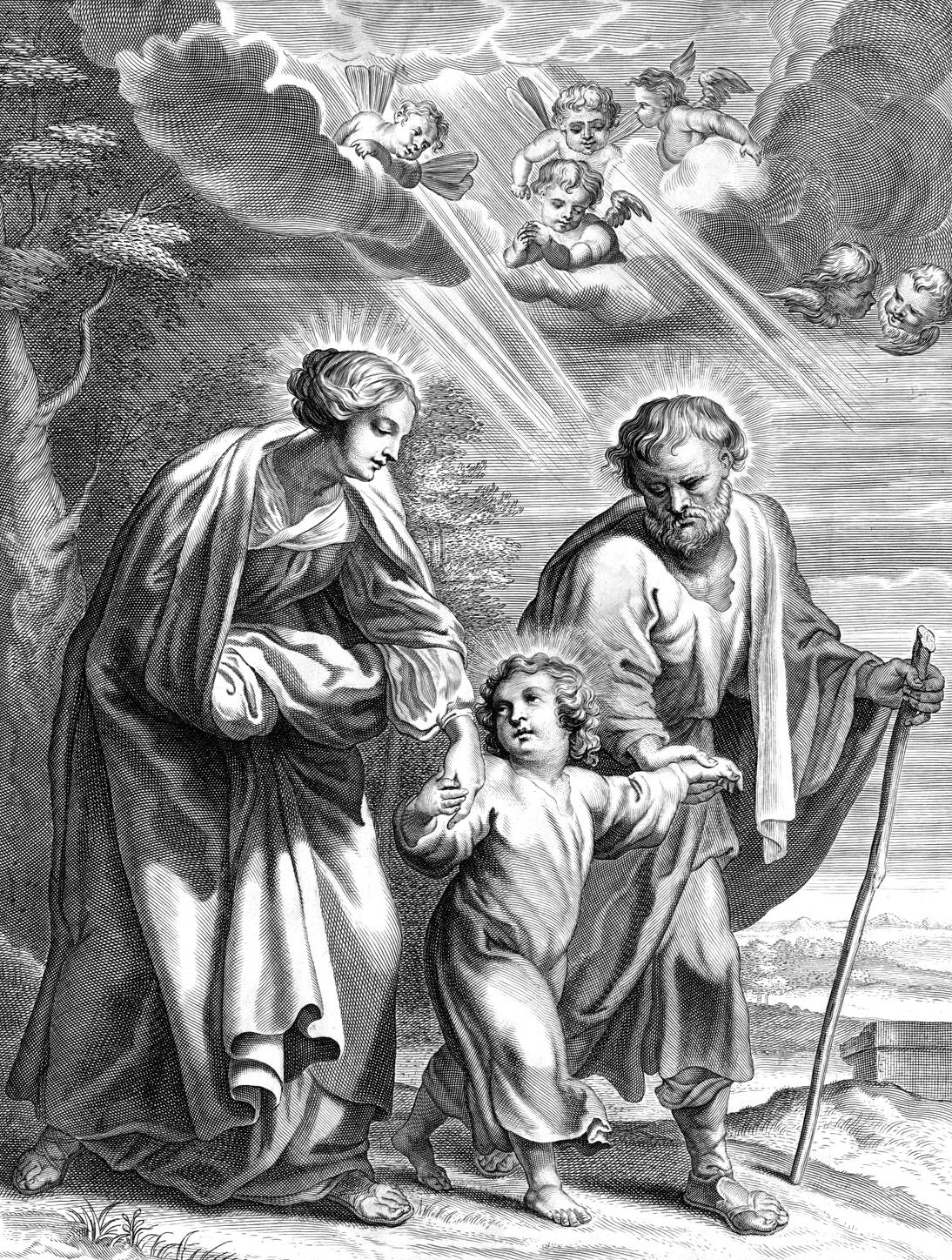
The Holy Family is the perfect model for all Christian families: Jesus, the Son of God made man; Mary, the Immaculate and ever-Virgin Mother; and Joseph, the just and silent patriarch.
In this family, God chose to be born and grow up as a man, submitting to the authority of earthly parents. Mary cared for the home with virginal maternal love, Joseph provided for them with honest work and protected them with courage, and Jesus obeyed with divine humility.
They were a family materially poor, but incredibly rich in grace, prayer, and virtue. They lived in Nazareth in seclusion and simplicity – three hearts united in perfect charity, chastity, and obedience to the will of the Eternal Father.
The Holy Family has forever sanctified domestic life, manual labor, family prayer, and the hidden life. It is the refuge of all families who seek to live according to God’s plan, a model of chaste love, filial obedience, and paternal devotion. In it is found the true peace that the world cannot give.
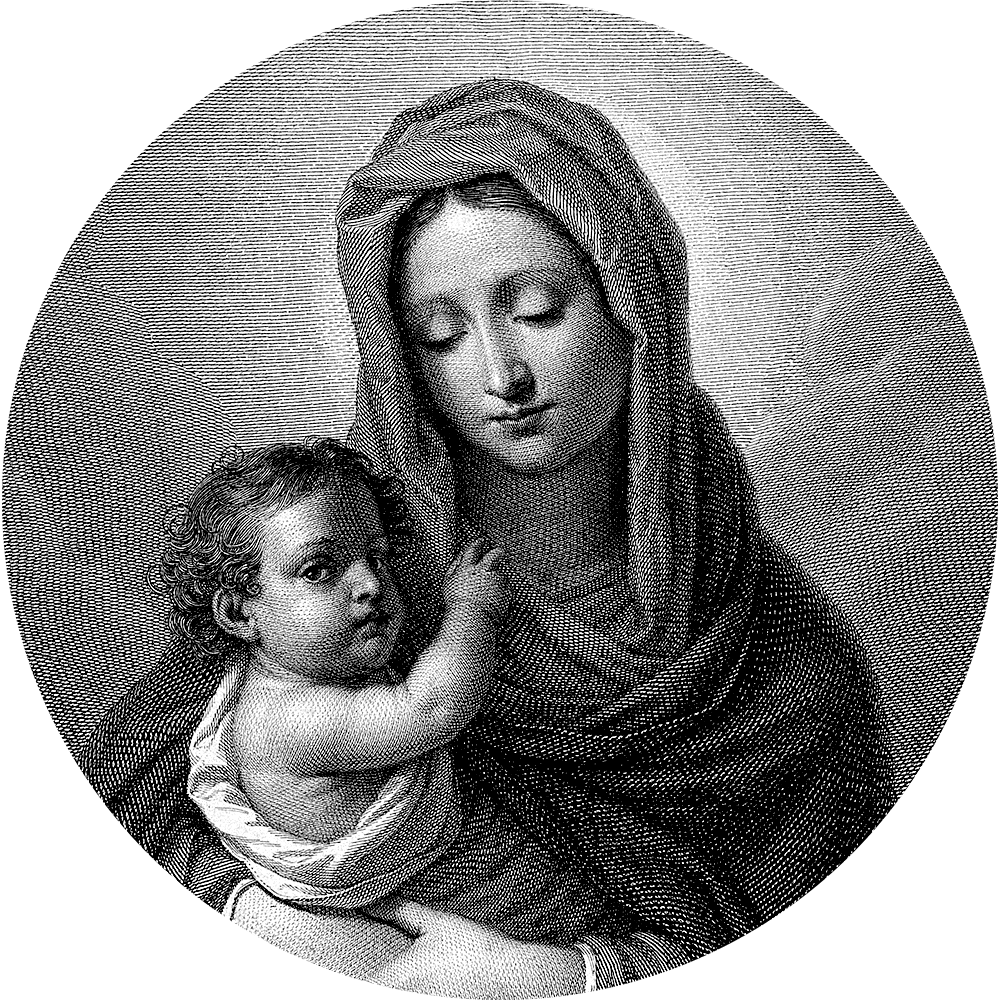
MARIA
The Mother of God (Theotokos)
Mary is venerated primarily because she gave birth to Jesus Christ, who is true God and true man. As the mother of Christ, she is literally the Mother of God – not in the sense that she created divinity, but that the one she bore was a divine person. This divine motherhood places her above all other saints and angels, for no creature has ever been so intimately united with God as she was during the nine months of gestation and throughout Jesus’ earthly life.
The New Eve and the New Garden
Church theologians have developed a profound parallel between Eve and Mary. Eve, in the Garden of Eden, said “yes” to the serpent and brought sin into the world. Mary, at the moment of the Annunciation, said “yes” to the angel Gabriel and brought the Savior into the world. Where Eve disobeyed, Mary obeyed. Where Eve brought death, Mary brought life. This cooperation of Mary with the divine plan was not passive – she needed to give her free and conscious consent for the Incarnation to take place. The destiny of humanity depended on this “Fiat” (let it be done) of Mary.
Immaculate since the Conception
The Church has always believed that Mary was preserved from original sin from the very first moment of her existence. This was necessary so that she could be a “worthy tabernacle” to receive the Son of God. Just as the Ark of the Covenant in the Old Testament was made of incorruptible wood and covered in pure gold to carry the divine presence, so Mary needed to be pure from the beginning to carry God himself in her womb. This preservation was not Mary’s own merit, but an anticipated grace of Christ’s merits – she was redeemed preventively, so to speak.
Always Virgin
Catholic tradition firmly maintains that Mary remained a virgin before, during, and after the birth of Jesus. She had no other children (the “brothers of Jesus” mentioned in the Gospels were cousins or close relatives, according to Catholic interpretation). Her perpetual virginity symbolizes her total consecration to God and the unique nature of her motherhood. The virgin birth also preserved the mystery that Jesus had no human father – he was conceived by the power of the Holy Spirit.
Mediatrix of All Graces
A central doctrine in traditional spirituality is that all divine graces reach the faithful through Mary. This does not mean that she replaces Christ – on the contrary, she always acts in dependence on her Son and according to His will. But just as she gave Christ to the world physically, she continues to give Christ to souls spiritually. No grace reaches us without passing through her maternal hands. Hence the saying: “It has never been heard that anyone who has had recourse to Mary’s protection was abandoned by her.”
Co-Redemptrix and Compassionate
Mary not only gave birth to the Redeemer, but also intimately participated in his redemptive work. At the foot of the Cross, she suffered with Christ in a unique way – theologians speak of the “seven sorrows of Mary” or of a “sword that pierced her soul,” as prophesied by Simeon. She offered her Son as a sacrifice for humanity, uniting her maternal sufferings to the redemptive sufferings of Christ. In this sense, she is a “co-redemptrix” – not because Christ’s redemption was insufficient, but because God wished to intimately associate her with this work.
Queen of Heaven and Earth
Mary was assumed into heaven body and soul, not experiencing the corruption of the tomb. There, she reigns as Queen alongside her Son, the King. She constantly intercedes for humanity, presenting our prayers to Christ. She is Queen of Angels, Patriarchs, Prophets, Apostles, Martyrs, Confessors, Virgins – of the entire heavenly court. Her royalty is not one of dominion, but of maternal intercession.
Mother of the Church and of All the Faithful
On the Cross, Jesus said to John, “Behold your mother,” and to Mary, “Behold your son.” This has been interpreted as Jesus entrusting all of humanity to Mary’s maternal care. She became the spiritual mother of all Christians. Every believer can turn to her as a child turns to their mother, with complete trust. She knows our weaknesses, our struggles, our needs – and intercedes for us as only a mother can.
Refuge of Sinners
Paradoxically, although she is the purest of all creatures, Mary is especially invoked by sinners. She never rejects those who seek her, no matter how grave the sin. Her maternal mercy reflects divine mercy. Many saints recount conversions through Mary’s intercession. She is seen as the last resort of the desperate, the hope in impossible cases.
Victorious over Satan
From Genesis it is prophesied that the “woman” would crush the serpent’s head. Mary is seen as this woman who, through her Son, defeats the devil. In Marian apparitions, she often appears treading on a serpent. She is “terrible as an army in battle array” against the forces of evil. The faithful turn to her for spiritual protection and deliverance from diabolical temptations.
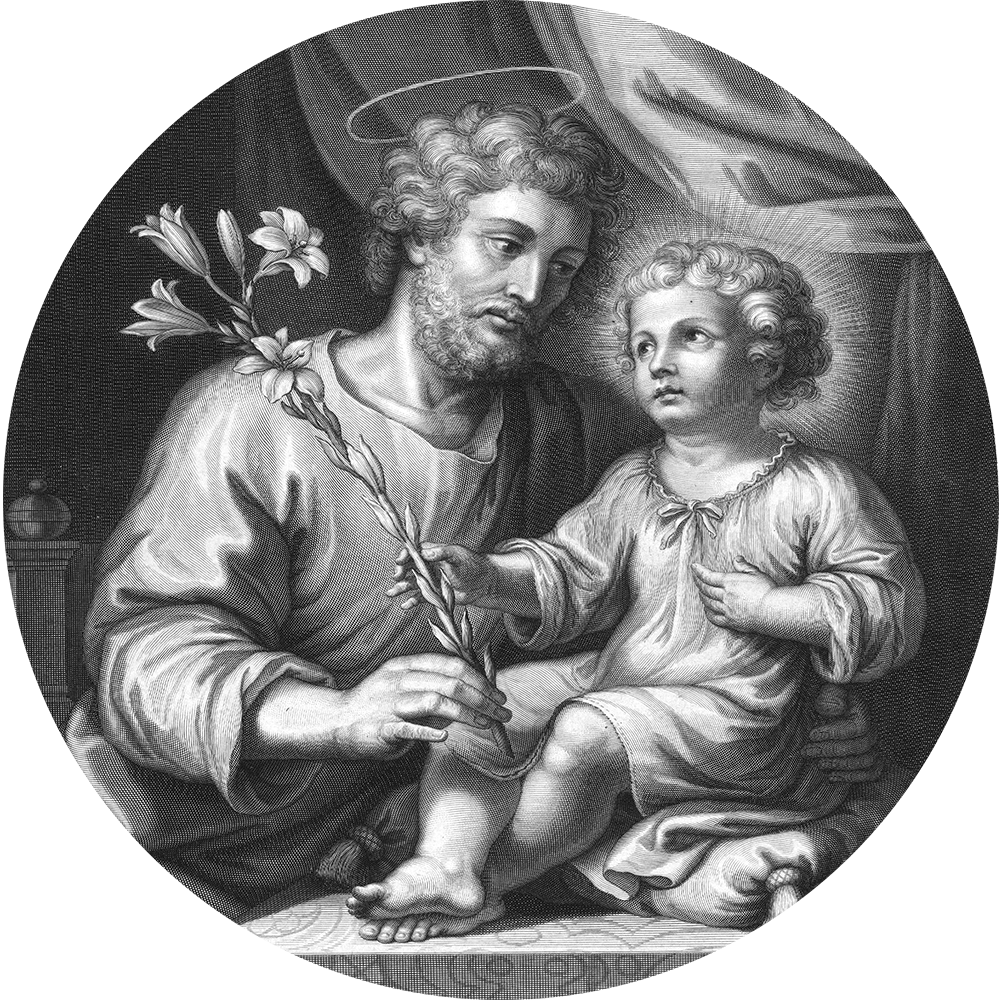
JOSEPH
The Just Man
The Gospel describes Joseph simply as a “righteous man”—an expression that in the Jewish context means someone perfectly aligned with God’s will. Joseph was a tzaddik, a completely righteous man. His righteousness was not merely legalistic, but full of mercy—when he discovered that Mary was pregnant, he considered secretly divorcing her so as not to expose her to public shame, although according to the Law he could have denounced her.
The Virgin Bridegroom
Joseph lived a unique marriage in history: a true, yet virginal marriage. He was truly Mary’s husband, but respected her perpetual virginity. This marriage protected Mary’s honor in Jewish society, where an unmarried pregnant woman would be stoned. Joseph assumed the legal paternity of Jesus, giving Him a recognized Davidic lineage, essential for Jesus to be identified as the promised Messiah of the House of David.
The Adoptive Father of the Son of God
Joseph had the extraordinary privilege of being called “father” by Jesus Christ. Although he was not the biological father, he exercised true fatherhood: he protected, provided for, educated, taught a trade, transmitted the Jewish faith, led Jesus to the Temple, and taught Him the Scriptures. Jesus learned to work with wood from Joseph, learned to pray with him, and grew up under his authority. The Son of God himself wanted to submit to an earthly father and learn obedience through him.
The Savior of the Savior
When Herod ordered the massacre of the innocents, it was Joseph who saved Jesus. Promptly obeying the angel who appeared to him in a dream, he got up in the middle of the night, took Mary and the Child, and fled to Egypt. Without this quick and courageous action of Joseph, Jesus would have been killed as a baby and the redemption of humanity would not have happened. Joseph was, literally, the savior of the Savior – not from eternal death, but from premature temporal death.
The Guardian of Mysteries
Joseph was a privileged witness to mysteries he could not fully comprehend: the virgin conception, the angelic apparitions, the adoration of the shepherds and Magi, the prophecies of Simeon and Anna in the Temple. He kept all these mysteries in his heart with faith and silence. He never questioned, never doubted. His faith was absolute even in the face of the inexplicable.
The Man of Silence and Obedience
No words of Joseph are recorded in the Gospels. His holiness was one of contemplative silence. But every time the angel spoke to him in dreams, he obeyed immediately – without arguments, without requests for confirming signs, without hesitation. When the angel said, “Flee to Egypt,” he fled. When he said, “Return to Israel,” he returned. When he had premonitions about Judea, he prudently withdrew to Nazareth. His life was one of continuous listening and obedience.
The Material and Spiritual Provider
Joseph supported the Holy Family with the work of his hands. He was a tekton – a carpenter or builder. He worked honestly to provide daily bread for Mary and Jesus. This humble and honest work sanctified manual labor forever. Jesus grew up seeing Joseph work with dignity, toil, and dedication. Joseph taught Jesus not just a profession, but the redemptive value of work.
The Model of Spiritual Fatherhood
Joseph is the perfect example of how to exercise authority with tenderness, how to be strong without being domineering, how to lead by serving. He never used his position as head of the family to impose his will, but always to serve and protect. He represents true masculinity: strong, yet gentle; decisive, yet humble; protective, yet not possessive.
The Patron Saint of a Good Death
Tradition holds that Joseph died in the arms of Jesus and Mary – the holiest death imaginable. For this reason, he is invoked as the patron saint of the dying. Who could have better assistance at the hour of death than one who had Jesus and Mary by his side? This belief has generated enormous devotion to Saint Joseph at the hour of death, asking him to intercede so that we too may have a holy and assisted death.
The Terror of Demons
Although a quiet and humble figure, Joseph is considered extremely powerful against Satan. He protected Jesus from the traps of Herod (who was being used by the devil to kill the Savior), and continues to protect the Church and families from diabolical traps. Many exorcists report that demons tremble at the name of Saint Joseph.
The Protector of the Universal Church
Just as Joseph protected the Holy Family (Jesus, Mary, and Joseph), he now protects the entire Church – which is the Mystical Body of Christ. He is invoked in times of persecution, crisis, doctrinal confusion, and attacks against the faith. His intercession is considered extremely powerful, especially in the material and temporal needs of the Church.
The Connection between Joseph and the Eucharist
There is a profound theological meditation on the fact that Joseph held in his hands the same Body that priests hold in the Eucharist. He embraced, nourished, and protected the Body of Christ in its visible human form. He had a physical access to Jesus that even the angels did not have. This unique bodily closeness makes him especially close to the Eucharistic mystery.