Language:
Holy Bible
THE HOLY BIBLE
and the Holy Catholic Church
Origin, Divine Inspiration, Canon, Interpretation and the Fundamental Difference between Catholic and Protestant Use of Scripture
THE WORD OF GOD AND THE CHURCH
Sacred Scripture is, for the Catholic Church, the Word of God set down in writing under the inspiration of the Holy Spirit. It is sacred, infallible in what it affirms as revealed, and inexhaustible in its spiritual depth. No generation of Christians has ever exhausted it; no human theologian has ever fully comprehended it.
But the Bible, for the Catholic Church, is not a book that exists by itself, independently of those who produced it, recognized it, and transmitted it. The Church did not receive the Bible from outside, as if someone had handed her a sealed chest. It was the Church herself guided by the Holy Spirit who recognized which writings were inspired, formed the canon of the Scriptures, copied and preserved them across the centuries, interpreted them with authority, and celebrated them in the sacred Liturgy.
This distinction is absolutely fundamental. Protestantism, born in the sixteenth century with Martin Luther, adopted the principle of Sola Scriptura Scripture alone. For Protestants, the Bible is the only and sufficient rule of faith, dispensing with Tradition and the Magisterium of the Church. Each believer, individually, would have the right and the capacity to interpret the Scriptures for himself, guided only by the Holy Spirit.
The Catholic Church, heir of the Apostles and guardian of the complete Revelation, rejects this principle not out of contempt for the Scriptures which she venerates with profound love but because this principle contradicts the very nature of Revelation, the history of the formation of the biblical canon, the teaching of the Apostles, and the unanimous testimony of the Fathers of the Church. This document explains, with all due depth, the Catholic doctrine on Sacred Scripture.
PART I – WHAT IS SACRED SCRIPTURE
1.1 Definition and Nature
Sacred Scripture is the collection of books written by human authors under the special inspiration of the Holy Spirit, such that God is their principal Author and the human writers are His instrumental authors. This doctrine is called biblical inspiration and is one of the most fundamental truths of the Catholic faith.
Inspiration does not mean that God mechanically dictated each word to the writers, as a manager dictates a letter to a secretary. The sacred writers were living men, with their intelligence, their culture, their literary style, their emotions, and their historical limitations. God inspired them in such a way that they truly wrote what He wished to communicate, without destroying their personality or their freedom, but elevating and directing their natural talents toward a supernatural end.
“”To compose the Sacred Books, God chose certain men who, while He employed them in this task, made full use of their powers and faculties so that, though He acted in them and by them, it was as true authors that they consigned to writing whatever He wanted written, and no more.”” Council of Trent and the Tradition of the Church
Therefore Scripture is simultaneously the Word of God and a human word divine in its principal author, human in its instrument. It is not merely a historical or literary document: it is a theandric reality, like the very Incarnation of the Word, Who is at once fully divine and fully human.
1.2 The Inerrancy of the Scriptures
From divine inspiration necessarily flows inerrancy: Sacred Scripture does not err in what it affirms as revealed. God, Who is Absolute Truth and can neither deceive nor be deceived, could not have inspired a work containing errors in matters of faith and morals.
Inerrancy, however, must be understood with theological precision, so as not to be confused with a naive concordism demanding from the Bible answers to modern scientific questions it never intended to address. Scripture is not a treatise on astronomy, nor biology, nor military history in the modern sense. Its authors described the realities of the world according to the cultural categories of their time, without any intention of doing science.
The absolute inerrancy of the Bible refers to what the sacred writers affirm in God’s name concerning the truths necessary for salvation: the existence and nature of God, creation, the fall of man, Redemption, the moral life, the sacraments, and eternal life. In these matters Scripture is infallible because God Himself affirms them.
1.3 The Unity of the Two Testaments
The Catholic Bible is composed of two great blocks: the Old Testament and the New Testament. Far from being independent or contradictory works, they form an organic and progressive unity that medieval theologians expressed in a perfect formula:
“”The New Testament lies hidden in the Old; the Old Testament is revealed in the New.”” Saint Augustine of Hippo
The Old Testament narrates the history of the people of Israel from the creation of the world to the period immediately preceding Christ. It contains the Law of Moses (the Torah), the historical books, the Prophets, the Psalms, and the wisdom books. The entire Old Testament is a preparation for Christ a long and patient divine pedagogy to educate humanity and prepare it to receive the Son of God.
The New Testament narrates the life, death, and resurrection of Jesus Christ the fulfillment of all the promises of the Old Testament and the life of the primitive Church. The four Gospels, the Acts of the Apostles, the Epistles of Saint Paul and the other Apostles, and the Apocalypse of Saint John constitute the New Testament.
The Church reads the Old Testament in the light of the New and the New in the light of the Old. This typological reading in which the realities of the Old Testament foreshadow those of the New is a fundamental characteristic of traditional Catholic exegesis. The Paschal Lamb prefigures Christ; the manna in the desert prefigures the Eucharist; the crossing of the Red Sea prefigures Baptism; the Levitical priesthood prefigures the priesthood of Christ.
PART II – THE FORMATION OF THE BIBLICAL CANON
2.1 What Is the Canon
The word canon comes from the Greek kanon, meaning rule, measure, standard. The biblical canon is the official list of books that the Church recognizes as inspired by God and therefore belonging to Sacred Scripture. There is no other authority capable of establishing the canon besides the Church of Christ and this fact, by itself, destroys the Protestant principle of Sola Scriptura.
The biblical canon did not fall from heaven ready and complete. It was discerned, recognized, and defined by the Church over many centuries, through a process guided by the Holy Spirit. There were doubts and discussions about certain books. The Church needed to exercise her Magisterium to define which writings were genuinely inspired.
2.2 The Formation of the Old Testament Canon
The Catholic Old Testament contains 46 books seven more than the Protestant Old Testament. These seven additional books (Tobit, Judith, 1 and 2 Maccabees, Wisdom, Sirach, and Baruch, along with portions of Daniel and Esther) are called deuterocanonical by Catholics belonging to the second canon established with complete clarity and apocryphal by Protestants, who reject them.
The reason for this difference is historical and theological. Jews of the Diaspora, scattered throughout the Mediterranean and speaking Greek, used a Greek translation of the Old Testament called the Septuagint (or LXX), which contained these seven books. Palestinian Jews, who spoke Hebrew, used a shorter canon that excluded them. The Primitive Church, following the Apostles, adopted the Septuagint which explains why the New Testament cites the Old Testament almost always from this Greek version.
The Protestant reformers of the sixteenth century decided to follow the shorter Hebrew canon, excluding the deuterocanonicals. This decision was not motivated by serious historical or textual reasons, but partly by the fact that some of the rejected books especially 2 Maccabees contain texts that support Catholic doctrines such as Purgatory and prayer for the dead. The rejection of the deuterocanonicals was therefore partly motivated by doctrinal convenience.
2.3 The Formation of the New Testament Canon
The New Testament contains 27 books, accepted by Catholics and most Protestants. But it is crucial to understand how these 27 books came to be recognized as inspired for this process reveals the indispensability of the Church and her Tradition.
In the early centuries, many writings circulated among Christian communities claiming to be apostolic: gospels, acts, epistles, and apocalypses of doubtful or clearly spurious authorship. How were the genuine ones to be distinguished from the false? The answer is: by the authority of the Church.
The criteria used by the Church to recognize the inspired books were fundamentally three: apostolicity (the book had to be written by an Apostle or under his direct supervision), orthodoxy (the content had to be in harmony with the faith received from the Apostles), and catholicity (the book had to be accepted and used by the principal churches of the Christian world).
The first councils to establish lists of the New Testament canon were the Council of Hippo (393 AD) and the Councils of Carthage (397 and 419 AD) all Catholic councils, gathered centuries before any Protestant division. The canon was definitively defined by the Council of Trent (1546), in response to the manipulations of the reformers.
“”It is the Church herself who tells us which books belong to Scripture. If you do not believe the Church, why believe the Scripture she has handed down to you?”” Saint Augustine
2.4 The Irrefutable Conclusion
The logical and historical conclusion is inescapable: the Bible as we know it today its exact canon, its 73 books (Catholic) or its 66 books (Protestant, after the sixteenth-century cuts) would not exist without the Catholic Church. It was the Church that recognized the inspired writings; that copied and preserved them for centuries before the printing press; that defended them against Gnostic and Manichaean heresies seeking to mutilate them; and that transmitted them to later generations.
The Protestant who reads his Bible without acknowledging the authority of the Church that formed it stands in a contradictory position: he receives the fruit but rejects the tree. He accepts the product of ecclesial discernment but denies the ecclesial authority that produced it.
PART III – THE THREE SOURCES OF DIVINE REVELATION
3.1 The Catholic Doctrine of the Three Sources
The Catholic Church teaches that Divine Revelation reaches man through three intimately related sources that do not contradict but complement one another: Sacred Scripture, Sacred Tradition, and the Magisterium of the Church. These three realities form a single living organism for the transmission of the Word of God.
Sacred Scripture
Sacred Scripture is the written Word of God the collection of canonical books of the Old and New Testaments, inspired by the Holy Spirit. It is one of the two forms in which Revelation was set down and transmitted.
Sacred Tradition
Sacred Tradition is the unwritten Word of God the body of revealed truths that the Apostles preached and that have been transmitted from generation to generation in the Church, through preaching, liturgical rites, the definitions of Councils, the writings of the Holy Fathers, and the constant practice of the Church.
Tradition is not a human invention posterior to the Scriptures. It is, chronologically, prior to them. The Apostles preached the Christian faith for decades before any book of the New Testament was written. The Church was born from the oral preaching of the Apostles from Tradition and the writings of the New Testament are, in a certain sense, the written fruit of this primitive oral preaching.
There are truths that the Church teaches by apostolic Tradition that are not explicitly in Scripture or are present only implicitly. The perpetual virginity of Mary after childbirth, the bodily Assumption of Our Lady, the exact number of the sacraments, the validity of Baptism by aspersion these realities are known through the apostolic Tradition living in the Church, not solely from the letter of Scripture.
The Magisterium of the Church
The Magisterium is the teaching authority of the Church, exercised by the Pope and the Bishops in communion with him. Christ promised the Apostolic College: “I am with you always, even to the end of the age” (Mt 28:20) and “The Holy Spirit will teach you all things” (Jn 14:26). This divine assistance guarantees that the Church does not err in matters of faith and morals when she teaches solemnly.
The Magisterium does not create new truths: it defines, clarifies, and protects the truths already contained in Revelation whether in Scripture or in Tradition. It is the authoritative arbiter of the correct interpretation of the Scriptures, preventing each individual from interpreting the Word of God according to personal whim.
3.2 The Relationship between the Three Sources
SOURCE | ROLE IN THE TRANSMISSION OF REVELATION |
Sacred Scripture | The Word of God set down in writing under the inspiration of the Holy Spirit. The written norm of faith. |
Sacred Tradition | The Word of God transmitted orally by the Apostles and kept alive in the Church. Prior to and complementary of Scripture. |
The Magisterium | The teaching authority of the Church that authentically interprets Scripture and Tradition, guarding them from distortions and errors. |
These three sources are not three independent or competing authorities. They are distinct aspects of the single act by which God transmits His Revelation to humanity and guarantees it across the centuries. To separate one from the others is like separating the soul from the body: it produces spiritual death.
PART IV – THE CATHOLIC USE OF THE BIBLE
4.1 The Bible in the Liturgy The Primordial Place
The most primordial and noble place of Sacred Scripture in Catholic life is the Sacred Liturgy especially the Holy Mass. The Church has never separated Scripture from Liturgy: both are the same Word of God in different forms. Scripture is the written Word of God; the Liturgy is the Word of God lived, sung, celebrated, and offered to the Father.
In the traditional Holy Mass, the Scriptures are present in dense and organic form: the Introit, the Psalms of the Gradual and the Offertory, the Epistle, the Gospel, the prayers of the Proper and the Common all of this is woven with threads of Sacred Scripture. A Catholic who attends Mass with attention is in fact immersing himself in the Scriptures far more deeply than one who reads them in isolation.
The Divine Office the body of liturgical prayers distributed across the hours of the day (Lauds, Prime, Terce, Sext, None, Vespers, Compline, and Matins) is composed primarily of the 150 Psalms, biblical antiphons, and readings from the Fathers. Priests and religious pray the complete Psalter in weekly cycles. Over a complete liturgical year, the entire Bible is traversed within the context of the Church’s prayer.
4.2 The Bible in Personal Prayer – The Lectio Divina
The Church has always encouraged the faithful toward prayerful reading of the Scriptures, known as Lectio Divina divine reading. This practice, cultivated especially in monasteries from the earliest centuries, consists in reading a passage of Scripture not as an intellectual exercise but as prayer: opening the heart to the voice of God speaking through the sacred text.
The four classical moments of the Lectio Divina are: Lectio (attentive and unhurried reading of the text), Meditatio (reflection on the meaning and application of the text to one’s own life), Oratio (dialogue with God arising from the text read), and Contemplatio (silent rest in the presence of God, beyond words).
The great contemplatives and Doctors of the Church Saint Benedict, Saint Bernard of Clairvaux, Saint John of the Cross, Saint Teresa of Avila all had the Scriptures impregnated in their memory and their soul. For them, the Bible was not a reference book to be consulted: it was an ocean in which they plunged daily to encounter the living God.
4.3 The Bible in Theology Catholic Exegesis
The Catholic interpretation of the Scriptures is guided by firmly established principles that prevent both excessive literalism and arbitrary allegorism. Medieval theologians identified four senses of Scripture that permit a complete and integrated reading of the sacred text:
SENSE | EXPLANATION |
Literal or Historical | The immediate and direct meaning of the words, as the author wrote them in their historical and cultural context. The foundation of all other senses. |
Allegorical or Typological | The realities of the Old Testament as foreshadowings of New Testament realities. E.g., the crossing of the Red Sea prefigures Baptism. |
Moral or Tropological | The application of the text to the Christian’s moral life: what the text asks me to do or avoid. |
Anagogical or Eschatological | The sense that points toward eternal realities – Heaven, Purgatory, Hell, and final glory. What the text reveals about the ultimate end of man. |
This interpretive richness completely ignored by Protestant fundamentalism which confines itself to the literal sense allows Scripture to be an inexhaustible source of spiritual, doctrinal, and moral light for every age and every situation of human life.
4.4 The Role of the Fathers of the Church in Interpretation
In the Catholic tradition, the interpretation of the Scriptures is not an individual undertaking. The faithful Christian does not read the Bible alone, without a guide, as if he were the first man to open it. He reads in communion with the Church, and especially in communion with the Holy Fathers the great theologians and bishops of the early centuries whose interpretation of the Scriptures carries special weight by reason of their historical and spiritual proximity to the apostolic age.
When the Fathers of the Church converge unanimously on an interpretation of a biblical text, this patristic unanimity is for the Catholic Church a sure sign of the true sense of the text. No later theologian however brilliant may contradict this unanimity without suspicion of error.
Saint Augustine commented on the entire Bible in depth; Saint John Chrysostom preached homilies on nearly all the books of the New Testament; Saint Jerome translated the entire Bible from Hebrew and Greek into Latin the celebrated Vulgate, which would be the official Bible of the Church for fifteen centuries. Saint Thomas Aquinas commented on the Gospels and the Epistles of Saint Paul with incomparable precision.
PART V – THE CATHOLIC BIBLE AND THE PROTESTANT BIBLE
5.1 The Difference in the Canon
The most immediately visible difference between the Catholic Bible and the Protestant Bible is the number of books. The Catholic Bible contains 73 books: 46 in the Old Testament and 27 in the New Testament. The Protestant Bible contains 66 books: only 39 in the Old Testament (the 7 deuterocanonicals were removed by Luther and the other reformers) and the same 27 of the New Testament.
The seven deuterocanonical books removed by the Protestants are: Tobit, Judith, 1 Maccabees, 2 Maccabees, the Wisdom of Solomon, Sirach (or Ecclesiasticus), and Baruch along with additions to Daniel and Esther. These books were part of the Bible used by the Apostles and by Christians of the early centuries. They were removed by human decision in the sixteenth century, without any foundation in the practice of the primitive Church.
The second book of Maccabees, for example, contains the passage that grounds the doctrine of Purgatory and prayer for the dead: “He made this atonement for the dead that they might be freed from their sin” (2 Mac 12:46). It is no coincidence that Luther removed precisely this book when rejecting Purgatory. The selection of the canon was, in part, motivated by doctrinal agenda.
5.2 The Principle of Sola Scriptura and Its Problems
The central principle of the Protestant Reformation in matters of religious authority is Sola Scriptura Scripture alone. This principle asserts that the Bible is the only sufficient rule of faith and that no other authority neither Tradition, nor the Pope, nor the Councils has the power to bind the Christian’s conscience.
This principle, however, suffers from devastating internal contradictions that history has demonstrated with complete clarity:
- First problem circularity: If Scripture alone is the sufficient authority, who determines which books belong to Scripture? The answer cannot be Scripture itself, for Scripture nowhere lists its own canon. The list of inspired books was established by the Church through her Councils. The Protestant accepts the canon by ecclesial authority and at the same time rejects ecclesial authority. This is an insoluble contradiction.
- Second problem fragmentation: If each believer can interpret Scripture for himself, guided by the Holy Spirit, why has the Holy Spirit led thousands of Protestants to mutually contradictory interpretations? Since the Reformation, Protestantism has fragmented into tens of thousands of denominations that disagree on baptism, the Eucharist, predestination, grace, morality, eschatology, and nearly every essential content of the faith. This is not the work of the Holy Spirit, but the fruit of doctrinal relativism.
- Third problem impossible sufficiency: The New Testament itself affirms that Scripture is not sufficient by itself. Saint Peter writes that in Paul’s Epistles “there are some things hard to understand, which the ignorant and unstable twist to their own destruction, as they do the other Scriptures” (2 Pet 3:16). Scripture, therefore, can be misinterpreted. It needs an external authority to interpret it correctly.
- Fourth problem the prior Tradition: The canon of the New Testament was not fixed during the lifetime of the Apostles. The Church lived for three centuries without a formally defined canon of the New Testament but with the apostolic Tradition alive. Even after the canon was fixed, the overwhelming majority of Christians were illiterate and never read the Bible directly. How could they have been saved without Sola Scriptura? By Tradition, by the sacraments, by the preaching of the Church exactly what Catholicism affirms.
5.3 The Catholic Position Scripture and Tradition
The Catholic Church does not undervalue Scripture by insisting on the necessity of Tradition and the Magisterium. On the contrary: it is precisely because she venerates the Scriptures as the Word of God that the Church insists they be interpreted correctly, with authority, in continuity with the understanding of the Apostles.
The Catholic position can be summarized thus: Sacred Scripture is the written Word of God; Sacred Tradition is the orally transmitted Word of God; and the Magisterium is the faithful servant of both not above them, but at their service, guaranteeing that the Word of God is transmitted faithfully and completely across the centuries.
“”The Church is not above the Word of God, but in its service, teaching only what has been handed down, listening to it with reverence, guarding it with care, and expounding it faithfully.”” The Tradition of the Church
This is why the Catholic Church has not produced sects unlike Protestantism. The authority of the Magisterium prevents each generation from remaking the faith according to its own tastes. The anchor of Tradition prevents the barque of the Church from drifting into error. Scripture read in the Church, with the Church, and through the Church is Scripture interpreted as God intended.
PART VI – THE BOOKS OF THE CATHOLIC BIBLE
6.1 The Old Testament (46 Books)
The Pentateuch – The Law of Moses
The first five books of the Bible – Genesis, Exodus, Leviticus, Numbers, and Deuteronomy form the Pentateuch, called by the Hebrews the Torah (The Law). Attributed to Moses as principal author, they narrate the creation of the world, the original fall, the history of the Patriarchs, the Exodus from Egypt, the giving of the Law on Sinai, and the forty-year wandering in the desert.
Genesis is the book of origins: creation in six days, the Garden of Eden, the fall of Adam and Eve, Cain and Abel, the Flood, the Tower of Babel, and the history of the Patriarchs Abraham, Isaac, Jacob, and Joseph. Exodus narrates the departure from Egypt under Moses’s leadership, the ten plagues, the crossing of the Red Sea, and the reception of the Ten Commandments on Sinai founding events for the people of God in the Old Testament.
The Historical Books
The historical books (Joshua, Judges, Ruth, 1 and 2 Samuel, 1 and 2 Kings, 1 and 2 Chronicles, Ezra, Nehemiah, Tobit, Judith, Esther, and 1 and 2 Maccabees) narrate the history of the people of Israel from the conquest of the Promised Land to the Maccabean period, a few centuries before Christ.
This history is not mere political chronicle: it is the history of the covenant (berith, foedus) between God and His people. Every event victories and defeats, faithfulness and infidelity, exile and return is read in the light of Israel’s relationship with the God of the Covenant. Sacred history is theology in narrative form.
The Wisdom Books and the Psalms
The wisdom books (Job, Psalms, Proverbs, Ecclesiastes, Song of Songs, Wisdom, and Sirach) are the poetic and meditative heart of the Old Testament. The 150 Psalms are the prayer par excellence of the people of God a synthesis of the entire human experience before God: praise, supplication, penance, lament, trust, and thanksgiving.
The Song of Songs is a love poem that Tradition has interpreted allegorically as the loving relationship between God and the soul, or between Christ and the Church. The books of Job and Ecclesiastes confront the most painful questions of human existence: the suffering of the just, the meaning of life, the inevitability of death with a depth that no purely human philosophy has equaled.
The Prophets
The prophets Isaiah, Jeremiah, Ezekiel, Daniel, and the twelve minor prophets are God’s messengers calling Israel back to fidelity to the Covenant and announcing the coming of the Messiah. Isaiah in particular is the great Messianic prophet: his chapters 42-53, the so-called Songs of the Servant, describe with astonishing precision the life, suffering, and redemptive death of Christ written six centuries before His coming.
6.2 The New Testament (27 Books)
The Four Gospels
The four Gospels Matthew, Mark, Luke, and John are the soul of the New Testament and the heart of Sacred Scripture. They narrate the life, teachings, miracles, Passion, death, and Resurrection of Our Lord Jesus Christ. They are the foundation of all Christian theology.
Each Evangelist has his own style and theological perspective. Matthew presents Christ as the new Moses and the fulfillment of Jewish prophecies his Gospel is deeply rooted in the Old Testament. Mark, the briefest and most dynamic, presents Christ in action the Son of God who heals, casts out demons, and proclaims the Kingdom with authority. Luke, the physician and companion of Saint Paul, has a special sensitivity for the poor, sinners, and women. John, the beloved Apostle, writes the most theological Gospel: he begins with the sublime Prologue on the eternal Word and leads the reader to contemplation of the divinity of Christ.
The Acts of the Apostles
The Acts of the Apostles, written by Saint Luke as a continuation of his Gospel, narrate the life of the primitive Church from the Ascension of Christ to the ministry of Saint Paul in Rome. It is the book of the action of the Holy Spirit in the newborn Church: the descent of the Spirit at Pentecost, the preaching of Saint Peter, the conversion of Saint Paul, the apostolic missions, and the birth of Christian communities throughout the Mediterranean.
The Apostolic Epistles
The fourteen Epistles attributed to Saint Paul (Romans, 1 and 2 Corinthians, Galatians, Ephesians, Philippians, Colossians, 1 and 2 Thessalonians, 1 and 2 Timothy, Titus, Philemon, and Hebrews) are the great theological systematization of the apostolic kerygma. Paul expounds the doctrine of justification by grace, of incorporation into Christ through Baptism, of life in the Spirit, of the Eucharist, of the priesthood, of marriage, and of eschatology with incomparable depth and coherence.
The Catholic Epistles of Saint James, Saint Peter (two), Saint John (three), and Saint Jude complete the doctrinal and moral panorama of the New Testament. The Epistle of Saint James is particularly important for its insistence that faith without works is dead a corrective to the antinomianism that Luther, paradoxically, sought to dismiss by calling it an ‘epistle of straw.’
The Apocalypse of Saint John
The Apocalypse the Revelation of Saint John is the last book of the Bible and one of the most mysterious. Written in the form of symbolic visions, it reveals the cosmic conflict between the Church and the powers of evil, the final triumph of Christ and the Church, the Universal Judgment, and the Heavenly Jerusalem. It is not a manual of historical predictions as many Protestant fundamentalists interpret it but a theological prophecy on the ultimate meaning of history: Christ conquers.
PART VII – THE VULGATE AND THE TRANSMISSION OF THE SCRIPTURES
7.1 Saint Jerome and the Vulgate
Saint Jerome (342–420), the greatest biblical scholar of Christian Antiquity, was commissioned by Pope Saint Damasus I to produce a complete and faithful Latin translation of the Bible for many imperfect and divergent Latin versions were then circulating, causing confusion among Latin-speaking Christians.
Jerome studied Hebrew directly with Jewish masters in the Holy Land something unprecedented for a Christian of his time and labored for decades on a translation of the Old Testament directly from the original Hebrew text (as opposed to earlier Latin versions based on the Greek Septuagint). The result was the Vulgate the Latin translation that would be the official Bible of the Western Church for fifteen centuries.
The Council of Trent, in the sixteenth century, declared the Vulgate of Saint Jerome as the official and authentic version of Sacred Scripture for the use of the Latin Church not because it is infallible in every textual detail, but because it faithfully expresses the content of the faith that the Church received from the Apostles.
7.2 The Monk-Copyists and the Preservation of the Bible
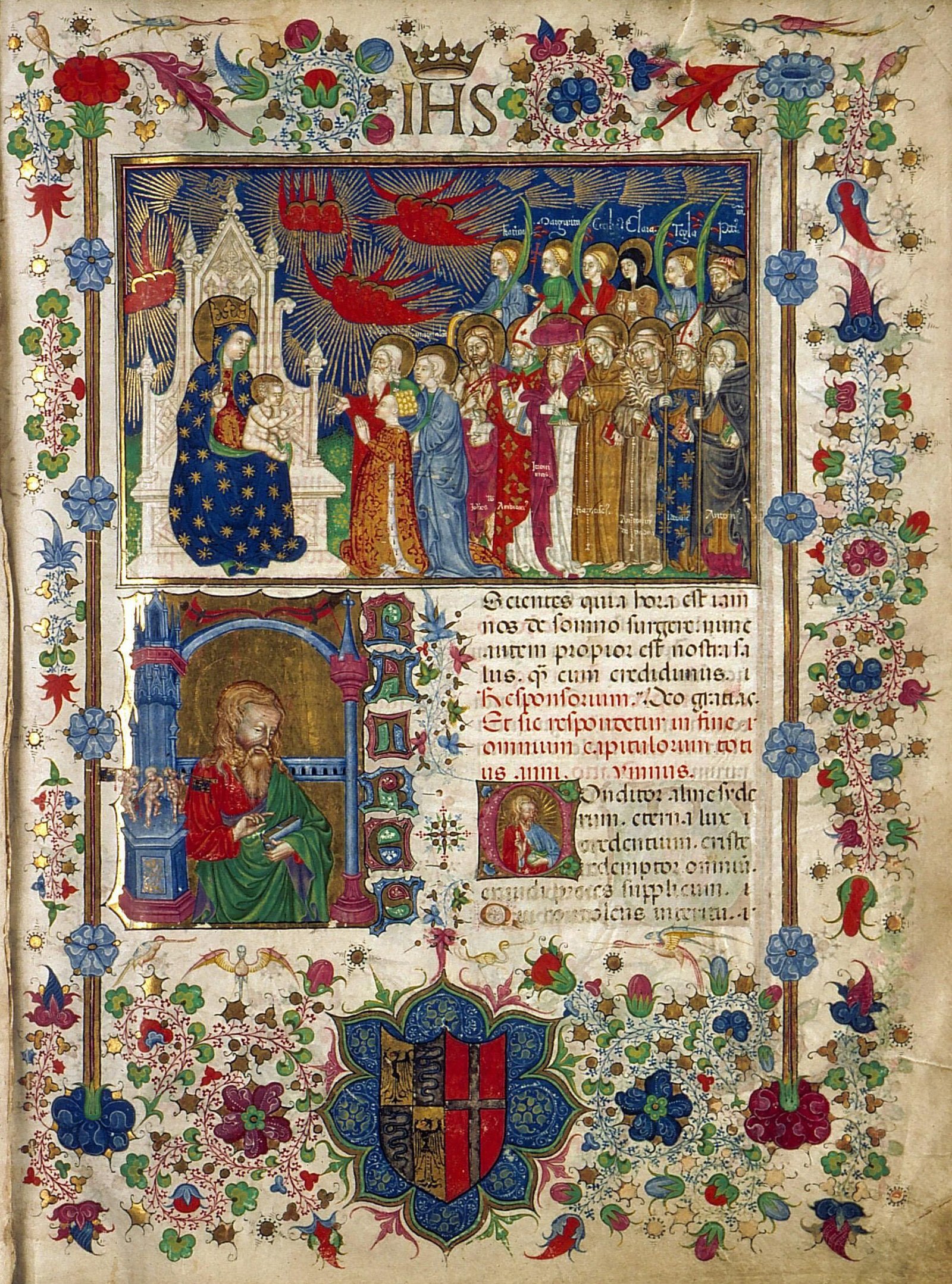
Before the invention of the printing press by Gutenberg (c. 1450), each copy of the Bible was made by hand, letter by letter, by monk-copyists in the scriptoria of monasteries. This was a work of love and of prayer: the monk who copied the Scriptures was praying the text he transcribed. Medieval manuscripts of the Bible are frequently extraordinary works of art, illuminated with miniatures and ornaments expressing the Church’s reverence for the Scriptures.
It was the Catholic monasteries Benedictine, Cistercian, Carmelite, Dominican, Franciscan that preserved biblical manuscripts through the barbarian invasions, wars, and plagues. Without the Catholic Church and her monks, the Bible as we know it would almost certainly not have survived the fall of the Roman Empire.
THE BIBLE IS A BOOK OF THE CHURCH
Sacred Scripture is a book of the Church, not a book against the Church. It was born in the bosom of the Church for the sacred writers were members of the community of the people of God; it was recognized as inspired by the Church for it was the Catholic Councils that defined the canon; it was preserved by the Church for it was the monks and copyists of the Church who copied and transmitted it; and it must be interpreted in the Church for only the Magisterium assisted by the Holy Spirit can interpret it with infallible authority.
The Church’s love for the Bible is not the love of the archivist for an ancient document, nor the love of the fundamentalist for the printed letter. It is the love of a child for the voice of the Father a voice that resounds in the Liturgy, in preaching, in Tradition, in theology, and in the lives of the saints. The Bible, for the Catholic, is not a book to be read in isolation: it is a voice to be heard in community, interpreted with the Church, and lived in the sacraments.
The Protestant principle of Sola Scriptura began from a legitimate intuition the supreme authority of the Word of God but drew from it an erroneous conclusion: that the Word of God is contained solely in the canonical writings and can be understood by each individual without the mediation of Tradition and the Magisterium. Two thousand years of history have demonstrated the result of this error: endless doctrinal fragmentation, growing religious relativism, and the progressive dissolution of Christian truths.
The Catholic Church, by contrast, received Scripture, Tradition, and the Magisterium as a single gift of the Holy Spirit inseparable, complementary, mutually necessary. This is the inestimable richness of the Catholic faith: to possess not only the sacred text, but its guardian, its interpreter, and its living context.
“To be ignorant of the Scriptures is to be ignorant of Christ.” – Saint Jerome
“I resolved to go nowhere except where the authority of Scripture or the Catholic Church preceded me.” – Saint Augustine