Benedict XV
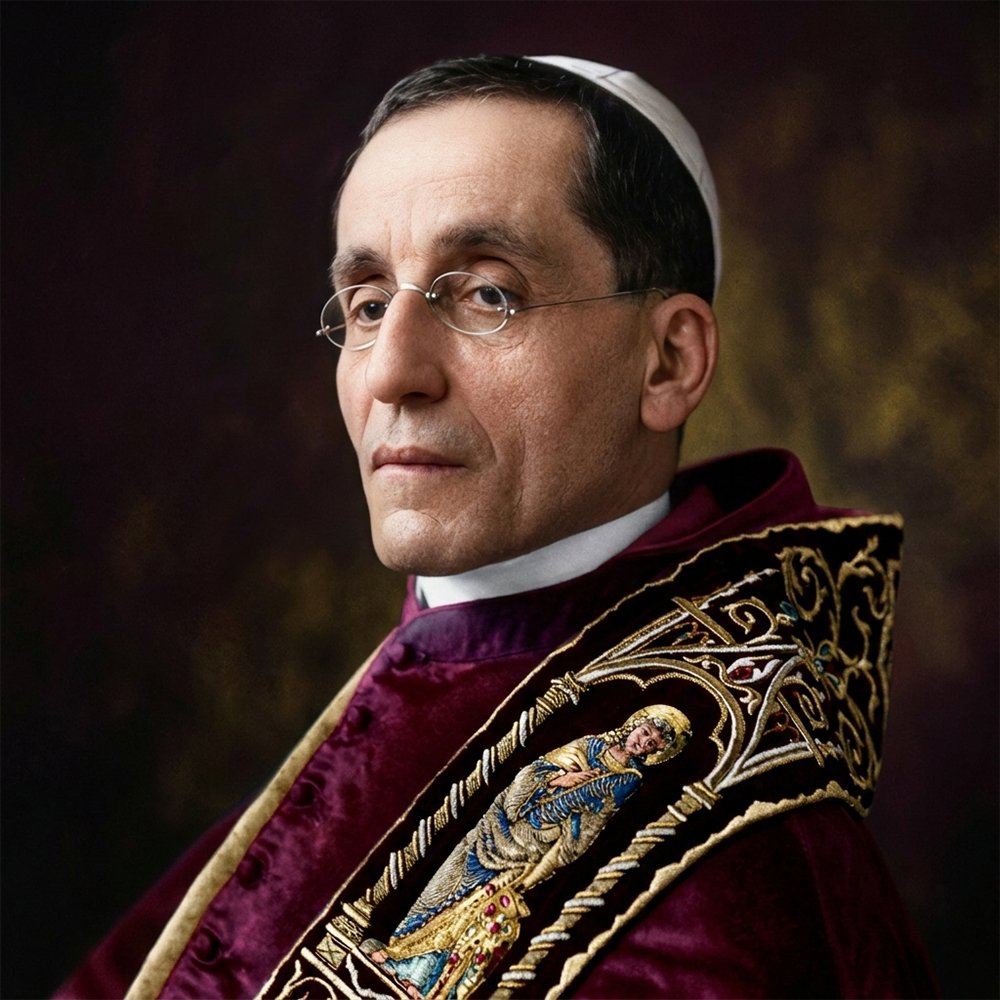
Pope Benedict XV (1914-1922)
BIOGRAPHICAL DATA
Birth name: Giacomo Paolo Giovanni Battista della Chiesa
Birth: November 21, 1854, Genoa, Italy
Papal election: September 3, 1914
Coronation: September 6, 1914
Pontificate: September 3, 1914 – January 22, 1922 (7 years, 4 months)
Death: January 22, 1922, Vatican City (67 years old)
Burial: Vatican Grottoes, St. Peter’s Basilica
Papal motto: None officially adopted
FORMATION AND ECCLESIASTICAL CAREER
Family Origins
Born into the Genoese aristocracy. The della Chiesa family (literally “of the Church”) was noble, ancient, and influential. Marquis by birth. Fourth of five children. Deeply Catholic family.
Priestly and Academic Formation
1865-1870: Jesuit College in Genoa
1870-1875: University of Genoa – Doctorate in Civil Law (unusual formation for a cleric)
1875: Decision to become a priest (after completing civil law)
1875-1878: Capranica College, Rome
Gregorian University: Theology
December 21, 1878: Priestly ordination (24 years old)
Physical Challenges
Short stature (approximately 1.52m – one of the shortest popes in history)
Slight build, slightly deformed shoulder
Delicate health since childhood
Physical appearance often commented upon (cruelty of the era)
Compensated with brilliant intellect and spiritual energy
Diplomatic Career (1878-1907)
Pontifical Ecclesiastical Academy (1878-1882):
Vatican diplomatic school
Formation of Holy See diplomats
Graduated with distinction
Vatican Secretariat of State (1882-1907):
25 years working in papal diplomacy
Under Cardinal Mariano Rampolla (Secretary of State of Leo XIII)
Rampolla became his mentor and model
Ascending positions:
Minutante (drafter of documents)
Secretary of the Nunciature in Spain (1883-1887) – Madrid
Return to Secretariat of State (1887)
Substitute (undersecretary) of the Secretariat of State (1901-1907)
Rampolla’s right-hand man
Expertise: canon law, diplomacy, international relations
Specialization:
Spanish affairs
Latin American affairs
Concordats
International arbitration
Change of Fortune (1903-1907)
Conclave of 1903:
Death of Leo XIII
Cardinal Rampolla (della Chiesa’s mentor) was the favorite
Imperial veto from Emperor Franz Joseph I of Austria-Hungary
Cardinal of Kraków pronounced the veto
Blocked Rampolla’s election
Last imperial veto in history (later abolished by Pius X)
Elected: Cardinal Giuseppe Sarto = Pius X
Consequences for della Chiesa:
Pius X conservative reformer, distrusted liberal diplomats like Rampolla/della Chiesa
Della Chiesa removed from the Secretariat of State (1907)
Gilded exile: Archbishop of Bologna (1907)
NOT created cardinal immediately (humiliation)
Tradition: Archbishops of Bologna automatically became cardinals
Pius X broke tradition, ignored della Chiesa
Only in May 1914 (3 months before Pius X’s death): created cardinal
Extremely late
Practically on the eve of papal election
Archbishop of Bologna (1907-1914)
Pastoral activity (first time as true pastor):
Visited all parishes
Reformed the seminary
Promoted Catholic social action
Mediated social conflicts (Bologna was “red,” socialist)
Organized Eucharistic congresses
Reputation for moderation, prudence, diplomatic skill
Contrast with Pius X:
Pius X: hardline against modernism, Opera dei Congressi dissolved
Della Chiesa: more conciliatory, favorable to moderate Catholic participation in politics
PAPAL ELECTION (1914)
Turbulent Conclave
Historical context:
August 20, 1914: Death of Pius X
July 28, 1914: Beginning of World War I (1 month earlier!)
Europe in flames
Conclave during world war for the first time in modern history
Situation:
Cardinals from belligerent nations gathered
France vs. Germany/Austria
Extreme tensions
Some cardinals unable to arrive (due to war)
Main candidates:
Cardinal Merry del Val (Spanish, Secretary of State of Pius X):
Continuity with Pius X’s hardline
Intransigent conservative
Favorite of the “zelanti”
Cardinal della Chiesa:
New cardinal (3 months!)
Experienced diplomat
Moderate
“Peace candidate”
Cardinal Ferrata:
Older, experienced
Initial favorite
Voting:
August 31 – September 3, 1914
57 cardinal electors
10 ballots
September 3, 10th ballot: Della Chiesa elected
Narrow majority initially, then widened
Victory of the moderate and diplomatic line
Choice of name: Benedict XV
Homage to Benedict XIV (1740-1758):
Bolognese pope (like della Chiesa)
Brilliant diplomat
Moderate, erudite
Balanced reformer
Signaled: moderation, diplomacy, culture, openness
First Action: Cancellation of Traditional Coronation
Planned a simple coronation due to the war. But the crowd expected it.
THE PONTIFICATE OF WAR AND PEACE (1914-1922)
Context: The Great War (1914-1918)
Benedict XV governed during ALL of World War I.
Elected: 1 month after its start
War ended: November 1918
Half of the pontificate during the conflict
Dimensions of the catastrophe:
15-20 million dead
Empires destroyed (Austro-Hungarian, Ottoman, Russian, German)
Russian Revolution (1917) – communism
Devastated Europe
European Christian civilization in collapse
Challenge for the Pope:
Catholics on both sides
France, Italy, Belgium (Allies) vs. Austria-Hungary, Germany (Central Powers)
How to be a universal pastor?
ENCYCLICALS AND PRINCIPAL DOCUMENTS
1914
1. Ad Beatissimi Apostolorum (November 1, 1914)
“Appeal for Peace and Reconciliation among Christian Peoples”
First encyclical – programmatic:
Analysis of the war:
“Horrible spectacle” of war
“Europe, the flourishing garden of Christian civilization, transformed into a field of death”
Four causes of war (prophetic diagnosis):
Contempt for authority (moral relativism)
Class hatred (Marxist class struggle)
Greed for material goods (materialism)
Contempt for eternal goods (secularism)
Absolute neutrality:
Pope will not take sides
“We cannot love one group of children more than another“
Church above nations
Total impartiality
Program of pacification:
Prayer for peace
Christian charity
Reconciliation among peoples
Overcoming nationalisms
Internal reform of the Church:
Appease internal tensions (modernism vs. integralism)
Suspended anti-modernist persecutions (different from Pius X)
Moderation, charity, dialogue
“War against war within the Church as well”
Impact:
Set the tone for the entire pontificate
Rejected by both belligerent sides:
Allies: wanted support against “Germanic barbarians”
Central Powers: expected support against “French Freemasonry”
Benedict XV refused both
1917
2. Humani Generis Redemptionem (June 15, 1917)
“On Preaching the Word of God”
Not about war, but on the formation of preachers:
Dignity of preaching
Biblical and theological formation
Simple, clear, pastoral preaching
Against empty rhetoric
Model: holy preachers (Bernardine, Francis de Sales)
1918
3. Quod Iam Diu (December 1, 1918)
“On Prayers for Peace”
After the armistice (November 11, 1918):
Gratitude for peace
Prayer for a just and lasting peace
Warning: armistice is not definitive peace
Need for true reconciliation
Prophetic: The Treaty of Versailles would fail
1919
4. In Hac Tanta (May 14, 1919)
12th centenary of St. Boniface; unity of the Church.
5. Paterno Iam Diu (November 24, 1919)
On starving children in Central Europe; humanitarian appeal.
6. Maximum Illud (November 30, 1919)
“On the Propagation of the Faith Throughout the World”
Revolutionary missionary encyclical:
Reform of missions:
Against nationalism in missions:
“The missionary is not an agent of his country”
“They expand the Kingdom of Christ, not European empires”
Prophetic: decolonization would come
Promote native clergy:
Ordain local priests
Prepare native hierarchy
Church must be truly Catholic (universal), not European
Respect for local cultures:
Evangelization is not Europeanization
Cultural adaptation (within the limits of doctrine)
Impact:
Foundation of ecclesiastical decolonization
Inspired Pius XI (first Chinese bishops, 1926)
Precursor of inculturation
1920
7. Pacem Dei Munus Pulcherrimum (May 23, 1920)
“On Peace and Christian Reconciliation”
Encyclical on peace – masterpiece:
Analysis of the post-war period:
Armistice did not bring true peace
Peace of Versailles (1919) is flawed:
Humiliating for the defeated (Germany)
Vindictive
Will create new conflict (prophecy of World War II!)
“Peace without charity is not true peace“
Elements of true peace:
Justice: fair reparations, not vengeance
Charity: Christian forgiveness
Reconciliation: overcoming national hatreds
International law: arbitration, League of Nations (with reservations)
Critique of the Treaty of Versailles:
Too harsh on Germany
Will create resentment
Will sow the next war
Prophecy fulfilled: Hitler rose exploiting the humiliation of Versailles
Constructive proposals:
Mutual forgiveness
International arbitration
Disarmament
Economic cooperation
Overcoming nationalisms
Reception:
Ignored by the victorious powers
Dismissed as “naive”
Vindicated by History (World War II proved he was right)
8. Spiritus Paraclitus (September 15, 1920)
“On St. Jerome and Biblical Studies”
15th centenary of the death of St. Jerome:
Defense of the total divine inspiration of Scripture
Against exegetical rationalism
Promoted translation and scientific study of the Bible
Balance: textual criticism yes, but faith in inspiration
Prepared the way for Pius XII’s Divino Afflante Spiritu
1921
9. In Praeclara Summorum (April 30, 1921)
6th centenary of the death of Dante Alighieri:
Praise of Dante as a Catholic poet
Divine Comedy as a theological work
Catholic culture
Reconciliation with modern Italian culture
10. Sacra Propediem (January 6, 1921)
7th centenary of the death of St. Dominic; Dominican Order.
11. Fausto Appetente Die (June 29, 1921)
7th centenary of the Franciscan Order; St. Francis of Assisi and the Third Order.
12. Annus Iam Plenus (December 1, 1921)
On starving children in Russia; humanitarian appeal.
THE DIPLOMATIC NOTE OF AUGUST 1917 – THE PEACE PLAN
Although not an encyclical, this was the most important act of the pontificate.
Context (Summer 1917)
Military situation:
Trench warfare, bloody stalemate
Millions dead
Stagnant fronts
Exhaustion on all sides
Political situation:
Russia: February Revolution (March 1917), Tsar deposed
USA: Entry into the war (April 1917)
Italy: Defeat at Caporetto imminent
Germany: British naval blockade causing famine
All sides seeking a way out
The Note of August 1, 1917
“Dès le début” (note in French)
Addressed to the “heads of the belligerent peoples”.
Analysis:
War is “useless carnage” (famous phrase)
“Useless massacre” must cease
No objective is worth so many lives
European civilization is committing suicide
Peace Plan in 7 Points:
Mutual simultaneous disarmament:
Reduction of armaments
Compulsory arbitration
Sanctions against violators
Freedom of the seas:
End of naval blockade
Free trade
Against unrestricted submarine warfare
Mutual renunciation of war indemnities:
No financial reparations
Mutual forgiveness of war debts
Radical: contrary to Versailles later
Restoration of occupied territories:
Evacuation of France, Belgium, colonial territories
Return to territorial status quo ante bellum
Negotiated solution for controversial territorial issues:
Alsace-Lorraine (France-Germany): plebiscite or autonomy
Trentino, Trieste (Italy-Austria): negotiation
Poland: reconstitution with access to the sea
Armenia: protection
Protection of minorities:
Rights of national and religious minorities
Universal religious freedom
Conciliation according to “justice and equity”:
Consideration of all parties
Neither victors nor vanquished
Peace without victory
Reception of the Plan
Rejected by ALL belligerents:
Allies (France, GB, Italy):
“Pope is pro-German”
“Betrayed the cause of justice”
Clemenceau (France): “The Pope is on the side of the Boches”
Italy: especially hostile (territorial issue)
They wanted total victory, not negotiated peace
Central Powers (Germany, Austria):
“Weak pope”
“Harms our negotiating position”
Militarists wanted victory
Accepted rhetorically but not in practice
Consequences:
Total isolation of the Vatican
Excluded from the Paris Peace Conference (1919)
Italy vetoed papal participation
“Roman Question” unresolved
Humiliation for the Holy See
Called the “Pope of useless peace” (insult at the time)
Historical vindication:
Wilson’s 14 Points (January 1918): very similar to the papal plan
Treaty of Versailles: exactly the errors Benedict XV warned about (punitive reparations, no forgiveness)
World War II: proved Benedict XV was right
Modern historians: “Benedict XV’s plan could have avoided Hitler”
HUMANITARIAN ACTIVITIES DURING THE WAR
Organization of Charity on an Industrial Scale
Numbers:
600,000 requests for information about prisoners of war processed
40,000 prisoners repatriated through papal mediation
Millions of lire distributed in humanitarian aid
Structure Created
Ufficio Informazioni (Information Office):
Location of missing soldiers
Connection between prisoners and families
Exchange of correspondence through the Vatican (neutral)
Compiled prisoner lists
Opera dei Prigionieri (Prisoners’ Work):
Visitation of prisoner camps
Sending of packages
Spiritual assistance
Negotiation for better conditions
Exchange of Seriously Wounded:
Mediated between Germany and France/England
Internment of seriously wounded in Switzerland (neutral)
Thousands of wounded soldiers transferred for neutral treatment
Repatriation of terminally ill
Aid to Civilian Populations
Occupied Belgium:
Food shipments
American Relief Commission (Hoover): collaboration
Vatican contributed massive funds
Armenia:
Armenian Genocide (1915-1917): 1.5 million dead
Benedict XV protested to the Ottoman Empire
Sent aid (limited, but significant)
Denounced the massacre (diplomatically)
Syria and Lebanon:
Famine during war (blockade)
Food aid through missionaries
Children of Central Europe (post-war):
Naval blockade continued after armistice (1919)
Germany, Austria: children dying of starvation
Benedict XV organized fundraising campaigns
Sent tons of food
Recognition
Benedict Kitchens:
Popular soup kitchens funded by the Pope
In multiple European cities
Fed millions
General statistics (estimates):
Vatican spent 82 million gold lire (immense fortune) on charity
Benedict XV emptied the papal coffers
Died with practically no financial reserves in the Vatican
Sold valuable papal objects to finance charity
DIPLOMATIC AND ECCLESIASTICAL ISSUES
Exclusion from the Paris Peace Conference (1919)
Historical humiliation:
All belligerent nations present
Holy See excluded
Italian veto (Roman Question unresolved)
Even Catholic countries did not insist on papal presence
Consequence:
Treaty of Versailles without Catholic moral input
Punitive, not reconciliatory peace
Confirmed Benedict XV’s analysis: it would be a disaster
Relations with Governments
Italy:
“Roman Question” still unresolved (until 1929)
Tense relations
Non expedit (Catholics forbidden from politics) maintained with flexibility
Benedict XV initiated discreet rapprochement (completed by Pius XI in 1929)
France:
Resumption of diplomatic relations (1921)
Interrupted since 1904 (Law of Separation)
Canonization of Joan of Arc (1920): gesture of rapprochement
Realpolitik: France needed Catholic support post-war
British Empire:
First British diplomatic mission to the Vatican (1914)
Cordial relations (despite official Anglicanism)
Collaboration on humanitarian issues
Germany and Austria:
Collapse of empires (1918)
Support for new republics
Encouraged formation of democratic Catholic parties (Center, People’s Party)
Soviet Russia:
Bolshevik Revolution (1917)
Beginning of brutal persecution of the Church
Benedict XV tried to negotiate (unsuccessfully)
Sent humanitarian mission to famine-stricken Russia (1921-1922)
Rejected by the Soviets
New States
World War I created new countries:
Poland (reconstituted)
Czechoslovakia
Yugoslavia
Finland, Estonia, Latvia, Lithuania
Hungary (separated from Austria)
Benedict XV’s action:
Quickly established diplomatic relations
Created dioceses and hierarchies
Appointed bishops
Stabilized the Catholic Church in the new European order
REFORM OF CANON LAW
1917 Code of Canon Law
Project initiated by Pius X (1904):
Compilation of all scattered canon law
Modern systematization
Commission led by Cardinal Pietro Gasparri
Promulgation by Benedict XV:
May 27, 1917: Apostolic Constitution Providentissima Mater Ecclesia
Code entered into force: May 19, 1918 (Pentecost)
First systematic code of canon law in history
Structure:
2,414 canons organized in 5 books:
General norms
Persons (clergy, religious, laity)
Things (sacraments, sacred places, goods)
Processes
Offenses and penalties
Significance:
Legal unification of the Latin Church
Clarity and accessibility
Replaced centuries of scattered legislation
Legal basis until 1983 (new code of John Paul II)
Monumental work – one of Benedict XV’s greatest legacies
Subsequent complements:
Code for Eastern Churches (begun under Benedict XV, completed later)
LITURGICAL AND SACRAMENTAL REFORM
Frequent Communion and Children’s Communion
Continued Pius X’s line:
Encouraged frequent communion (even daily)
Maintained first communion at age 7 (decree of Pius X, 1910)
Promoted Eucharistic piety
Liturgy
Conservative but pastoral:
Fully maintained the Tridentine Mass
Promoted Gregorian chant
Active participation of the faithful (limited to the standards of the time)
Dignity of ceremonies
Regulation of Indulgences
Reformed the discipline of indulgences:
Simplification of conditions
Doctrinal clarification
Combat against superstitions
BEATIFICATIONS AND CANONIZATIONS
Saints Canonized
1920:
St. Joan of Arc (May 19, 1920)
French heroine, burned by the English (1431)
Political significance: reconciliation with France
Beatified by Pius X (1909)
Canonization celebrated in St. Peter’s Basilica
Brilliant diplomatic act: pleased French nationalism without offending others
France resumed diplomatic relations with the Vatican (1921)
1920:
St. Margaret Mary Alacoque (May 13, 1920)
French visionary (1647-1690)
Apparitions of the Sacred Heart
Promoted devotion to the Sacred Heart
1925 (posthumous – process under Benedict XV):
St. John Eudes (prepared by Benedict XV, canonized by Pius XI)
Important Beatifications
Oliver Plunkett (blessed, Irish martyr)
Numerous English and Irish martyrs
Continued processes of many who would be canonized later
CONGREGATION FOR THE EASTERN CHURCHES (1917)
Historic Creation
Motu Proprio Dei Providentis (May 1, 1917):
Created Congregation for the Eastern Churches
Separated from Propaganda Fide (missions)
Recognition of the proper dignity of the Eastern Catholic Churches
Significance:
Eastern Churches are no longer “missions”
Equality with the Latin Church
Respect for Eastern liturgical traditions
Prepared future ecumenism
Benefited Churches:
Maronite, Melkite, Ukrainian, Ruthenian, Armenian Catholic, Chaldean, etc.
Liturgical and disciplinary autonomy preserved
Pontifical Oriental Institute (1917)
Founded simultaneously:
School for the study of Eastern traditions
Formation of clergy who would work with the East
Academic research on Eastern Christianity
Promoted mutual East-West knowledge
ACADEMIC AND CULTURAL INSTITUTIONS
Pontifical Gregorian University
Reformed and expanded:
New academic programs
Modernization of methods
International openness
Vatican Library
Expanded access:
More scholars admitted
Improved cataloging
Support for research
Pontifical Academy of Sciences
Prepared reorganization (completed by Pius XI):
Faith-science dialogue
Recognition of scientific autonomy
MODERATION OF ANTI-MODERNISM
Legacy of Pius X
Inherited situation:
Pius X condemned “modernism” (1907)
Lamentabili and Pascendi
Mandatory anti-modernist oath
Surveillance network (Sodalitium Pianum – “espionage”)
Climate of suspicion and denunciations
Progressive theologians persecuted
Benedict XV’s Policy
Moderation without revocation:
Maintained doctrinal condemnation of modernism
But dismantled the repressive apparatus:
Dissolved informant networks
Reduced persecutions
Allowed freer theological discussion (within orthodoxy)
Letter to Cardinal Mercier (Belgium):
Asked for an end to internal divisions
“Catholics should not call each other modernists or integralists, only Catholics”
Internal reconciliation
Result:
Less oppressive climate
Catholic theology could breathe
Delicate balance:
Did not revoke doctrinal condemnations (maintained orthodoxy)
But eliminated witch hunts (restored charity)
RELATIONS WITH THE NON-CHRISTIAN WORLD
Attempts at Dialogue (limited by the era)
Islamic world:
Protested against the Armenian genocide (1915-1917)
Tried to protect Christians in the Ottoman Empire (limited)
Maintained missions in Muslim lands
Asia:
Promoted missions in China, India, Japan
Maximum Illud (1919): respect for local cultures
Africa:
Missionary expansion
First steps towards native African clergy
Judaism:
No documentation of specific pro or anti-Semitic actions
Maintained traditional position (theological, not racial)
Did not condemn the Balfour Declaration (1917 – Jewish state in Palestine)
PERSONAL CHARACTERISTICS AND PAPAL STYLE
Personality
The Diplomat:
Diplomatic formation and temperament
Extreme prudence
Negotiating skill
Discretion
Humility and Simplicity:
Despite aristocratic origin
Austere personal life
Devoid of excessive pomp
Accessible (within the standards of the time)
Acute Intelligence:
Brilliant jurist
Linguist (Italian, Latin, French, Spanish, German)
Exceptional memory
Strategic vision
Fragile Health:
Always delicate
Worked exhaustively despite physical limitations
Exhaustion contributed to premature death
Governance Style
Moderate and Conciliatory:
Avoided extremes
Sought consensus
Mediation between factions
Centralized but Consultative:
Trusted competent advisors
Cardinal Gasparri (Secretary of State): perfect partnership
Listened to bishops and cardinals
Prudent Reformer:
Code of Canon Law
Curial reorganization
But without ruptures
VISION OF INTERNATIONAL ORDER
League of Nations
Ambivalent position:
Supported the principle of international arbitration
But criticized the exclusion of the Holy See
Reservations about effectiveness (prophetic – League failed)
Proposal:
International organization based on:
Natural law
Christian morality
Justice, not just force
Compulsory arbitration
Not heard:
League of Nations: secular organization
Holy See excluded
Failed to prevent World War II (Benedict XV foresaw it)
Vision of Peace
“Pax Christi in Regno Christi” (theme later developed by Pius XI):
True peace only possible in Christ
International order based on:
Justice
Charity
Forgiveness (not vengeance)
Reconciliation (not humiliation)
Natural law (not just force)
Critique of exacerbated nationalism:
Nationalism = idolatry of the nation
Supranationality of the Church
Universal Christian fraternity
LAST MONTHS AND DEATH
Deteriorating Health (1921)
Autumn-Winter 1921:
Worsening chronic bronchitis
Extreme exhaustion
Weight loss
Continued working intensely
Causes of wear and tear:
7 years of war tension
Exhaustive work
Diplomatic tension
Emptying of papal coffers (charity)
Fragile constitution
January 1922
Sudden worsening:
Early January: cold
Progressed to pneumonia (antibiotics did not exist)
Tried treatments of the time (ineffective)
January 15-22:
Serious condition
Received last sacraments
Continued dispatching until the end
Mental lucidity preserved
Death
January 22, 1922:
Passed away at 6:00 AM
67 years old (relatively young for a pope)
Only 7 years, 4 months of pontificate
Cause: pneumonia with cardiac complications
Last words (reported):
Offered his suffering for world peace
Blessed the Church and faithful
Funeral:
January 28-30, 1922
Crowds in Rome (despite “unpopularity” during the war)
Buried in the Vatican Grottoes
State of Papal Finances
Discovery after death:
Papal treasury practically empty
Benedict XV spent everything on charity during the war
Successor (Pius XI) inherited empty coffers
Testimony to extraordinary generosity
LEGACY AND HISTORICAL EVALUATION
During Life: “Pope of Useless Peace”
Contemporary misunderstanding:
Rejected by both sides in the war
Allies: “pro-German,” “coward,” “traitor”
Central Powers: “weak,” “useless idealist”
Excluded from the Peace Conference
Diplomatic isolation
Apparently “failed”
Specific criticisms:
Neutrality seen as weakness
1917 peace plan rejected
Could not stop the war
Not present at Versailles
Subsequent Historical Reassessment
1930s-1940s:
Rise of Hitler confirmed warnings about Versailles
World War II proved Benedict XV was right
Punitive treaty generated Nazism
Current historical consensus:
Ignored prophet
Extraordinarily accurate political analysis
1917 plan could have avoided Hitler
Versailles = exactly the errors he warned about
Pope John XXIII (1958-1963):
Venerated Benedict XV
Model of pastoral diplomacy
Pope Francis (2013-):
Cited Benedict XV as a model of peace
Centenary of WWI (2014-2018): recovered memory of Benedict XV
“Prophetic Pope of Peace”
Enduring Contributions
1. Prophetic Vision of Peace:
First pope to systematically condemn modern war
Analysis of causes (materialism, nationalism, secularism)
Proposal for just international order
Reconciliation instead of vengeance
2. Code of Canon Law:
Legal unification of the Church
Clarity and systematization
Legal basis for 66 years (until 1983)
3. Missionary Reform:
Maximum Illud (1919)
Ecclesiastical decolonization
Native clergy
Cultural respect
4. Heroic Charity:
600,000 families assisted
Millions saved from starvation
Papal coffers emptied
Model of concrete love
5. Internal Moderation:
Pacified Church after anti-modernist wars
Balance between orthodoxy and charity
Prepared theological renewal
6. Dignification of the Christian East:
Congregation for Eastern Churches
Oriental Institute
Respect for traditions
7. Social Doctrine:
Application of Rerum Novarum to post-war
Social justice
Capital-labor reconciliation
Prepared Pius XI’s Quadragesimo Anno
Memorable Quotes
“Useless carnage“ (about World War I – 1917)
“We cannot love one group of our children more than another” (on neutrality)
“Peace without charity is not true peace” (Pacem Dei Munus, 1920)
“The missionary should not be an agent of his country, but of Christ” (Maximum Illud, 1919)
“Let these fratricidal wars cease” (appeal of 1917)
BEATIFICATION PROCESS
Status: NOT officially initiated
Reasons for absence:
No organized movement
Pontificate “forgotten” for decades
Overshadowed by Pius X (before) and Pius XII (after)
Lack of “popular cult”
Arguments in favor (if there were a process):
Heroic charity
Exceptional virtues
Fulfilled prophecy
Extraordinary humility
Obstacles:
Lack of attributed miracles
Absence of popular movement
Not a current priority
MONUMENTS AND MEMORY
Statue in Istanbul
Church of St. Anthony of Padua, Istanbul:
Statue of Benedict XV
Gratitude for humanitarian aid to refugees
Only papal statue in a Muslim country
Squares and Streets
Numerous European cities:
Piazza Benedetto XV in several Italian cities
Streets named after him (especially in Bologna and Genoa)
Recent Rediscovery
Centenary of WWI (2014-2018):
Exhibitions on the pontificate
Books and studies
Recognition of his prophetic vision
WRITINGS AND THOUGHT
Theology of Peace
Foundations:
Peace = gift of Christ
Justice + Charity
Christian forgiveness essential
Reconciliation, not vengeance
Critique of modern war:
Total war = against natural law
Kills innocent civilians
Disproportion between means and ends
Destruction of Christian civilization
Ecclesiology
Universal Church above nations:
Supranationality
Universal motherhood
Cannot take sides between children
Role of the Pope:
Universal pastor
Mediator of peace
Prophetic voice
Independence from political powers
Social Vision
Continuity with Leo XIII:
Rerum Novarum applied to post-war
Social justice
Dignity of labor
Capital-labor collaboration
Against extremes:
Neither wild capitalism
Nor revolutionary socialism
Christian third way
Benedict XV was the “Pope of Peace” who could not achieve peace, the ignored prophet who was right, the rejected diplomat who offered the best plan, the unknown saint who lived heroic charity.
He governed only 7 years, but his legacy resonates a century later. Small in body, giant in vision. A failure in the eyes of the world, victorious in the eyes of God and History.
“Useless carnage” – two words that defined a war and a pontificate. The pope who called war by its true name and offered a Christian alternative. Ignored in life, rediscovered in death, a model forever.
Requiescat in pace – Rest in peace, prophet of peace.