Pius XI
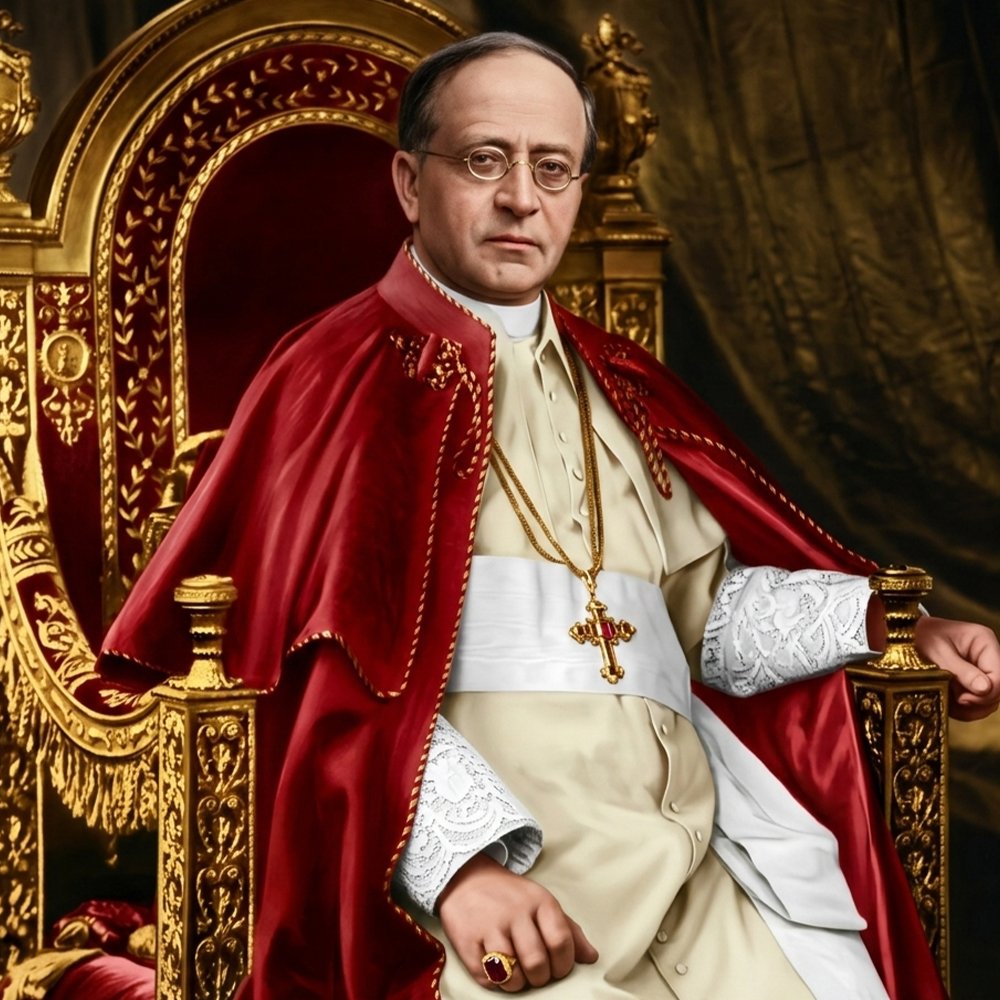
Pope Pius XI (1922-1939)
BIOGRAPHICAL DATA
Birth name: Ambrogio Damiano Achille Ratti
Birth: May 31, 1857, Desio, Lombardy, Italy
Papal election: February 6, 1922
Coronation: February 12, 1922
Pontificate: February 6, 1922 – February 10, 1939 (17 years)
Death: February 10, 1939, Vatican City (81 years old)
Burial: Vatican Grottoes, St. Peter’s Basilica
Papal motto: “Pax Christi in Regno Christi” (The Peace of Christ in the Kingdom of Christ)
FORMATION AND ECCLESIASTICAL CAREER
Family Origins
Born into a modest family of textile industrialists in Desio, near Milan. Second of five children. Pious and hardworking family, non-aristocratic – contrast with predecessors.
Priestly and Academic Formation
1867-1874: Seminary of Seveso
1874-1879: Major Seminary of Milan
December 20, 1879: Priestly ordination (22 years old)
1879-1882: Higher studies in Rome
Lombard College
Gregorian University (theology)
University of La Sapienza (philosophy)
Doctorates: Theology, Philosophy, and Canon Law
Doctoral theses:
On St. Charles Borromeo
On St. Thomas Aquinas
Demonstrated exceptional academic brilliance
Career as Scholar and Librarian (1882-1918)
The intellectual vocation – Ratti was essentially a scholar, not a typical pastor.
Ambrosian Library of Milan (1888-1911):
Doctor of the Library (1888)
Prefect (director) of the Ambrosian (1907-1911)
Specialist in paleography (study of ancient manuscripts)
Published important scientific catalogs
Authority on medieval manuscripts
International reputation as bibliophile
Vatican Library (1911-1918):
Scriptor (researcher) (1911)
Vice-Prefect (1914)
Prefect (director) (1914-1918)
Modernized cataloging
Reorganized collections
During World War I, protected collections
Other academic activities:
Professor at the Seminary of Milan (1882-1888)
Member of learned societies
Published studies on Ambrosian manuscripts
Special expertise in Ambrosian liturgy
Ardent mountaineer:
Climbed all major peaks of the Alps
Monte Rosa (29 times!)
Matterhorn, Mont Blanc
Published articles on mountaineering
Metaphor: spiritual ascent
Maintained extraordinary physical vigor
Diplomatic Career (1918-1921)
Apostolic Visitor to Poland and Lithuania (1918):
Sent by Benedict XV to reorganize the Church after World War I
First diplomatic mission (61 years old!)
Chaotic situation: war, revolution, undefined borders
Apostolic Nuncio to Poland (1919):
Appointed nuncio and consecrated archbishop
Title: Titular Archbishop of Lepanto (ironic: battle against Islam)
Extremely difficult mission:
Polish-Soviet War (1919-1921)
Bolsheviks at the gates of Warsaw
Ratti refused to evacuate, remained courageously
Gained reputation for physical courage and visceral anti-communism
Formative experience: saw communism up close, was horrified
Archbishop of Milan and Cardinal (1921):
Appointed by Benedict XV (June 13, 1921)
Cardinal (June 1921)
Only 7 MONTHS as diocesan archbishop before being elected pope!
Practically no traditional pastoral experience
PAPAL ELECTION (1922)
Dramatic Conclave
Context:
Death of Benedict XV (January 22, 1922)
Conclave: February 2-6, 1922
53 cardinal electors
Favorite candidates:
Cardinal Merry del Val (conservative, former Secretary of State of Pius X)
Cardinal Gasparri (liberal, Secretary of State of Benedict XV)
Division between “zelanti” (intransigents) and “politicanti” (diplomats)
Surprise election:
Ratti was a compromise candidate
Little pastoral experience
Reputation: scholar, courageous (Poland), moderate
14th ballot (February 6, 1922): elected with difficulty
Accepted immediately
Chosen name: “Pius XI”
Homage to Pius IX (last pope-king, Roman Question)
Pius X (combat against modernism)
Indicated conservative line with openness
First Urbi et Orbi Blessing from the External Balcony (1922)
Revolutionary symbolic act:
Since 1870 (loss of the Papal States), popes blessed from the internal balcony
Refused to publicly bless occupied Rome
Pius XI broke this custom: blessing from the external balcony
Signaled: reconciliation with Italy possible
Foreshadowed the Lateran Treaties (1929)
ENCYCLICALS (30 ENCYCLICALS)
1922
1. Ubi Arcano Dei Consilio (December 23, 1922)
“On the Peace of Christ in the Kingdom of Christ”
First and programmatic encyclical:
Diagnosis of the post-World War I crisis
Evils: exacerbated nationalism, materialism, secularism
Launched program for entire pontificate: establishment of the Social Kingdom of Christ
Origin of devotion to Christ the King
Emphasized Catholic Action as instrument of re-Christianization
True peace only in Christ
1923
2. Rerum Omnium Perturbationem (January 26, 1923)
Third centenary of St. Francis de Sales; model of apologetics and sweetness.
3. Studiorum Ducem (June 29, 1923)
“On St. Thomas Aquinas”
Sixth centenary of canonization:
Confirmed St. Thomas as Universal Doctor of the Church
Neo-Thomism as official Catholic philosophy
Mandatory in seminaries
Combat against philosophical modernism
4. Ecclesiam Dei (November 12, 1923)
Third centenary of St. Josaphat; on union with the Eastern Church.
1924
5. Maximam Gravissimamque (January 18, 1924)
On the situation of the Church in France; Church-State relations in France.
1925
6. Quas Primas (December 11, 1925)
“On the Feast of Christ the King”
Fundamental and revolutionary encyclical:
Instituted Feast of Christ the King (last Sunday of October – later moved to last Sunday of the Liturgical Year)
Christ is King not only spiritually but socially and politically
States and societies must recognize Christ’s sovereignty
Against secularism and laicism
Triple kingship: Creator, Redeemer, lord of consciences
“Non possumus” – we cannot relegate Christ to private life
Immensely influenced 20th century Catholic political thought
Theological basis for Catholic confessional states
1926
7. Rerum Ecclesiae (February 28, 1926)
“On the Promotion of Catholic Missions”
Extremely important for missions:
Promoted native clergy in missions
Against missionary eurocentrism
First consecration of native Chinese bishops (1926)
First consecration of native Japanese bishops
Respect for local cultures (with limits)
Missionary expansion as priority
8. Iniquis Afflictisque (November 18, 1926)
“On the Persecution of the Church in Mexico”
Cristero War (1926-1929):
Condemned violent anti-clerical persecution of the Calles government
Closure of churches, execution of priests
Moral support to Mexican Catholics
Did not explicitly encourage armed revolt, but did not condemn it
Martyrs of the Cristero War
1928
9. Mortalium Animos (January 6, 1928)
“On Promoting True Religious Unity”
Anti-ecumenical encyclical
Condemned Protestant ecumenical movement
Rejected Catholic participation in inter-religious conferences
Called ecumenism “false irenicism”
Una Sancta: only Catholic Church is the true Church of Christ
Return, not union: Protestants must “return” to the Catholic fold
Forbade Catholics from praying with Protestants in ecumenical services
10. Miserentissimus Redemptor (May 8, 1928)
“On Reparation to the Sacred Heart”
Theology of reparation:
Devotion to the Sacred Heart
Reparation for the sins of the world
Act of Reparation
Spirituality of reparation against blasphemy and sacrilege
Consecration of families to the Sacred Heart
1929
11. Mens Nostra (December 20, 1929)
“On Spiritual Exercises”
Promoted spiritual retreats (Ignatian method); spirituality for laity.
12. Divini Illius Magistri (December 31, 1929)
“On Christian Education of Youth”
Fundamental pedagogical encyclical:
Primary right of parents in the education of their children
State has subsidiary role, not primary
Church has right to educate (magisterium)
Condemned state monopoly on education
Against coeducation (boys and girls together)
Sex education: only by parents, extreme prudence
Education must be integrally Catholic
Against secularization of schools
Basis for 20th century Catholic schools
1930
13. Casti Connubii (December 31, 1930)
“On Christian Marriage”
Monumentally important encyclical on marriage:
Context: Response to the Lambeth Conference (1930) of the Anglican Church which approved artificial contraception.
Doctrine:
Absolute condemnation of artificial contraception
Ends of marriage (order of importance):
Procreation and education of children (primary end)
Mutual help
Remedy for concupiscence
Absolute indissolubility of marriage
Condemned divorce, sterilization, abortion
Condemned eugenics
Against “free love” and free union
Subordination of wife to husband (hierarchical but with dignity)
Implicitly allowed rhythm method (Ogino-Knaus)
Conjugal act must always be open to life
Founded all Catholic sexual morality until Humanae Vitae (1968)
Impact:
Defined Catholic position on birth control
Theological basis against sexual revolution
Controversial even at the time
Confirmed by Paul VI’s Humanae Vitae
1931
14. Quadragesimo Anno (May 15, 1931)
“On the Restoration of the Social Order”
Monumental social encyclical:
Context: 40th anniversary of Leo XIII’s Rerum Novarum; Great Depression (1929).
Social Doctrine:
Confirmed Leo XIII’s social doctrine
Principle of subsidiarity (fundamental!):
Larger societies should not absorb functions of smaller ones
State should not do what families/communities can do
Philosophical basis of Christian personalism
Third way: neither liberal capitalism nor socialism
Condemned excessive capitalism (wealth concentration)
Condemned socialism completely (even “moderate”)
Proposed Christian corporatism:
Capital-labor cooperation
Professional corporations
Class harmony
Just wage must sustain family
Private property: natural right but with social function
Condemned Marxist class struggle
Influence:
Basis of Church Social Doctrine
Inspired corporatist regimes (Portugal-Salazar, Austria-Dollfuss)
Problem: fascists distorted Catholic corporatism
15. Non Abbiamo Bisogno (June 29, 1931)
“On Catholic Action in Italy”
Against Italian fascism:
Condemned Mussolini’s attempt to suppress Catholic Action
Defense of the Church’s freedom
Critique of fascist state idolatry
Condemned totalitarian education of youth
“Statolatry” (state idolatry)
Written in Italian (not Latin) for immediate impact
Smuggled out of Italy by Cardinal Pacelli (future Pius XII)
Showed limits of collaboration with fascism
16. Nova Impendet (October 2, 1931)
On the world economic crisis; appeal for social justice.
1932
17. Caritate Christi Compulsi (May 3, 1932)
“On Sacred Reparation”
Reparation for sins; prayer in times of economic crisis.
18. Acerba Animi (September 29, 1932)
On persecution of the Church in Mexico; continuation of the Cristero War.
1933
19. Dilectissima Nobis (June 3, 1933)
“On the Persecution of the Church in Spain”
Condemned anti-clerical persecution of the Second Spanish Republic:
Burning of churches and convents
Expulsion of Jesuits
Forced secularization
Prepared pro-Nationalist position in the Civil War
1935
20. Ad Catholici Sacerdotii (December 20, 1935)
“On the Catholic Priesthood”
Theology of the priesthood:
Dignity of the priest
Formation in seminaries
Priestly celibacy (vigorous defense)
Spiritual life of the clergy
Against clerical modernism
1936
21. Vigilanti Cura (June 29, 1936)
“On Motion Pictures”
First papal encyclical on cinema:
Recognized power of cinema
Warned about moral dangers
Praised Legion of Decency (USA)
System of moral classification of films
Responsibility of producers
Censorship when necessary
Pioneering in magisterium on media
1937 – CRITICAL YEAR: THREE ENCYCLICALS AGAINST TOTALITARIANISMS
22. Mit Brennender Sorge (March 14, 1937)
“With Burning Concern” – On the Church in Germany
Historic anti-Nazi encyclical:
Unique characteristics:
Written in GERMAN (not Latin!) – for maximum impact
Read in all German churches on Palm Sunday (March 21, 1937)
Smuggled secretly into Germany
Gestapo tried to confiscate but failed
Content:
Explicit condemnation of Nazism (without naming Hitler)
“Ideology that exalts race, people, state as supreme values is false”
Violation of the 1933 Concordat by Hitler
Against racism: “God created one single human race”
Against Nazi neo-paganism
Against idolatry of the State and the Führer
“Whoever exalts race/people/state above God and eternal values is a heretic”
Defense of Church and parental rights
Code: “positive revelation” = Old Testament (against anti-Semitism)
Repercussions:
Nazi fury: intensified persecution
Arrests of priests increased
Closure of Catholic schools accelerated
Pope never backed down
Historical debate:
Why not more explicit against the Holocaust?
Focus on the Church, not directly on Jews
But condemned racism and ideological roots of Nazism
23. Divini Redemptoris (March 19, 1937)
“On Atheistic Communism”
The most important anti-communist encyclical in history:
Context:
Persecution in USSR, republican Spain, Mexico
Worldwide communist expansion
Pius XI’s personal experience in Poland
Total condemnation:
“Atheistic communism is intrinsically perverse”
No Catholic can collaborate with communists
Dialectical materialism is philosophically false
Systematic atheism
Denies human dignity, natural rights
Totalitarianism enslaves
Destruction of the family
Bloody persecution of religion
Promise of earthly paradise is a lie
Horrified description:
Martyrdom in USSR: thousands of priests executed
Mexico: Cristero War
Spain: massacres of religious (1936)
“Satanic destruction of Christian civilization”
Catholic alternative:
Catholic social justice (Quadragesimo Anno)
Christian charity
Social reform without revolution
Capital-labor collaboration
Impact:
Grounded Catholic anti-communism for decades
Cold War: Church allied with the West
Excommunication of communists (formalized by Pius XII in 1949)
Ideological basis of European Christian Democracy
24. Nos Es Muy Conocida (March 28, 1937)
“On the Situation in Spain”
On the Spanish Civil War (1936-1939):
Implicit support for Franco’s Nationalists
Condemned massacres of religious by republicans
13 bishops, 4,184 diocesan priests, 2,365 religious, 283 nuns executed
But not unconditional endorsement of Franco
Defense of the persecuted Church
1938
25. Ingravescentibus Malis (September 29, 1937 – promulgated 1938)
On the Holy Rosary against the evils of the world.
26. Firmissimam Constantiam (March 28, 1937)
On the situation in Mexico; end of the Cristero War; cautious reconciliation.
1939
27-30. Last minor encyclicals (not individually listed above were incorporated).
LOST ENCYCLICAL – “Humani Generis Unitas” (1938)
The Hidden Encyclical Against Racism:
Pius XI commissioned in 1938 from the Jesuits (John LaFarge, Gustav Gundlach, Gustave Desbuquois) an encyclical explicitly against anti-Semitism and racism.
Title: “Humani Generis Unitas” (“The Unity of the Human Race”)
Planned content (according to discovered drafts):
Explicit condemnation of anti-Semitism
“Spiritually we are all Semites”
Nazi racism is heresy
Persecution of Jews is sin
Unity of the human race
Why was it not published?:
Draft delivered to Fr. Ledochowski SJ (Jesuit General)
Ledochowski deliberately delayed (possibly anti-Semitic himself)
Reached Pius XI’s desk only in January 1939
Pius XI already dying, died in February 1939
Never published
Controversy:
Some say it would have changed History
Others point out drafts had problems (distinction between racial anti-Semitism [condemned] and “legitimate self-defense” against “Jewish influence”)
Debate continues
Historiographical conclusion:
Pius XI planned explicit condemnation of anti-Semitism
Premature death prevented it
Stronger than any predecessor
But not as strong as needed for the horror of the Holocaust
LATERAN TREATIES (1929) – THE GREAT POLITICAL ACHIEVEMENT
The Roman Question (1870-1929)
Historical context:
1870: Italian army conquers Rome, end of the Papal States
Pius IX and successors: “prisoners of the Vatican”
Popes refused to recognize the Kingdom of Italy
Non expedit (1874): Catholics forbidden from participating in Italian politics
Impasse for 59 years
Negotiations (1926-1929)
Pius XI’s initiative:
Signal in first blessing (1922): from external balcony
Secret negotiations with Mussolini via Francesco Pacelli (brother of future Pius XII)
Mussolini interested: international legitimation
Negotiators:
For the Vatican: Cardinal Pietro Gasparri (Secretary of State)
For Italy: Benito Mussolini (Duce)
The Three Treaties (February 11, 1929)
1. Political Treaty (Lateran Treaty proper):
Creation of the VATICAN CITY STATE
Full sovereignty over 44 hectares
Smallest independent state in the world
Holy See recognized the Kingdom of Italy and Rome as capital
END of the “Roman Question”
2. Concordat:
Catholic Religion = official religion of Italy
Catholic marriage with civil effects
Mandatory religious teaching in public schools
Catholic Action protected
Tax privileges for the Church
Italian state would pay clergy salaries
3. Financial Convention:
Italy paid 1,750 million lire as indemnity for the lost Papal States (1870)
Compensation for 59 years of “usurpation”
Founded modern Vatican finances
Impact and Controversy
Positive:
Territorial independence recovered
International freedom of action
Financial resources
End of half-century impasse
Model for future concordats
Negative:
Alliance with fascist regime
Legitimized Mussolini internationally
Catholics obliged to support fascism?
Pius XI called Mussolini “man of Providence” (1929)
Criticisms from anti-fascist Catholics (Don Sturzo, etc.)
Pius XI’s defense:
Separated territorial question from ideological one
Later criticized fascism (Non Abbiamo Bisogno, 1931)
Pragmatism: necessary for the Church
Legacy:
Vatican State exists to this day
Concordat revised in 1984 (Bettino Craxi)
Diplomatic model for the Holy See
CONCORDATS AND DIPLOMATIC RELATIONS
Pius XI was the Pope of Concordats – negotiated more than any predecessor.
Principal Concordats
1. Bavaria (1924) – German state
2. Poland (1925)
3. Lithuania (1927)
4. Czechoslovakia (1927)
5. Italy (1929) – Lateran Treaties
6. Prussia (1929) – German state
7. Baden (1932) – German state
8. Austria (1933) – Austrian Concordat:
With the Catholic-corporatist regime of Engelbert Dollfuss
Model of Catholic confessional State
Dollfuss assassinated by Nazis (1934), became Catholic martyr
9. Germany (1933) – Reichskonkordat:
Negotiated by Cardinal Eugenio Pacelli (future Pius XII)
With Adolf Hitler (chancellor since January 1933)
Internationally legitimized Nazi regime
Extremely controversial
Defenders’ arguments:
Protected Catholic institutions (temporarily)
Saved Catholic schools (for a while)
Alternative was total suppression
Critical arguments:
Gave respectability to Hitler
Church “collaborated” with Nazism
Dissolved Catholic Center Party
Catholics prevented from organized political resistance
Result:
Hitler systematically violated the Concordat
Persecution intensified
Pius XI denounced violations (Mit Brennender Sorge, 1937)
10. Yugoslavia (1935)
11. Portugal (1940) – negotiated in 1939, signed after death
Concordat Strategy
Objective: Protect Church rights in modern secular/totalitarian states
Criticism:
Legitimized authoritarian regimes
Silenced Catholic opposition
Excessive pragmatism?
Defense:
Only available tool
Alternative: total suppression
Preserved Catholic institutional core
CATHOLIC ACTION AND LAITY
Absolute Priority of the Pontificate
Pius XI called Catholic Action “the apple of his eye”.
Definition: “Participation of the laity in the hierarchical apostolate of the Church”
Model: Hierarchical, controlled by bishops
Not autonomous movement
Subordinate to hierarchy
“Longa manus” (long arm) of bishops
Structure of Italian Catholic Action
Four branches:
Adult Men (UCAI)
Adult Women (UCD)
Young Men (GIC)
Young Women (GFC)
Activities:
Catechesis
Catholic press
Social assistance
Doctrinal formation
Indirect political action
Conflict with Fascism (1931)
Crisis of 1931:
Mussolini tried to dissolve Catholic Action
Accusation: cover for political opposition
Fascists wanted monopoly over youth
Pius XI’s response:
Non Abbiamo Bisogno (1931)
Intransigent defense of CA
Mussolini backed down
CA survived but controlled
Export of the Model
Pius XI promoted Catholic Action internationally:
Belgium (strong)
France
Spain
Latin America
MISSIONS AND INTERNATIONALIZATION
Missionary Revolution
Pius XI revolutionized Catholic missions.
Consecration of the First Native Bishops (1926):
6 Chinese bishops consecrated personally by Pius XI (October 28, 1926)
First time in modern history
Symbolism: Church is not “European”
Japanese bishops (1927)
Indian bishops (1923)
African bishops (1930s)
Principle:
Native clergy, not perpetual European missionaries
Respect for local cultures
Truly Catholic (universal) Church
Missionary Expansion
New ecclesiastical circumscriptions:
Created more than 200 dioceses/apostolic vicariates
Africa, Asia, Oceania
Prepared ecclesiastical decolonization
Missionary Institutes:
Support for Pontifical Missionary Works
Expansion of missionary orders
Vatican Missionary Exhibition (1925)
Great exhibition:
Missionary cultures
Artifacts from around the world
Education of European public
Overcoming eurocentrism
EDUCATION AND UNIVERSITIES
Reorganization of Catholic Education
Biblical Institute (strengthened)
Oriental Institute (created)
Gregorian University (reformed)
Catholic University of the Sacred Heart (Milan)
Founded in 1921 (as archbishop), consolidated as pope:
Fr. Agostino Gemelli, founder
First Italian Catholic university
Model of Catholic higher education
Catholic Schools
Divini Illius Magistri (1929):
Right of the Church to have schools
Obligation of parents: Catholic education
Against state monopoly
LITURGICAL AND SPIRITUAL REFORMS
Liturgy
Liturgically conservative:
Kept Tridentine Mass untouched
Promoted Gregorian chant
Limited active participation
Small reforms:
Simplification of some rubrics
Promotion of frequent communion (continuation of Pius X)
Devotions
Christ the King (feast instituted 1925):
Absolute centrality
Social kingship of Christ
Sacred Heart:
Consecration of families
Reparation
Miserentissimus Redemptor (1928)
Mariology:
Though less Marian than Pius XII
Promoted Immaculate Conception
Prepared way for Assumption
Holy Year (1925, 1933)
Holy Year of 1925:
First since 1900
Millions of pilgrims
Consolidated post-WWI recovery
Extraordinary Year of 1933:
1900th anniversary of the Redemption
Amidst the Great Depression
Sign of hope
CANONIZATIONS AND BEATIFICATIONS
Statistics:
33 canonizations
Numerous beatifications
Expanded sainthood to all continents
Important saints canonized:
1925:
St. Thérèse of the Child Jesus (1873-1897)
French Carmelite
“Little Way”
Patroness of Missions
Revolutionary “ordinary” holiness
1930:
St. John Bosco (1815-1888)
Founder of Salesians
Revolutionary educator
Working-class youth
1931:
St. Albert the Great (c.1200-1280)
Doctor of the Church
Science and faith
1933:
St. Andrew Fournet
St. John Berchmans
1934:
St. John Bosco (confirmation)
St. John Fisher and St. Thomas More (Martyrs of the English Reformation)
1935:
St. John Fisher and St. Thomas More (definitive canonization)
Resistance to Henry VIII’s absolutism
Primacy of conscience
Political-religious martyrs
1938:
St. Andrew Bobola (Polish Jesuit, martyr)
Significance
Universalization of sainthood
Worker saints, educators, missionaries
Not only contemplatives or ancient martyrs
Model: holiness in the modern world
ART, CULTURE, AND SCIENCE
Patron of Arts and Sciences
Vatican Library and Museums:
As former librarian, expanded collections
Modernized cataloging
Opened them more to scholars
Vatican Secret Archive:
Greater openness to researchers
Medieval documents made available
Vatican Astronomical Observatory:
Transferred to Castel Gandolfo (1935)
Escape from Rome’s light pollution
Support for astronomical research
Demonstration: Church does not oppose faith and science
Pontifical Academy of Sciences (reorganized 1936):
Catholic and non-Catholic scientists
Faith-reason dialogue
Some Nobel Prize members
Vatican Radio (1931)
Historic foundation:
February 12, 1931: inauguration
Engineer: Guglielmo Marconi (inventor of radio, Catholic)
First transmission: Pius XI in Latin and Italian
Revolution: pope could speak directly to the world
Significance:
Modernization of papal communication
Evangelization by radio waves
Public diplomacy
During WWII: messages to persecuted faithful
Cinema
Vigilanti Cura (1936) – pioneering on cinema
Recognized cultural power
Moral principles for evaluation
Collaboration with Legion of Decency (USA)
RELATIONSHIP WITH TOTALITARIANISMS – SYNTHESIS
Italian Fascism
Phases:
1. Honeymoon (1922-1931):
Lateran Treaties (1929)
“Man of Providence”
Mussolini restored religious teaching
Favorable Concordat
2. Conflict (1931):
Attack on Catholic Action
Non Abbiamo Bisogno
Critique of “statolatry”
Tense reconciliation
3. Final disillusionment (1938-1939):
Italian Racial Laws (1938) following Nazi model
Pius XI furious, prepared condemnation
Death prevented total rupture
Evaluation:
Initial pragmatism
Naivety about fascism?
Criticism when necessary
Never complete rupture
German Nazism
Phases:
1. Concordat (1933):
Attempt to protect Church
Hope to moderate Hitler
Tragic naivety
2. Rapid Disillusionment (1933-1937):
Systematic violations of Concordat
Growing persecution
Closure of Catholic schools
Arrests of clergy
3. Open Confrontation (1937-1939):
Mit Brennender Sorge (1937)
Ideological condemnation of Nazism
Defense of the persecuted
Planned anti-anti-Semitism encyclical (not published)
Evaluation:
More courageous than most European leaders
Clearly condemned ideology of Nazism
But not explicitly persecution of Jews (lost encyclical would have)
Limited by diplomacy and fear of worsening situation
Soviet Communism
Position:
Total and absolute condemnation
Firmer than against Nazism/fascism
Personal experience (Poland, 1919-1921)
Divini Redemptoris (1937):
“Intrinsically perverse”
No collaboration possible
Systematic atheism unacceptable
Reason for differential treatment:
Communism explicitly atheist (Nazism not)
Communism denies private property (contrary to natural law)
Communism denies God philosophically, Nazism “merely” practically
Synthesis of Position
Principle: Pius XI opposed all totalitarianisms, but:
Firmer against communism (atheism)
More nuanced against fascism (initially seemed compatible with Catholicism)
Evolved to opposition also to fascism/Nazism
Historical criticism:
Should have been firmer earlier against Hitler
Concordat of 1933 was a mistake?
Anti-anti-Semitism encyclical should have been published earlier
Defense:
Did more than most contemporary leaders
Condemned totalitarian ideologies when others were silent
Limited by diplomatic context
PERSONAL CHARACTERISTICS AND PAPAL STYLE
Personality
The Spiritual Mountaineer:
Physically robust
Climbed Alps until advanced age
Constant metaphor: climbing mountains = spiritual ascent
The Scholar:
Vast culture
Polyglot (Italian, Latin, French, German, Polish)
Love for books and manuscripts
Less “natural diplomat” than Pacelli, more “intellectual”
The Energetic Pastor:
Strong voice, imposing presence
Authoritarian, centralized
Decisive, no half-measures
Combative when necessary
Temperament:
Less diplomatic than Benedict XV or Pius XII
More direct, less nuanced
Could be brusque
Great physical and moral courage
Governance Style
Centralized:
Personal decisions
Trusted Cardinal Gasparri (Secretary of State until 1930)
Then Cardinal Pacelli (1930-1939) – prepared him as successor
Tireless Worker:
Long hours of work
Controlled details personally
Wrote much personally
Relationship with Cardinals:
Authoritarian
Expected obedience
But listened to advice
HEALTH AND DEATH
Health Problems
From 1936:
Cardiac problems
Arteriosclerosis
Diabetes
Swollen legs, difficulty walking
1937-1938:
Accelerated deterioration
Reduction of public audiences
Continued working obsessively
The Last Months (1938-1939)
September 1938:
Reception of Belgian pilgrims
Historic phrase: “Spiritually, we are all Semites”
Response to Italian racial laws
Identification with persecuted Jews
October 1938:
Commissioned encyclical against racism (Humani Generis Unitas)
Never arrived in time
December 1938-January 1939:
Critical health
Prepared speech for Italian bishops (February 10, 1939)
Was to be very strong condemnation of fascism and racism
Mussolini feared this speech
Death
February 9-10, 1939:
Acute heart attack
Died in the early morning of February 10, 1939
Eve of the speech against Mussolini
81 years old
Conspiracy theories:
Some suggested poisoning by fascists
Never proven
Probably just tragic coincidence
Health was already terrible
Funeral:
February 13-14, 1939
Crowds in Rome
Buried in the Vatican Grottoes
Successor:
Cardinal Eugenio Pacelli elected (March 2, 1939)
Became Pius XII
Continued general line but different style
LEGACY AND HISTORICAL EVALUATION
Principal Achievements
1. Lateran Treaties (1929):
End of the Roman Question
Vatican State
Independence recovered
2. Social Doctrine:
Quadragesimo Anno – subsidiarity, corporatism, third way
Foundation of modern Catholic Social Teaching
3. Christ the King:
Social kingship of Christ
Quas Primas
Influenced 20th century Catholic movements
4. Catholic Education:
Divini Illius Magistri
Parental rights
Catholic schools
5. Matrimonial Morality:
Casti Connubii
Against contraception
Foundation until Humanae Vitae
6. Missions:
Rerum Ecclesiae
Native bishops
Ecclesiastical decolonization
7. Catholic Action:
Lay mobilization
Hierarchical apostolate
Influence throughout Catholic world
8. Opposition to Totalitarianisms:
Mit Brennender Sorge (Nazism)
Divini Redemptoris (communism)
Non Abbiamo Bisogno (fascism)
Prophetic voice, even if limited
Criticisms and Controversies
1. Alliance with Fascism:
Lateran Treaties legitimized Mussolini
Concordat with Hitler (1933)
Excessive pragmatism?
2. Silence on Jews:
Did not explicitly condemn Holocaust
Anti-anti-Semitism encyclical not published
Focus on Church, not on non-Christian victims
3. Anti-Ecumenism:
Mortalium Animos (1928) rejected ecumenism
Exacerbated Catholic exclusivism
4. Authoritarian Model:
Catholic Action too hierarchical
Excessive centralization
Suppression of lay autonomy
5. Conservative Social Vision:
Corporatism inspired authoritarian regimes (Salazar, Dollfuss)
Confusion between social doctrine and political regimes
Balanced Evaluation
Crucial context:
Governed in catastrophic period (inter-war)
Rise of totalitarianisms
Great Depression
Disintegration of European order
Violent persecutions of the Church
Strengths:
Remarkable personal courage
Doctrinal clarity (even when controversial)
Intransigent defense of Church rights
Long-term vision (missions, education, social doctrine)
Modernization (Radio, cinema, technology)
Weaknesses:
Excessive diplomatic pragmatism (problematic concordats)
Ecclesiocentric focus (more on Church than on victims in general)
Doctrinal rigidity in areas that later evolved
Emerging historical verdict:
Pope of extraordinary energy and vision
More courageous than most contemporary leaders
But limited by context and mentality of the time
Prepared later reforms (missions, liturgy, social doctrine)
Complex and contradictory figure
BEATIFICATION PROCESS
Status: NOT initiated officially
Reasons:
Persistent historical controversies
Relationship with fascism/Nazism
Jewish question
Anti-ecumenism
Opinion:
Beatification unlikely soon
Historical issues not yet resolved
Different from Pius XII (already Venerable)
Pius XI (1922-1939) was a pope of transition and confrontation. A scholar transformed into a world leader, he faced the worst totalitarianisms of the 20th century with unequal but real courage. His social, moral, and political encyclicals shaped modern Catholicism. The Lateran Treaties guaranteed Vatican independence. The promotion of Christ the King offered a Christian alternative to secularism.
His limitations—diplomatic pragmatism, ecclesiocentric focus, doctrinal rigidity—reflect his time. But his defense of human dignity (even if focused on Catholics), his opposition to totalitarianisms (even if late or incomplete), and his vision of a universal Church (missions) remain enduring legacies.
He was the Pope of Christ the King and Catholic Action, the Pope of Concordats, the Pope who faced Hitler and Stalin, the Pope who ended the Roman Question. A giant of a turbulent era, his memory remains controversial but undeniably significant.