Gehenna
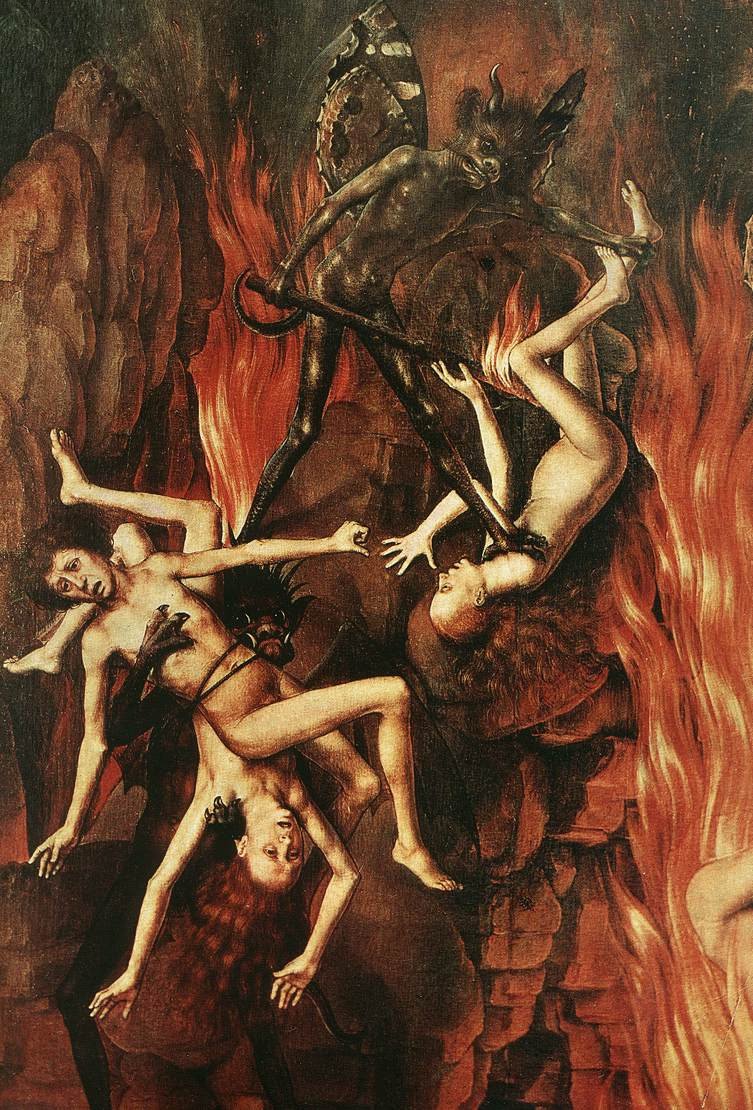
The traditional Catholic teaching on hell as developed by the Church Fathers, ancient Councils, and infallible Magisterium
I. The Word Itself — Gehenna and Its Origins
The word “Hell” in the theological tradition carries several layers of meaning that must be carefully distinguished, because the ancient teachers used different terms for different realities that modern language often collapses into one.
The Hebrew word Sheol, used throughout the Old Testament, referred originally to the realm of the dead in general — the shadowy underworld where the souls of all the departed went, both the righteous and the wicked. It was a place of darkness and diminished existence, not yet the fully developed concept of Hell as eternal punishment. The Greek Septuagint translated Sheol as Hades, which carried similar connotations in Greek thought.
But the word that Christ Himself used most frequently, and which became the primary biblical term for the place of eternal punishment, was Gehenna. This word has a concrete geographical origin that the early Fathers considered deeply significant. Gehenna is the Greek form of the Hebrew Ge-Hinnom — the Valley of Hinnom, a ravine just southwest of Jerusalem. In the time of the Old Testament kings, this valley was the site of the abominable cult of Moloch, in which children were burned alive as sacrifices. The prophet Jeremiah cursed the place in the name of God. After the reforms of King Josiah, the valley was desecrated and turned into the refuse dump of Jerusalem, where garbage burned continuously, where the bodies of criminals and the unburied poor were thrown, where worms fed on decaying flesh and fires never went out.
Christ took this image — the perpetually burning dump outside the holy city, a place of corruption and fire and exclusion — and used it repeatedly as the image of the eternal state of the damned. When He spoke of the fire that is not quenched and the worm that does not die, He was drawing on the visceral reality of Gehenna. The early Christians understood immediately what He meant. The theologians built their entire doctrine of Hell on these foundations.
II. The Certainty of Hell — A Defined Dogma
One of the most important things to understand about the traditional Catholic teaching on Hell is that it was not a pious opinion or a theological hypothesis. It was a defined dogma of faith — something that every Catholic was obliged to believe as a truth revealed by God.
The Fourth Lateran Council in 1215 defined explicitly that the wicked will receive perpetual punishment with the devil. The Council of Florence in 1439 stated that souls who die in actual mortal sin descend immediately into Hell, to be tormented by unequal pains. The Council of Trent confirmed and reinforced these definitions. The traditional Athanasian Creed, recited in the Divine Office, declared plainly that those who have done evil will go into everlasting fire.
The traditional theologians never treated Hell as an embarrassment or an exaggeration. They considered it an indispensable truth — one that revealed the absolute seriousness of the moral life, the infinite gravity of sin, the genuine reality of human freedom, and the perfect justice of God. To deny Hell was, in their view, to deny the significance of human choice, to make sin ultimately inconsequential, and to strip the Gospel of its urgency. The preaching of Hell was not cruelty — it was, they argued, an act of love, because it warned men of a real danger that could be avoided.
III. What Hell Is — The Fundamental Definition
Hell, in precise theological terms, is the state of eternal separation from God, undergone by rational creatures — human souls and fallen angels — who die in a state of final impenitence, having definitively chosen evil over God.
Several elements of this definition require careful unpacking.
Hell is first and foremost a state, not merely a place. It is a condition of the soul — a permanent, irreversible orientation away from God. The external circumstances of Hell — fire, darkness, confinement — are secondary to this essential reality: the soul is separated from God, and this separation is complete, definitive, and eternal.
It is the state of those who die in final impenitence. This phrase is crucial. The traditional teaching did not say that every sinner goes to Hell — the whole sacramental system of Confession and the entire doctrine of God’s mercy were built on the premise that sin can be forgiven and the soul restored to grace. Hell is for those who reach the moment of death having refused, finally and definitively, to repent — having chosen, in their last free act, to remain turned away from God. This is what the theologians called the sin unto death — not necessarily the most dramatic sin, but the sin that is held onto without repentance to the very end.
The damned include both fallen angels — the demons, with Lucifer or Satan at their head — and human souls who have chosen damnation through their own free will. The traditional doctrine was absolutely firm that God does not send anyone to Hell arbitrarily or unjustly. Hell is chosen, in the sense that it is the logical and just consequence of a free, persistent, and final rejection of God.
IV. The Two Great Punishments of Hell
The scholastic tradition, following Saint Augustine and elaborated with great precision by Saint Thomas Aquinas and the other great doctors, distinguished two fundamental and distinct punishments that constitute the suffering of Hell. These are called the Pain of Loss and the Pain of Sense.
The Pain of Loss – Poena Damni
The Pain of Loss is the primary and most terrible punishment of Hell. It is the eternal deprivation of the Beatific Vision — the permanent exclusion of the soul from the direct sight and possession of God.
To understand why the theologians considered this the worst punishment, one must recall what they taught about the Beatific Vision in relation to Paradise. The human soul was created with an orientation toward God as its final end. God implanted in the rational soul a natural desire for the infinite good, which ultimately can be satisfied by nothing less than God Himself. Every human being who has ever lived, however confused or distorted their desires became through sin, is at the deepest level of their being moving toward something they identify with happiness, with the good, with fulfillment. The theologians taught that this deepest desire is in fact, whether the person knows it or not, a desire for God.
In Hell, this desire — this fundamental orientation of the rational soul toward the infinite — is permanently frustrated. The soul knows, with agonizing clarity, what it has lost. The damned see, with a terrible intellectual lucidity, that God is the supreme good, that He alone could have fulfilled the soul’s deepest longing, and that He is now irreversibly beyond their reach. This knowledge does not bring them closer to God — it torments them, because their will remains permanently hardened against God even while their intellect recognizes His supreme goodness.
Saint Thomas Aquinas called this the greatest punishment of Hell — greater even than the fire and the physical torments — because it is the privation of the infinite good. He argued that all other sufferings are finite, however intense, but the loss of God is the loss of the infinite. Nothing can compensate for it. No earthly pleasure, multiplied infinitely, could begin to substitute for the Beatific Vision that the damned have lost.
The traditional preachers pressed this point with great force. They would say to their congregations: imagine possessing perfect health, infinite wealth, every earthly pleasure and satisfaction simultaneously, forever — and yet being separated from God. That condition would be Hell, even without fire or any other torment, because the soul’s fundamental longing would remain forever unsatisfied. The Pain of Loss is Hell’s deepest reality.
There is also a particular element of the Pain of Loss that the theologians noted: the damned are aware not only of their privation but of the contrasting happiness of the blessed. They know that others have attained what they have lost. Whether this knowledge is continuous or comes in particular moments of torment was debated, but many theologians considered it part of the punishment — the awareness of a happiness irrevocably forfeited.
The Pain of Sense – Poena Sensus
The second punishment is the Pain of Sense — a positive suffering inflicted upon the damned, beyond the mere absence of God. This is what is commonly imagined when people think of Hell: fire, torment, anguish.
The reality of the Pain of Sense was a defined teaching of the Church, affirmed explicitly at the Council of Florence. The precise nature of this punishment, however, generated extensive theological debate that was never definitively settled on all points.
The most debated question concerned the nature of hellfire. Christ had spoken repeatedly of fire in connection with Hell: the fire that is not quenched, the furnace of fire, the lake of fire. The question was whether this fire was to be understood literally as material fire, or metaphorically as an intense spiritual suffering.
The majority of the great scholastic theologians, including Saint Thomas Aquinas, held that the fire of Hell is in some sense real and material — not identical to ordinary earthly fire, but a genuine physical element that acts upon souls and, after the resurrection, upon resurrected bodies. Aquinas argued that there is no contradiction in a material fire acting upon a spiritual soul, because fire does not need to be of the same nature as what it torments — it can act as an instrument of divine justice upon the soul. Many theologians were careful to note that hellfire differs from earthly fire: it does not consume or destroy what it burns, it gives no light, it produces only pain without any of the warmth or energy that ordinary fire provides.
Other theologians, particularly in the mystical tradition, leaned toward understanding the fire more metaphorically — as an image of the intense anguish of frustrated desire, of a will burning with hatred and rage, of the conscience tormented by remorse. The image of fire, on this reading, perfectly captures the quality of the suffering: burning, consuming, inescapable, without relief — but the substance of the suffering is spiritual.
The Church never definitively ruled between these interpretations at the level of dogma. What was defined is that the Pain of Sense is real, positive, and eternal — not merely the absence of God but an active torment.
V. The Eternity of Hell — The Most Difficult Teaching
No aspect of the doctrine of Hell generated more theological discussion, or more pastoral anguish, than its eternity. And yet on this point, the traditional teaching was among its most absolute.
The eternity of Hell’s punishments was not merely a theological opinion. It was a solemn definition of the faith, repeated at multiple councils. The Fourth Lateran Council spoke of perpetual punishment. The Council of Florence spoke of torments without end. The traditional Catechism of the Council of Trent declared that the punishment of the damned shall never have an end, and that they are to be tormented forever in the fire which shall not be extinguished.
The theologians offered several lines of reasoning for why Hell must be eternal.
The first argument concerns the nature of the act by which Hell is incurred. Mortal sin, in traditional theology, is a turning away from God — the infinite good — in favor of some created, finite good. Because the object offended is infinite (God Himself), the offense carries an infinite gravity that temporal punishment alone cannot satisfy. Justice requires a proportionate response, and an offense against the infinite good can only be repaid, in creatures who cannot make infinite reparation, by an eternal punishment. This was the argument of Saint Anselm, developed further by Aquinas.
The second argument concerns the state of the will at the moment of death. Traditional theology taught that death fixes the will in its final orientation. During life, the human will is mobile — capable of turning toward God or away from Him, of repentance and conversion. But this mobility belongs to the condition of earthly life, where the soul is still on its way, still in via. At death, the journey ends. The will is fixed in its last free choice. If that choice was a definitive rejection of God, it remains permanently fixed in that rejection — not because God arbitrarily freezes the will, but because the condition that made change possible (the state of being a pilgrim soul in bodily life) no longer exists. The damned do not repent in Hell, not because repentance is denied to them from outside, but because they do not will to repent. Their hatred of God, their rejection of Him, is permanent.
Saint Thomas Aquinas elaborated this point with characteristic precision. He said that the natural end of the will is God — the will naturally tends toward the good. But in the damned, the will has been so completely distorted by the accumulation of sinful choices, confirmed finally at death, that it now habitually and permanently chooses against God. The damned know that God is good. They hate Him anyway. This hatred is not temporary frustration but a settled and permanent condition of the will.
The third argument concerns the purposes of punishment. Punishment in traditional theology serves three possible purposes: correction of the offender, protection of others, and satisfaction of justice. In Hell, correction is no longer possible — the state of the damned is fixed. Protection of others is no longer the primary concern — the damned are isolated from the living. What remains is pure justice: the eternal punishment satisfies the demands of divine justice for an offense that was, in its innermost nature, a choice against the eternal God.
The traditional preachers did not soften this teaching. The Jesuit preacher Paolo Segneri in the seventeenth century, Alphonsus Maria de Liguori in the eighteenth, and countless others before them preached the eternity of Hell with unflinching directness. They considered it an act of charity toward their congregations — a loving warning, not a cruelty. The man who understood that Hell is eternal and might await him had every reason to repent immediately. The man who was told Hell was temporary, or perhaps nonexistent, had been robbed of his greatest motive for conversion.
VI. The Inequality of Punishments in Hell
Just as there are different degrees of glory in Paradise corresponding to different degrees of charity, the traditional theology taught that there are different degrees of punishment in Hell corresponding to different degrees of guilt.
This was not a late addition to the tradition — it is rooted in the words of Christ Himself, who spoke of those who will receive greater condemnation, and of punishments that vary according to the knowledge and responsibility of the sinner. The Council of Florence referred explicitly to unequal pains among the damned.
Saint Thomas Aquinas taught that the degree of punishment in Hell corresponds to the gravity of the sins committed, measured both by their objective seriousness and by the subjective culpability of the sinner. A soul that sinned with full knowledge, full consent, and in defiance of great graces received will suffer more intensely than a soul that sinned with less knowledge or under greater pressure of passion or circumstance.
This doctrine preserved both the justice and the mercy of God within the framework of Hell. It acknowledged that not all guilt is equal, that God’s judgment takes account of the full interior reality of each soul’s history, and that the punishment is always perfectly proportionate to the offense — never arbitrary, never excessive, never unjust.
The degree of the Pain of Loss also varies among the damned. All the damned are deprived of the Beatific Vision — that is the constant. But the anguish of that deprivation is greater for those who received more grace, more light, more opportunity for conversion and refused it. The soul that sinned against great light suffers the loss of God more acutely than the soul that sinned in greater darkness.
VII. The State of the Damned – Their Inner Condition
Beyond the external punishments, the theologians painted a detailed and harrowing picture of the interior state of the damned soul.
The primary interior characteristic of the damned is despair — not the temporary despair of earthly suffering, which can be relieved or transformed, but an absolute, permanent, and total despair. The damned know with certainty that their condition will never change. They know that no rescue is coming, that no intercession will alter their fate, that the eternity stretching before them is identical to the eternity behind them. This certain and permanent knowledge of hopelessness is itself a dimension of torment that the theologians considered almost impossible for the living to fully imagine.
Closely related to despair is hatred. The damned hate God — not with the passionate hatred that still acknowledges the greatness of its object, but with a cold, confirmed, settled rejection. They hate God because He is good, because His goodness reveals and condemns their evil, because His justice has sealed their fate. This is a hatred that cannot be appeased, cannot be softened, and that the damned themselves cannot escape. They are imprisoned within their own hatred.
The damned also hate each other. The disordered love that united sinners on earth — in bonds of shared vice, mutual flattery, complicity in evil — collapses in Hell into mutual recrimination, rage, and contempt. The traditional teachers pointed out that Hell contains no community, no friendship, no solidarity. Each soul is utterly alone in its suffering, and to whatever extent the damned are aware of each other, that awareness adds to their torment rather than providing any comfort.
The damned also suffer the torment of memory and remorse. They remember their earthly lives with perfect clarity — every grace received and rejected, every moment in which conversion was possible and was refused, every warning given and ignored, every person who prayed for them or spoke to them of God. This memory is not consoling but condemning. The remorse it produces is not the fruitful sorrow of contrition that leads to conversion — it is a sterile anguish, a regret without repentance, a gnawing that never yields any fruit.
The traditional term for this aspect of the punishment was the worm that does not die — drawn from the words of Christ Himself quoting Isaiah. The worm of conscience, feeding perpetually on the memory of sins and lost graces, without ever consuming what it feeds on and without ever ceasing its activity.
VIII. The Demons – The Company of Hell
Hell was not only the place of condemned human souls. It was also the permanent abode of the fallen angels — the demons — led by Lucifer, called by various names in Scripture and tradition: Satan, the Devil, the ancient serpent, the prince of this world, the accuser.
The traditional theology taught that the angels fell before the creation of humanity. They were created in a state of grace, given a single probationary test of their free will — the precise nature of which was debated, though many theologians following Saint Thomas held it to be a test involving the Incarnation, in which the angels were called to adore God in human flesh, and Lucifer refused in pride — and those who failed the test were immediately and permanently fixed in their rebellion. Their nature as pure spirits, possessing intellect without the hesitation and gradual deliberation of embodied creatures, meant that their choice was total and instantaneous, and therefore irrevocable in a way that human choices during earthly life are not.
The demons suffer the same two punishments as the damned human souls: the Pain of Loss and the Pain of Sense. They are excluded from the Beatific Vision forever. They suffer in the fire of Hell. Their punishment, like that of the human damned, is eternal.
But the demons have a particular role in the theology of Hell that distinguishes them from the human damned. During the present age — before the Final Judgment — the demons are permitted by divine providence to operate in the world, tempting human beings, working against the Kingdom of God, serving as instruments of trial and purification for the saints. The traditional theology held that this permission of divine providence has a positive dimension: the resistance of the saints to demonic temptation purifies them, strengthens their charity, and increases their merit and eventual glory. God draws good even from the malice of the demons.
After the Final Judgment, this temporary permission ends. The demons will be confined to Hell entirely and forever, no longer permitted to roam the world. Their torment will be complete and their activity entirely circumscribed.
The relationship between the demons and the human damned in Hell was not one of camaraderie. The demons do not rule over the damned as lords over subjects in any comfortable sense — rather, the demons themselves are tormented, and their proximity to the human damned adds to the general character of Hell as a place of total disorder, hatred, and mutual torment. There is no peace, no hierarchy that functions justly, no society. Hell is the absolute negation of community.
IX. Hell and the Justice and Mercy of God
The traditional theologians were acutely aware that the doctrine of Hell raised the most profound questions about the character of God. How can an infinitely merciful God permit any of His creatures to suffer eternally? Is Hell compatible with divine love?
Their answer was carefully constructed and rested on several pillars.
The first is the reality of human freedom. God does not send anyone to Hell who did not choose it. This point was non-negotiable in traditional theology. Hell is not an arbitrary punishment imposed from outside — it is the natural and just consequence of a free and final rejection of God. God created rational beings with genuine freedom precisely because He wanted their love to be real, not compelled. Real love requires the genuine possibility of refusal. Hell is the ultimate consequence of that possibility. To eliminate Hell would be to eliminate freedom — to make human beings not persons who freely love God but mechanisms that automatically tend toward Him.
The second pillar is the perfection of divine justice. The theologians insisted that God’s mercy and God’s justice are not in conflict — they are both perfect expressions of His one infinite nature. Mercy is God’s disposition to forgive and restore when the sinner turns to Him. Justice is God’s disposition to give every creature exactly what it deserves. A God who simply overrode the free choices of the wicked and forced them into Paradise against their will would be neither merciful nor just — He would be violating the very nature of the persons He created. True mercy respects the freedom of the beloved. It offers, it pleads, it endures — but it does not coerce.
The third pillar concerns the nature of the damned’s own choice. The traditional teachers emphasized that the damned in Hell do not wish to be with God. They hate God and do not desire Him. To force such souls into the presence of God against their will would not be mercy toward them — it would be a torment of a different kind. The Beatific Vision, which is Paradise for those who love God, would be an unbearable agony for those whose will is permanently fixed in hatred of God. In a profound paradox, Hell is the mercy of God toward those who have definitively rejected Him — it is the granting to them of what they truly wanted: existence without God.
The fourth pillar is the absolute certainty that no soul goes to Hell without having had sufficient grace for salvation. God, in the traditional theology, is not a God who predestines some to damnation arbitrarily. Every soul that is lost is lost because it freely and knowingly refused the grace that God genuinely offered it. The traditional teaching held firmly to both sides of this truth: God sincerely wills the salvation of all, offering sufficient grace to all; and human beings genuinely and freely reject that grace in choosing Hell. How these two truths are ultimately reconciled in the mystery of divine providence was acknowledged to be beyond full human comprehension — but both were held as certain.
X. The Pastoral Purpose of the Doctrine
The traditional Church did not preach Hell merely as an abstract theological proposition. Hell was a pastoral instrument of the first importance, used by generations of preachers to move congregations to genuine conversion.
The logic was simple and direct. If Hell is real, if it is eternal, if any given soul might be on the path toward it, then the urgency of repentance and conversion is absolute. No earthly consideration — pleasure, wealth, reputation, comfort, human respect — is remotely worth risking an eternity of suffering. The mathematics are overwhelmingly clear: the longest earthly life is a momentary flash compared to eternity. Whatever sacrifice conversion requires — however much pride must be swallowed, however many habitual sins must be broken, however much ridicule must be endured — it is infinitely worthwhile if it means avoiding Hell.
The great preachers of the Counter-Reformation era — the Jesuits above all, but also Dominicans, Franciscans, and diocesan clergy — used the doctrine of Hell as the foundation of their missions and retreats. The Spiritual Exercises of Saint Ignatius include a famous meditation on Hell in the first week, designed to produce what Ignatius called a salutary fear — not a craven, paralyzing terror, but a healthy, motivating fear of the consequences of sin that propels the soul toward God and away from evil.
This fear, the traditional theology carefully noted, was not the highest motive for serving God. The perfect motive is love — the love of God for His own sake, because He is infinitely good and worthy of all love. But the Church, realistic about human psychology and the power of self-deception and sensory attraction, acknowledged that fear of Hell is a legitimate and valuable beginning of conversion. The soul that initially flees sin because it fears punishment may, through grace and growth, eventually come to flee sin out of pure love for God. But it is better to begin with fear than never to begin at all.
The doctrine of Hell was also, paradoxically, a source of consolation for the righteous suffering injustice on earth. The martyrs who saw their persecutors triumphant, the poor who watched the wicked prosper, the innocent who suffered violence at the hands of the cruel — all of these could take genuine comfort in the certainty that divine justice would ultimately be perfectly and permanently satisfied. No evil goes unpunished in the economy of God. Every injustice will be addressed. Every cruelty will be answered. The patience required of the just in this life will be infinitely rewarded, and the impunity of the wicked is temporary and illusory.
This is why the traditional Catholic understanding of Hell, far from being merely a weapon of terror, was embedded within a complete and coherent vision of reality — a vision in which God is perfectly good, perfectly just, perfectly merciful, human freedom is genuinely real, earthly life is genuinely consequential, and the eternal destinies of souls are the most serious realities in existence.
I. Biblical Foundations
Scripture Terminology
Old Testament:
Sheol (Hebrew): Place of the dead, lower region
Described as a place of darkness, silence, separation from God.
New Testament:
Gehenna (Greek: γέεννα): From the Hebrew Ge-Hinnom (Valley of Hinnom), place of eternal fire.
Hades (ᾍδης): Greek equivalent of Sheol
Tartarus: Mentioned once (2 Peter 2:4), abyss of darkness.
Lake of Fire: Revelation 20:14-15, final destination
Words of Christ about Hell
Christ spoke more about hell than about heaven, with stark warnings:
Matthew 5:22 – “He who is guilty of the fire of Gehenna”
Matthew 5:29-30 – “It is better to lose one part of your body than for your whole body to go to hell.”
Matthew 10:28 – “Rather fear him who can destroy both soul and body in hell.”
Matthew 13:41-42 – “They will throw them into the fiery furnace, where there will be weeping and gnashing of teeth.”
Matthew 18:8 – “Eternal fire” (πῦρ τὸ αἰώνιον)
Matthew 23:33 – “You snakes! You brood of vipers! How will you escape being condemned to hell?”
Matthew 25:41 – “Depart from me, you cursed, into the eternal fire prepared for the devil and his angels.”
Matthew 25:46 – “And these will go away into eternal punishment (κόλασιν αἰώνιον), but the righteous into eternal life.”
Mark 9:43-48 – “Gehenna, where the worm does not die and the fire is not quenched ” (repeated three times for emphasis)
Luke 16:19-31 – Parable of the Rich Man and Lazarus: “I am tormented in these flames”
Apostolic Teaching
2 Thessalonians 1:9 – “They will suffer the punishment of eternal destruction , away from the presence of the Lord.”
Jude 7 – Sodom and Gomorrah as an example, “suffering the punishment of eternal fire ”
Revelation 14:11 – “And the smoke of their torment rises forever and ever .”
Revelation 20:10 – “They will be tormented day and night forever and ever .”
Revelation 21:8 – “Their portion will be in the lake that burns with fire and sulfur, which is the second death.”
II. DOCTRINE OF THE CHURCH FATHERS
Apostolic Fathers (1st-2nd Century)
SAINT IGNATIUS OF ANTIOCH (†107) Letter to the Ephesians: “Those who corrupt the faith of God through false doctrine… will go into the unquenchable fire , as will those who listen to them.”
SAINT POLYCARP OF SMYRNA (†155) Martyrdom of Polycarp: When threatened with temporal fire, he replied: “You threaten me with fire that burns for an hour and then goes out, but you are ignorant of the fire of future judgment and eternal punishment reserved for the wicked.”
Didache (c. 100) “There are two paths: one of life and the other of death… the path of death leads to eternal damnation.”
Apologetic Fathers (2nd Century)
SAINT JUSTIN MARTYR (†165) First Apology: “The souls of the wicked, united to their bodies, will be sent to eternal fire for endless punishment… God did not make man like cattle or irrational animals that perish and are annihilated. Therefore, it would be irrational for the wicked to cease to exist along with their bodies and not suffer punishment while they last.”
SAINT IRENAEUS OF LYON (†202) Against Heresies: “The Lord clearly taught that the fire is eternal for those who do not repent… Just as those who do good will receive eternal life, so those who do evil will receive eternal fire … Those who reject Him He deprives of the benefit of eternal life and sends them to eternal fire .”
School of Alexandria (3rd Century)
Tertullian (†220) Apologetic: “That immense fire of the world which will devour all things is not known to poets and philosophers… But we, whom the Scriptures instruct… know of it and believe that it is reserved for the end of the world as punishment. The same divine fire that will nourish the saints will also nourish the wicked for all eternity .”
De Anima: “The soul in hell suffers torment in the flames… and thus receives a prelude to its future judgment and eternal punishment .”
Clement of Alexandria (†215) Stromata: Although he tended toward universal restoration (a heresy that the Church rejected), he still affirmed the reality of severe punishment after death.
ORIGEN (†254) taught apokatastasis (final restoration of all), but this doctrine was condemned as heresy at the Second Council of Constantinople (553). This shows that already in the 3rd century the Church confronted and rejected universalism.
Fathers of the 4th Century (Golden Age)
SAINT ATHANASIUS (†373) Against the Arians: “Those who despise the Son… will be cast into outer darkness where there is weeping and gnashing of teeth , and into the unquenchable fire.”
SAINT BASIL THE GREAT (†379) Homily on Psalm 28: “The sinner will be punished with eternal torment , unquenchable fire, a worm that does not die… These are not empty words or empty threats.”
SAINT GREGORY OF NAZIANZENE (†390) Prayers: “I fear the eternal fire, the gnashing of teeth, the worm that does not die, the outer darkness.”
SAINT JOHN CHRYSOSTOM (†407) Homilies on Matthew: “When you hear about eternal fire, understand that there is no end to it… ‘Eternal’ means precisely this: that it has no end… There is nothing more terrible than hell, nothing more horrendous; and yet no description can reach its reality… Even if someone were to describe it for a thousand years, they could not express the tiniest portion of those torments.”
Regarding Lazarus: “The rich man asked for a drop of water, but did not receive it. If after five thousand years of torment he had obtained relief, it would have been a great consolation… but the punishment is eternal and unending .”
SAINT CYRIL OF JERUSALEM (†386) Catecheses: “We believe… in eternal life for the righteous and in eternal fire for sinners. Both without end.”
Latin Fathers (4th-5th centuries)
SAINT AMBROSE OF MILAN (†397) Commentary on Luke: “The fire of hell is perpetual for those who deserve to be burned… There will be no end to the torments.”
SAINT JEROME (†420) Against Jovinian: “Just as the righteous will receive incorruptible bodies fit for eternal glory, so the wicked will receive incorruptible bodies but fit to endure eternal torment … The fire will be eternal, and the pain of the worm that does not die will be perpetual.”
SAINT AUGUSTINE OF HIPPO (†430)
Augustine provided the most complete and systematic exposition of hell in antiquity:
The City of God (Book XXI):
“Those who do not believe in the eternity of punishment must be refuted… Scripture declares the eternal punishment of the damned more frequently and clearly than the eternal happiness of the saints.”
“Souls after death cannot obtain mercy that will deliver from eternal fire those whom God has said will go to eternal torment .”
“It is utterly vain and ridiculously merciful to suppose that such punishments will last a long time but not forever… When God says ‘eternal,’ let us believe that He is ETERNAL .”
“The fire will be corporeal and real , and will torment the bodies of the damned, both devils and men… The bodies will be of such a nature that the fire will consume them without destroying them, causing pain without ceasing.”
“Let us not allow this deceptive mercy to deceive us. There are only two final destinations: eternal life with God or eternal death far from God .”
Enchiridion:
“After the resurrection… some will be consigned to eternal fire with the devil… This punishment consists not only of separation from God, but also of positive torment.”
“God in His justice prepares eternal punishments for sins, no matter how short their temporal duration may have been… Sinning against the Eternal deserves eternal punishment.”
III. TEACHING OF THE COUNCILS
Quicumque Symbol (Creed of Saint Athanasius, c. 500)
“Those who have done good will go to eternal life, but those who have done evil will go to eternal fire .”
Early Local Councils
Synod of Constantinople (543) condemned Origen and his doctrine of apokatastasis (universal restoration):
“If anyone says or thinks that the punishment of demons and wicked men is temporary… let him be accursed.”
Second Council of Constantinople (553) – 5th Ecumenical Council
Canon 1: He condemned Origen again:
“If anyone says or thinks that the punishment of demons and wicked men is only temporary and will end after a certain time… let him be anathema.”
Clear definition: He definitively rejected any idea that hell would ever end.
Council of Toledo XVI (693)
“We believe that the wicked, along with the devil, will be consigned to eternal flames… there they will remain in perpetual torment .”
Lateran Creed (649)
Pope Saint Martin I proclaimed:
“The Holy Roman Church believes… that the wicked will receive eternal punishment with the devil.”
IV. CHARACTERISTICS OF HELL
1. Absolute Eternity (Aeternitas)
Fundamental principle: The Greek word aiōnios (αἰώνιος) and the Latin word aeternus both mean “without end”.
Patristic argumentation:
The same word describes the eternal life of the saints and the eternal punishment of the wicked (Mt 25:46).
If hell had an end, heaven would too.
“Eternal” cannot mean “very long but finite” when applied to God or spiritual realities.
Saint Augustine: “If ‘eternal’ does not mean ‘without end,’ then not even God is eternal.”
2. Penalty of Damage ( Poena Damni )
Definition: Eternal loss of the beatific vision of God, definitive exclusion from the divine presence.
Patristic theology:
This is the primary and essential punishment.
God is the Supreme Good and the ultimate end of man.
To lose Him forever is the greatest possible misfortune.
Separation not only spatial but ontological.
Matthew 25:41: “Depart from me, you cursed…”
2 Thessalonians 1:9: “Far from the presence of the Lord”
Saint Augustine: “The greatest misery is to be separated from Him in whom all happiness resides.”
Saint John Chrysostom: “Even if there were no fire, to be excluded from the glory of Christ and to be hated by Him would be punishment enough.”
3. Meaningful Punishment ( Poena Sensus )
Definition: Positive torment caused by an external agent, primarily fire.
A. The Fire of Hell
Nature according to the Fathers:
Real and corporeal fire:
It’s not a metaphor, but physical reality (after the resurrection of the bodies).
A special type of fire created by God specifically for punishment.
It acts on both bodies and spirits (souls and demons).
Saint Augustine: “Fire will be corporeal… we believe and affirm that it will be real… we do not know exactly how it acts upon spirits, but we know that it can.”
Saint Basil: “The fire prepared for demons is something special… fire created for the punishment of the wicked.”
Special features:
It burns without consuming: It causes perpetual pain without destroying (like Moses’ burning bush).
Burn spirits: Acts upon separated souls and immaterial demons.
Darkness: Paradoxically accompanied by shadows (“outer darkness”)
Variable intensity: Priests teach degrees of punishment according to the severity of the sins.
Saint Gregory the Great: “There will be a fire, but it will not burn everyone equally… each one will suffer according to their guilt.”
B. The Worm That Doesn’t Die
Mark 9:48: “Where their worm does not die and the fire is not quenched.”
Patristic interpretations:
Literal: Real worms that devour without ceasing. Allegorical: Remorse of conscience, perpetual memory of sins.
Saint Augustine: “The worm is the conscience tortured by the memory of sins.”
Saint Jerome: “The worm is the inner pain that corrupts the soul as a worm corrupts the flesh.”
C. Other Afflictions
Outer darkness (Mt 8:12, 22:13, 25:30):
Absolute darkness
Deprivation of all divine light
Horrible isolation
Weeping and gnashing of teeth (Mt 13:42, 24:51):
Perpetual lamentation
Impotent rage against God and oneself.
Utter despair without consolation.
Extreme cold:
Rabbinic tradition and some Church Fathers mention alternating periods of extreme heat and cold.
Job 24:19: “From the snow they go to the warm waters”
Unbearable stenches:
Apocalyptic descriptions mention a “lake of sulfur.”
Spiritual decay manifested through the senses.
4. Degrees of Punishment
Principle of proportional justice:
Luke 12:47-48: “The servant who knew the Lord’s will and did not carry it out will be beaten with many blows, but the one who did not know it will be beaten with few blows.”
Romans 2:5-6: “God will repay each person according to what they have done.”
Saint Augustine: “There will be distinctions in punishment… not all will suffer equally… in proportion to their guilt.”
Saint Gregory the Great: “Just as there are many mansions in the Father’s house for the blessed, there are different degrees of punishment for the damned.”
Patristic categories:
Upper Hell: Lighter punishments for unexpiated venial sins and invincible ignorance.
Lower Hell: Severe torments for mortal sinners.
Deepest abyss: Extreme punishment for apostates, obstinate heretics, and blasphemers.
5. Nature of the Convicts
The State of Souls before the Resurrection
Unanimous patristic tradition:
Souls separated from bodies suffer immediately after death (particular judgment).
They suffer primarily the punishment of harm and spiritual torment.
They are already experiencing a prelude to ultimate hell.
Saint Augustine: “Between death and the final resurrection there are hidden places where souls are kept… the wicked already in torment.”
State after Universal Resurrection
After Judgment Day:
Bodies are resurrected in a state of corruption.
Reunited with the condemned souls
They suffer both spiritually and physically.
Incorruptible bodies, yet susceptible to eternal pain.
Qualities of condemned bodies:
Immortality without impassivity: They live forever but can suffer. Heavy: Without agility, trapped in a place of torment. Deformity: They reflect the moral ugliness of the soul. Heightened sensitivity: To fully feel pain.
Saint Thomas Aquinas (summarizing patristic tradition): “The bodies of the condemned will be impassive with regard to corruption but susceptible with regard to the sensation of pain.”
6. Inhabitants of Hell
A. Demons
Traditional education:
Satan and fallen angels were the first inhabitants.
Hell was “prepared for the devil and his angels” (Mt 25:41)
Demons suffer eternal fire, but they also torment condemned humans.
Saint Augustine: “The devil and his angels will receive eternal punishment… they will be both tormentors and tormented at the same time.”
B. Condemned Human Beings
Categories according to the Fathers:
Obstinate infidels: Pagans who rejected the natural light of reason.
Formal heretics: Christians who stubbornly rejected known truth.
Apostates: Baptized individuals who have renounced the faith.
Unrepentant mortal sinners: Catholics who died in mortal sin without repentance.
Saint John Chrysostom: “Not only those who deny Christ, but also the baptized who live in fornication, greed, malice, without repentance, will go to eternal fire.”
7. Impossibility of Regret
Fundamental theological principle:
After death, there is no longer any possibility of conversion or meritorious repentance.
Hebrews 9:27: “Just as people are destined to die once, and after that to face judgment.”
Reasons according to the Fathers:
Free will fixed: At death, one’s will is definitively established in the choice made. End of probationary period: Earthly life is the only opportunity for merit. Diabolical obstinacy: Condemned souls become like demons, voluntarily adhering to evil.
Saint Augustine: “Just as the good angels were confirmed in good, the evil angels and condemned souls are confirmed in evil… they can no longer genuinely repent.”
Saint John Damascene: “For men there is repentance until death; for angels there was not and will not be… so also for souls after death.”
8. Divine Justice in Hell
Theological problem: How to reconcile God’s infinite mercy with the eternity of hell?
Patristic responses:
A. Sin against Infinite Good
Saint Anselm (summarizing tradition): “To sin against God, who is infinite Good, deserves infinite punishment. As a creature, it cannot suffer punishment infinite in intensity, but it suffers it in duration.”
Saint Thomas Aquinas: “The gravity of sin is measured by the dignity of the one who is offended. Since God has infinite dignity, to sin against Him is infinitely grave.”
B. Free Choice Respected
Saint Augustine: “God does not send anyone to hell against their will… each person freely chooses to reject God… hell is the eternal ratification of that choice.”
Saint John Chrysostom: “Let us not blame God but ourselves… no one is condemned except by their own wickedness.”
C. Abundant Warnings
Priests emphasize: God gave:
Natural reason to know moral law
A conscience that accuses or defends.
Enough thanks for everyone
Warnings in Scripture
Examples of saints and temporal punishments
Saint John Chrysostom: “What excuse will those have who, having heard so many times about hell, have chosen to ignore the warnings?”
9. Lack of Communion Among Convicts
Tradition teaches:
Unlike heaven, where there is communion among the saints, in hell there is no community or mutual comfort.
Features:
Each one isolated in their torment.
Mutual hatred between convicts
Envy of those who suffer less.
Impossibility of friendship or compassion.
Saint Augustine: “In hell, each one is alone with his torments… there is no charity, no mutual consolation.”
V. DEFINITIVE SUBSEQUENT TEACHING
Fourth Lateran Council (1215) – 12th Ecumenical Council
Dogmatic definition:
“But all will rise again with their own bodies that they now have, to receive according to their works, whether good or evil: those [reprobate] with the devil eternal punishment (poenam perpetuam) , those [elect] with Christ eternal glory.”
Second Council of Lyon (1274) – 14th Ecumenical Council
“The souls of those who die in mortal sin or even just with original sin descend immediately to hell, to be punished, though with unequal punishments.”
Benedictus Deus Constitution of Pope Benedict XII (1336)
Ex cathedra definition:
“According to God’s common disposition, the souls of those who die in actual mortal sin descend immediately after death to hell where they are tormented with infernal pains .”
VI. THEOLOGICAL SYNTHESIS
Truths of Faith Defined
The real existence of hell – A dogma of faith
Eternity of punishments – Dogma of faith
Real Fire – Common and Certain Doctrine
Double penalty (damage and meaning) – Correct doctrine
Degrees of punishment – Common doctrine
Impossibility of post-mortem repentance – Doctrine of faith
Immediate condemnation after death – Dogma of faith
Purpose of Hell
Threefold purpose according to tradition:
Manifestation of divine justice: God is just and punishes evil.
Vindication of the moral order: Good and evil cannot share the same destiny.
A warning for the living: Motivation for conversion and holiness.
Saint John Chrysostom: “God speaks to us about hell not to send us there, but so that no one may fall there.”
The Church’s traditional teaching on hell is:
Clear and unequivocal: Without modern ambiguities.
Unanimous among the Fathers: Absolute consensus of the Holy Fathers
Defined in Councils: Infallible dogmatic truth
Based on Scripture: Christ taught this repeatedly.
Confirmed by the Magisterium: Century after century
Traditional doctrine does not recognize:
“Hell as a psychological state”
“Annihilationism”
“Universal restoration”
“Second chance after death”
“A purely symbolic interpretation of fire”
It is a physical, eternal, horrifying – but just – reality , the result of humanity’s free choice to reject God definitively.
Saint Alphonsus Liguori (summarizing the entire tradition): “There is no article of faith more certain than this: those who die in mortal sin go to hell for all eternity.”