Saints
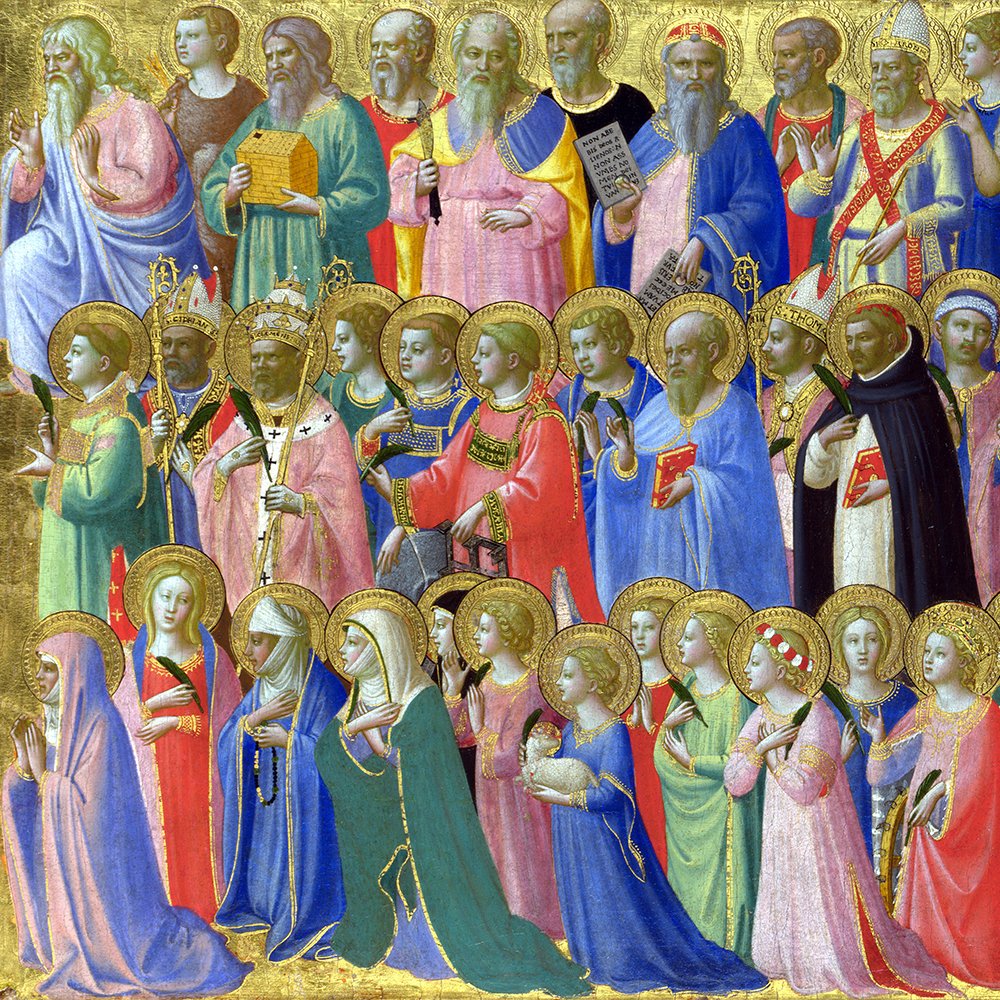
The word saint comes from the Latin sanctus, meaning holy, consecrated, set apart for God. In Catholic theology the term carries two senses. In the broad sense, all the baptized who live in sanctifying grace are called saints, which is the constant usage of Saint Paul in his Epistles when he greets the saints of Corinth, the saints of Rome, and the saints of Ephesus. In this sense, holiness is the life of grace and every Christian is called to it.
In the strict and technical sense, a saint is one whom the Church, after a long and rigorous process of investigation, solemnly declares to have died in the state of grace, to have attained eternal glory, and to be worthy of public veneration and imitation by all the faithful. This solemn declaration is called canonization.
Catholic doctrine on the saints rests on three pillars: holiness is the work of God, not of man; the saint dwells in Heaven and intercedes for the living; and the veneration of saints is not adoration, which belongs to God alone, but a loving honour rendered to the friends of God.
DOCTRINE ON THE SAINTS
Holiness as the Work of God
The first and most fundamental principle of Catholic theology on the saints is that holiness is not a human achievement. No man makes himself holy by his own efforts or willpower. Holiness is the gift of God, the sanctifying grace communicated by the Holy Spirit, which transforms the soul and progressively conforms it to Christ. Saint Paul is explicit: It is God who works in you both the willing and the doing according to his good pleasure (Phil 2:13).
The Communion of Saints
The Church professes in the Apostles Creed the communion of saints. This communion encompasses the faithful on earth (Church Militant), the souls in Purgatory (Church Suffering), and the blessed in Heaven (Church Triumphant). These three parts form one Body of Christ, whose members assist one another by prayer and merit. The saints in Heaven intercede for their brothers and sisters still on earth, as shown by the vision in the Apocalypse of the twenty-four elders presenting before the Lamb golden bowls full of incense, which are the prayers of the saints (Rev 5:8).
Types of Religious Honour
TYPE OF HONOUR | DEFINITION AND RECIPIENT |
Latria (adoration) | Supreme worship due to God alone. To adore any creature as God is idolatry. The Mass, Eucharistic adoration, and prayers of adoration are acts of latria. |
Hyperdulia | The special veneration due to the Blessed Virgin Mary, superior to that of the other saints by reason of her unique dignity as Mother of God, but infinitely inferior to the adoration owed to God. |
Dulia (veneration) | The religious honour due to saints and angels as friends of God and models of virtue. It is not adoration but the respectful honour rendered to the servants of the King. |
The Process of Canonization
Canonization is the solemn and infallible act by which the Pope declares that a particular person is in Heaven and must be venerated by the universal Church. The process is lengthy and demands extraordinary proof. Its main stages are:
Servant of God: the title given when the diocesan investigation into the candidate’s life, virtues, and writings is officially opened.
Venerable: the title conferred by the Pope after confirming that the candidate lived the Christian virtues to a heroic degree.
Blessed (Beatification): the Pope, after verifying an approved miracle, authorizes public veneration in a specific region. This is the penultimate step.
Saint (Canonization): the solemn and infallible act by which the Pope, after verifying a second miracle worked after beatification, declares the Blessed a Saint and orders universal veneration throughout the whole Church.
THE APOSTOLIC SAINTS AND MARTYRS
The Blessed Virgin Mary (1st c. BC / 1st c. AD) Mother of God and Queen of All Saints
Mary holds an absolutely singular place among the saints. She is not merely the greatest among them; she is the Mother of God (Theotokos), the Immaculate Conception, the Ever-Virgin, and the Queen of Heaven and Earth. The Church defines four Marian dogmas: the Divine Maternity (Council of Ephesus, 431), Perpetual Virginity, the Immaculate Conception, and the Bodily Assumption into Heaven. Mary cooperated uniquely in the work of Redemption by giving Christ His human nature through her fiat and by standing at the foot of the Cross.
Saint John the Baptist (c. 5 BC to c. 30 AD) Prophet, Forerunner, Martyr
John the Baptist is the last and greatest of the Old Testament prophets. Christ Himself declared: among those born of women, no one greater than John the Baptist has arisen (Mt 11:11). He lived in the desert, preached repentance on the banks of the Jordan, and was the first to recognize Christ: Behold the Lamb of God who takes away the sin of the world (Jn 1:29). He was beheaded by Herod Antipas at the instigation of Herodias, becoming a martyr for the truth he had proclaimed publicly.
Saint Peter the Apostle (c. 1 BC to 64/68 AD) Prince of the Apostles, First Pope, Martyr
Simon Peter, a fisherman of Bethsaida, was called by Christ beside the lake of Gennesaret. Jesus changed his name to Peter (Rock): You are Peter, and on this rock I will build my Church (Mt 16:18). After the Resurrection, Peter led the primitive Church, preached at Pentecost converting three thousand souls, presided at the Council of Jerusalem, and finally went to Rome, where he was martyred under Nero, crucified upside down, considering himself unworthy to die as his Master.
Saint Paul the Apostle (c. 5 AD to c. 64/67 AD) Apostle of the Nations, Doctor, Martyr
Saul of Tarsus was a strict Pharisee and a fierce persecutor of Christians. His conversion on the road to Damascus, when Christ appeared to him in a blinding light, is one of the most extraordinary events in religious history. From the greatest persecutor of the Church arose its greatest missionary. Paul undertook three great missionary journeys across the Mediterranean, founded communities in Philippi, Corinth, Ephesus, and other cities, and wrote fourteen Epistles that are the great theological systematization of the New Testament. He was beheaded in Rome under Nero.
Saint John the Evangelist (c. 6 AD to c. 100 AD) Beloved Apostle, Evangelist, Virgin
John, son of Zebedee, is the only one of the Twelve who was not martyred, yet Tradition gives him the title of martyr of desire. He was the disciple whom Jesus loved, the only Apostle who remained at the foot of the Cross, to whom Christ entrusted His own Mother. John wrote the Fourth Gospel, three Epistles, and the Apocalypse. He died of natural causes in Ephesus at an advanced age, the last surviving Apostle.
Saint Stephen (? to c. 34-36 AD) Deacon, Protomartyr
Stephen is the Protomartyr, the first martyr of the Christian Church. Chosen as one of the first seven deacons, he was arrested, tried before the Sanhedrin, and stoned to death outside the walls of Jerusalem. As the stones struck him, Stephen saw the Son of Man standing at the right hand of God and prayed: Lord Jesus, receive my spirit and Lord, do not hold this sin against them (Acts 7:59-60), echoing Christ’s own words on the Cross. A young man named Saul stood watching, the future Saint Paul.
THE GREAT FATHERS AND DOCTORS
Saint Augustine of Hippo (354 to 430 AD) Bishop, Doctor of the Church, Father of Western Theology
Augustine is the greatest theologian of the Western Church. Born in Tagaste in North Africa to a pagan father and a holy mother, Saint Monica, Augustine spent his youth in pleasure and in the Manichaean sect. His conversion in a Milan garden in 386, narrated in his Confessions with unmatched honesty and beauty, was the fruit of years of intellectual searching and the tears of his mother. Baptized by Saint Ambrose at Easter 387, he became Bishop of Hippo and produced a theological output of incomparable breadth, combating Pelagianism, Donatism, and Arianism. His Confessions, The City of God, and On the Trinity remain foundational works of Western thought.
“You have made us for Yourself, O Lord, and our heart is restless until it rests in You.” Saint Augustine, Confessions I, 1
Saint Jerome (342 to 420 AD) Father of the Church, Translator of the Bible
Jerome is the greatest biblical scholar of Christian Antiquity. He learned Hebrew from Jewish masters in the Holy Land and spent decades translating the entire Bible from the original Hebrew and Greek into Latin, producing the Vulgate, which became the official Bible of the Western Church for fifteen centuries. He lived as a hermit in Bethlehem near the site of Christ’s birth, where he also wrote extensive biblical commentaries and polemical works against the heresies of his day.
“To be ignorant of the Scriptures is to be ignorant of Christ.” Saint Jerome
Saint Ambrose of Milan (339 to 397 AD) Bishop, Doctor of the Church, Defender of the Faith
Ambrose was a civil governor of Milan when he was acclaimed bishop by the people before he had even been baptized. He distributed his goods to the poor, studied theology intensively, and became one of the greatest bishops of Antiquity. He faced the imperial power without fear, compelling Emperor Theodosius to perform public penance for the massacre of Thessalonica in 390 AD. It was Ambrose who baptized Augustine at Easter 387, perhaps the most fruitful act of his entire episcopal ministry.
Saint John Chrysostom (347 to 407 AD) Archbishop of Constantinople, Doctor of the Church
Chrysostom, whose name means Golden Mouth, is the greatest preacher in the history of the Church. Trained in Antioch as a monk and hermit, he was appointed Archbishop of Constantinople and preached homilies on the entire New Testament with prophetic courage, sparing neither sinners nor emperors. His conflict with the Empress Eudoxia led to two exiles. He died in 407 during the second exile, exhausted by a forced march in winter. His last words were: Glory to God for all things.
Saint Thomas Aquinas (1225 to 1274) Dominican Priest, Angelic Doctor, Father of the Church
Thomas Aquinas is the greatest philosopher and theologian in the history of the Church. A Dominican friar from a noble family in southern Italy, he synthesized Aristotelian philosophy with Christian theology in a harmonious system known as Scholasticism or Thomism. His Summa Theologica, covering the whole of theology with incomparable philosophical rigour, remains the reference point of Catholic intellectual tradition. The Church declared him the Angelic Doctor and recommended Thomism as the philosophy of Catholic education. Near the end of his life he experienced a profound mystical vision after Mass and said of all his writings: it seems to me like straw compared to what I have seen.
THE GREAT MEDIEVAL SAINTS
Saint Benedict of Nursia (480 to 547) Abbot, Father of Western Monasticism, Patron of Europe
Benedict of Nursia is the Father of Western Monasticism and Patron of Europe. Repelled by the corruption of Rome, he withdrew to the hermitage of Subiaco and later founded the great monastery of Monte Cassino. His Rule of Saint Benedict, in seventy-three brief chapters, establishes a perfect balance between prayer, work, and study (Ora et Labora) and between abbatial authority and community life. The Benedictine monasteries preserved ancient manuscripts through the barbarian invasions, developed agriculture, founded schools and hospitals, and kept the flame of Christian culture burning through the darkest centuries of European history.
Saint Francis of Assisi (1181/82 to 1226) Founder of the Franciscans, Stigmatic, the Poor Little Man
Francis of Assisi is the most beloved saint in the history of the Church after the Virgin Mary. The son of a wealthy cloth merchant in Assisi, he abandoned wealth and worldly ambition after a series of transforming experiences, including hearing the voice of Christ from a crucifix: Francis, go and repair my Church. He embraced absolute poverty, served the lepers, and founded the Order of Friars Minor. In 1224, on Mount Alverna, during forty days of prayer and fasting, he received the stigmata, the five wounds of Christ, in his hands, feet, and side. He was the first confirmed stigmatic in Church history. He died in 1226, asking to be laid naked on the bare earth as a final act of radical poverty.
“Lord, make me an instrument of Your peace; where there is hatred, let me bring love.” Prayer attributed to Saint Francis of Assisi
Saint Dominic of Guzman (1170 to 1221) Founder of the Dominicans, Preacher, Apostle of the Rosary
Dominic of Guzman, a Spanish priest from Caleruega in Castile, founded the Order of Preachers, known as Dominicans, a radically new kind of religious order: not monks enclosed in a monastery, but itinerant preachers living in poverty and studying theology to combat heresy with reasoned argument and apostolic life. The Dominican Order would give the Church some of its greatest intellects, including Albert the Great and Thomas Aquinas. Tradition credits Dominic with spreading the Rosary as a spiritual weapon against the Albigensian heresy.
Saint Catherine of Siena (1347 to 1380) Virgin, Doctor of the Church, Patron of Italy and Europe
Catherine Benincasa, daughter of a Sienese dyer, was one of the most extraordinary figures in Church history. From childhood she experienced mystical visions, took the habit of the Dominican Third Order at sixteen, received the invisible stigmata and the mystical marriage with Christ, and is said to have lived for long periods on the Eucharist alone. Yet her sanctity was also fiercely active: she corresponded with popes, cardinals, kings, and queens across Europe, calling them to conversion with prophetic boldness. It was she who convinced Pope Gregory XI to leave Avignon and return to Rome, ending nearly seventy years of exile. Her Letters and her Dialogue are monuments of Christian mysticism.
Saint Bernard of Clairvaux (1090 to 1153) Cistercian Abbot, Doctor Mellifluous, Mystic
Bernard of Clairvaux is the great mystic and reformer of the twelfth century. Entering the monastery of Citeaux with thirty companions, including his own brothers, he founded the monastery of Clairvaux in 1115 and became the spiritual leader of the Cistercian reform. His eighty-six Sermons on the Song of Songs are a summit of Christian mysticism. The Church called him Doctor Mellifluous, the one who flows like honey, for the sweetness and depth of his writing. He was simultaneously a contemplative and a man of action, a mystic and a statesman, whose influence shaped the twelfth century as decisively as any pope or emperor.
THE SAINTS OF THE MODERN ERA
Saint Teresa of Avila (1515 to 1582) Doctor of the Church, Reformer of Carmel, Mystic
Teresa of Avila is the first woman declared Doctor of the Church and one of the greatest mystics in Christian history. After years of mediocre religious life, she experienced at the age of forty a deep conversion that inaugurated a life of high contemplative prayer. With Saint John of the Cross, she reformed the Carmelite Order, founding the Discalced Carmelites. Her spiritual masterpiece, The Interior Castle, describes the human soul as a crystal castle with seven mansions, with God dwelling in the innermost centre. Prayer is the entry into this castle, and the soul journeys from mansion to mansion until it reaches transforming union with God in the seventh. Her other great works are The Way of Perfection and her autobiography, The Book of Her Life.
“Let nothing trouble you, let nothing frighten you. All things pass; God does not change. Patience achieves everything. Whoever has God lacks nothing. God alone suffices.” Saint Teresa of Avila
Saint John of the Cross (1542 to 1591) Carmelite Priest, Doctor of the Church, Mystic
John of the Cross is the greatest theologian of Christian mysticism. His four major spiritual treatises, The Ascent of Mount Carmel, The Dark Night of the Soul, The Spiritual Canticle, and The Living Flame of Love, are the most rigorous and beautiful descriptions of the soul’s process of purification and union with God ever written. His doctrine of the dark night of the soul describes the radical spiritual desolation in which God seems absent and the soul is purified of its last imperfections before full union. John was imprisoned by unreformed Carmelites in Toledo, and it was during this captivity that he composed some of his most beautiful poetry from memory. He died in 1591 after requesting that the Song of Songs be read to him.
Saint Ignatius of Loyola (1491 to 1556) Founder of the Society of Jesus, Mystic, Educator
Inigo de Loyola was a Basque nobleman and soldier whose conversion began during his convalescence after being wounded by a cannonball at Pamplona in 1521. During his recovery he read the Life of Christ and the lives of the saints, and was transformed. He elaborated the Spiritual Exercises, a four-week method of prayer and discernment that leads the exercitant through meditation on sin, the life of Christ, the Passion, and the Resurrection to a personal encounter with God and the discernment of personal vocation. In 1540 he founded the Society of Jesus, a new kind of religious order organized around obedience to the Pope and mission, whose members became the great educators and missionaries of the Counter-Reformation.
Saint Francis Xavier (1506 to 1552) Jesuit Priest, Apostle of the Orient
Francis Xavier, companion of Ignatius and co-founder of the Society of Jesus, is the greatest missionary since Saint Paul. In eleven years of mission in the Orient (1541 to 1552), he traversed India, Sri Lanka, Indonesia, and Japan, baptizing tens of thousands and founding Christian communities that survived centuries of persecution. He died on the island of Sancian, in sight of the Chinese coast he had not been able to reach, on December 3, 1552, aged forty-six, alone on a beach. His body, which remained incorrupt, was carried to Goa in India, where it is still venerated today as one of the greatest relics of the Christian Orient.
Padre Pio of Pietrelcina (1887 to 1968) Capuchin Priest, Stigmatic, Mystic
Francesco Forgione, a Capuchin friar from Pietrelcina in southern Italy, known worldwide as Padre Pio, is one of the most venerated saints of the twentieth century. On September 20, 1918, in the church of Santa Maria delle Grazie in San Giovanni Rotondo, he received the visible stigmata of the five wounds of Christ, which he bore for fifty years until his death in 1968. He was the first stigmatized priest in Church history. He was also documented as possessing extraordinary spiritual gifts including bilocation, the reading of consciences, and numerous miraculous cures. He spent up to eighteen hours a day in the confessional, attracting pilgrims from all over the world, and founded the Casa Sollievo della Sofferenza hospital in San Giovanni Rotondo.
OTHER GREAT SAINTS OF THE TRADITION
Saint Nicholas of Myra (270 to 343 AD) Bishop, Confessor, Patron of Children
Nicholas, Bishop of Myra in Lycia in present-day Turkey, is one of the most popular saints in Christian history. The historical record confirms that he was a bishop of great charity who participated in the Council of Nicaea in 325. His legendary generosity toward the poor and toward children, including the famous tale of the three bags of gold secretly tossed through a window to provide dowries for three poor maidens, made him the patron of children, sailors, merchants, and students. His figure merged with Nordic medieval traditions to give rise to the figure of Father Christmas or Santa Claus.
Saint Mary Magdalene (1st century AD) Disciple of Christ, Apostle of the Apostles
Mary of Magdala is one of the most fascinating figures in the New Testament. The Gospel of Luke records that seven demons had gone out of her, marking a radical liberation wrought by Christ. She was among the women who followed Jesus and served him from their resources. Mary Magdalene is the only woman mentioned in all four Gospels as present at the Crucifixion, the burial, and the morning of the Resurrection. She was the first to encounter the Risen Christ in the garden and received the mission of announcing the Resurrection to the Apostles. For this reason Tradition gave her the glorious title Apostolorum Apostola, the Apostle of the Apostles.
Saint Anthony of Lisbon (of Padua) (1195 to 1231) Franciscan Friar, Doctor of the Church, Wonder-Worker
Fernando of Bulhoes, born in Lisbon around 1195, is the most popular saint of Portugal and one of the most venerated in the world. Originally an Augustinian canon in Coimbra, he transferred to the Franciscans and set out for Morocco seeking martyrdom. Falling ill and diverted to Italy, his gifts as preacher and theologian were discovered by accident at a chapter in Forli. Saint Francis sent him to preach and teach theology. Anthony traversed northern Italy, southern France, and Spain, converting multitudes with his ardent preaching and his miracles. He died in 1231 at the age of thirty-five and was canonized only 352 days after his death, the fastest canonization in Church history.
Saint Louis IX of France (1214 to 1270) King of France, Confessor, Crusader
Louis IX, King of France, is the classical model of the Christian king: a just ruler, a virtuous father, a defender of the poor and the Church, and a warrior of the faith. Under his reign, medieval France reached its cultural and spiritual apogee. The Sainte-Chapelle in Paris, built to house the Crown of Thorns, is the summit of Gothic architecture. Louis slept on the floor, wore a hair shirt, personally fed the poor, washed the feet of beggars, and visited hospitals. He led two Crusades and died of plague before Tunis during the second, with the word Jerusalem on his lips. He represents an ideal too often forgotten: that holiness is compatible with the exercise of political power.
THE CLOUD OF WITNESSES
The history of the saints is the most beautiful story the Church can tell: it is the story of God working in human clay, transforming sinners into models of virtue, weakness into strength, and suffering into redemption. The saints are not supermen immune to temptation and sin. They are ordinary men and women who responded to the extraordinary call of grace with extraordinary faithfulness.
The diversity of the saints is itself a witness to the richness of the Holy Spirit: fishermen and philosophers, kings and beggars, virgins and mothers, warriors and contemplatives, scholars and the simple, the young and the old. All found the same God by different paths. All confirmed, each in his own way, that the Christian life lived with integrity produces fruits of holiness that defy human comprehension.
The cloud of witnesses, Saint Paul’s expression in the Letter to the Hebrews (Heb 12:1), is not a crowd of ghosts from the past. It is an assembly of living intercessors, present at the throne of God, powerful friends who await with love their brothers and sisters still on pilgrimage on earth. To invoke the saints is not an escape from reality; it is to recognise that reality is greater than our senses can reach.
“None of us lives for himself, and none of us dies for himself. If we live, we live for the Lord; if we die, we die for the Lord. Whether we live or die, we belong to the Lord.” Saint Paul, Romans 14:7-8