Leo XII
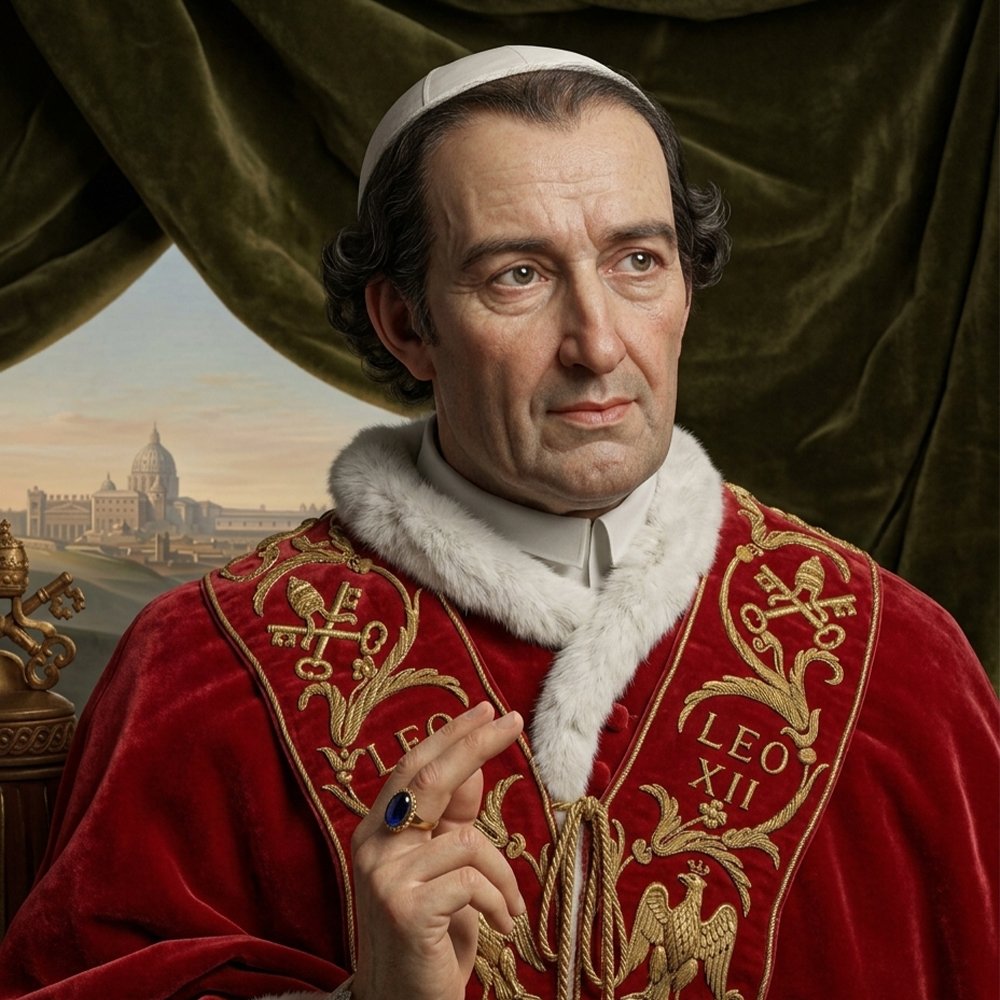
Pope Leo XII (1823-1829)
BIOGRAPHICAL DATA
Birth name: Annibale Francesco Clemente Melchiorre Girolamo Nicola della Genga
Birth: August 2, 1760, Castello della Genga (near Spoleto), Papal States
Papal election: September 28, 1823
Coronation: October 5, 1823
Pontificate: September 28, 1823 – February 10, 1829 (5 years, 4 months, 13 days)
Death: February 10, 1829, Rome, Papal States (age 68)
Burial: St. Peter’s Basilica, Vatican City (simple earthen tomb before the altar of St. Leo the Great)
Religious order: Secular clergy (diocesan priest)
Papal motto: None officially recorded
Cognome: “The Austere Pope,” “The Reactionary Pope,” “The Jubilee Pope,” “The Zelanti Pope”
NOTE: His pontificate was marked by a sharp conservative reaction against the policies of his predecessor, the celebration of the only Jubilee of the 19th century (1825), the condemnation of Freemasonry and Bible societies, and a deeply controversial domestic policy that sought to “resacralize” Rome by reversing Enlightenment-era reforms . Despite his reputation for harshness, he was personally austere, simple in lifestyle, and cared deeply for the poor .
EARLY LIFE AND FORMATION
Noble Origins – The Della Genga Family
The Della Genga of the Marche:
Ancient noble family from Genga, a small town in the March of Ancona, part of the Papal States
The family had been ennobled by Pope Leo XI in 1605
The family castle (Castello della Genga) stood in the territory of Fabriano
Annibale was the sixth of ten children born to Count Ilario della Genga and Maria Luisa Periberti of Fabriano
The family had seven sons and three daughters
He was the uncle of Gabriele della Genga Sermattei, who in the 19th century was the only nephew of a pope to be elevated to cardinal
Childhood (1760-1773):
Born into the nobility of the Papal States
Early education: humanistic formation befitting his noble status
Destined for ecclesiastical career from an early age
Education
Collegio Campana, Osimo (1773-1778):
At age thirteen, placed in the Collegio Campana of Osimo
Studied theology and humanities
Foundation for later ecclesiastical studies
Collegio Piceno, Rome (1778-1783):
Transferred to the Collegio Piceno in Rome
Continued philosophical and theological studies
Pontifical Academy of Ecclesiastical Nobles:
Shortly after arrival in Rome, entered the prestigious Accademia dei Nobili Ecclesiastici
Training ground for future diplomats and curial officials
Studied canon law, diplomacy, and classical languages
Ordination and Dispensation:
Received subdiaconate in 1782
Ordained deacon in 1783
Ordained priest: June 4, 1783 (or June 14, sources vary)
Received dispensation for defect of age, being only 23 (canonical minimum age was 24)
Ordained by Cardinal Marcantonio Colonna
Early Curial Career
Papal Chamberlain:
Soon after ordination, attracted notice of Pope Pius VI during a papal visit to the Academy
Pius VI raised him to the prelature as cameriere segreto (private chamberlain)
Funeral Oration for Joseph II (1790):
Chosen to deliver the funeral oration in the Sistine Chapel for the Emperor Joseph II of Austria
Accomplished this difficult task to the admiration of all hearers
Navigated carefully: did not offend Austrian susceptibilities nor compromise papal authority
His eloquence and tact brought him to wider attention
Canon of St. Peter’s (1792):
Appointed a canon of St. Peter’s Basilica
Position of honor and responsibility at the heart of Christendom
EPISCOPATE AND DIPLOMATIC CAREER (1793-1816)
Titular Archbishop of Tyre
Appointment (1793):
Created Titular Archbishop of Tyre (in partibus infidelium)
Consecrated bishop: February 24, 1794
Principal consecrator: Henry Benedict Stuart, Duke of York (Cardinal-Bishop of Ostia and Velletri, last of the Stuart claimants)
Age at consecration: 34 years old
Nuncio to Switzerland (1794)
Mission to Lucerne:
Despatched to Lucerne as Apostolic Nuncio to Switzerland
Brief assignment before transfer to more important post
Nuncio to Germany (1794-1805)
Appointment to Cologne (1794):
Transferred to the Apostolic Nunciature at Cologne
Due to French Revolutionary Wars and French occupation of the Rhineland, forced to reside in Augsburg, Bavaria
Served effectively for eleven years (1794-1805)
Diplomatic Missions:
Entrusted with several honorable and difficult missions
Brought into contact with the courts of Dresden, Vienna, Munich, and Stuttgart
Also dealt with Napoleon during this period
Controversies:
During his dozen years in Germany, it was charged that his finances were disordered and his private life not above suspicion
These allegations would follow him, though never proven definitively
Nuncio Extraordinary to the Diet of Regensburg (1805):
Accredited by Pope Pius VII as nuncio extraordinary to the Diet of Ratisbon (Regensburg)
Mission: deal with difficulties between the German Church and Prussian rulers
Returned to Rome to confer with Cardinal Consalvi
Learned that Napoleon desired his replacement by another nuncio more devoted to French interests
Pius VII remained firm in his support; Della Genga returned to Munich
Mission to Paris (1808):
Went with Cardinal Caprara to Paris to negotiate with Napoleon I
Received coldly; negotiations came to nothing
Witnessed the indignities offered to Pius VII by the French
Retirement at Monticelli (1808-1814)
Abbey of Monticelli:
Returned to Rome in dismay after Napoleon’s treatment of the Pope
Retired to the Abbey of Monticelli (near Florence, also near Piacenza according to some sources)
The abbey had been granted to him in commendam for life by Pope Pius VI
Expected to end his days there
Life in Retirement:
During the Napoleonic abolition of the States of the Church (1798), he had already lived there
Solaced himself with music and bird-shooting
Taught his choir of peasants to play the organ and sing plainchant
Built tombs in the abbey church for his mother and himself, expecting to be buried there
Effectively a state prisoner during Pius VII’s captivity in France
Return to Diplomacy (1814)
Mission to Paris:
With the fall of Napoleon (1814), Pius VII returned to Rome
Della Genga sent to Paris as envoy extraordinary to convey the pope’s congratulations to King Louis XVIII upon his restoration
Conflict with Consalvi:
Cardinal Ercole Consalvi, Pius VII’s powerful Secretary of State, was also in Paris accredited to all the sovereigns
Consalvi strongly resented Della Genga’s mission as a slight to himself
Louis XVIII attempted to smooth matters, but Consalvi prevailed
Della Genga returned to Rome, then retired again to Monticelli
CARDINALATE (1816-1823)
Creation as Cardinal
Created Cardinal (March 8, 1816):
Elevated by Pope Pius VII
Cardinal-Priest of Santa Maria in Trastevere
Received red zucchetto on March 11, titular church on April 29, 1816
Bishop of Senigallia (1816):
Appointed Bishop of Senigallia (Sinigaglia) with personal title of archbishop
Never entered his diocese due to ill health
Resigned the see in 1818
Retired to his residence near Spoleto for health reasons
Roman Curia Positions
Vicar-General of Rome (May 9, 1820):
Appointed by Pius VII to this distinguished post
Position: deputy to the pope for the Diocese of Rome
Oversight of clergy, parishes, religious life in the city
Other Appointments:
Archpriest of the Basilica of Santa Maria Maggiore (1821-1823)
Prefect of several congregations
Prefect of the Roman Curia (1820-1823)
Prefect of the Congregation of Ecclesiastical Immunity (1820-1823)
Health at This Period:
His health had improved sufficiently to take up these positions
But remained frail, suffering from various ailments
CONCLAVE OF 1823 – ELECTION
Context: Death of Pius VII
Death of Pius VII (August 20, 1823):
Pontificate: 23 years (1800-1823)
One of the longest and most tumultuous pontificates in history
Pius VII had endured Napoleon’s captivity and seen the Restoration
His Secretary of State, Cardinal Ercole Consalvi, had pursued moderate, conciliatory policies
Political Situation (1823):
Europe in the Restoration era after Napoleon’s fall
Congress of Vienna (1815) had reshaped Europe
Conservative reaction against revolutionary ideas
Papal States recovering from French occupation
Liberal movements (Carbonari, Freemasons) spreading in Italy
Factions in the College of Cardinals:
Zelanti (Conservatives): Wanted a break with Consalvi’s “liberal” policies, a return to more reactionary governance, primarily religious interest
Moderates/Politicanti: Supported Consalvi’s approach, favored cooperation with the great powers
French and Austrian factions: Representing the interests of Catholic monarchies
The Conclave
Dates: September 2 – September 28, 1823
Duration: 26 days
Location: Quirinal Palace, Rome
Major Candidates:
Candidate | Faction | Position |
|---|---|---|
Cardinal Antonio Gabriele Severoli | Zelanti | Leading conservative; favored by Zelanti |
Cardinal Francesco Saverio Castiglione | Moderate | Later Pius VIII; favored by powers |
Cardinal Annibale della Genga | Conservative | Seen as pious, austere, compromised |
The Struggle:
First phase (September 2-20): Various candidates considered; Severoli gained strength daily
September 21, morning: Severoli had received 26 votes, just below the required two-thirds; next scrutiny would likely elect him
The Austrian Veto:
Cardinal Giuseppe Albani, representing Austria at the conclave, informed the cardinals that the election of Cardinal Severoli would not be acceptable to the Emperor
Formal veto pronounced against Severoli
The Zelanti were furious but had to accept
The Turning Point:
At Severoli’s own suggestion, the Zelanti bloc transferred their support to Della Genga
Before the great powers realized what was happening, Della Genga was elected
September 28, 1823: Received 34 votes, elected pope
Della Genga’s Reluctance:
Initially unwilling to accept
With tears, reminded cardinals of his ill health: “You are electing a dead man”
They insisted it was his duty
Finally accepted gracefully
Assured Cardinal Castiglione that he would someday be pope (prophesying his successor Pius VIII)
Announced intention to take name: Leo XII
Significance of Election:
Victory for the Zelanti conservatives
Rejection of Consalvi’s moderate policies
Despite French and initial Austrian opposition, Della Genga prevailed
His poor health was actually a factor in his favor (expected short pontificate)
Coronation and Possession
Coronation (October 5, 1823):
Crowned in St. Peter’s Basilica
Age at coronation: 63 years old
Possession of St. John Lateran:
Traditional ceremony taking possession of the cathedral of Rome
Date not specified in sources
First Act:
Appointed Cardinal Giulio Maria della Somaglia (an octogenarian) as Secretary of State
Significant: signaled immediate break with Consalvi’s policies
Consalvi himself was dismissed
PONTIFICATE (1823-1829) – THE CONSERVATIVE RESTORATION
Character and Governing Style
Personal Piety and Austerity:
Simple, devout man, morally strong
Left the gilded Quirinal Palace to live at the more austere Vatican, abandoned for two centuries
According to French ambassador Chateaubriand: “Leo XII, a prince of great stature and with a serene yet sad air, is dressed in a simple white cassock. He has no pomp and stands in a poor room, almost without furniture.”
Devoted himself to work
Simple in mode of life
Endured pain well
Hobbies:
Passion for shooting birds
Continued this pastime from his Monticelli days
Rumored to have killed a peasant with whom he argued about sporting rights (unverified)
Health:
Frail from before his election
Fell ill after coronation but rallied surprisingly
Endured despite constant infirmities
The Miracle of Strambi:
December 1823: Leo XII fell suddenly ill, seemed likely to die
Bishop Vincenzo Strambi of Marittima (former advisor to Pius VII) offered his own life to God so that the pope could live
Leo XII rallied to great surprise
Strambi died of a stroke within the week
Leo showed surprising endurance in work thereafter
Governing Philosophy:
Shared the wish of the Zelanti that his pontificate should have a less political, more religious orientation
“He was determined to change the condition of society, bringing it back to the utmost of his power to the old usages and ordinances, which he deemed to be admirable; and he pursued that object with never flagging zeal.”
Little insight into the hopes and visions of those pioneering greater liberty
Sought to “resacralize” Rome after French occupation
Domestic Policy – The Reactionary Program
Appointments and Administration:
Replaced Consalvi with conservative della Somaglia
Appointed a Congregation of State to advise on political and religious matters
Purified the Curia of inefficient and venal officials
Restoration of Ecclesiastical Control:
Collegio Romano restored to Jesuits (1824):
Returned to the efficient hands of the Society of Jesus
Symbol of educational reclamation
Educational Reorganization:
Education placed entirely under priestly control
New chairs founded at universities but teaching supervised to stifle criticism
Required secondary instruction in Latin
Bull Quod divina sapientia reorganized educational system
Legal System:
Ecclesiastical courts of pre-1800 pattern returned
Laicization of administration halted
Court proceedings required to be in Latin
Made justice less costly
Charitable Institutions:
All placed under direct ecclesiastical supervision
Fiscal Policy:
Reduced taxes
Reduced superfluous offices
Strict economy
Yet left Church’s finances more confused than he found them
Even the Jubilee of 1825 did not mend financial matters
Treatment of Jews:
Property Restrictions: Forbade Jews to own property
Forced Sale: Allowed only the shortest possible time to sell what they owned
Ghettoization: Confined Jews again to ghettos
Revived Medieval Regulations: Required segregation and identification marks
Result: Many of Rome’s Jews emigrated to Trieste, Lombardy, and Tuscany
Social and Moral Regulations:
Dress Code: Decreed that dressmakers who sold low or transparent dresses incurred ipso facto excommunication
Catechism: Required all Roman residents to listen to Catholic catechism commentary
Surveillance: Petty clerical surveillance of private life
Suppression of Dissent:
Carbonari and Freemasons: Hunted down
Secret Societies: Condemned (1825)
Repression in the Provinces: Particularly severe in Umbria, Marche, and Romagna
Methods: System of espionage, secret denunciation, wholesale application of gibbet and galleys
Cardinal Rivarola: Charged with suppression in Romagna; his severities met popular discontent
Result: Insurrections, conspiracies, assassinations, rebellion
Assessment of Domestic Policy:
“The results of his method of governing his states soon showed themselves in insurrections, conspiracies, assassinations and rebellion”
Left “a very terrible, rankling and long-enduring debt of party hatreds, political and social demoralisation, and contempt for and enmity to the law”
The modern state that Consalvi had been tentatively fostering reverted to a police regime
Economic stagnation, alienation of middle classes, hatred for the personally mild pontiff
Papal state became one of the most backward in Europe
Religious Policy and Doctrinal Condemnations
First Encyclical (May 5, 1824):
Condemned indifferentism, toleration, and religious liberty
Condemned Bible societies
Reinforced the Index of Forbidden Books
Strengthened the Holy Office (Inquisition)
Condemnation of Freemasonry (1825):
Declared “perpetual” ban on Masonic lodges
Condemned their derivatives such as the Carbonari
Bull Quo Graviora issued
Support for Jesuits:
Favored them consistently
Returned Collegio Romano to them
Supported their educational work
Encouraged their spiritual exercises
Jubilee of 1825:
Only Jubilee of the 19th century:
Those of 1800, 1850, and 1875 prevented by historical circumstances
Announced despite opposition of timid and reactionary prelates and sovereigns
Sought to make it a time of spiritual and authoritarian reform for Rome
Attendance: Brought tens of thousands to Rome, but very few from outside Italy
Effect: Did not mend finances as hoped
Significance: Demonstrated Catholic renewal after Napoleonic devastation
Foreign Policy
Rejection of Consalvi’s Policies:
Immediate dismissal of Consalvi
Rejection of Pius VII’s moderate approach
Return to more traditional papal diplomacy
Secretaries of State:
Secretary | Tenure | Notes |
|---|---|---|
Cardinal Giulio Maria della Somaglia | 1823-1828 | Octogenarian; conservative |
Cardinal Tommaso Bernetti | 1828-1829 | More able; negotiated concordats |
Concordats:
Negotiated certain concordats very advantageous to the papacy
Hanover (1824): Agreement with the Kingdom of Hanover
Netherlands (1827): Agreement with the United Kingdom of the Netherlands
These aimed to regularize Church-state relations in predominantly Protestant lands
Latin America:
Wars of Independence (1810s-1820s): Spanish colonies fighting for independence
Initially displayed cautious neutrality
Allowed ordination of clergy sympathetic to independence movements
Sought to avoid anti-clerical policies by the Liberadores
Encyclical Etsi longissimo terrarum: Exhorted Hispanic American clergy to urge obedience and submission to legitimate sovereign (Spain)
Encyclical Etsi iam diu (September 24, 1824):
Called for prayers for the Church in Latin America
Maintained pro-royalist stance
Due to logistical problems, delivered after the Battle of Ayacucho (December 1824), which ended the wars
Concerned about liberal ideologies and Enlightenment errors spreading
Netherlands:
Met and overcame persecution of Catholics in the Netherlands
Encouraged Catholic resistance
Concordat of 1827 regularized situation
British Isles:
Managed and encouraged the movement for Catholic Emancipation
Success assured by the end of his pontificate (Catholic Emancipation Act passed 1829, shortly after his death)
France and Spain:
Supported legitimist cause in both countries
In France, this meant support for the ultra-royalist policies of Charles X
In Spain, support for Ferdinand VII against liberals
Noted that in both countries, religion was misused as instrument of political reaction
Even when legitimist representatives showed themselves indifferent or opposed to the interests of the Faith, Leo supported them
German States:
Continued engagement with German ecclesiastical affairs
Built on his long experience as nuncio in Germany
Relations with Religious Orders
Jesuits:
Restored Collegio Romano to them (1824)
Favored them in all their ventures
Supported their educational and missionary work
Oblates of Mary Immaculate:
Crucial Role in Approbation (1825-1826):
Eugène de Mazenod (1782-1861): Founder of the Missionary Oblates of Mary Immaculate
Arrived in Rome November 26, 1825, seeking approbation of his Rule
Learned that Congregation for Bishops and Religious initially granted only decree of praise
Audience with Leo XII (December 20, 1825):
De Mazenod spent half an hour with the pope
Convinced Leo XII to approve rather than merely praise the Rule
Leo expressed to Bishop Adinolfi: “This society pleases me, I wish to favour it. Choose a Cardinal, one of the mildest of the Congregation… go to him on my behalf and tell him my intention is not merely that these Rules be praised but that they be approved.”
Approbation (February 17, 1826):
Leo XII confirmed the decision of the congregation of Cardinals
Specifically approved the Institute, Rules, and Constitutions
Signed the brief on March 21, 1826
De Mazenod wrote: “Te Deum laudamus… yesterday evening, the Sovereign Pontiff Leo XII confirmed the decision… and accompanied this solemn act of his pontifical power, with most admiring words for those who happily form this society from which the head of the Church indeed expects the greatest good.”
Second Audience (April 15, 1826):
De Mazenod received another half-hour audience
Leo spoke with “goodness” and “grace”
De Mazenod learned that the pope had a plan to gather a Roman council, calling theologians from outside Italy, elevating them to cardinalate and placing them in curia
In France, Leo’s choice had settled on Lamennais and on de Mazenod
Significance:
Leo XII’s personal intervention crucial for Oblate approval
De Mazenod mentioned him about 150 times in his writings
The pope’s name appears in almost every issue of Missions O.M.I. for a century
Patronage of Arts and Learning
Vatican Printing Press:
Restored the Vatican printing press
Improved production of liturgical and scholarly books
Vatican Library:
Enriched with new acquisitions
Supported scholars and librarians
Scholars Encouraged:
Cardinal Giuseppe Maria Velzi (later Prefect of Index)
Mauro Cappellari (future Pope Gregory XVI)
Angelo Mai (prefect of Vatican Library)
Jean-François Champollion: Egyptian scholar who deciphered hieroglyphics
Archaeology:
Supported excavation and preservation
Encouraged study of Christian antiquities
Restoration of St. Paul’s Outside the Walls:
Much done toward rebuilding
Continued work on major Roman basilicas
Music and Liturgy:
Restored seemliness of worship
Encouraged sacred music
Continued his personal love of music from Monticelli days
Creation of Cardinals
Number of Cardinals Created:
Created cardinals in several consistories during his pontificate
Among them future Pope Gregory XVI (Mauro Cappellari, created in pectore 1825, published 1826)
Also Cardinal Tommaso Bernetti, later Secretary of State
Notable Appointments:
Cardinal | Date | Notes |
|---|---|---|
Mauro Cappellari (future Gregory XVI) | 1825 (in pectore) | Camaldolese monk; scholar |
Tommaso Bernetti | 1826 | Later Secretary of State |
Giacomo Giustiniani | 1826 | Diplomat, nuncio |
Carlo Odescalchi | 1823 | Jesuit (later) |
Writings and Documents
Major Encyclicals:
Document | Date | Subject |
|---|---|---|
Ubi Primum | May 5, 1824 | Condemnation of indifferentism, Bible societies |
Quod Hoc Ineunte | May 24, 1824 | On the Jubilee |
Quo Graviora | 1825 | Condemnation of Freemasonry and Carbonari |
Etsi Iam Diu | September 24, 1824 | On the Church in Latin America |
Ad Plurimas | 1825 | On the Jubilee indulgences |
Charitate Christi | 1825 | On the Jubilee |
Other Documents:
Numerous briefs and constitutions
Approbation of religious orders (including Oblates)
Concordats with Hanover and Netherlands
LAST YEARS AND DEATH
Final Years (1828-1829)
Continuing Work:
Despite constant ill health, continued to govern
Replaced della Somaglia with Bernetti as Secretary of State (1828)
Continued diplomatic efforts
Followed Catholic Emancipation movement in Britain
February 5, 1829:
After a private audience with Cardinal Bernetti, suddenly taken ill
Seemed himself to know that his end was near
Last Days:
February 8: Asked for and received Viaticum; was anointed
February 9, evening: Lapsed into unconsciousness
Death
February 10, 1829:
Died at age 68
Location: Vatican Palace, Rome
Cause: complications from illness; exact cause unspecified
Surrounded by cardinals and attendants
Had reigned 5 years, 4 months, 13 days
Last Words:
Not recorded precisely
Likely prayers, commendation of soul
Reaction:
Rome: unpopular pope, but personally respected
The poor he had cared for mourned
Cardinals prepared for new conclave
Liberals relieved at end of repressive regime
Successor:
Conclave: February – March 1829
Elected: Pope Pius VIII (Francesco Saverio Castiglione)
The man Leo XII had prophesied would succeed him
Pius VIII reigned 1829-1830
Funeral and Burial
Funeral:
St. Peter’s Basilica
Ceremony: standard papal funeral
Eulogies: mixed; praised personal piety but not temporal governance
Burial:
According to his wishes: simple earthen tomb in St. Peter’s Basilica
Location: before the altar of St. Leo the Great (Pope Leo I)
Epitaph: describes him as “a humble devotee, the smallest of the heirs of such a great name”
Consistent with his personal austerity: no grand monument
LEGACY AND HISTORICAL EVALUATION
Major Achievements
1. Jubilee of 1825:
Only Jubilee of 19th century
Demonstrated Catholic renewal after Napoleonic devastation
Brought thousands of pilgrims to Rome
Spiritual high point of pontificate
2. Condemnation of Secret Societies:
Bull Quo Graviora (1825) condemned Freemasonry and Carbonari
Reinforced Church’s opposition to anti-clerical movements
Clarified Catholic position on secret societies
3. Concordats:
Hanover (1824) and Netherlands (1827) regularized Church-state relations
Advantageous terms for the Church
Built on diplomatic experience from nunciature years
4. Support for Religious Orders:
Crucial role in approbation of Oblates of Mary Immaculate (1826)
Restoration of Collegio Romano to Jesuits (1824)
Encouraged traditional religious life
5. Personal Austerity:
Lived simply despite noble origins
Moved to Vatican to show less political, more religious orientation
Cared for the poor
Buried in simple earth tomb
6. Patronage of Learning:
Restored Vatican printing press
Enriched Vatican Library
Encouraged scholars like Champollion
Supported archaeology and restoration
7. Catholic Emancipation Support:
Encouraged movement in Britain
Success achieved shortly after his death
Major victory for English Catholics
8. Defense of Church in Netherlands:
Met and overcame persecution
Concordat of 1827 secured rights
Failures and Criticisms
1. Reactionary Domestic Policy:
Reversed Consalvi’s moderate reforms
Restored ecclesiastical courts and clerical control
Created police state with spies and informers
Provoked insurrections and rebellion
2. Anti-Jewish Measures:
Forbade property ownership
Confined to ghettos
Revoked Enlightenment-era improvements
Caused emigration of many Roman Jews
Moral stain on pontificate
3. Economic Failure:
Despite tax reduction and economy, finances remained confused
Jubilee did not mend matters
Papal States economically backward
4. Harsh Repression:
Wholesale application of gibbet and galleys
System of espionage and secret denunciation
Created lasting hatreds
5. Support for Legitimist Reaction:
Supported regimes that misused religion for political ends
Even when legitimists opposed Church interests
Alienated liberals who might have been allies
6. Lack of Political Insight:
“He lacked insight into, and sympathy with, the temporal developments of his period”
“Little insight into the hopes and visions of those who were then pioneers of the greater liberty that had become inevitable”
Diminished chances for successors to solve new problems
Personal Assessment
Virtues:
Personally pious and devout
Morally strong
Simple in lifestyle, austere
Endured pain well
Cared for the poor
Devoted to work
Faithful to what he believed right
Weaknesses:
Lacked flair for leadership
No insight into modern developments
Reactionary rather than creative
Harsh where gentleness might have served better
Surrounded by relatives? (sources note he was uncle of future cardinal, but personal nepotism not emphasized)
Personality:
Tall and thin, ascetic look, melancholic countenance
Serene yet sad air
Loved music (taught peasants to sing plainchant)
Loved bird-shooting
Simple, devout, morally strong
Historiographical Assessment
Catholic Encyclopedia (1913):
Balanced assessment: acknowledges failures in temporal policy but praises spiritual governance
“There is something pathetic in the contrast between the intelligence and masterly energy displayed by him as ruler of the Church and the inefficiency of his policy as ruler of the Papal States”
Praises his noble character, passion for order and efficiency
Regrets his lack of insight into modern developments
Encyclopedia Britannica (historical):
Focuses on reactionary policies, anti-Jewish measures
Notes personal austerity and piety
Emphasizes Jubilee of 1825
Oxford Reference:
“A simple, devout man, morally strong but lacking the flair of leadership”
Documents reactionary policies and their consequences
Notes Papal States became “one of the most backward in Europe”
Aleteia (Catholic popular source):
Positive: “strict but humble,” “cared about the poor”
Emphasizes Jubilee and move to Vatican
Quotes Chateaubriand’s description
Swedish Nordisk familjebok (1912):
Documents ultramontane policies, persecution of radicals, harassment of Jews
But acknowledges some administrative merits: superfluous offices reduced, controls tightened, attention to economic flourishing
OMI World:
Entirely positive: crucial role in approving Oblate rule
De Mazenod’s gratitude
Comparison with Predecessors and Successors
Leo XII (1823-29) | Pius VII (1800-23) | Pius VIII (1829-30) | Gregory XVI (1831-46) |
|---|---|---|---|
5.5-year pontificate | 23-year pontificate | 1.5-year pontificate | 15-year pontificate |
Reactionary | Moderate/Conciliatory | Moderate | Conservative |
Anti-Jewish measures | Concordat with Napoleon | Continued moderation | More repression |
Jubilee 1825 | Endured Napoleon | Brief reign | Missionary expansion |
Personal austerity | Diplomatic skill | Compromised | Traditionalist |
Comparison with Innocent XII (1691-1700):
Innocent XII: abolished nepotism, reformed Curia, austere, beloved by poor
Leo XII: also austere, also cared for poor , but reactionary rather than reformer
Innocent XII built little but reformed much; Leo XII built little and reformed unwisely
Both personally pious; Leo XII’s temporal policies far more controversial
Comparison with Clement XI (1700-1721):
Both long diplomatic experience before election
Both faced major controversies (Clement: Chinese Rites; Leo: Restoration politics)
Both patrons of learning
Clement’s decisions more lasting (Unigenitus); Leo’s policies largely reversed
Epitaph
Actual Inscription:
Describes him as “a humble devotee, the smallest of the heirs of such a great name”
Reference to St. Leo the Great, before whose altar he is buried
Chateaubriand’s Description:
“Leo XII, a prince of great stature and with a serene yet sad air, is dressed in a simple white cassock. He has no pomp and stands in a poor room, almost without furniture.”
Implied Epitaph:
“Here lies Annibale della Genga, Leo XII, who in five years tried to turn back the clock of history. He condemned the errors of his age with firm voice, celebrated the only Jubilee of a troubled century, and lived in a poor room though he ruled a state. He loved the poor, feared God, and distrusted the future. The Jews he confined to ghettos; the liberals he sent to galleys; the revolutionaries he hunted down. Yet he was personally kind, morally strong, and simple as a monk. He rests before the altar of the Great Leo—the smallest heir of such a great name, as he wished.”
The Jubilee of 1825
Significance:
Only Holy Year in the 19th century
Napoleonic wars and political turmoil prevented others
Leo XII determined to make it a time of spiritual and authoritarian reform
Intended to “resacralize” Rome after French occupation
Celebration:
Pilgrims came from throughout Italy and Europe
But fewer from outside Italy than hoped
Indulgences granted, devotions encouraged
Elaborate ceremonies in Roman basilicas
Outcome:
Did not mend finances
But demonstrated Church’s survival after Napoleonic trauma
Leo’s great spiritual achievement
The Oblate Connection
Importance for Oblates of Mary Immaculate:
Leo XII personally intervened to approve their Rule
De Mazenod’s gratitude: mentioned him 150 times in writings
The pope’s name appears in almost every issue of Missions O.M.I. for a century
Leo saw de Mazenod as potential cardinal and theologian for a Roman council
De Mazenod ever attributed the credit to Leo XII’s express will
De Mazenod’s Words:
“The Pope knew everything and weighed everything in his profound wisdom…”
“With what goodness he spoke to me, with what grace he smiled at the things I said, with what abandon he granted me all that I asked”
Final Judgment
Pope Leo XII, Annibale della Genga, reigned for five and a half years—a brief but consequential pontificate at the dawn of the Restoration era. He stands as the reactionary pope, a man who tried to turn back the clock of history, to undo the work of the French Revolution and Napoleon, and to restore the old order in Church and state. He failed—but his failure was instructive.
His greatest spiritual achievement was the Jubilee of 1825, the only Holy Year of the 19th century. In an age of revolution and doubt, he called the faithful to Rome, to prayer, to penance. Thousands came. The Church, battered by decades of persecution, showed that it still lived.
His most lasting institutional legacy may be his support for new religious orders, especially the Oblates of Mary Immaculate. His personal intervention ensured their approbation, and they spread throughout the world. Eugene de Mazenod never forgot his kindness.
His personal example was admirable. He lived simply in a poor room, dressed in a plain white cassock, had no pomp . He cared for the poor, endured pain without complaint, worked tirelessly despite constant illness. He was, in private, the kind of man anyone would respect.
His temporal governance was a disaster. The Papal States under Leo XII became a police state, with spies and informers, gibbet and galleys . The Jews were confined to ghettos, stripped of property, driven to emigrate . The middle classes were alienated, the economy stagnated, hatreds accumulated that would explode after his death . He left his successors a poisoned inheritance.
His political judgment was flawed. He supported legitimist regimes that misused religion for reactionary ends . He had no insight into the “hopes and visions of those who were then pioneers of the greater liberty that had become inevitable” . He saw the modern world only as error to be condemned, not as challenge to be met.
In the history of the papacy, Leo XII occupies a paradoxical place: a good man who governed badly, a pious pope whose policies provoked impiety, an austere ruler whose rule created resentment. He is remembered as the Jubilee Pope, the Reactionary Pope, the last pope to celebrate a Holy Year until the 20th century.
Comparison with Innocent XII (1691-1700) is instructive. Innocent XII also lived simply, also cared for the poor, also tried to reform the Church. But Innocent XII looked forward; Leo XII looked backward. Innocent XII abolished nepotism, streamlined the Curia, and prepared the Church for the modern world. Leo XII revived old oppressions, alienated the middle classes, and stored up troubles for the future. Personal holiness is not enough; a pope must also govern wisely.
His burial before the altar of St. Leo the Great is fitting. He chose to be called Leo XII, and he lies in the shadow of the greatest Leo. The epitaph he wanted—”a humble devotee, the smallest of the heirs of such a great name” —captures his self-understanding. He did not aspire to greatness; he aspired to fidelity. But fidelity to the past, without openness to the future, is not enough.
Chateaubriand’s portrait lingers: the tall, sad-faced pope in the poor room, with serene yet melancholy air . A man who tried, who failed, who loved God and loved the poor, who governed harshly and was personally kind, who died mourned by few but respected by all who knew him.
His epitaph might be: “He condemned the errors of his age and loved the poor of his city. He celebrated the Jubilee and restored the Jesuits. He governed harshly and left a bitter legacy. But in his poor room, in his simple white cassock, he knelt before God and asked only to be the smallest heir of a great name. May God, who sees the heart and not the policy, have mercy on him.”
Leo XII: the pope who tried to restore the past and failed—but whose personal holiness, even in failure, commands a certain respect.