Pius X
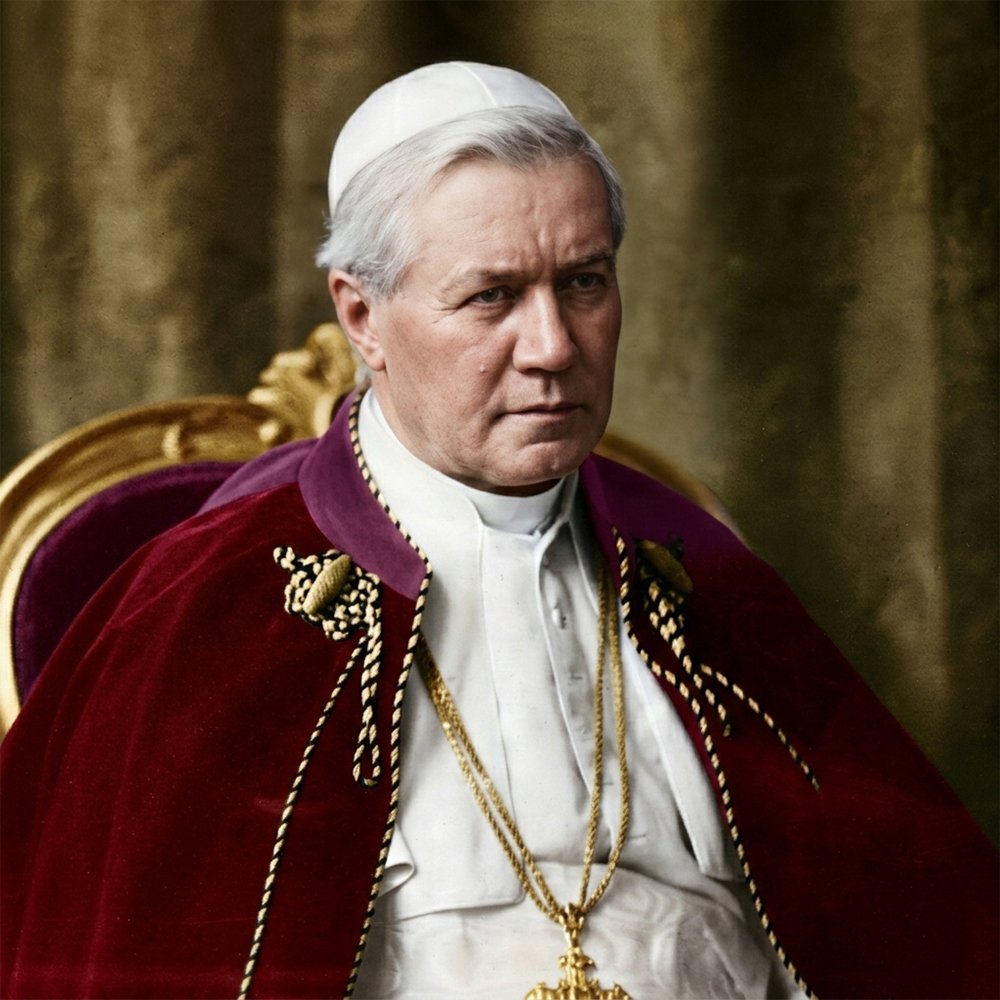
Pope Saint Pius X (1903-1914)
BIOGRAPHICAL DATA
Birth name: Giuseppe Melchiorre Sarto
Birth: June 2, 1835, Riese, Lombardy-Venetia Kingdom (Austria, now Italy)
Papal election: August 4, 1903
Coronation: August 9, 1903
Pontificate: August 4, 1903 – August 20, 1914 (11 years)
Death: August 20, 1914, Vatican City (age 79)
Canonization: May 29, 1954 by Pius XII
Liturgical feast: August 21
Burial: St. Peter’s Basilica (incorrupt body)
Papal motto: “Instaurare Omnia in Christo” (To restore all things in Christ – Eph 1:10)
FORMATION AND ECCLESIASTICAL CAREER
Humble Origins – The Poor Pope
Family:
Father: Giovanni Battista Sarto – municipal mailman of Riese
Mother: Margherita Sanson – seamstress
10 children (Giuseppe was the second)
Extremely poor family
Lived in two small rooms
Giuseppe slept in the barn
Political context:
Born a subject of the Austrian Empire (Veneto under Austrian rule until 1866)
Rural, poor, deeply Catholic region
Venetian peasant culture
Priestly Formation
Primary education:
Parish school of Riese
Exceptional intelligence recognized early
Local priest (Don Tito Fusaroni) perceived vocation
Minor Seminary of Castelfranco (1850-1854):
Walked 6km daily (family had no money for boarding)
Wore wooden clogs (had no shoes)
Scholarship from the Diocese of Treviso
Major Seminary of Padua (1854-1858):
Theology and philosophy
Brilliant student
Solid Neo-Thomist formation
Extraordinary piety
Priestly Ordination:
September 18, 1858 (age 23)
Cathedral of Castelfranco Veneto
First Mass in Riese
Priestly Ministry (1858-1884)
Assistant in Tombolo (1858-1867):
Small rural parish
9 years as parochial vicar
Dedicated pastor
Personal catechesis of children
Visited the sick and poor
Organized agricultural cooperative (social innovation)
Taught sacred music
Pastor of Salzano (1867-1875):
First parish of his own
8 years
Renovated parish church
Expanded parish school
Developed reputation as exceptional preacher
Simplicity and clarity in preaching
Loved by simple parishioners
Pastoral characteristics:
Evangelical simplicity
Total accessibility
Special love for children
Promoted frequent communion (revolutionary for the time)
Personal teaching of catechism
Intense prayer life
Canon of Treviso Cathedral (1875-1884)
Promotion:
Appointed Canon (chapter dignity)
Episcopal Chancellor (diocesan administration)
Spiritual Director of the Seminary of Treviso
First contact with formation of future priests
Activities:
Reformed seminary
Raised intellectual and spiritual level
Emphasized Thomas Aquinas
Eucharistic piety
Discipline without rigidity
Growing reputation:
Known for personal holiness
Administrative competence
Doctrinal orthodoxy
Pastoral zeal
Bishop of Mantua (1884-1893)
Episcopal appointment:
November 10, 1884: appointed by Leo XIII
Consecration: November 16, 1884
Large and complex diocese (Lombardy)
9 years as bishop
Challenges:
Diocese neglected by predecessor
Undisciplined clergy
Seminary in ruins
Widespread poverty
Masonic and anticlerical influence
Reforms:
Diocesan Synod (1888) – total reorganization
Completely reformed seminary:
New study regime
Emphasis on Thomas Aquinas
Rigorous spiritual formation
Restored discipline
Exhaustive pastoral visitations (all parishes)
Raised quality of clergy
Promoted systematic catechesis
Fought clerical concubinage
Reformed liturgy and sacred music
Social works:
Founded diocesan bank for poor farmers
Organized cooperatives
Promoted popular education
Systematized assistance to the poor
Episcopal style:
Extreme personal austerity
Lived as a poor man
Donated episcopal salary to the needy
Accessible to the humblest
Doctrinal firmness with pastoral charity
Cardinal Patriarch of Venice (1893-1903)
Promotion:
June 12, 1893: appointed Patriarch of Venice
Cardinal: June 12, 1893 (created in pectore)
Publication: June 19, 1893
One of the most prestigious dioceses in Italy
Political obstacle:
Italian government (anticlerical) blocked entry into Venice initially
Unresolved “Roman Question”
Exequatur (government authorization) denied
Sarto waited 15 months in Mantua
Finally permitted: November 24, 1894
Pastoral work in Venice (1894-1903):
Constant visitations of parishes (boat through canals)
Reformed patriarchal seminary
Promoted Catechetical Congresses
Encouraged frequent communion (still rare)
Reformed sacred music (against opera in churches)
Combated emerging modernism
Social action:
Opera dei Congressi (Catholic lay movement) – supported
Social question: supported Catholic workers’ organizations
Arbitrated strikes and social conflicts
Defense of the poor
Characteristics:
“Patriarch of the poor”
Maintained personal poverty
Refused luxuries of the patriarchal palace
Walked through streets (unusual for a cardinal)
Conversation with gondoliers and fishermen
Extreme evangelical simplicity
Doctrinal firmness:
Vigilant against doctrinal errors
Intransigent orthodoxy
But with pastoral charity
Famous phrase (as Patriarch): “I was born poor, I lived poor, I wish to die poor”
PAPAL ELECTION (1903)
Dramatic Conclave
Context:
July 20, 1903: Death of Leo XIII (after 25-year pontificate)
Tense international situation
Modernism growing
Acute social question
Unresolved “Roman Question”
Conclave: July 31 – August 4, 1903
62 cardinal electors
Main candidates:
Cardinal Mariano Rampolla del Tindaro (Leo XIII’s Secretary of State):
Absolute favorite
Brilliant diplomat
Moderate liberal
Conciliatory policy with governments
Cardinal Giuseppe Sarto (Patriarch of Venice):
Pastoral, not diplomatic
Conservative
Reputed saint
Wanted to remain in Venice
Cardinal Serafino Vannutelli:
Conservative
Less known
The Imperial Veto – Decisive Moment
First ballot (August 1):
Rampolla: 24 votes
Sarto: 5 votes
Others: scattered
Rampolla leading
Second ballot (August 2):
Rampolla: 29 votes (growing)
Election seemed certain
THE VETO (August 2, afternoon):
Cardinal Jan Puzyna (Archbishop of Krakow, Poland)
Rose solemnly
In the name of Emperor Franz Joseph I of Austria-Hungary
Pronounced IMPERIAL VETO (ius exclusivae) against Rampolla
Reasons for Austrian veto:
Rampolla considered pro-French
Leo XIII’s foreign policy had favored France
Austria feared continuity
Geopolitical rivalry (Triple Alliance vs. France-Russia)
Reaction:
Scandal in the conclave
Many cardinals indignant (secular interference)
Rampolla behaved with dignity
But veto was technically legal (ancient secular right)
Voting continued
Election of Sarto
Subsequent ballots (August 3-4):
Votes migrated from Rampolla to Sarto
Sarto resisted initially
Wept, begged not to be elected
“I am not capable, I am unworthy”
August 4, 1903, 7th ballot:
Giuseppe Sarto elected with necessary majority (more than 2/3)
Accepted trembling, weeping
“Accepto… as a cross”
Choice of name: Pius X
Homage to the “Pius” popes who suffered persecution (especially Pius VI and Pius VII – Napoleon)
Prophetic premonition of suffering?
Last “Pius” would be Pius XII (1958)
Coronation: August 9, 1903
First Measure: Abolition of the Imperial Veto
Apostolic Constitution Commissum Nobis (January 20, 1904):
DEFINITELY ABOLISHED the ius exclusivae (imperial veto)
No secular power can veto papal election
Under pain of automatic excommunication
END of centuries of monarchical interference
The last veto in history was the one that elected him
MOTTO AND PONTIFICAL PROGRAM
“Instaurare Omnia in Christo”
“To restore all things in Christ” (Ephesians 1:10)
Meaning:
Restoration of Christian society
Against modern secularization
Re-Christianize Western civilization
Christ center of everything: individual, family, society, State
Program:
Internal reform of the Church (liturgy, clergy, discipline)
Combat against doctrinal errors (modernism)
Formation of the Christian people (catechesis)
Sanctification through the Eucharist (frequent communion)
Catholic social action
Militant conservatism:
Against liberalism
Against modernism
Against secularism
Doctrinal intransigence
But with pastoral charity
ENCYCLICALS (16 ENCYCLICALS)
1903
1. E Supremi (October 4, 1903)
“On the Restoration of All Things in Christ”
First encyclical – programmatic:
Diagnosis:
Apostasy of nations from God
Secularization of society
Separation of Church and State
Materialism, relativism
“Humanity has renounced Christ”
Identified evils:
Contempt for authority (rationalism)
Class hatred (socialism)
Disordered love of pleasures (hedonism)
Disrespect for the Church
Program “Instaurare Omnia in Christo”:
Restoration in all spheres:
Individual: personal holiness
Family: restore paternal authority
Society: reject secularism
States: recognize Christ as King
Catholic Action: laity under direction of hierarchy
Solid formation: catechesis, Thomist theology
Eucharist: center of Christian life
Tone:
Combative
Intransigent
Apocalyptic (world in rebellion against God)
Call to spiritual arms
1904
2. Ad Diem Illum Laetissimum (February 2, 1904)
“On the Immaculate Conception”
50th anniversary of the dogmatic definition (Pius IX, 1854):
Marian theology
Mary as mediatrix of all graces
Marian devotion essential
“To God through Mary”
Prepared 20th-century Mariology
3. Iucunda Sane (March 12, 1904)
13th centenary of St. Gregory the Great; historical liturgical reform.
1905
4. Il Fermo Proposito (June 11, 1905)
“On Catholic Action in Italy”
Encyclical on Catholic Social Action:
Italian context:
Non expedit (1868): Catholics prohibited from participating in Italian politics (Roman Question)
Socialism growing
Need for Catholic presence
Doctrine:
Catholic Action: “participation of the laity in the hierarchical apostolate”
Subordinate to bishops
Not an autonomous movement
Instrument of the hierarchy
Three fields of action:
Religious formation (catechesis, piety)
Economic-social action (Catholic unions, cooperatives, assistance)
Civic action (politics when permitted)
Flexibilization of Non Expedit:
In particular cases, with episcopal permission
Catholics may vote to avoid socialist victory
Cautious opening to political participation
Organization model:
Hierarchical
Centralized
Lay movement but controlled by clergy
Radically different from modern autonomous movements
1906
5. Vehementer Nos (February 11, 1906)
“On the Separation of Church and State in France”
Condemnation of the French Law of Separation (1905):
Context:
Separation Law (December 9, 1905) of the French government:
Total separation of Church and State
End of the 1801 Concordat (Napoleon)
Confiscation of ecclesiastical goods
Prohibition of religious symbols in public spaces
Creation of “Cultural Associations” to administer Church property (lay control)
Papal condemnation:
Law is “deeply injurious to God”
Violates natural and divine right
Thesis of separation of Church and State is condemned:
“It is an absolutely false and pernicious thesis”
State must recognize God
Society cannot be religiously neutral
Secularism = practical atheism
Doctrine of the Catholic confessional State
Consequences:
Rupture of France-Vatican relations (until 1921)
Pius X forbade Catholics from forming “Cultural Associations”
Preferred to lose all property rather than accept lay control
Heroic intransigence
French Church remained without resources but free
Impact:
Material impoverishment of the French Church
But spiritual strengthening
Witness of independence
Model of resistance to secularism
6. Gravissimo Officii Munere (August 10, 1906)
Continuation on the French situation; instructions to bishops.
7. Une Fois Encore (January 6, 1907)
Third encyclical on France (in French!):
Reiterated prohibition of “Cultural Associations”
Absolute firmness
Prefers poverty to compromise with secularism
1907 – ANTI-MODERNIST YEAR
8. Pascendi Dominici Gregis (September 8, 1907)
“On the Doctrines of the Modernists”
MONUMENTAL ENCYCLICAL – THE MOST IMPORTANT OF THE PONTIFICATE:
Context: Modernism
What was Modernism?
Intellectual movement within the Catholic Church (late 19th – early 20th century) that attempted to adapt Catholic doctrine to modernity:
Main representatives:
Alfred Loisy (France) – biblical exegete
George Tyrrell (England) – Jesuit
Ernesto Buonaiuti (Italy) – historian
Baron Friedrich von Hügel (Austria-England) – philosopher
Modernist ideas:
Biblical exegesis:
Bible is a human document, not divine verbal revelation
Radical historical-critical methods
Denies miracles as historical
Pentateuch not written by Moses
Gospels not eyewitness accounts
Many late “interpolations”
Dogma:
Dogmas are not eternal truths but evolve
Dogmatic formulas change over time
No immutable content
Truth is relative to the age
Revelation:
Revelation is not communication of truths by God
It is immanent religious experience
Arises from human “religious consciousness”
No objective supernatural intervention
Christ:
Historical Jesus vs. Christ of faith (separation)
Jesus did not know He was God
Church “created” Christ’s divinity
Resurrection is “subjective experience” of the apostles
Church:
Church arose through sociological evolution
Not directly founded by Christ
Hierarchy developed naturally
Papacy is late human institution
Philosophy:
Immanentism: religion springs from within man
Agnosticism: reason cannot know God
Pragmatism: truth = what works
CONDEMNATION BY PIUS X in Pascendi:
Structure of the encyclical:
Systematic description of modernism:
Pius X synthesized modernism (which was diffuse)
Created coherent system from scattered ideas
“The modernist as: philosopher, believer, theologian, historian, critic, apologist, reformer”
Refutation:
Philosophically: against agnosticism and immanentism
Theologically: against evolution of dogma
Exegetically: against denial of inspiration
Severe judgment:
Modernism = “synthesis of all heresies”
“Collector of all heresies” (famous phrase)
More dangerous than Protestantism
Destroys faith from within
Causes of modernism:
Intellectual curiosity without humility
Pride (wanting to be original)
Ignorance (deficient philosophical/theological formation)
Religious sentimentalism (instead of solid doctrine)
Remedies:
Scholastic philosophy (Thomas Aquinas) mandatory in seminaries
Vigilance over professors and publications
Prior censorship of Catholic books
Removal of suspect professors
Diocesan vigilance committees
Concrete disciplinary measures:
Prohibition of modernist books
Removal of suspect professors
Censorship of publications
Creation of informant network (Sodalitium Pianum)
Tone:
Extremely harsh
Without nuances
Total identification: modernist = heretic
Unrelenting combat
Consequences:
Positive (traditional perspective):
Preserved Catholic orthodoxy
Avoided liberal Protestant dissolution (Harnack, etc.)
Maintained faith in biblical inspiration
Defended supernaturalness of revelation
Negative (criticisms):
Severe intellectual repression
Climate of fear and denunciation
Innocent theologians persecuted
Delayed Catholic biblical studies (until Pius XII, Divino Afflante Spiritu, 1943)
“Intellectual terror”
Suspicion of any innovation
Exiled/Excommunicated:
Alfred Loisy: excommunicated
George Tyrrell: expelled from Jesuits, died without sacraments
Ernesto Buonaiuti: excommunicated
Romolo Murri: excommunicated
Dozens of professors removed
Later reassessment:
Modernists had legitimate questions (historical method, etc.)
Pius X systematized excessively (created a “system” that didn’t exist so coherently)
But some modernists truly denied Catholic faith
Complex issue
1909
9. Communium Rerum (April 21, 1909)
3rd centenary of St. Anselm of Aosta; theology and reason.
1910
10. Editae Saepe (May 26, 1910)
3rd centenary of St. Charles Borromeo; model of reforming bishop.
1911
11. Iamdudum (May 24, 1911)
On separation of Church and State in Portugal (Republican Revolution of 1910).
1912
12. Lacrimabili Statu (June 7, 1912)
On indigenous peoples of Latin America; protection and evangelization.
1914
13. Singulari Quadam (September 24, 1912 – promulgated 1914)
On Catholic unions in Germany; social question.
14. Fin Dalla Prima Nostra (December 18, 1912 – promulgated 1914)
On colonization in Italian Libya.
MOTU PROPRIO “SACRORUM ANTISTITUM” (1910) – THE ANTI-MODERNIST OATH
Complement to Pascendi
September 1, 1910:
Crucial document in the anti-modernist campaign.
Content: Anti-Modernist Oath
All clergy (priests, bishops, professors, religious superiors) had to swear:
Anti-modernist profession of faith (main points):
“I firmly believe that God… can be known with certainty by the natural light of reason”
Against agnosticism
“I sincerely accept the doctrine of faith handed down to us from the Apostles… in the same sense and always in the same interpretation”
Against evolution of dogma
“I firmly believe… that the Church was instituted immediately and directly by Christ”
Against sociologism
“Faith is not a blind religious feeling… but true assent of the intellect to truth received externally”
Against immanentism
“Christ worked true miracles… which clearly prove the divine origin of the Christian religion”
Against exegetical rationalism
“The Church… has always taught and continues to teach the same truths… nor has it added nor can it add anything to the deposit of faith”
Substantial immutability of faith
Obligation:
Every cleric before ordination
Professors of theology/philosophy annually
Confessors and preachers
Religious superiors
Penalty: Suspension a divinis (prohibition from exercising orders)
Impact:
Massive ideological control
Orthodoxy test
Caused crises of conscience
Some withdrew from ministry
Guaranteed orthodoxy but at human cost
LITURGICAL AND SACRAMENTAL REFORM
Frequent and Early Communion – PASTORAL REVOLUTION
Pre-Pius X context:
Rare communion was the norm:
Jansenism (17th-18th centuries) emphasized human unworthiness
Communion seen as “reward” for the perfect
Majority communicated 1-4 times/year (Easter, Christmas, great feasts)
Extremely rigorous preparation required
Confession before each communion
Atmosphere of fear
Late First Communion:
At 12-14 years (age of full reason)
After years of catechesis
Rare and solemn event
DECREE “SACRA TRIDENTINA SYNODUS” (December 20, 1905)
On Daily Communion
Complete revolution:
Frequent (even daily) communion is DESIRABLE for all:
Not a privilege of saints
It is spiritual food for all
“Our Lord instituted the Eucharist as DAILY food”
Minimum conditions:
State of grace (no mortal sin)
Right intention (not out of routine)
THAT’S IT! Not necessary:
Heroic holiness
Absence of imperfections
Long preparation
Prior confession (if no mortal sin)
Confessors should ENCOURAGE, not discourage
Impact:
Unprecedented pastoral revolution
Multitudes began to communicate frequently
Eucharistic piety flourished
Prepared 20th-century “Eucharistic Movement”
Foundation for devotion to the Blessed Sacrament
DECREE “QUAM SINGULARI” (August 8, 1910)
On Children’s First Communion
Another revolution:
Age of discretion = 7 years (approximately)
Not 12-14 years
When child distinguishes ordinary bread from Eucharistic bread
Rudimentary knowledge sufficient
Obligation to give communion as soon as child reaches use of reason
Confession before (if necessary):
But child can confess and communicate at same age
Catechesis adapted to age:
Not requiring complex theology
Simple teaching: “Jesus present, food of the soul”
Initial resistance:
Some reluctant bishops
Fear of sacrilege (small children)
Pius X was inflexible
Consequences:
Millions of children communicating at age 7 ever since
Transformed children’s pastoral care
Eucharistic devotion from childhood
“Pope of Children”
Famous phrase of Pius X: “Let the little children come to me”
REFORM OF THE BREVIARY (1911-1913)
Problem: Divine Office (Liturgy of the Hours) was overloaded
Multiplied saints’ offices
Psalter (150 psalms) not recited integrally
Extremely complicated rubrics
Reform:
Redistribution of the 150 psalms throughout the week
Simplification of saints’ feasts
Priority to Sundays and liturgical season
More prayable Office
Motu Proprio Abhinc Duos Annos (October 23, 1913):
Promulgated new Breviary
Mandatory from January 1, 1914
Significance:
First profound liturgical reform since Trent
Paved way for greater reforms of the 20th century
REFORM OF SACRED MUSIC
Motu Proprio “Tra le Sollecitudini” (November 22, 1903)
One of the FIRST actions of the pontificate (4 months after election!)
Context:
Operatic music in churches (especially Italy)
Theatrical arias during Mass
Female singers and castrati
Profane virtuosity
Loss of sacred character
Established principles:
Gregorian Chant = supreme music of the Church:
Model of sacred music
Must be restored
Latinity preserved
Classical polyphony (Palestrina) – second position
Modern music permitted IF:
Truly sacred
Without theatricality
Sacred text (Latin)
Prohibitions:
Women in choir (literal interpretation of St. Paul!)
Only men and boys
Controversial even then
Profane instruments (piano, drums, etc.)
Operatic arias
Music reminiscent of theater
People’s singing: encouraged (simple Gregorian chant)
Implementation:
Pontifical School of Sacred Music (1911)
Reformed Schola Cantorum
Editio Vaticana of Gregorian chant (official edition)
Diocesan commissions for sacred music
Impact:
Worldwide Gregorian restoration (Solesmes, etc.)
Purification of sacred music
Prohibition of female singers
CODE OF CANON LAW
Monumental Project
Motu Proprio “Arduum Sane Munus” (March 19, 1904):
Pius X initiated project to codify all Canon Law
Dispersed in thousands of documents (centuries I-XX)
Need for systematization
Commission:
Presided by Cardinal Pietro Gasparri
Dozens of canonists
13 years of work
Pius X did not see completion:
Published by Benedict XV in 1917
But it was Pius X’s work (initiative and direction)
1917 Code:
2,414 canons
Systematic and clear
In force until 1983
Legal monument
REFORM OF THE ROMAN CURIA
Constitution “Sapienti Consilio” (June 29, 1908):
Complete reorganization of Vatican administration:
Congregations reduced and reorganized:
From 37 to 11 Congregations
Clarified competencies
Avoided overlaps
Administrative efficiency
Clear separation:
Congregations (legislation)
Tribunals (justice)
Offices (administration)
Modernization:
Streamlined procedures
Organized archives
Improved communication
Centralization:
Greater papal control over Curia
Against cardinalatial fiefdoms
Pope as true CEO
FIGHT AGAINST MODERNISM – PRACTICAL MEASURES
Beyond the Encyclicals
1. Decree “Lamentabili Sane Exitu” (July 3, 1907)
“Syllabus” of modernist errors:
65 condemned propositions
Style of Pius IX’s Syllabus (1864)
Errors on:
Biblical exegesis
Dogma
Revelation
Christology
Ecclesiology
Sacraments
Examples of condemned propositions:
“The Resurrection of the Savior is not properly a fact of historical order”
“The dogmas which the Church presents as revealed are not truths that have come down from heaven”
“Christ did not teach a determined body of doctrine applicable to all times”
“The Church shows herself hostile to the progress of natural and theological sciences”
Holy Office (Inquisition) issued the decree.
2. Anti-Modernist Oath (1910)
Already described above.
3. Sodalitium Pianum (Pian Society)
Secret anti-modernist vigilance network:
Founder: Mons. Umberto Benigni
Curial prelate
Ultra-conservative
Created informant network
Activities:
Espionage on clergy and theologians
Anonymous denunciations
Blacklists of suspects
Secret bulletins (Correspondance de Rome)
Infiltration in seminaries
Questionable methods:
Unfounded denunciations
Persecution of innocents
Climate of paranoia
“Catholic McCarthyism” avant la lettre
Pius X:
Knew of its existence
Supported indirectly
Did not directly control
Permitted it as necessary evil
Innocent victims:
Orthodox priests but intellectually curious
Some future cardinals (!)
Competent professors removed
Dissolution:
Benedict XV (successor) dissolved immediately (1914)
Considered methods unacceptable
Restored reputations
Stain on the pontificate:
Most negative aspect
Disproportionality
Injustices committed
Intellectual terror
4. Censorship of Books
Index Librorum Prohibitorum (Index of Prohibited Books):
Dozens of books added
Modernist works
Catholics forbidden to read under pain of sin
Rigorous Imprimatur:
Mandatory prior censorship
Nihil obstat (nothing hinders)
Tight control
Examination of seminaries:
Apostolic visitations
Professors removed
Books confiscated
SOCIAL AND POLITICAL QUESTIONS
Flexibilization of Non Expedit (Italy)
Context:
Non expedit (1868, Pius IX): Italian Catholics forbidden to vote/be elected
Unresolved “Roman Question”
But socialism growing
Il Fermo Proposito (1905):
Case-by-case flexibilization:
Bishops may permit Catholic vote
When necessary to avoid socialists
No formal revocation of Non expedit
But pragmatic opening
Result:
Italian Catholics gradually returned to politics
Formation of Catholic deputies
Prepared future Italian Popular Party (Don Sturzo, 1919)
Italo-Vatican reconciliation facilitated (Lateran Treaties, 1929)
French Separatism (already described)
Vehementer Nos (1906), etc.
Portuguese Question
Republican Revolution (October 5, 1910):
Monarchy overthrown
Anticlerical Republic
Separation of Church and State (French model)
Persecution of the Church
Pius X:
Condemned Portuguese republic
Supported Catholic monarchists
Iamdudum (1911)
No practical success
Mexican Question
Preparation for Mexican Revolution (1910):
Growing anticlericalism
Pius X warned of dangers
Persecution would come later (1920s, Cristero War under Pius XI)
Social Doctrine
Continuity with Leo XIII:
Rerum Novarum (1891) maintained
Support for Catholic unions
Against socialism
Against savage capitalism
Emphasis:
Social action through Catholic Action
Organization under hierarchy
Less lay autonomy than Leo XIII
INTERNATIONAL RELATIONS AND DIPLOMACY
Relative Isolation
Characteristic: Pius X was less diplomatic than predecessor (Leo XIII) and successor (Benedict XV)
Reasons:
Pastoral, not diplomatic formation
Priority: internal reform
Doctrinal intransigence hindered negotiations
Ruptures:
France (1904-1905): total rupture for 17 years
Portugal (1910): after republican revolution
Tense relations with Italy (Roman Question)
Concordats: Few (compared to Leo XIII and Pius XI)
First World War – Final Tragedy
Context:
July 28, 1914: Austria-Hungary declares war on Serbia
Beginning of the Great War
Pius X with already debilitated health
Peace attempts:
Appeals for peace (July-August 1914)
Not heeded by any power
Painful diplomatic impotence
Death amid war:
August 20, 1914 (3 weeks after beginning of war)
They say he “died of grief” from the war
Last breath: prayer for peace
Attributed phrase: “I cannot bless weapons destined to kill Christians”
BEATIFICATIONS AND CANONIZATIONS
Modest statistics (compared to successors):
Some canonizations
Various beatifications
Emphasis on pious and pastoral saints
Notable canonized saints:
St. Joseph Oriol (1909)
St. Joan of Arc – beatified (1909), canonized by Benedict XV (1920)
PERSONAL CHARACTERISTICS AND SPIRITUALITY
Personal Holiness
Evangelical simplicity:
Maintained personal poverty in the Vatican
Refused luxuries
Lived austerely
Donated papal salary to the poor
Accessibility:
Received the poor and humble
Talked with everyone
Without excessive protocol
“Pope of the poor”
Profound piety:
Long hours of prayer
Intense Eucharistic devotion
Love for the Virgin Mary
Daily Mass celebrated devoutly
Humility:
Never considered himself worthy
Tears at election (resisted)
“I was born poor, I lived poor, I wish to die poor”
Miracles During Life
Numerous testimonies:
Instantaneous healings through blessing
Supernatural knowledge (reading souls)
Prophecies (foretold his own death, WWI)
Bilocation (unconfirmed reports)
Reputation for holiness:
Already considered a saint during life
Crowds sought his blessing
“Living saint”
Character Traits
Doctrinal firmness:
Intransigent with error
No middle ground
Combative when necessary
Pastoral charity:
Severe with errors, charitable with persons
Distinction between sin and sinner
Welcomed the repentant
Simplicity:
Direct language
Without excessive sophistication
Pastoral, not academic
Prudence (limited):
Occasionally imprudent (Sodalitium Pianum)
Excessive zeal against modernism
But always well-intentioned
DEATH AND FUNERAL
Last Days
July-August 1914:
War began
Pius X emotionally devastated
Health deteriorated rapidly
Chronic bronchitis aggravated
August 15-19:
High fever
Pleurisy
Serious condition
August 20, 1914:
1:15 AM: death
79 years
11-year pontificate
Cause: bronchopneumonia with cardiac complications
Last words: “It is God’s punishment… The war is the punishment for sin” (Referring to WWI as divine punishment for the apostasy of nations)
Funeral
August 24, 1914:
Immense crowds
Popular clamor for immediate canonization
“Santo Subito!” (Saint immediately!)
Buried in the Vatican Grottoes
Successor Conclave
August 31 – September 3, 1914
Elected: Cardinal Giacomo della Chiesa = Benedict XV
Radical change of style (diplomat vs. pastor)
Benedict XV dismantled the repressive anti-modernist apparatus
But maintained doctrinal core
CANONIZATION (1954)
Process
Initiated: 1923 (9 years after death – very rapid!)
Cause:
Notorious personal holiness
Abundant post-mortem miracles
Pastoral reforms
Eucharistic piety
Beatification: June 3, 1951 by Pius XII
Canonization: May 29, 1954 by Pius XII
Pentecost Day
St. Peter’s Square packed
First pope canonized since Pius V (16th century)
Incorrupt Body
Exhumation (1944, 1951, 1959):
Partially incorrupt body
Recognizable face
Sign of holiness (Catholic tradition)
Currently in own altar in St. Peter’s Basilica
Liturgical Feast
August 21:
Day after death
Obligatory memorial
Celebrated especially in Venice and Treviso
LEGACY AND HISTORICAL EVALUATION
Enduring Impact
1. Liturgical and Sacramental Renewal:
Frequent communion – revolutionized Catholic piety
First Communion at age 7 – transformed generations
Gregorian chant – restoration
Breviary reform – prepared modern liturgy
Active participation (still limited, but encouraged)
2. Combat against Modernism:
Preserved Catholic orthodoxy
Avoided liberal Protestantism
But high human cost (persecutions, intellectual terror)
3. Code of Canon Law:
Legal systematization
Legal basis for 66 years (1917-1983)
Unification of ecclesiastical discipline
4. Curia Reform:
Administrative modernization
Improved efficiency
Model for later reforms
5. Catholic Action:
Mobilization of laity
Hierarchical model (later surpassed, but important at the time)
Prepared 20th-century Catholic militancy
6. Roman Centralization:
Strengthened papal authority
Uniformized practices
Prepared 20th-century Church
Controversial Aspects
1. Anti-Modernist Repression:
Criticisms:
Excessive zeal caused injustices
Intellectual terror paralyzed Catholic theology
Sodalitium Pianum – unacceptable methods
Excessive censorship – books, professors
Anti-Modernist Oath – ideological control
Delayed development of Catholic biblical exegesis until Pius XII (1943)
Defenses:
Modernism truly denied fundamental dogmas
Without intervention, Church might have followed liberal Protestant path (dissolution)
Preserved core of faith
Context: real crisis, not imaginary
Excessive means, but right intention
Contemporary reassessment:
Personal holiness indisputable
But anti-modernist methods were disproportionate
Distinction between:
Doctrine preserved (positive)
Repressive methods (negative)
2. Political Inflexibility:
France-Vatican separation (1904-1921)
Preferred rupture to compromise
Heroism or stubbornness?
Defenders: principles above pragmatism
Critics: diplomacy would have been better
3. Excessive Centralization:
Catholic Action too hierarchical
Little lay autonomy
Clericalized lay apostolate
Historical Comparison
Versus Leo XIII (predecessor):
Leo XIII: diplomat, intellectual, cautious openness
Pius X: pastor, simple, doctrinal intransigence
Leo XIII: Rerum Novarum, Aeterni Patris – dialogue with modernity
Pius X: Pascendi – confrontation with modernity
Versus Benedict XV (successor):
Benedict XV: diplomat, moderator
Dismantled repressive apparatus (maintained doctrine)
Allowed “breathing” after asphyxiation
Versus Pius XII (admirer):
Pius XII venerated Pius X
Canonized him (1954)
Continued anti-modernist line (but more sophisticated)
Humani Generis (1950) = new anti-modernism
But opened biblical exegesis (Divino Afflante Spiritu, 1943)
Influence on the 20th Century
Inspired movements:
Catholic Traditionalism: venerates Pius X as model
Tridentine Liturgy: defends his reforms
Integrism: inspired by his intransigence
FSSPX (Society of St. Pius X – Lefebvre): name honors him
Eucharistic piety:
Frequent communion became universal norm
First Communion at age 7 = worldwide standard
Eucharistic adoration flourished
International Eucharistic Congresses
Liturgical reform:
Prepared Liturgical Movement (Dom Guéranger, Dom Beauduin)
Gregorian chant restored (Solesmes)
Active participation encouraged (even if limited)
FAMOUS PHRASES
“Instaurare Omnia in Christo” – To restore all things in Christ
“I was born poor, I lived poor, I wish to die poor”
“Modern society repels Christ. We must restore Him.”
“I came not to bring peace, but the sword” (quoting Christ when assuming papacy)
“The little ones must come to Jesus” (on First Communion)
“Modernism is the synthesis of all heresies”
“Give me Catholic children, and I will make a Catholic world”
“Prayer is the first condition for the success of Catholic action”
WRITINGS AND THOUGHT
Theology of Restoration
Worldview:
Medieval Christendom as model (idealized)
Modern society in apostasy
Need for Christian reconquest
Spiritual militancy
Diagnosis of modernity:
Secularization = principal evil
Philosophical rationalism
Political liberalism
Economic socialism
All derive from rejection of Christ
Solution:
Re-Christianization at all levels:
Individual: holiness, Eucharist
Family: Catholic education
Society: Catholic Action
State: Catholic confessionality
Ecclesiology
Hierarchical Church:
Strict pyramidal structure
Pope → Bishops → Priests → Laity
Descending authority
Essential obedience
Emphasized infallibility:
Ordinary and extraordinary Magisterium
Total intellectual submission
Suspicion of dissent
Laity:
Apostolate under hierarchical direction
Not autonomous movement
“Long arm” of the hierarchy
Spirituality
Centered on the Eucharist:
Eucharistic Christ = absolute center
Communion = daily food
Perpetual adoration
Reparation for sacrileges
Marian:
Profound Marian devotion
Mary Mediatrix
Daily Rosary
Rigorous asceticism:
Combat against sin
Mortification
Renunciation of the world
Intense interior life
MONUMENTS AND MEMORY
St. Peter’s Basilica
Own altar:
Body of St. Pius X in side altar
Crystal reliquary
Constant visitation
Popular veneration
Priestly Fraternity of St. Pius X (FSSPX)
Founded by Mons. Marcel Lefebvre (1970):
Name honors Pius X
Traditionalist
Irregular canonical situation (de facto schism)
Defends Pius X’s intransigent line
Controversial use of legacy
Parishes and Institutions
Thousands of “St. Pius X” parishes worldwide
Especially Italy, France, Brazil
Catholic schools
Seminaries
Movements
Iconography
Typical representation:
White papal vestments
Pectoral cross
Hands in prayer or blessing
Often with host/chalice (eucharistic piety)
Serene, pastoral expression
ATTRIBUTED MIRACLES
For Beatification
Healing of Marie-Françoise Deperras (France, 1921):
Incurable bone tuberculosis
Given up by doctors
Prayer to Pius X
Instantaneous and complete healing
Investigated and approved
For Canonization
Healing of Sister Maria-Nazarena of the Holy Cross (1946):
Incurable cancer
Novena to Pius X
Sudden healing
Medically documented
Approved as miraculous
Post-Canonization
Countless reported miracles:
Physical healings
Conversions
Protection from dangers
Intense popular devotion
FINAL EVALUATION
The Paradox of Pius X
Indisputable saint:
Most holy personal life
Heroic charity
Extraordinary pastoral zeal
Enduring liturgical reforms
Transformative love for the Eucharist
Controversial ruler:
Excessive repressive methods
Unjustifiable intellectual terror
Sodalitium Pianum = stain
Injustices committed against innocents
Necessary distinction:
Personal holiness ≠ Perfect governance
Can be a saint and err in practical judgments
Canonization confirms heroic virtues, does not approve all acts of governance
Complex Legacy
Positive:
Liturgical and sacramental renewal – permanent impact
Frequent communion – revolutionized piety
Early First Communion – transformed generations
Preservation of orthodoxy – avoided liberal Protestant dissolution
Code of Canon Law – legal systematization
Curia reform – administrative efficiency
Gregorian chant – restoration of sacred music
Negative:
Anti-modernist repression – disproportionate methods
Intellectual terror – paralyzed theology
Injustices – persecutions of innocents
Excessive centralization – suffocated legitimate autonomy
Diplomatic isolation – harmful ruptures
Contemporary Relevance
For traditionalists:
Absolute model of pope
Doctrinal intransigence admired
Defense of Tridentine Mass
Opposition to modernism
For progressives:
Negative example of authoritarianism
Unacceptable repression
Outmoded model
Need to overcome
Balanced evaluation:
Holy pastor with excessive zeal
Visionary liturgical reformer
Guardian of orthodoxy with problematic methods
Man of profound faith but limited prudence
Real saint, but not perfect governance
Is Canonization Justified?
Favorable arguments:
Evident personal holiness
Heroic virtues (poverty, charity, zeal)
Proven miracles
Beneficial pastoral reforms
Always right intention
Abundant spiritual fruits
Questions raised:
Anti-modernist methods
Injustices committed
Sodalitium Pianum
Theological response:
Canonization does not canonize all acts of governance
Confirms life of heroic virtue
Saints can err in prudential judgments
Personal holiness ≠ practical infallibility
Church distinguishes between person (saint) and specific acts (some problematic)
Saint Pius X (1903-1914) was one of the most contradictory and influential popes of the 20th century. A pastor of simple soul elevated to the supreme dignity, he brought revolutionary liturgical renewal (frequent communion, early First Communion, Gregorian chant) that permanently transformed Catholic piety.
His personal holiness was indubitable: evangelical poverty, heroic charity, ardent pastoral zeal, profound Eucharistic devotion. As liturgical and sacramental reformer, his legacy is immensely positive and enduring.
However, as ruler, his excessive zeal against modernism resulted in disproportionate repression, intellectual terror, and injustices against innocent theologians. The Sodalitium Pianum (espionage network) was a stain on his pontificate.
His doctrinal intransigence preserved Catholic orthodoxy at a critical moment, avoiding liberal Protestant dissolution. But the human cost was high, and Catholic theology remained paralyzed for decades.
“Instaurare Omnia in Christo” – his program of Christian restoration of society was noble but utopian, based on an idealization of medieval Christendom incompatible with pluralistic modernity.
He remains a canonized saint, model of Eucharistic life and pastoral zeal, but also a warning about the dangers of zeal without prudence and intransigence without charity.
His memory is venerated by traditionalists, criticized by progressives, but respected by all as a spiritual giant who indelibly marked the 20th-century Church.
Requiescat in pace – Rest in peace, Saint Pius X, Pope of the Eucharist, restorer of sacred music, combatant for orthodoxy, saint of God with heroic virtues and human limitations.
Saint Pius X, pray for us!