Gregory XIII
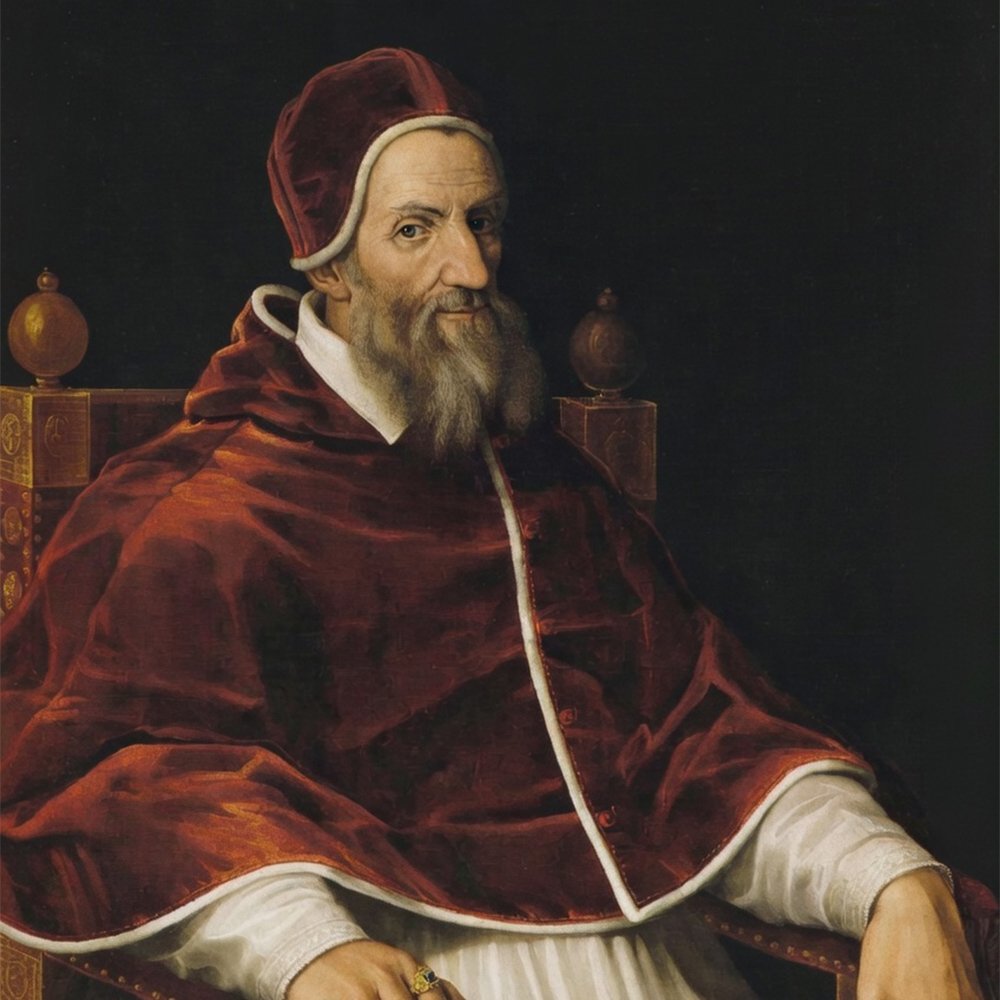
Pope Gregory XIII (1572-1585)
BIOGRAPHICAL DATA
Birth name: Ugo Boncompagni
Birth: January 7, 1502, Bologna, Papal States (Italy)
Papal election: May 14, 1572
Coronation: May 25, 1572
Pontificate: May 14, 1572 – April 10, 1585 (12 years, 10 months, 27 days)
Death: April 10, 1585, Rome (83 years old)
Burial: St. Peter’s Basilica, Vatican City
Religious order: Secular clergy (did not belong to a religious order)
Papal motto: None officially recorded
Cognomen: “The Calendar Pope”, “The Jesuit Pope”, “Pope of the Massacre” (controversial)
NOTE: Reformed the calendar still used worldwide today (Gregorian Calendar)! Strong supporter of Jesuits and Counter-Reformation education. BUT: controversially celebrated the St. Bartholomew’s Day Massacre of French Protestants, and left papal finances in serious disarray!
FORMATION AND RELIGIOUS LIFE
Bolognese Origins – Boncompagni Family
Boncompagni Family:
- Bolognese family, moderate nobility (professional class – not among greatest aristocratic houses)
- Cristoforo Boncompagni: father, merchant/professional
- Angela Marescalchi: mother, from respectable Bolognese family
- Family: educated, prosperous but not among Bologna’s greatest dynasties
- Ugo: showed early intellectual promise, directed toward legal/ecclesiastical career
Childhood and youth (1502-1520):
- Bologna: great university city, intellectual center of Italy
- Education: solid, comprehensive (family resources adequate)
- Ugo: highly intelligent, studious child
- Health: robust (would live to 83 – exceptional for era!)
- Illegitimate son: Giacomo Boncompagni born to Ugo before his ordination (common practice pattern for era – acknowledged, later legitimized)
Academic Formation – Legal Brilliance
University of Bologna (1520-1530):
- Premier law faculty in Europe
- Civil and Canon Law
- In utroque iure (doctorate in both laws)
- Doctorate: 1530 (28 years old)
- Student: exceptional (among most brilliant legal minds of generation)
- Teaching position: immediately began lecturing at Bologna (unusual honor – retained as professor)
Professor of Law (1530-1539):
- Taught at University of Bologna: nearly a decade
- Reputation: brilliant jurist, exceptional teacher
- Students included: many future cardinals, bishops, important figures
- Scholarly output: significant legal commentaries, treatises
Priestly Ordination: 1539 (37 years old)
- Relatively late ordination (after establishing legal career, having illegitimate son)
- Pattern common for era: worldly career first, then Church commitment
EARLY ECCLESIASTICAL CAREER (1539-1565)
Legal and Administrative Positions (1539-1558):
- Continued legal expertise application within Church administration
- Various curial positions: utilizing exceptional legal knowledge
- Council of Trent participation (1545-1563):
- Attended multiple sessions: significant contributor to Counter-Reformation’s defining council
- Legal expertise valued: helped draft canonical decrees
- Reputation enhanced: through substantive theological/legal contributions
Bishop of Vieste (1558):
- First episcopal position
- Brief tenure: quickly moved to more significant diplomatic roles
Papal Diplomat – Key Missions (1558-1565):
Legal representative to various courts:
- Spain: significant diplomatic missions
- Reputation: skilled negotiator, brilliant legal mind applied to diplomacy
- Trust built: with King Philip II (crucial relationship for future papacy)
Characteristics (1539-1565):
- Legal genius: among era’s most respected canonists
- Diplomatic skill: effective negotiator
- Worldly experience: balanced scholarly brilliance with practical political acumen
- Ambitious: carefully built reputation, relationships across Europe
CARDINAL AND CONTINUED SERVICE (1565-1572)
Created Cardinal by Pius IV (March 12, 1565):
- 63 years old
- Cardinal-Priest of San Sisto
- Reasons:
- Distinguished legal career
- Council of Trent contributions
- Diplomatic successes
- Spanish relations valuable
Cardinal (1565-1572):
Continued diplomatic service:
- Legate to Spain (1565-1572): extended, crucial diplomatic mission
- Philip II relationship: cultivated strong personal, political ties
- Spanish support: would prove crucial for papal election
Legal/administrative contributions:
- Continued canonical work: applying legal expertise to Church governance
- Trent implementation: helped ensure Council’s decrees properly executed
Personal characteristics as Cardinal:
- Worldly sophistication: combined scholarly achievement with political savvy
- Spanish alliance: carefully cultivated (would prove essential for election)
- Reputation: brilliant administrator, skilled diplomat
- Age: already elderly (65-70) by standards of era, but vigorous
CONCLAVE OF 1572 – ELECTION
Pre-Conclave Context
Death of Pius V (May 1, 1572):
- Significant reforming pontificate (1566-1572): rigorous Counter-Reformation implementation
- Lepanto victory (1571): major Christian naval triumph over Ottomans (occurred during Pius V’s reign)
- Strong legacy: left Church with renewed vigor, but continuing challenges
Situation of Church (1572):
- Counter-Reformation: ongoing implementation of Trent reforms
- Ottoman threat: still significant despite Lepanto victory
- Protestant Reformation: continuing challenge, especially in France, England, Germany
- Spanish influence: significant in Italian, papal politics
Cardinals wanted:
- Continuation of Tridentine reforms
- Strong administrator: experienced in Church governance
- Good relations with Spain: crucial ally against Protestants, Ottomans
The Conclave – Efficient
Start: May 1572
Duration: Brief (approximately 2 weeks – relatively quick process)
Factors favoring Boncompagni:
- Spanish support:
- Strong Philip II backing: crucial diplomatic relationship paid off
- Spanish faction: actively promoted his candidacy
- Legal/administrative reputation:
- Proven competence: decades of distinguished service
- Council of Trent credentials: valued reforming credentials
- Age (paradoxically):
- 70 years old: mature, experienced
- Not seen as threat: to various factions’ interests
- Assumed shorter reign: (ironically would live to 83, reign nearly 13 years!)
Election: May 14, 1572
- Achieved necessary majority relatively efficiently
- Boncompagni: accepted readily
- Chose name: Gregory XIII
- Homage to Gregory I “the Great” and continuing papal tradition
Coronation: May 25, 1572
- St. Peter’s Basilica
- Ceremony: appropriately solemn
- Spanish satisfaction: their preferred candidate secured
PONTIFICATE (1572-1585) – REFORM AND CONTROVERSY
THE ST. BARTHOLOMEW’S DAY MASSACRE – CONTROVERSIAL RESPONSE
The Massacre (August 23-24, 1572):
Context:
- French Wars of Religion: ongoing Catholic-Huguenot conflict
- Catherine de’ Medici, Charles IX: orchestrated mass killing of Protestant (Huguenot) leaders in Paris
- Occasion: wedding of Henry of Navarre (Protestant) to Margaret of Valois (Catholic) – supposed reconciliation event
- Massacre erupted: thousands of Huguenots killed in Paris, spreading to provinces
- Death toll: estimates range from 5,000-30,000 across France
Gregory XIII’s Response – HIGHLY CONTROVERSIAL:
Celebration in Rome:
- News reached Rome: early September 1572 (just months into pontificate!)
- Gregory XIII’s reaction:
- Ordered Te Deum sung: thanksgiving hymn celebrating “victory” over Protestants
- Commissioned commemorative medal: depicting massacre as triumph
- Commissioned fresco: Vasari painted scene in Vatican’s Sala Regia depicting massacre approvingly!
- Public celebrations: bonfires, festivities ordered in Rome
Historical/theological justification (contemporary Catholic view):
- Viewed as: suppression of dangerous rebellion/heresy (not simply religious persecution)
- Catherine de’ Medici’s framing: presented as preemptive strike against Huguenot coup plot
- Gregory XIII accepted this framing: believed genuine political conspiracy had been thwarted
Modern historical assessment – CONDEMNATORY:
- Universally condemned: as one of history’s worst religious massacres
- Gregory XIII’s celebration: seen as profound moral failure
- Legacy stain: darkest aspect of his pontificate
- Contrasts sharply: with his otherwise significant educational, scientific achievements
Long-term impact:
- Symbol: of Counter-Reformation’s darker excesses
- Protestant propaganda: used extensively (proof of Catholic brutality)
- Historical memory: Gregory XIII’s celebration remains deeply troubling historical episode
- Modern Catholic Church: would later distance itself from this response (different theological/historical understanding developed)
Assessment:
- Cannot be excused by “context of times”: even contemporaries recognized massacre’s brutality
- Represents: genuine moral blind spot in otherwise accomplished pontificate
- Historical lesson: demonstrates how religious conflict could corrupt moral judgment even in sophisticated, educated leaders
THE GREGORIAN CALENDAR REFORM – LASTING SCIENTIFIC ACHIEVEMENT
The Problem:
Julian Calendar’s accumulated error:
- Julian Calendar (45 BC): slight miscalculation of solar year length
- Accumulated drift: by 1572, calendar was 10 days out of alignment with astronomical reality
- Practical problems:
- Easter calculation: increasingly disconnected from proper astronomical timing
- Seasonal drift: calendar dates no longer matched actual seasons accurately
- Agricultural, religious calendar confusion
Scientific Background:
- Long-recognized problem: astronomers, mathematicians had noted issue for centuries
- Previous popes: had commissioned studies but never implemented solution
- Council of Trent: had specifically called for calendar reform
Gregory XIII’s Implementation:
Scientific commission:
- Assembled leading astronomers, mathematicians:
- Christopher Clavius (Jesuit mathematician): primary scientific architect
- Aloysius Lilius (Italian physician/astronomer): proposed core solution (died before implementation, but his work fundamental)
- International consultation: Vatican gathered best available astronomical knowledge
The Solution:
Bull “Inter Gravissimas” (February 24, 1582):
- Immediate correction:
- October 4, 1582 was followed immediately by October 15, 1582
- 10 days eliminated: to realign calendar with astronomical reality
- Dramatic implementation: people literally “lost” 10 days!
- Future accuracy mechanism:
- Leap year refinement:
- Julian system: leap year every 4 years (too frequent, caused drift)
- Gregorian solution: century years (1700, 1800, 1900) NOT leap years UNLESS divisible by 400
- Result: 1600, 2000 ARE leap years; 1700, 1800, 1900 are NOT
- Mathematical precision: reduced calendar drift to negligible levels (accurate to within 26 seconds per year!)
- Easter calculation improvement:
- More accurate determination: of Easter’s proper astronomical timing
- Aligned with: Council of Nicaea’s original 325 AD specifications
Implementation challenges:
Catholic countries: adopted relatively quickly
- Spain, Portugal, Italian states, Poland: implemented 1582
- France: implemented December 1582
Protestant resistance:
- Religious suspicion: Protestant countries initially refused papal calendar reform
- Political/religious tension: seen as papal overreach
- Gradual adoption:
- Germany (Protestant states): eventually adopted 1700
- England: finally adopted 1752! (170 years later!)
- Russia: didn’t adopt until 1918 (after Bolshevik Revolution!)
- Various Orthodox countries: even later adoption
Historical significance – EXTRAORDINARY LASTING IMPACT:
Universal modern usage:
- THE GREGORIAN CALENDAR IS THE INTERNATIONAL STANDARD CALENDAR TODAY!
- Used globally: regardless of religious affiliation
- Scientific accuracy: remains remarkably precise even by modern astronomical standards
- Secular adoption: transcended its religious origins to become universal practical standard
Assessment:
- GREATEST SCIENTIFIC/PRACTICAL ACHIEVEMENT of Gregory XIII’s pontificate
- Demonstrates: successful integration of scientific expertise with papal authority
- Legacy: literally shapes how humanity measures time, 400+ years later
- Irony: secular, scientific achievement outlasts religious controversies of era
EDUCATIONAL REVOLUTION – JESUIT SUPPORT AND COLLEGE FOUNDATION
Strong Support for Jesuit Order:
Context:
- Society of Jesus (Jesuits): founded 1540, rapidly growing educational, missionary force
- Counter-Reformation education: Jesuits recognized as crucial for combating Protestant influence, training orthodox clergy
Gregory XIII’s Patronage:
- Roman College (Collegio Romano) expansion:
- Massive investment: in Jesuit’s flagship educational institution
- New building construction: significant architectural investment
- Curriculum support: enabled expanded theological, philosophical, scientific education
- Later renamed: Pontifical Gregorian University (in his honor!) – still exists today as major Vatican-affiliated university!
- German College (Collegium Germanicum) support:
- Training German Catholic clergy: crucial for Counter-Reformation in Germany
- Combat Protestant influence: through well-trained, orthodox German priests
- English College (Venerable English College) foundation:
- 1579 establishment: training English Catholic priests
- Context: English Catholics faced persecution under Elizabeth I
- Purpose: prepare priests for dangerous missionary work in Protestant England
- Many graduates: later martyred (demonstrates serious, dangerous mission)
- Greek College foundation:
- 1577: for training clergy to work with Eastern Christian communities
- Purpose: reunion efforts with Orthodox churches, support for Eastern Catholics
- Maronite College:
- Supporting: Maronite Christians (Lebanon) – Eastern Catholic community
- Numerous other national colleges:
- Hungarian College
- Various other national seminaries: supporting Catholic education across Europe
Comprehensive educational strategy:
- Systematic approach: training clergy for specific national/regional contexts
- Counter-Reformation tool: education as primary weapon against Protestant expansion
- Global vision: colleges prepared missionaries for worldwide Catholic expansion
Assessment:
- TRANSFORMATIVE EDUCATIONAL LEGACY: created lasting institutional infrastructure
- Many institutions still exist: or evolved into modern Catholic universities/seminaries
- Strategic vision: recognized education’s crucial role in religious conflict
- Positive counter-balance: to St. Bartholomew’s controversy – genuine constructive achievement
MISSIONARY EXPANSION SUPPORT
Global Catholic Missions:
Americas:
- Continued support: for Spanish, Portuguese colonial missionary efforts
- Jesuit missions: expanding throughout Spanish America
Asia:
- Jesuit missions to Japan, China: significant support
- Matteo Ricci’s China mission: began during this period (though major impact came slightly later)
- Japan missions: continued support despite eventual severe persecution
Support mechanisms:
- Financial backing: for missionary expeditions
- Educational preparation: through college system (training missionaries)
- Diplomatic support: encouraging Catholic monarchies’ colonial missionary efforts
FINANCIAL MISMANAGEMENT – SERIOUS ADMINISTRATIVE FAILURE
The Problem:
Excessive spending:
- Educational institutions: massive investment (colleges, universities)
- Building projects: various construction initiatives
- Missionary support: significant ongoing financial commitment
- Charitable works: continued traditional papal charity
Poor financial administration:
- Inadequate revenue collection systems
- Insuffient fiscal oversight: compared to what successor Sixtus V would implement
- Nepotism costs: some family enrichment (though not as scandalous as later Innocent X situation)
Nepotism – Moderate but Present:
Giacomo Boncompagni (illegitimate son):
- Legitimized: during Gregory XIII’s pontificate
- Advanced significantly:
- Castellan of Sant’Angelo: important, lucrative position
- Various other appointments: benefiting from father’s papal position
- Not as extreme as some nepotism cases: but definitely benefited from father’s status
Result – Financial Crisis by End of Pontificate:
Treasury severely depleted:
- By 1585 (Gregory XIII’s death): papal finances in serious disarray
- Successor’s challenge: Sixtus V would inherit near-bankruptcy
- Contrast: with Sixtus V’s subsequent dramatic financial turnaround
Assessment:
- Well-intentioned spending: (education, missions, charity) but poor fiscal management
- Lacked: systematic financial administration that successor would implement
- Legacy burden: left successor with significant financial challenge to solve
OTHER ADMINISTRATIVE AND RELIGIOUS MATTERS
Council of Trent implementation:
- Continued enforcement: of Tridentine reforms throughout Church
- Seminary establishment: encouraged throughout Catholic dioceses (Trent requirement)
- Liturgical standardization: continued implementation of reformed liturgical practices
Relations with Catholic monarchs:
Spain (Philip II):
- Strong, continued alliance: crucial diplomatic relationship maintained throughout pontificate
- Mutual support: against Protestant threats, Ottoman Empire
France:
- Complex relationship: St. Bartholomew’s Massacre complicated moral standing
- Continued engagement: with French Catholic monarchy despite massacre’s troubling nature
Holy Roman Empire:
- Support for Catholic princes: against Protestant expansion
- German College: specifically designed to support this struggle
Inquisition:
- Maintained: standard Counter-Reformation vigilance
- Continued enforcement: of doctrinal orthodoxy
Beatifications/Canonizations:
- Some activity: though not primary focus of pontificate
- Continued process: for various sainthood causes
FINAL YEARS AND DEATH (1583-1585)
Continued Activity Despite Advanced Age
1583-1584:
- Age 81-82: remarkably still active for era
- Continued educational, missionary support
- Calendar reform implementation: ongoing process (different countries adopting at different times)
Health Decline
Early 1585:
- Health beginning to fail: natural decline given advanced age (83)
- Continued some activities: despite weakening condition
April 1585:
- Rapid final decline
- Received Last Rites
Death
April 10, 1585:
- Death: in Rome
- Age: 83 years old (exceptionally long life for era!)
- Reign: nearly 13 years (12 years, 10 months)
- Cause: natural causes, advanced age
Immediate reaction:
Rome:
- Mixed assessment:
- Appreciation: for educational, calendar achievements
- Concern: about financial disarray left behind
- Complex legacy: brilliant achievements alongside serious administrative problems and moral controversy (St. Bartholomew’s)
Cardinals:
- Recognition: of significant achievements (calendar, education)
- Awareness: of financial crisis requiring urgent attention
- Need: for strong successor to address fiscal problems, restore order
FUNERAL AND IMMEDIATE LEGACY
Funeral
April 1585:
- St. Peter’s Basilica
- Ceremony: appropriately significant given lengthy, consequential pontificate
- Attendance: substantial (long reign meant significant personal connections)
Burial:
- St. Peter’s Basilica
- Tomb: eventually significant monument (reflecting substantial pontificate)
Immediate Successor
Conclave 1585:
- Urgent need: address severe financial crisis
- Result: Sixtus V elected
- Dramatic transformation: would completely reverse financial disaster
- Contrast: Gregory XIII’s spending vs. Sixtus V’s fiscal discipline
- Continuity: Sixtus V built upon some Gregory XIII initiatives while fixing fundamental problems
HISTORICAL LEGACY
Assessment by Historians
Positive – Significant:
- Calendar reform:
- MOST LASTING ACHIEVEMENT: Gregorian Calendar still used globally today!
- Scientific sophistication: demonstrated successful integration of astronomy, mathematics with papal authority
- Universal impact: transcended religious boundaries to become secular standard
- Educational investment:
- Jesuit college system: created lasting institutional infrastructure
- Roman College/Gregorian University: continues operating today
- National colleges: trained generations of clergy, some still existing in evolved forms
- Strategic vision: recognized education’s crucial role in religious conflict
- Missionary support:
- Global Catholic expansion: facilitated through educational, financial support
- Long-term impact: on global Catholic Church’s geographic spread
Negative – Serious:
- St. Bartholomew’s Day Massacre celebration:
- PROFOUND MORAL FAILURE: celebrating mass killing of Protestants
- Historical stain: remains deeply troubling aspect of pontificate
- Cannot be excused: by contemporary religious conflict context
- Financial mismanagement:
- Left successor: near-bankruptcy
- Poor administrative oversight: contrast with Sixtus V’s subsequent fiscal genius
- Well-intentioned but poorly executed: spending priorities
- Nepotism:
- Moderate but present: illegitimate son’s advancement
- Not scandalous: by era’s worst standards, but still ethically questionable
Overall verdict:
- MIXED BUT SIGNIFICANT LEGACY:
- Calendar reform: ensures lasting positive historical memory
- Educational achievements: substantial constructive contribution
- St. Bartholomew’s response: permanent moral stain
- Financial management: serious administrative failure
Comparisons
With predecessor (Pius V, 1566-1572):
- Pius V: rigorous reformer, Lepanto victory, canonized saint (1712)
- Gregory XIII: scientific achievement (calendar) but moral controversy (Bartholomew’s)
With immediate successor (Sixtus V, 1585-1590):
- Dramatic contrast: Gregory XIII’s financial mismanagement vs. Sixtus V’s fiscal genius
- Sixtus V: inherited crisis, transformed it completely
- Complementary legacies: Gregory XIII’s educational/scientific achievements, Sixtus V’s administrative/financial reforms
With other “calendar” achievements:
- Julius Caesar (Julian Calendar, 45 BC): original system Gregory XIII corrected
- Gregory XIII’s reform: more scientifically sophisticated, longer-lasting accuracy
Legacy Complexity – The Central Paradox
How reconcile:
- Brilliant scientific achievement (calendar) representing rational, mathematical sophistication
- With troubling moral failure (Bartholomew’s celebration) representing religious conflict’s darker impulses
- And administrative weakness (financial mismanagement) representing governance limitations
Historical assessment must hold multiple truths simultaneously:
- Genuine intellectual, scientific achievement (calendar reform)
- Serious moral failure (massacre celebration)
- Significant constructive achievement (educational investment)
- Administrative shortcoming (financial crisis)
CULTURAL AND SCIENTIFIC LEGACY
The Gregorian Calendar – Enduring Global Standard
Continued relevance:
- Used by: virtually every country in world today (regardless of religious affiliation)
- Scientific accuracy: remains remarkably precise (26-second annual error – won’t require adjustment for thousands of years)
- Cultural integration: so completely normalized that most people don’t realize its papal origin!
Vatican Observatory connection:
- Scientific tradition: established groundwork for later Vatican astronomical work
- Christopher Clavius: his calendar work influenced broader Jesuit scientific tradition
Educational Institution Legacy
Pontifical Gregorian University:
- Direct descendant: of Roman College Gregory XIII expanded
- Continues today: major Vatican-affiliated university, training priests, scholars globally
- Named in his honor: reflecting recognition of foundational contribution
Various national colleges:
- English College: continues existing (evolved through centuries)
- German College: ongoing institutional presence
- Pattern established: national seminary model influenced later Catholic educational development
PERSONAL CHARACTERISTICS
Virtues
Intellectual brilliance:
- Legal genius: among era’s most respected canonists
- Scientific sophistication: successfully oversaw complex calendar reform
- Educational vision: recognized crucial importance of systematic clergy training
Diplomatic skill:
- Spanish alliance: carefully cultivated, maintained throughout career
- Effective negotiator: demonstrated throughout diplomatic career
Institutional building:
- Long-term thinking: educational investments show strategic vision beyond immediate political concerns
- Systematic approach: to training clergy for specific regional/national contexts
Weaknesses/Criticisms
Moral judgment failure:
- St. Bartholomew’s celebration: represents serious ethical lapse
- Religious zealotry: allowed anti-Protestant sentiment to override basic humanitarian concern
Administrative weakness:
- Financial mismanagement: serious oversight failure
- Inadequate fiscal systems: compared to what successor would implement
Nepotism:
- Illegitimate son’s advancement: though moderate, still ethically questionable
CURIOSITIES AND ANECDOTES
- The “lost” ten days:
- October 4, 1582 → October 15, 1582: People literally went to sleep on the 4th and woke up on the 15th!
- Popular confusion: some ordinary people believed authorities had literally “stolen” ten days of their lives
- Practical chaos: contracts, rents, various time-sensitive matters required careful adjustment
- Protestant resistance to calendar:
- England’s 170-year delay: didn’t adopt Gregorian Calendar until 1752!
- Riots reported: when England finally switched, some claimed rioters shouted “Give us back our eleven days!” (though historical accuracy of this specific incident is debated)
- Religious stubbornness: Protestant countries’ delayed adoption purely due to papal origin, despite scientific superiority
- Vasari’s massacre fresco:
- Sala Regia, Vatican: still exists today!
- Modern visitors: can see controversial fresco depicting St. Bartholomew’s Massacre approvingly
- Historical reminder: uncomfortable artistic testimony to papal celebration of violence
- Illegitimate son’s rise:
- Giacomo Boncompagni: born before father’s ordination
- Legitimized, advanced: significant positions despite illegitimate birth
- Reflects: era’s complex relationship between clerical celibacy ideals and actual practice
- Christopher Clavius’s mathematical genius:
- Jesuit mathematician: primary scientific architect of calendar reform
- Complex calculations: required sophisticated astronomical, mathematical knowledge
- Legacy: calendar’s continued accuracy testament to his mathematical precision
DOCUMENTS AND ADMINISTRATIVE ACTS
Major Bulls and Documents
“Inter Gravissimas” (February 24, 1582):
- THE CALENDAR REFORM BULL
- Most historically significant document of pontificate
- Detailed scientific, theological justification for calendar change
Various educational foundation documents:
- Roman College expansion charters
- National college establishment documents: English, German, Greek, Maronite colleges
Financial administration documents:
- Various fiscal records: showing spending patterns, eventual crisis
CHRONOLOGY SUMMARY
- 1502: Birth in Bologna (Boncompagni family)
- 1530: Doctorate in both laws (28 years old); began teaching at Bologna
- 1539: Priestly ordination (37 years old, after establishing legal career)
- 1545-1563: Council of Trent participation (multiple sessions)
- 1565: Created cardinal by Pius IV
- 1565-1572: Legate to Spain (cultivated crucial Philip II relationship)
- 1572 (May 14): Papal election (70 years old)
- 1572 (September): Celebrated St. Bartholomew’s Day Massacre – controversial response
- 1577: Greek College founded
- 1579: English College founded
- 1582 (February 24): “Inter Gravissimas” – Gregorian Calendar reform announced
- 1582 (October): Calendar implementation – 10 days eliminated
- 1585 (April 10): Death in Rome, 83 years old, after nearly 13-year pontificate
FINAL ASSESSMENT
Pope Gregory XIII presents historians with a profound paradox: the creator of humanity’s most successful, lasting calendar system, who simultaneously celebrated one of history’s most notorious religious massacres, while leaving papal finances in near-ruinous condition.
The Scientific Triumph
Gregorian Calendar:
- UNPARALLELED LASTING IMPACT: literally still used by entire world today
- Scientific sophistication: successfully integrated cutting-edge astronomical knowledge with practical governance
- Universal adoption: transcended religious origins to become secular global standard
- Precision: remains remarkably accurate even by modern scientific standards
The Educational Achievement
Jesuit college system:
- Strategic vision: recognized education’s crucial role in religious/cultural conflict
- Lasting institutions: many colleges evolved into modern universities, seminaries
- Global impact: trained missionaries, clergy who shaped Catholic Church’s worldwide development
The Moral Failure
St. Bartholomew’s Day Massacre celebration:
- INEXCUSABLE RESPONSE: to mass killing of religious minorities
- Permanent historical stain: cannot be rationalized away by “context of times”
- Demonstrates: how religious conflict corrupted moral judgment even in sophisticated leaders
- Historical lesson: warning about dangers of religious triumphalism overriding basic humanity
The Administrative Weakness
Financial mismanagement:
- Serious governance failure: left successor near-bankruptcy
- Contrast: with subsequent Sixtus V’s fiscal genius
- Well-intentioned spending: (education, missions) but poor systematic oversight
Historical Position
Complex legacy requiring nuanced assessment:
- Cannot simply celebrate: without acknowledging Bartholomew’s controversy
- Cannot simply condemn: without recognizing genuine calendar, educational achievements
- Historical maturity requires: holding multiple truths simultaneously
Among “mixed legacy” popes:
- Similar to: other historical figures combining genuine achievement with serious moral failures
- Requires: honest historical assessment rather than simple hero/villain categorization
Epitaph (Balanced Historical Assessment)
“Here lies Gregory XIII Boncompagni, who gave humanity a calendar so precise it still governs our understanding of time itself, more than four centuries later. He built colleges that educated generations of scholars and missionaries, recognizing education’s power to shape faith and culture. Yet this same brilliant mind celebrated the mass murder of religious dissenters with bonfires and commemorative medals, revealing how deeply religious conflict can corrupt moral judgment even in humanity’s most sophisticated thinkers. He left the papal treasury in crisis, requiring his successor’s fiscal genius to repair the damage. His legacy demands neither simple celebration nor simple condemnation, but honest acknowledgment that historical figures often embody profound contradictions: scientific genius alongside moral blindness, educational vision alongside administrative failure, lasting positive contribution alongside permanent troubling memory.”
Modern Relevance
Institutional lessons:
- Scientific achievement possible: even within religious institutional context (calendar reform)
- Education’s transformative power: strategic investment in training, knowledge transmission
- Financial oversight crucial: even well-intentioned spending requires systematic management
Broader historical insight:
- Moral complexity of historical figures: genuine achievement doesn’t excuse serious ethical failures
- Religious conflict’s corrupting potential: even sophisticated, educated leaders can lose moral clarity amid sectarian conflict
- Legacy assessment requires nuance: avoiding both hagiography and simple condemnation
Calendar’s continued relevance:
- Daily reminder: every time we check a calendar, we use Gregory XIII’s scientific achievement
- Secular triumph: demonstrates how religious institutional achievement can transcend original context to serve universal human need
- Symbol: of successful science-religion collaboration, despite era’s other religious conflicts
Pope Gregory XIII – the pope who gave the world its calendar while revealing religious conflict’s capacity to corrupt even brilliant moral judgment. His scientific legacy governs our daily lives; his moral failure reminds us that intellectual brilliance doesn’t guarantee ethical wisdom.
Requiescat in pace – in St. Peter’s Basilica, having left humanity a calendar that will outlast every empire, every religious conflict, every historical controversy—yet also having demonstrated, through his response to Bartholomew’s massacre, that even history’s most scientifically sophisticated minds can fail catastrophically in basic moral judgment when religious triumphalism clouds fundamental human decency.
Every time we consult a calendar—checking a date, planning an event, marking time’s passage—we unknowingly invoke Gregory XIII’s genius. Yet his celebration of religious massacre reminds us that scientific achievement and moral wisdom don’t always travel together, and that history’s judgment must encompass both the brilliant calculations that govern our days and the troubling choices that reveal our capacity for both genius and profound moral failure.