Clement IX
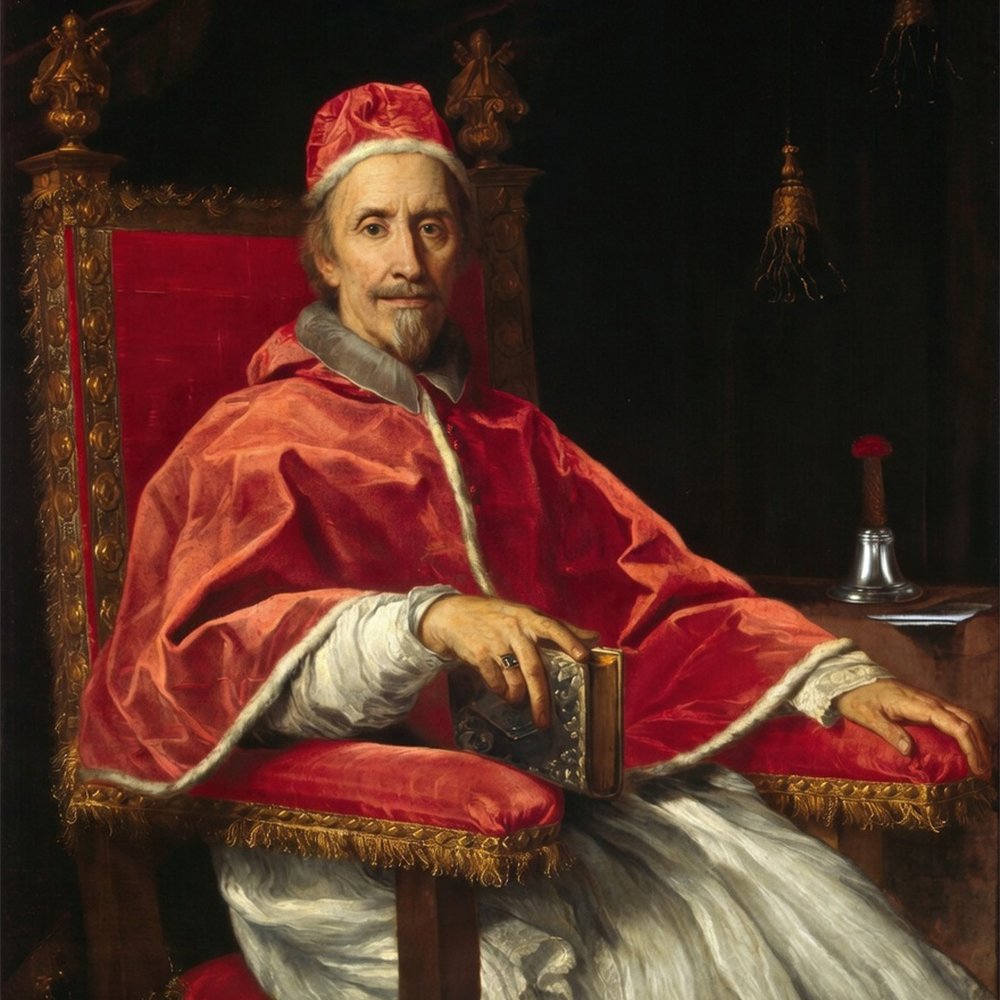
Clement IX (1667-1669)
BIOGRAPHICAL DATA
Birth name: Giulio Rospigliosi
Birth: January 28, 1600, Pistoia, Grand Duchy of Tuscany
Papal election: June 20, 1667
Coronation: June 26, 1667
Pontificate: June 20, 1667 – December 9, 1669 (2 years, 5 months, 19 days)
Death: December 9, 1669, Rome, Papal States (69 years old)
Burial: Basilica of Santa Maria Maggiore, Rome (pavement tomb; later monument erected by Clement X)
Religious order: Secular clergy (diocesan priest)
Papal motto: “Aliis non sibi Clemens” (“Clement to others, not to himself”)
Cognome: “The Clementine Pope,” “The Poet Pope,” “The Amiable Pope,” “The Peacemaker,” “The Idol of the Romans”
NOTE: His brief pontificate was marked by the temporary Peace of Clement IX (Pax Clementina) in the Jansenist controversy, his role as mediator in the War of Devolution leading to the Peace of Aachen, his patronage of the arts including collaboration with Bernini, and his profound personal charity which made him “the idol of the Romans” . He died of a broken heart upon learning of the fall of Candia to the Turks .
EARLY LIFE AND FORMATION
Aristocratic Origins – The Rospigliosi Family
The Rospigliosi of Pistoia:
- Ancient noble family originally from Lombardy, later established in Pistoia, Tuscany
- The family derived its wealth from sheep-farming
- Giacomo Rospigliosi: father
- Caterina Rospigliosi: mother
- Giulio was born into the noble Rospigliosi family in Pistoia, part of the Grand Duchy of Tuscany
Childhood in Pistoia (1600-1610s):
- Born on January 28, 1600, in Pistoia
- Early education: humanistic, in the Tuscan tradition
- Showed early talent for letters and arts
Formation Under the Jesuits
Seminario Romano (c. 1610s-1620):
- Studied at the Roman Seminary, an institution of the Jesuits
- Studied liberal arts at Rome with the Jesuits
- Curriculum: humanities, rhetoric, philosophy
- Brilliant student: distinguished himself in his studies
University of Pisa (1620-1623):
- Transferred to the University of Pisa for higher studies
- Pupil of the Jesuits
- Received doctorates in theology, philosophy, and both canon and civil law (in utroque iure) in 1623, at the age of twenty-three
- Theses: brilliant, orthodox, learned
Professor at Pisa (1623-1625):
- After receiving his doctorate, taught theology as a professor from 1623 to 1625
- Beginning of a promising academic career
Entry into Curial Service
Patronage of the Barberini:
- With the patronage of the Barberini family, who admired his artistic flair, and of Pope Urban VIII himself, he rose steadily in the Roman Curia from 1624
- Urban VIII (1623-1644): himself fond of literature and poetry, favored Rospigliosi
- Worked in the diplomatic corps
Referendary of the Apostolic Signatura (1632-1636):
- Judicial position in the curia
- Initial administrative experience
Secretary of the Sacred Congregation of Rites (1632-1636):
- Responsibility: liturgical questions and canonizations
- Close work with Church administration
Priestly Ordination:
- Date not precisely recorded in sources
- Probably occurred before his episcopal appointment
EPISCOPATE AND CARDINALATE (1644-1667)
Apostolic Nuncio to Spain (1644-1653)
Titular Archbishop of Tarsus (1644):
- Appointed Titular Archbishop of Tarsus in 1644
- Episcopal consecration: March 29, 1644
- Consecrator: Antonio Marcello Barberini
- Location: Vatican
Nuncio to Spain (1644-1653):
- Most important diplomatic mission of his career
- Served as papal ambassador to the Spanish court
- Difficult context:
- Spain under Philip IV, in decline
- Complex relations between Holy See and Spanish crown
- Questions of royal patronage and ecclesiastical jurisdiction
- Left Madrid in January 1653
- Performance: competent, discreet, effective
Retirement During Innocent X’s Pontificate
Years of Retirement (1653-1655):
- Resigned from the post of nuncio in 1653
- Lived in retirement throughout the pontificate of Pope Innocent X (1644-1655)
- Innocent X disliked and distanced himself from those associated with his predecessor
- Also made vicar of Santa Maria Maggiore in Rome
Cardinalate Under Alexander VII
Cardinal Secretary of State (1655-1667):
- Recalled to office by Pope Alexander VII
- Appointed Cardinal Secretary of State in 1655, a position he held until 1667
- In this capacity, despite the hostility to Alexander of the powerful minister Cardinal Mazarin (1602-1661) and Louis XIV, he managed to retain the esteem of the French court
Created Cardinal (April 9, 1657):
- Elevated by Pope Alexander VII
- Cardinal-Priest of San Sisto Vecchio
- Age: 57 years old
Cardinal-Priest of San Sisto (1657-1667):
- Served in this capacity for ten years before his own election
Governor of Rome (1655):
- Made governor of Rome during the sede vacante after Innocent X’s death
Man of Letters
Accomplished Writer and Librettist:
- Giulio Rospigliosi was an accomplished man of letters who wrote poetry, dramas, and libretti
- Before his election as Pope Clement, he wrote poetry but gained fame through his dramas with religious themes and several libretti
- Credited with creating comic opera as an individual form
- Wrote what may be the first comic opera: his 1637 libretto Chi soffre, speri (“He Who Suffers, Hopes”)
Major Libretti:
Title | Composer | Year |
I Pastori di Betlemme | Giovanni Girolamo Kapsperger | 1630 |
Il Sant’Alessio | Stefano Landi | 1631-32, 1634 |
Erminia sul Giordano | Michele Angelo Rossi | 1633 |
I Santi Didimo e Teodora | (composer unknown) | 1635, 1636 |
Chi Soffre, Speri | Marco Marazzoli and Virgilio Mazzocchi | 1637, 1639 |
La Sincerità Trionfante | Aurelio Aureli | 1638, 1639 |
Il San Bonifazio | Virgilio Mazzocchi | 1638, 1639 |
La Genoinda | Virgilio Mazzocchi | 1641 |
Il Palazzo Incantato | Luigi Rossi | 1642 |
Patron of Nicolas Poussin:
- He was also a patron of the artist Nicolas Poussin, commissioning A Dance to the Music of Time from him and dictating its iconography
CONCLAVE OF 1667 – ELECTION
Context: Death of Alexander VII
Death of Alexander VII (May 22, 1667):
- Pontificate: 12 years (1655-1667)
- College of Cardinals: approximately 70 electors
- Need for pope capable of resolving tensions with France
Situation of the Church (1667):
- France: Louis XIV at height of power, aggressive foreign policy
- Spain: declining but still influential
- Jansenism: ongoing controversy in France
- Portugal: seeking independence from Spain, ecclesiastical reorganization needed
- Turks: continuing threat to Venetian Crete
The Conclave
Dates: May 22 – June 20, 1667
Duration: Approximately one month
Political Alignments:
- French faction: supporting candidates favorable to Louis XIV
- Spanish faction: supporting candidates favorable to Charles II
- Independent cardinals: seeking compromise candidate
Why Rospigliosi Won:
- French support: King Louis XIV of France instructed the French faction to turn their support to Rospigliosi
- Spanish acceptability: Believed also that he would appease the Spanish faction of Charles II due to the fact that he had once been the Apostolic Nuncio to Spain
- Curial experience: Fifteen years as nuncio and cardinal secretary of state
- Personal reputation: Known for learning, charity, and diplomatic skill
- Moderate temperament: Seen as capable of healing rift between Paris and Rome
Election (June 20, 1667):
- Elected on the twentieth day of the conclave
- Received all but two votes (voted for another; Cardinal Neri Corsini voted for Cardinal Flavio Chigi)
- Chose name: Clement IX
- Indicative of a policy of appeasement
Comment on Election:
When asked about Rospigliosi becoming pope, Cardinal Francesco Albizzi said: “Urban turned the Holy See into a bank; Innocent into a brothel; Alexander into a tavern; this one will make a playhouse of it.” Albizzi also alluded to Rospigliosi’s passion for music and said, “He will emasculate the Sacred College by giving the hat to all the castrated singers in Europe!”
Coronation (June 26, 1667):
- Crowned by the protodeacon, Cardinal Rinaldo d’Este
- Age at coronation: 67 years old
Possession of St. John Lateran (July 3, 1667):
- Traditional ceremony taking possession of the cathedral of Rome
PONTIFICATE (1667-1669) – THE AMIABLE POPE
Character and Governing Style
Personal Piety and Charity:
- “He was the idol of the Romans, not so much for his erudition and application to business, as for his extreme charity and his affability towards great and small”
- Two days each week he occupied a confessional in St. Peter’s Basilica and heard anyone who wished to confess to him
- He frequently visited the hospitals
- He was lavish in his alms to the poor
Anti-Nepotism:
- In an age of nepotism, he did little or nothing to advance or enrich his family
- He almost wholly broke with the traditional nepotism, and assigned his relatives only modest and moderately profitable offices
- In his aversion to notoriety, he refused to permit his name to be placed on the buildings erected during his reign
Economic Reforms:
- He increased the goodwill of his subjects by buying off the monopolist who had secured the macinato, or privilege of selling grain
- As his predecessor had collected the money for the purpose, Clement IX had the decree published in the name of Alexander VII
- By strict economy he brought the papal finances into good order
Work Habits:
- Applied himself diligently to business
- But remembered more for charity than administration
The Clementine Peace (Pax Clementina)
Background – Jansenist Controversy:
- Jansenism: theological movement emphasizing grace, predestination, limited redemption
- Cornelius Jansen’s Augustinus (1640) condemned by Urban VIII, Innocent X, Alexander VII
- Formulary controversy: requirement that clergy sign condemnation of five propositions from Jansen
- A minority of Jansenists, including four bishops and the nuns of Port-Royal, still refused subscription
Negotiations:
- Clement’s policy of appeasement materialized in an agreement called the Peace of Clement IX (January 1669)
- Through discussions between French Foreign Minister Hugues de Lionne and the papal nuncio, Clement was prevailed upon to accept (January 19, 1669) the recalcitrant bishops’ subscription
- This occurred despite it being hedged around with qualifications to which he had to turn a blind eye
- It was in fact a victory for Louis XIV, who considered the Jansenists a threat to the unity of his kingdom
Outcome:
- Procured a lull in the storm, which, unfortunately, owing to the insincerity of the sectaries, was but temporary
- It suspended persecution of the Jansenists
- The Peace lasted from 1669 to 1679
- “It soon became apparent at Rome that the ‘Peace’ was being interpreted as a sign of the church’s weakness in the face of French pressure”
Assessment:
- By a mild compromise, he procured temporary peace
- Demonstrated his commitment to reconciliation
- But unresolved issues would resurface
Mediation in European Wars
War of Devolution (1667-1668):
- Louis XIV invaded Spanish Netherlands, claiming they had “devolved” to his wife (Maria Theresa of Spain) through a local inheritance law
- France vs. Spain
- England, Dutch Republic, and Sweden formed Triple Alliance to check French expansion
Peace of Aachen (May 2, 1668):
- Clement IX brought about, as arbiter, the Peace of Aix-la-Chapelle between France and Spain
- He gravely admonished Louis XIV against the aggressive career upon which he was setting forth
- However, he was no match diplomatically for Hugues de Lionne, Mazarin’s brilliant successor as French foreign minister
- The peace left in France’s hands the fortified towns in Flanders it wanted
- While it flattered him to play a role in the negotiations, the diplomatic advantage was with France
Admonition to Louis XIV:
- Clement gravely admonished Louis XIV against the aggressive career upon which he was setting forth
- Though unable to stop French expansion, he registered papal concern
Reorganization of the Church in Portugal
Context:
- Portugal had achieved independence from Spain (1640, recognized 1668)
- Ecclesiastical situation confused during decades of war
- Numerous vacant sees needed filling
Clement’s Action:
- He reorganized the Church in Portugal, after that nation had achieved its independence from Spain
- When Spain recognized (February 1668) the independence of Portugal, he felt able to settle the confused ecclesiastical situation in that country by at last filling the numerous vacant sees
Relations with France
Removal of Humiliating Inscription:
- A humiliating inscription admitting the guilt of the papal soldiers which Louis XIV had forced Alexander VII to set up in Rome was removed
- But Clement in return had to allow the French crown a free hand in church appointments
- Demonstrated the continuing pressure of Gallicanism on the papacy
Defense of Crete Against the Turks
The Siege of Candia:
- Venetian fortress of Candia (modern Heraklion) on the island of Crete
- Had been under siege by the Ottoman Turks for twenty years (1648-1669)
- Last major Christian outpost in the eastern Mediterranean
Clement’s Efforts:
- He was able to furnish material aid to Venice for the defence of Crete, then besieged by the Turks
- He attempted to strengthen Venetian defenses against the Turks on the island of Crete
- However, he was unable to get wider support for this cause
- Had the European powers listened to his exhortations, that important island would not have been lost to Christendom
- Louis XIV refused Clement’s plea for aid to Crete
The Fall:
- The Cretan seaport city of Candia, after a siege of 20 years, fell on September 5, 1669
- Followed by the submission of the island to the Turks
Canonizations and Beatifications
Beatification (April 15, 1668):
- St. Rose of Lima (1586-1617): Peruvian Dominican tertiary
- First saint of the Americas
- “On 15 April, 1668, he declared blessed, Rose of Lima, the first American saint”
Canonizations (April 28, 1669):
- St. Mary Magdalene de’ Pazzi (1566-1607): Carmelite mystic, Florentine saint
- St. Peter of Alcántara (1499-1562): Franciscan reformer, Spanish mystic
- “On 28 April, 1669, he solemnly canonized S. Maria Maddalena dei Pazzi and St. Peter of Alcantara”
Confirmation of Cultus (October 9, 1669):
- Blessed Margaret of Savoy (1390-1464): Marchioness of Montferrat, Dominican tertiary
Creation of Cardinals
Three Consistories:
- Elevated 12 new cardinals in three consistories
- This included Emilio Bonaventura Altieri, who would succeed him as Pope Clement X
- On November 29, just ten days before he died, he named seven new cardinals and announced one whom he had reserved “in pectore”
PATRONAGE OF THE ARTS
Collaboration with Gian Lorenzo Bernini
Lifelong Collaboration:
- Clement IX was a committed patron of the arts during his short term as pope
- He embellished the city of Rome through his engagement with the celebrated artist Gian Lorenzo Bernini, with whom he had collaborated before ascending to the papacy
- Bernini created stage designs for performances of operas and plays written by the young Rospigliosi
Major Commissions:
- Angels of Ponte Sant’Angelo:
- Bernini designed the angels for the bridge leading to Castel Sant’Angelo
- One of Rome’s most famous artistic landmarks
- Colonnade of St. Peter’s Basilica:
- Bernini continued work on the great piazza
- The colonnade embracing the faithful was completed during Clement’s reign
- Santa Maria Maggiore Expansions:
- A papal medal by Girolamo Lucenti, created in 1669, commemorated Clement’s expansion of the basilica of Santa Maria Maggiore, which the pontiff also entrusted to Bernini
Modesty in Patronage:
- Somewhat unusually for popes of the era, Clement IX did not have his name displayed on monuments he built
- Consistent with his aversion to notoriety
Opera and Theater
Carnival Celebrations (1668):
- For the Carnival celebrations of 1668, commissioned Antonio Maria Abbatini of the Sistine Chapel Choir to set to music his free Italian translation of a Spanish religious drama La Baltasara
- The production had sets designed by Bernini
First Public Opera House:
- He opened the first public opera house in Rome
- Despite Cardinal Albizzi’s prediction, he did not make the College of Cardinals a “playhouse”
Portrait Medals
Medallic Art:
- A portrait medallion of Clement IX, attributed to Girolamo Lucenti (c. 1627-1698), survives in the Harvard Art Museums
- Gilt bronze in high relief, 30.8 cm diameter
- Depicts the pope in profile: high forehead, slightly hooked nose, curly hair extending to collar, mustache, medium-length beard
- The image bears a strong resemblance to a papal medal by Lucenti created in 1669 to commemorate Clement’s expansion of Santa Maria Maggiore
LAST YEARS AND DEATH
Illness and Anxiety
Health Decline (Autumn 1669):
- Clement IX was seriously ill throughout the autumn in 1669 with a hernia and kidney stones
- Despite his illness and his anxiety over the Turkish advances in Crete, he travelled on a pilgrimage to the seven Roman basilicas
- That night, he had a severe apoplexy (stroke)
The News from Crete:
- At the end of October 1669, Clement IX fell ill after receiving news that the Venetian fortress of Candia in Crete had surrendered to the Turks
- The news of its fall, after a gallant resistance of twenty years, hastened the pope’s death
- He died, allegedly of a broken heart
Final Acts (November 29, 1669):
- Just ten days before he died, he named seven new cardinals and announced one whom he had reserved “in pectore”
- The dying pope intended to create a “faction” for his nephew with which to use in the next conclave to defend his policies
Death
December 9, 1669:
- Died at age 69
- Location: Rome, Papal States
- Cause: complications from hernia, kidney stones, stroke, possibly brought on by grief over the fall of Candia
- Clement IX died mourning the Christians slain at Candia
Last Words:
- Not recorded precisely
- Likely prayers, commendation of soul
Posthumous Allegation:
- Following his death, the Florentine agent in Rome, writing to Grand Duke Ferdinando II de’ Medici a few days later, accused the late Clement IX of having hidden the fact that he was epileptic, which would have, according to the canon law in place at the time, disqualified him from exercising any ecclesiastical functions
- However, this has never been proven
Reaction to Death
Rome’s Mourning:
- “The death of the beloved pontiff was long lamented by the Romans, who considered him, if not the greatest, at least the most amiable of the popes”
- He was universally mourned for his charity, affability, and personal holiness
Successor:
- Conclave: December 1669 – April 1670
- Elected: Pope Clement X (Emilio Bonaventura Altieri)
- Altieri had been created cardinal by Clement IX
Burial and Monument
Clement’s Wishes:
- He ordered his remains to be buried under the pavement of Santa Maria Maggiore
- With the simple inscription: Clementis IX, Cineres (“The ashes of Clement IX”)
- Consistent with his humility and aversion to self-promotion
Monument by Clement X:
- His successor, Clement X, erected in his honour the sumptuous monument which stands at the right-hand side of the nave, near the door of Santa Maria Maggiore
- Ironically, the humble pope who refused to put his name on buildings received one of Rome’s more elaborate papal tombs
LEGACY AND HISTORICAL EVALUATION
Major Achievements
- The Clementine Peace (Pax Clementina – 1669):
- Temporary resolution of Jansenist controversy
- Suspended persecution for a decade
- Demonstrated papal commitment to reconciliation
- Mediation of Peace of Aachen (1668):
- Ended War of Devolution between France and Spain
- Enhanced papal diplomatic prestige
- Demonstrated continuing relevance of papacy in European affairs
- Support for Venice Against Turks:
- Furnished material aid for defense of Crete
- Called for European coalition that never materialized
- Died of grief at Christian defeat
- Canonizations and Beatifications:
- Rose of Lima (first American saint)
- Mary Magdalene de’ Pazzi
- Peter of Alcántara
- Strengthened Counter-Reformation sanctity
- Patronage of Arts:
- Collaboration with Bernini on Sant’Angelo angels and St. Peter’s colonnade
- Opera librettist, patron of music
- Opened first public opera house in Rome
- Anti-Nepotism:
- Refused to enrich family
- Assigned relatives only modest offices
- Anticipated reforms of Innocent XII
- Financial Reform:
- Brought papal finances into good order
- Bought out grain monopoly for people of Rome
- Strict economy without stinginess
- Reorganization of Portuguese Church:
- Filled vacant sees after Portuguese independence
- Regularized ecclesiastical situation
Personal Qualities
Virtues:
- Charity: lavish alms to poor, frequent hospital visits
- Humility: heard confessions in St. Peter’s weekly
- Affability: approachable by great and small
- Piety: daily Mass, devotion to sacraments
- Anti-nepotism: rare for era
- Aversion to notoriety: refused to put name on buildings
Talents:
- Literary: poet, dramatist, librettist, creator of comic opera
- Diplomatic: nuncio to Spain, cardinal secretary of state
- Patron: discerning supporter of Bernini, Poussin
- Administrator: reformed finances, governed effectively
Limitations:
- Short pontificate: only 2.5 years
- Diplomatically outmatched: by de Lionne at Aachen
- Jansenist peace temporary: unresolved issues returned
- Unable to save Crete: European powers refused aid
- Physical health: plagued by hernia, kidney stones
Historical Assessment
Contemporary Views:
- Catholic Encyclopedia (1908): “the idol of the Romans,” “if not the greatest, at least the most amiable of the popes”
- Remembered for charity more than politics
- Universally mourned at death
Modern Scholarship:
- Oxford Reference: notes his anti-nepotism, diplomatic limitations, role in Jansenist peace
- Britannica: emphasizes mediation, Jansenist peace, support for Venice, grief at Candia’s fall
- Wikipedia: comprehensive treatment of artistic patronage, libretti, papal actions
Comparison with Contemporaries:
Clement IX (1667-69) | Alexander VII (1655-67) | Clement X (1670-76) |
2.5-year pontificate | 12-year pontificate | 6-year pontificate |
Anti-nepotist | Moderate nepotism | Altieri nepotism |
Pax Clementina | Jansenist conflicts | Continued policies |
Patron of Bernini | Patron of Bernini | Patron of arts |
Died of grief | Political challenges | Longer reign |
Comparison with Reformers:
Clement IX (1667-69) | Innocent XII (1691-1700) | Clement XI (1700-21) |
Anti-nepotist | Abolished nepotism | Anti-nepotist |
Temporary Jansenist peace | Romanum Decet Pontificem | Unigenitus (1713) |
Died of grief | Died aged 85 | 20-year pontificate |
Amiable | Austere | Scholar |
The “Poet Pope”
Literary Legacy:
- Giulio Rospigliosi was the last pope to make significant contributions to literature before his election
- His libretti were performed throughout the 17th century
- Credited with creating comic opera as an individual form
- Chi soffre, speri (1637) is considered the first comic opera
Significance:
- Unique among popes for direct artistic creation
- Combined pastoral care with cultural patronage
- Model of Renaissance ideal of the artist-cleric
Epitaph
Clement’s Request:
- “Clementis IX, Cineres” (“The ashes of Clement IX”)
Implied Epitaph:
“Here lie the ashes of Clement IX, who asked for no monument but the memory of his charity. He heard confessions in St. Peter’s, fed the poor of Rome, and died of grief when Candia fell. He enriched the Church with saints and the city with beauty, but refused to enrich his own family. The amiable pope, the poet pope, the pope of broken heart—may he rest in the peace he sought for others.”
Actual Monument (by Clement X):
- Sumptuous tomb in Santa Maria Maggiore
- Right-hand side of nave, near door
- Ironically magnificent for pope who sought simplicity
The Fall of Candia and Clement’s Death
Symbolic Significance:
- Clement died of grief at Christian defeat
- His last days consumed by anxiety for Crete
- The news hastened his death
- A fitting end for a pope who cared deeply for Christendom
Historical Irony:
- Had European powers listened to his exhortations, Crete might not have been lost
- Louis XIV’s refusal of aid contributed to defeat
- Clement’s death symbolized the end of an era of papal leadership in crusading
The Amiable Pope
Why Romans Loved Him:
- Extreme charity
- Affability towards great and small
- Weekly confessions in St. Peter’s
- Visits to hospitals
- Buying off the grain monopolist
- Refusal to put name on buildings
- Anti-nepotism
Judgment:
- “The idol of the Romans”
- “If not the greatest, at least the most amiable of the popes”
- Unanimously mourned
Final Judgment
Pope Clement IX, Giulio Rospigliosi, reigned for only two and a half years—one of the shorter pontificates of the 17th century. Yet in that brief time, he left an indelible mark on the Church, on Rome, and on the hearts of the Roman people. He stands as the amiable pope, a man whose charity, humility, and kindness made him beloved in an age of absolutism and ambition.
His greatest political achievement was the Peace of Aachen, mediating between France and Spain and ending the War of Devolution. Though diplomatically outmatched by the brilliant de Lionne, he at least brought the parties to the table and secured a temporary peace. He also reorganized the Church in Portugal after its independence from Spain, filling vacant sees and regularizing ecclesiastical life.
His most complex legacy is the Clementine Peace regarding Jansenism. By accepting a compromise that turned a blind eye to qualifications in the bishops’ subscription, he procured a temporary lull in the storm. It was a victory for Louis XIV and French policy, and it would soon become apparent that the peace was being interpreted as a sign of the Church’s weakness in the face of French pressure. Yet for a decade, the controversy subsided—a breathing space that might have led to permanent reconciliation had the parties been more sincere.
His greatest sorrow was the fall of Candia. He furnished material aid to Venice, called on European powers to help, and watched as they refused. Louis XIV, the Most Christian King, would not lift a finger to save the last Christian outpost in the eastern Mediterranean. When Candia fell, Clement’s health, already fragile, collapsed. He died of a broken heart—a martyr to the cause of Christendom.
His most enduring legacy may be his personal example. In an age of nepotism, he did little or nothing to advance his family. In an age of self-promotion, he refused to put his name on buildings. In an age of distance between pope and people, he heard confessions in St. Peter’s twice a week, visited hospitals, and was lavish in alms to the poor. He was the idol of the Romans not for his learning or his business acumen, but for his charity and his affability.
His artistic legacy is significant. He collaborated with Bernini on the angels of Ponte Sant’Angelo and the colonnade of St. Peter’s. He opened the first public opera house in Rome. He wrote libretti that are credited with creating comic opera as an individual form. He was a patron of Poussin. He was the last pope to be a significant creative artist in his own right.
His canonizations gave the Church Rose of Lima (the first American saint), Mary Magdalene de’ Pazzi, and Peter of Alcántara—a Peruvian, an Italian, and a Spaniard, reflecting the universality of the Church he served.
His simplicity was remarkable. He ordered his remains buried under the pavement of Santa Maria Maggiore with only the simple inscription “Ashes of Clement IX.” His successor gave him a magnificent monument instead—the irony of a humble pope receiving posthumous grandeur.
In the history of the papacy, Clement IX occupies a unique place: not among the great popes who changed the course of history, but among the beloved popes who changed hearts. He proved that a pope could be both holy and amiable, both principled and kind, both a diplomat and a pastor. He died mourned by all, and his memory remained long in Rome.
Comparison with Innocent XII is instructive. Innocent XII abolished nepotism by law; Clement IX practiced anti-nepotism by inclination. Innocent XII reformed the Curia; Clement IX reformed hearts. Innocent XII was austere; Clement IX was amiable. Both, in their different ways, prepared the Church for the reforms of the 18th century.
Comparison with Clement XI is also revealing. Clement XI reigned 20 years, faced the Chinese Rites controversy, issued Unigenitus, and died in political defeat. Clement IX reigned 2.5 years, faced Jansenism and Turkish invasion, and died of grief. Both were learned, both were pious, but Clement IX was beloved in a way few popes have been.
The story of his death is perhaps the most revealing. When Candia fell, he fell. His heart was so invested in the cause of Christendom, in the defense of the faith, in the suffering of Christians under Turkish rule, that their defeat was his death. It was a death worthy of a pastor—dying for his sheep, even sheep he had never seen.
His epitaph might be: “He loved the poor, heard confessions, enriched the Church with saints and the city with beauty, and died of grief when Christendom was wounded. The amiable pope, the poet pope, the pope of broken heart.”
Giulio Rospigliosi of Pistoia was a man of many gifts: scholar, poet, librettist, diplomat, cardinal, pope. But above all, he was a man of heart—a heart open to God in prayer, to the poor in charity, to the sick in compassion, to the whole Church in pastoral care, and finally to the suffering of Christians far away in Crete. That heart broke on December 9, 1669, and Rome mourned.
Clement IX: the pope who proved that holiness and amiability are not opposites, that charity is the greatest art, and that a broken heart can be the most eloquent witness to love.