Innocent XIII
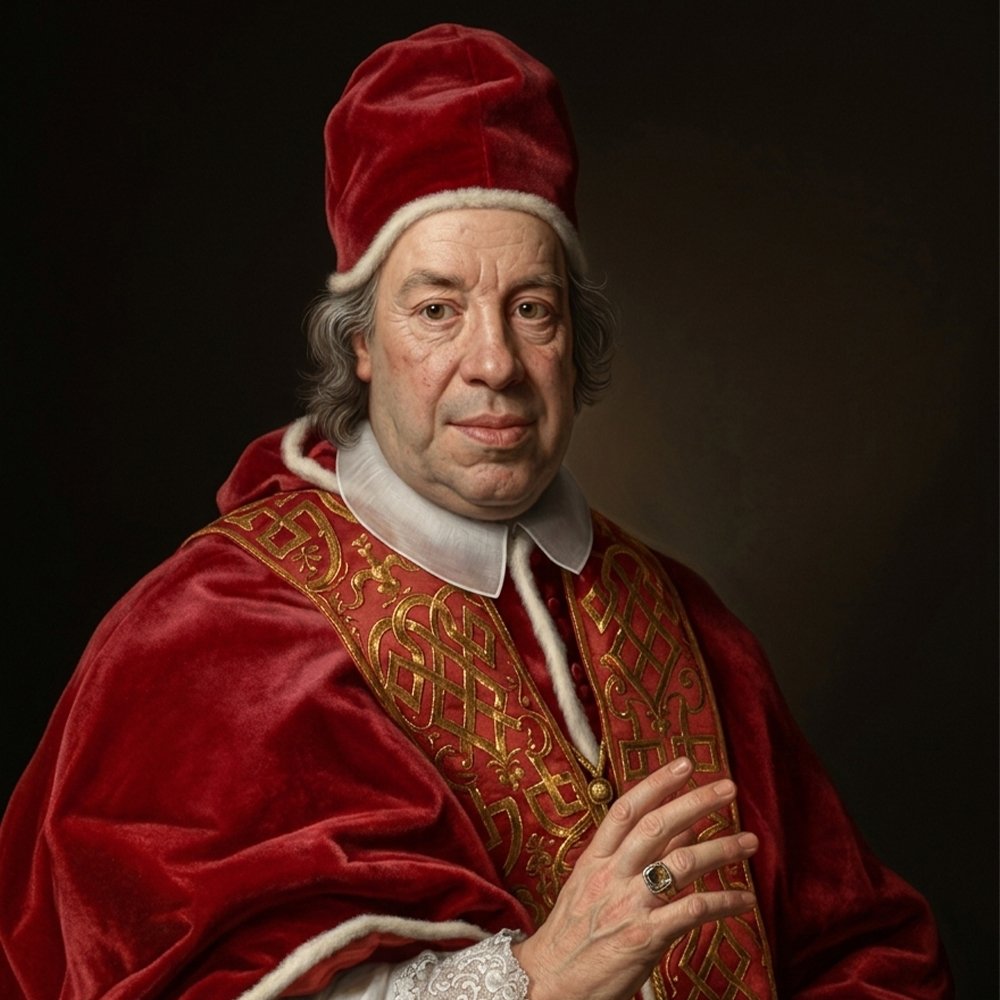
Innocent XIII (1721-1724)
BIOGRAPHICAL DATA
Birth name: Michelangelo dei Conti
Birth: May 13, 1655, Poli, Papal States (Lazio, Italy)
Papal election: May 8, 1721
Coronation: May 18, 1721
Pontificate: May 8, 1721 – March 7, 1724 (2 years, 9 months, 29 days)
Death: March 7, 1724, Rome (age 68)
Burial: St. Peter’s Basilica, Vatican City
Religious order: Secular clergy (did not belong to a religious order)
Papal motto: None officially recorded
Nicknames: “Ephemeral Pope”, “Sick Pope”, “Forgotten Pope”
NOTE: One of the shortest and most obscure pontificates of the 18th century – ill from the time of his election, he accomplished very little!
FORMATION AND RELIGIOUS LIFE
Aristocratic Origins – The Conti Family
Conti Family:
Ancient Roman/Italian aristocratic family
Carlo II dei Conti: father, Duke of Poli, noble of the Papal States
Isabella Muti: mother, from a Roman noble family
Family: produced 4 previous popes!
Innocent III (1198-1216): one of the most powerful popes in history
Gregory IX (1227-1241): reformer, founded the Inquisition
Alexander IV (1254-1261)
Boniface IX (1389-1404, disputed origin)
Palazzo Conti: in Poli (small mountain town, near Rome)
Michelangelo: second son (firstborn would inherit the title)
Privileged childhood (1655-1670):
Aristocratic education
Family castle in Poli
Private tutors
Family: past glory (ancestral popes), but moderate wealth
Michelangelo: studious child, fragile health
Destiny: Church (tradition for second sons)
Academic Formation
Roman College, Rome (1670-1676):
Elite Jesuit school
Curriculum: humanities, rhetoric, philosophy
Competent student (not as brilliant as Lambertini)
Developed solid piety
Sapienza University, Rome (1676-1680):
Canon Law (main)
Civil Law
In utroque iure (doctorate in both laws)
Thesis: on ecclesiastical jurisdiction
Defense: respectable but not exceptional
Priestly Ordination: 1681 (age 26)
Early Ecclesiastical Career (1681-1695)
Papal Domestic Prelate (1681-1686):
Service in the papal court
Ceremonies, secretariat
Learning the Roman Curia
Aristocratic networking
Governor of Ascoli (1686-1689):
City in the Papal States
Local administration
Reputation: competent, just, moderate
No scandals (always positive!)
Governor of Viterbo (1689-1692):
Larger, more important city
Proximity to Rome: strategic
Demonstrated administrative skill
Cordial relations with local nobility
Governor of Fermo (1692-1695):
Third governorship
Experience: growing
But: health began to fail
Illness outbreaks (gout? fever?)
Characteristics (1681-1695):
Competent: solid administrator
Prudent: avoided conflicts
Pious: correct personal life (no scandals)
Moderate: neither an extreme zealot nor excessively political
Fragile health: recurring problem already in his 30s
APOSTOLIC NUNCIO AND CARDINAL (1695-1721)
Diplomatic Career
Nuncio in Switzerland (1695-1698):
First important diplomatic mission
Difficult context:
Switzerland: Catholic vs. Protestant cantons
Persistent religious tensions after the Reformation
Holy See: protect Catholics, avoid conflicts
Performance:
Discreet, effective diplomacy
Mediated local disputes
Strengthened Catholic position without provoking Protestants
Reputation: skilled diplomat
Health: suffered from Alpine cold, isolation
Nuncio in Portugal (1698-1709):
Most important and longest mission (11 years!)
Context:
King Peter II (1683-1706): devout but regalist
King John V (1706-1750): absolutist, controlled the Portuguese Church
Portugal: immense colonial empire (Brazil, Africa, Asia)
Portuguese Inquisition: powerful, semi-independent
Challenges:
Royal Regalism:
Portuguese Crown: appointed bishops without full consultation with Rome
Padroado: system giving the Crown control over missions
Conti: negotiated compromises
Inquisition:
Inquisitor-General: practically independent
Conti: attempted Roman supervision (resistance)
Colonial questions:
Bishops in Brazil, Africa: disputed appointments
Conti: defended papal prerogatives (partially successful)
Relations with John V:
Initially cordial
John V: young, ambitious, wanted more power over the Church
Conti: resisted (diplomatically)
Growing tension (but without rupture)
Result:
Mission: partially successful
Avoided open conflict
But: did not recover Roman control over the Portuguese Church
Health deteriorated severely (climate, stress, years)
Return to Rome (1709):
Mission concluded
Conti: exhausted, ill
Reputation: competent but not exceptional diplomat
Cardinal (1706-1721)
Created Cardinal by Clement XI (June 7, 1706):
Age 51
In pectore (initially secret – for diplomatic reasons, still in Portugal)
Published: 1709 (after return to Rome)
Cardinal-Priest of Santi Quirico e Giulitta
Activity in the College of Cardinals (1709-1721):
Congregations:
Holy Office (Inquisition)
Council (interpretation of the Council of Trent)
Propaganda Fide (missions)
Ecclesiastical Immunity
Political position:
Moderate
Did not lead factions
Respected for diplomatic experience
But: increasingly ill
Severe gout (swollen joints, pain)
Stomach problems
Recurring fever
Years 1715-1720: frequently bedridden
Conclave of 1721:
Participated (despite illness)
Was not an obvious candidate (poor health was known)
But: name emerged as a compromise
CONCLAVE OF 1721 – PAPAL ELECTION
Pre-Conclave Context
Death of Clement XI (March 19, 1721):
Long pontificate (21 years, 1700-1721)
Erudite pope, reformer
But: last years: conflicts with monarchies
Left the Church in tension with European powers
Situation of the Church (1721):
War of Spanish Succession (1701-1714): ended, but with consequences
Regalism: monarchies controlling national churches
Jansenism: strong in France, Low Countries
Chinese Rites controversy: unresolved
Papal finances: exhausted by war
Papal States: administration needed reforms
The Conclave – Very Brief!
Start: March 31, 1721
Duration: 38 days (fast for the standards of the time)
Factions:
Zelanti (“Zealous”):
Intransigent, pro-papal independence
Wanted a strong pope against monarchies
Candidates: combative cardinals
“Crown” (Imperials/Bourbons):
Pro-Catholic monarchies
Wanted a conciliatory pope
Candidates: diplomatically flexible
Moderates:
Silent majority
Wanted peace, stability
Conti: perceived as ideal moderate
Main candidates (initially):
Cardinal Paolucci: Zelanti favorite (but vetoed by Spain)
Cardinal Altieri: pro-imperial (but vetoed by France)
Cardinal Piazza: respected but too old
Cardinal Conti: not an initial favorite
Impasse and resolution:
First ballots: impasse (vetoes blocked favorites)
“Transition pope” strategy:
Conti: 66 years old, ill (everyone knew)
Logic: “He won’t live long, gives time to reorganize”
Zelanti: accepted (Conti not offensive)
“Crown”: accepted (Conti experienced diplomat)
Conti’s advantages:
Diplomatic experience: Switzerland, Portugal (11 years)
Illustrious family: Conti (4 ancestral popes – continuity)
Moderate: not an extremist
Ill: paradoxically an advantage (short pontificate expected)
No enemies: discreet career, without major controversies
Election: May 8, 1721
Vote: comfortable majority (not unanimous, but solid)
Conti: hesitated (aware of his health)
But: accepted (pressure, duty)
Chose name: Innocent XIII
Homage to Innocent III (Conti ancestor, most famous pope of the family)
Number XIII: continuity
Coronation: May 18, 1721
St. Peter’s Basilica
Ceremony: solemn
But: Innocent XIII visibly fragile
Needed to be supported
Ceremony: abbreviated (could not endure full protocol)
Romans: apprehensive (pope already seemed moribund)
PONTIFICATE (1721-1724) – “GHOST POPE”
Catastrophic Health From the Beginning
Medical conditions:
Severe gout:
Joints: swollen, painful (especially feet, hands)
Attacks: frequent, incapacitating
Immobilized him for days/weeks
Dropsy (edema):
Fluid retention (probably heart/kidney failure)
Abdominal swelling, legs
Difficulty breathing
Recurring fevers:
Infections? Malaria? (common in Rome)
Severely debilitated him
Digestive problems:
Constant stomach pains
Ate little
Progressive weight loss
Impact on governance:
Entire months bedridden
Audiences: extremely rare, very short
Dispatches: delayed
Decisions: necessarily delegated
Pontificate: practically inoperative
Governance by Delegation – Cardinal Paolucci
Fabrizio Paolucci – Secretary of State:
Experienced, had already served under Clement XI
De facto: governed
Innocent XIII: too ill to supervise
Paolucci: made routine decisions
Important matters: awaited the pope’s improvement (frequently postponed)
Other influential cardinals:
Cardinal Albani (nephew of Clement XI)
Cardinal Sacripante
Informal collective governance (Innocent XIII absent)
International Relations – Minimal
Spain:
King Philip V: questions about episcopal appointments
Innocent XIII: attempted to negotiate (correspondence)
But: illness prevented active diplomacy
Results: minimal
Portugal:
King John V: continued regalism
Innocent XIII: knew Portugal well (had been nuncio for 11 years)
But: unable to pressure effectively
Relations: stagnant
France:
Louis XV (minor, regency): Jansenist questions
Innocent XIII: renewed condemnations (letters)
But: without strength to impose
Jansenism: persisted
Holy Roman Empire (Austria):
Emperor Charles VI: cordial relations
Innocent XIII: did not cause friction
But: did not advance papal interests
Republic of Venice:
Partial reconciliation (conflicts under Clement XI)
Innocent XIII: sent conciliatory letter
Venice: responded positively
Only modest diplomatic “success”
Ecclesiastical Questions
Chinese Rites Controversy:
Inherited problem: Jesuits vs. other orders
Innocent XIII: did not resolve (had no time/energy)
Left for successor
Jansenism:
Condemned (pastoral letters)
But: no impact (France ignored)
Beatifications/Canonizations:
None during the pontificate!
Processes: paralyzed (ill pope could not preside over ceremonies)
Missions:
Continued formal support
But: no new initiatives
Jubilee 1725:
Planned (it was obligatory – every 25 years)
But: died before (successor carried it out)
Administration of the Papal States
Government:
Local governors: maintained (appointments of Clement XI)
Reforms: none (pope incapable)
Justice: routine
Finances: stagnant
Rome:
Public works: minimal
Charity: continued (institutional, not personal papal)
Cultural life: without significant patronage
Nepotism:
Minimal (Innocent XIII had no energy to favor relatives)
Conti family: did not enrich scandalously
Positive aspect of the inactive pontificate!
Papal Activities (Rare)
Audiences:
Public: frequently canceled
Private: only emergencies
Ambassadors: frustrated (could not gain access)
Ceremonies:
Papal Masses: rarely celebrated personally
Christmas, Easter: sometimes appeared (supported)
Urbi et Orbi blessing: irregular
Documents:
Bulls, briefs: few
Most: administrative, routine
No major theological/political pronouncement
Final Months – Prolonged Agony (1723-1724)
1723:
Health: dramatic worsening
Practically confined to bed
Rumors in Rome: the pope would die soon
Cardinals: prepared for conclave
Winter 1723-1724:
Roman cold: aggravated conditions
Dropsy: severe (abdomen enormously swollen)
Difficulty breathing (suffocation)
Constant pain
February-March 1724:
Final agony
Lucid intermittently
Received Extreme Unction (several times – they thought he would die, he briefly recovered)
Death
March 7, 1724:
Morning: coma
Noon: death
Age 68
Cause: multiple organ failure (gout, dropsy, infections)
Last words (reported):
“Forgive… I could not serve…” (?)
Or simply prayers (vague reports)
Reaction:
Rome: discreet relief (pope practically absent for years)
Cardinals: expected (prepared for conclave)
Europe: little repercussion (obscure pontificate)
FUNERAL AND LEGACY
Funeral
March 9-11, 1724:
St. Peter’s Basilica
Ceremony: solemn but without great crowds
Romans: respect but not emotion (the pope was little known)
Burial:
St. Peter’s
Tomb: modest
Inscription: brief, formal
No great monument (contrast with important popes)
Legacy – Practically Nonexistent
Achievements:
None significant
Avoided conflicts (by inaction)
Did not cause scandals (incapable of any action)
Minimal nepotism (had no energy)
Contemporaries:
Common view: wasted pontificate
“Transition pope” as predicted
But: 3 years of paralysis (harmful)
Historiography:
18th century: largely ignored
19th-20th centuries: footnote
21st century: almost completely forgotten
Mentioned only in chronological lists
Comparisons:
Other ill popes:
Clement XII (1730-1740): blind but lived 10 years
Pius IX (1846-1878): ill in last years but long pontificate
John Paul II (1978-2005): Parkinson’s but governed
Innocent XIII: only modern pope practically incapable from his election
Questions Raised
Should he have resigned?
Precedent: Celestine V (1294) abdicated
But: tradition: pope until death
Innocent XIII: did not consider it (or could not decide this?)
Why was he elected?
Cardinals: wanted a transition pope
Calculation: worked (3 years), but harmed the Church
Lesson: do not elect a moribund pope
Impact:
Negative: 3 years of governmental paralysis
Urgent questions: unresolved
Reforms: postponed
But: did not cause catastrophes (merit of inaction?)
CURIOSITIES AND PERSONAL DETAILS
Personality (Pre-Illness)
Virtues:
Prudent: avoided conflicts
Competent: good administrator, diplomat
Pious: correct personal life
Moderate: neither extremist nor excessively flexible
Limitations:
Fragile health: always
Limited ambition: did not seek power
Low charisma: discreet personality
Shyness: preferred the backstage to the stage
Life as a Sick Pope
Routine (when able):
7:00 AM: Rose (with help)
8:00 AM: Mass (assisted, rarely celebrated)
9:00-11:00 AM: Dispatches (very brief)
11:00 AM: Rest (exhausted)
12:00 PM: Light lunch (ate little)
1:00-5:00 PM: Rest, sleep
5:00-6:00 PM: Audience (if able)
6:00 PM: Private prayer
7:00 PM: Minimal dinner
8:00 PM: Retired (pain prevented sleep)
Medical treatments:
Bloodletting (standard of the era – useless, harmful)
Purgatives (more suffering)
Ointments, poultices (ineffective)
Doctors: impotent (18th-century medicine primitive)
Appearance
Descriptions:
Face: pale, prematurely aged
Body: swollen (dropsy)
Eyes: sunken, painful
Hands: deformed (gout)
Posture: bent (constant pain)
Papal vestments: too heavy (wore them rarely)
Personal Relationships
Conti Family:
Visited him occasionally
But: the sick pope did not favor them
Did not get rich (contrast with the Corsinis under Clement XII)
Cardinal Paolucci:
Relationship: necessary trust
Innocent XIII: delegated everything (had no choice)
Paolucci: loyal, competent (did not abuse like Coscia under Benedict XIII)
Servants:
Doctors, nurses: constant attention
Pope: difficult patient (pain made him irritable)
Anecdotes (Few)
1. Reluctant election:
When elected, Conti: “But I am too ill!”
Cardinals: “Precisely for that reason” (they wanted a short pontificate)
Conti: accepted (duty)
2. Abbreviated ceremony:
Coronation: protocol required hours
Innocent XIII: nearly fainted
Masters of ceremonies: improvised a quick ending
3. Frustrated ambassador:
Spanish ambassador: waited weeks for an audience
Finally: 10 minutes with the pope lying down
Pope: barely able to speak
Ambassador: returned to Madrid without resolving anything
4. Christmas 1723:
Last Christmas as pope
Attempted to celebrate Mass in the Basilica
Mid-ceremony: needed to be carried
Ended in the papal bedroom
Romans: moved but worried
IMPORTANT DOCUMENTS (Very Few)
Bulls and Briefs
“Apostolici Ministerii” (1723):
Renewal of condemnations of Jansenism
Without practical impact
Letters to monarchs:
Portugal, Spain, France
Mostly: routine diplomacy
No important resolution
Episcopal appointments:
Some (necessary)
But: many vacant sees (pope could not process requests)
Consistories
Created 29 cardinals (1721-1723)
Necessary (College reduced)
But: without great criteria (delegated to Paolucci)
SUMMARY CHRONOLOGY
1655: Birth in Poli (Conti family)
1681: Priestly ordination
1686-1695: Governor of papal cities (Ascoli, Viterbo, Fermo)
1695-1698: Nuncio in Switzerland
1698-1709: Nuncio in Portugal (11 years)
1706: Created cardinal in pectore by Clement XI
1709: Publication of the cardinalate, return to Rome
1709-1721: Ill but respected cardinal
1721 (May): Papal election (age 66, already very ill)
1721-1724: Practically inoperative pontificate (constant illness)
1724 (March): Death in Rome, age 68
Pope Innocent XIII is the ghost of the 18th-century papacy – elected, crowned, but never truly governed. Victim of a political calculation that elected him precisely because he was dying, he personifies the cynicism of conclaves that prioritized convenience over capacity.
His election was a self-fulfilling prophecy: cardinals wanted a “transition pope” (brief, inoffensive), elected a sick man, and obtained a paralyzed pontificate. Three wasted years while urgent questions – Jansenism, regalism, Chinese Rites, administrative reforms – awaited a capable pope.
It was not his fault. Conti accepted out of duty, aware of his incapacity. He suffered heroically – torturous gout, suffocating dropsy, recurring fevers – while trying (rarely succeeding) to dispatch minimally. Cardinal Paolucci governed honorably, without abuses (contrast with Coscia under the future Benedict XIII).
But the pontificate was institutional waste. The Church, already weakened by conflicts with monarchies, remained for three years without effective leadership. Innocent XIII did not cause disasters (merit of inaction), but also resolved nothing.
Legacy? Practically none. Historians mention him only chronologically. Contemporary Romans barely knew him – a confined, invisible, silent pope. His death was more relief than mourning: finally a conclave could elect a pope capable of governing.
Cruel irony: he chose the name Innocent XIII honoring Innocent III – a Conti ancestor who was the most powerful pope of the Middle Ages (1198-1216), who humiliated kings, organized crusades, reformed the Church. The contrast could not be more brutal: from the pope who made emperors tremble to the pope who could barely get out of bed.
If Innocent XIII has a historical lesson, it is a warning: Conclaves should not elect the dying, no matter how politically convenient it may seem. The Church needs a pastor, not a symbol; a governor, not a placeholder.
Rest in St. Peter’s, a modest tomb among monuments of popes who mattered. Unspoken but true epitaph: “Here lies one who was elected pope, but could never be one.”
Rome, hurrying past his forgotten tomb, rarely asks who he was. The honest answer would be: no one knows, because he never had a chance to show it.
“Ephemeral Pope” – not only for brevity (3 years is not extremely short), but for absence. He governed so little that it is as if he had not governed at all. A pontificate that was a hiatus, an interval, a vacuum.
Peace to his suffering soul. But may the Church never repeat the error: the immediate need for a conclave does not justify electing an incapable candidate. Better a long conclave than a nonexistent pope.