Pius VI
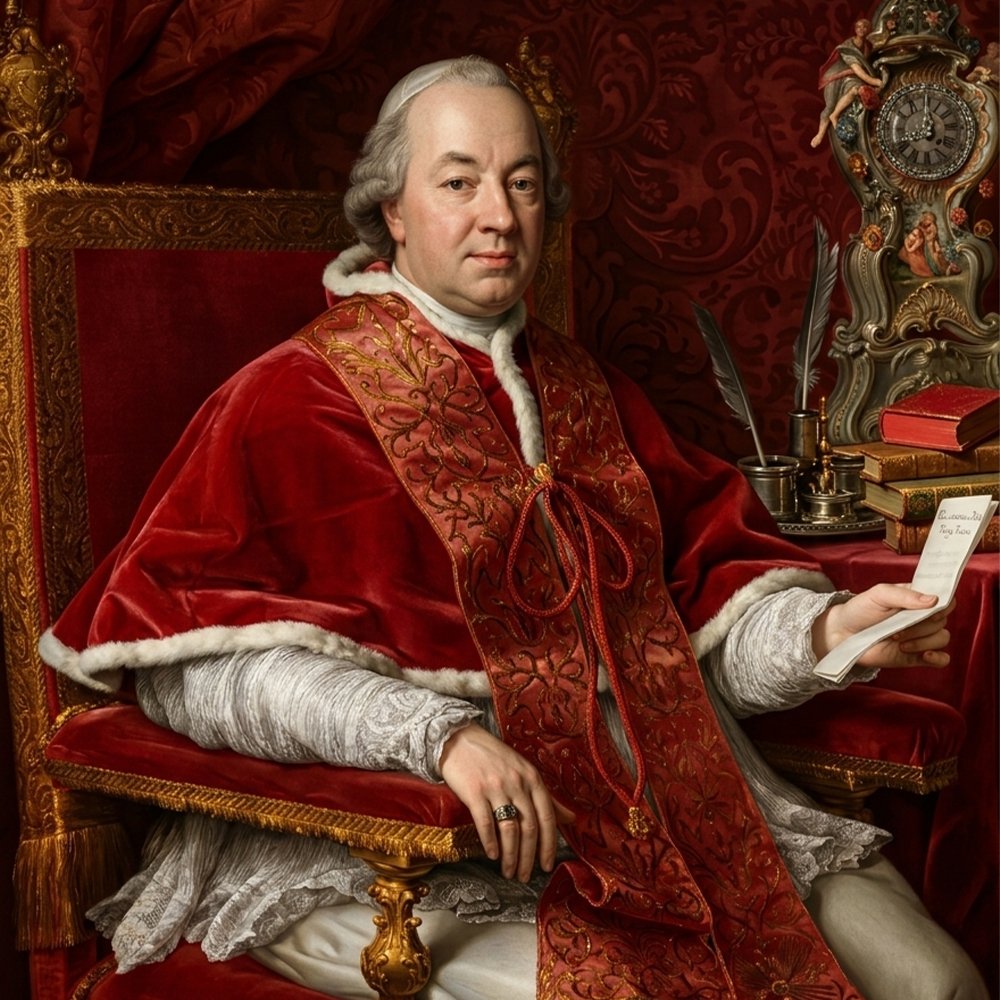
Pope Pius VI (1775-1799)
BIOGRAPHICAL DETAILS
Birth Name: Giovanni Angelo Braschi (or Gian Angelo, variant Gianangelo)
Birth: 25 December 1717 (Christmas Day), Cesena, Papal States (Italy)
Papal Election: 15 February 1775
Coronation: 22 February 1775
Pontificate: 15 February 1775 – 29 August 1799 (24 years, 6 months, 14 days)
Death: 29 August 1799, Valence, France (81 years old) – PRISONER
Burial: Initially Valence; transferred (1802) to Rome – St. Peter’s Basilica
Papal Motto: None officially recorded
Sobriquets: “The Martyr Pope”, “Last Pope of the Ancien Régime“
NOTE: The only modern pope who DIED IN EXILE AS A PRISONER
FORMATION AND ECCLESIASTICAL CAREER
Aristocratic Origins
Braschi Family:
Count Marco Aurelio Tommaso Braschi: father, aristocrat from Cesena
Countess Anna Teresa Bandi: mother
Noble family but not extremely wealthy
Cesena: papal city (Romagna, Emilia-Romagna)
First child (of several)
Traditional aristocratic education
Christmas Birth: Considered auspicious by the family (providential)
Humanistic and Legal Formation
Jesuit College (Cesena):
Classical education
Latin, Greek, rhetoric
Philosophy
University of Ferrara:
Canon Law and Civil Law
Doctorate in both (utroque iure)
Brilliant student
Legal specialization (would mark his career)
Formation in Rome:
Completed theological studies
Preparation for a curial career
Priestly Ordination: 1758 (41 years old – late!)
Secular career first (lawyer)
Then: priesthood
Career in the Roman Curia
Beginning (1740s-1750s):
Secretary to important cardinals
Cardinal Ruffo: private secretary
Diplomatic and administrative apprenticeship
Apostolic Treasurer (1766):
Important financial position
Administration of papal finances
Under Clement XIII (1758-1769)
Demonstrated administrative competence
Cardinal (1773):
Created cardinal by Clement XIV (26 April 1773)
Cardinal-Priest of Sant’Onofrio
56 years old – relatively old for the cardinalate
Pre-papal Characteristics:
Competent administrator
Not a brilliant theologian (unlike many predecessors)
Not an experienced diplomat (had not been a nuncio)
Appearance: tall, handsome, aristocratic bearing
Known nepotist (favored his nephew Luigi Braschi-Onesti)
CONCLAVE OF 1775 – PAPAL ELECTION
Death of Clement XIV
22 September 1774:
Death of Pope Clement XIV (Lorenzo Ganganelli)
Controversial pontificate (1769-1774)
Suppressed the Society of Jesus (1773) – traumatic act
Pressure from the Bourbons (France, Spain, Portugal)
Jesuits: dispersed, orders confiscated
“Dominus ac Redemptor” – brief of suppression
Church in tension with absolutist monarchies
Conclave (5 October 1774 – 15 February 1775)
Duration: 134 days (4 and a half months!)
One of the longest conclaves of the 18th century
Harsh winter (1774-1775)
Cardinals: cold, illness, death of one cardinal during the conclave
46 cardinal electors
Complex factions:
1. “Zelanti” (Spanish/Bourbon Party):
Continuity with Clement XIV
Maintain the suppression of the Jesuits
Appease the Catholic Crowns (France, Spain, Portugal)
Candidates: several, not unified
2. Austrian/Imperial Party:
Less hostile to the Jesuits
Candidate: Cardinal Braschi (initial support)
3. Pro-Jesuit “Zelanti” (minority):
Wanted to restore the Society
Knew it was impossible immediately
Candidate: none viable
Central Issues:
Jesuits: maintain suppression or reverse?
Relations with the Bourbons: submission or resistance?
Reform of the Church: what kind?
Total Impasse:
More than 100 votes (!)
No candidate: needed 2/3
Spanish vetoed several candidates (informal ius exclusivae)
Growing exhaustion
Final Compromise:
Cardinal Braschi: compromise candidate
Not an extremist
Not strongly identified with any faction
Competent administrator (not a controversial theologian)
Dignified appearance (important at the time!)
Good health (crucial – they wanted a long pontificate after the short one of Clement XIV)
15 February 1775:
Giovanni Angelo Braschi elected
Finally a 2/3 majority
57 years old – neither young nor old
Accepted immediately
Choice of name: Pius VI
Homage to Pius V (1566-1572):
Reforming Pope (Council of Trent)
Saint (canonized 1712)
Victor at Lepanto (1571) against the Ottomans
Symbol: firmness, orthodoxy
Other Pius: tradition of firmness
Avoided “Clement” (did not want to seem like a continuation)
Coronation: 22 February 1775
Pompous ceremony
St. Peter’s Basilica
Demonstration of papal splendor
THE PONTIFICATE (1775-1799) – 24 TRAGIC YEARS
PHASE I: SPLENDOR AND REFORMS (1775-1789)
Initial Characteristics
Style of Government:
Personally centralized
Papal magnificence restored
Contrast with Clement XIV (austere)
Pompous ceremonies
Grandiose constructions
Open nepotism
Declared Priorities:
Administration of the Papal States
Jesuit question (postpone, not resolve)
Relations with Catholic monarchies
Public works and art
Combating the Enlightenment (theoretically)
Scandalous Nepotism
Nephew Luigi Braschi-Onesti:
Elevated to Duke of Nemi
Enormously enriched
Lands, titles, income
Married a Spanish noblewoman
Scandal: nepotism at a time when the practice was condemned
Pius VI: did not care about criticism
Braschi Family:
Other relatives benefited
Fortunes accumulated
Palaces built
Last great example of systematic papal nepotism
Public and Artistic Works in Rome
Constructions and Renovations:
1. Sacristy of St. Peter’s:
New sacristy (begun 1776)
Neoclassical architecture
Enormous, sumptuous
Cost: immense (criticized)
2. Vatican Museums:
Museo Pio-Clementino (expanded and reorganized)
Started by Clement XIV
Pius VI: completed and massively expanded it
Collection of Greco-Roman sculptures
Magnificent architecture (Michelangelo Simonetti)
Round Room, Room of the Muses, etc.
One of the world’s greatest museums of classical art
3. Obelisk on the Quirinal:
Transport and erection of an Egyptian obelisk
Piazza del Quirinale (Quirinal Palace)
Feat of engineering
4. Drainage of the Pontine Marshes:
Largest engineering project
Pontine Marshes (Lazio): unhealthy, malaria-ridden
Attempt to drain and make arable
Enormous investment
Partial failure: marshes returned
But demonstrated ambition
5. Church Restorations:
Multiple Roman churches restored
St. Mary Major, etc.
Artistic Patronage:
Antonio Canova (Neoclassical sculptor): commissions
Painters, architects
Rome: cultural flourishing
Criticisms:
Exorbitant cost (papal finances deteriorated)
Priorities: construction vs. pastoral care
But lasting artistic legacy
Journey to Vienna (1782) – Diplomatic Failure
Context:
Joseph II (Holy Roman Emperor, Austria):
“Josephinism” (extreme regalism)
Total interference in ecclesiastical affairs
Closure of “unproductive” monasteries
Civil marriage
Secularized education
Appointment of bishops without consulting the pope
Pius VI’s Decision: Personal journey to Vienna
To convince Joseph II to moderate his policies
First long papal journey since the Middle Ages (!)
March-April 1782
Journey:
Crossed Italy and the Alps
Crowds acclaimed him (Catholics)
Vienna: courteous but cold reception
Meetings with Joseph II:
Discussions
Pius VI: asked for reversal of decrees
Joseph II: refused to change anything
Courteous but inflexible
Result: Total failure
No concessions obtained
Pius VI: publicly humiliated
Josephinism: continued and intensified
Loss of prestige for the pope demonstrated
Lesson: absolute monarchies ignored the pope
Other governments (Tuscany, Naples, etc.): Imitated Josephinism
Febronianism (Germany)
Regalism (Spain, Portugal)
Pope: progressively marginalized
The Jesuit Question – Non-Resolution
Dilemma:
Pressure to restore the Society (many Catholics)
Political impossibility: Bourbons would not allow it
Pius VI: procrastinated
Survival of the Jesuits:
Russia: Catherine the Great refused to promulgate the brief of suppression
Jesuits legally continued in Russia
Pius VI: tacitly tolerated
Prussia (Frederick II): similar
Seed of future restoration (1814, Pius VII)
PHASE II: FRENCH REVOLUTION (1789-1793)
Beginning of the Revolution (1789)
14 July 1789: Fall of the Bastille
News: shock in Rome
Pius VI: initially did not understand the magnitude
August-September 1789:
Declaration of the Rights of Man:
Liberty, equality, popular sovereignty
Pius VI: initial silence (did not condemn yet)
4 August 1789: Abolition of feudal privileges
Including ecclesiastical tithes
Church property in sight
Civil Constitution of the Clergy (1790) – First Condemnation
12 July 1790: National Assembly (France) approved the Civil Constitution of the Clergy
Main Provisions:
Ecclesiastical property nationalized (confiscated)
Sold to pay the national debt
French Church: totally impoverished
Bishops and parish priests elected by citizens (including non-Catholics!)
No longer appointed by the pope/king
Number of dioceses drastically reduced
State salary for the clergy (replaces their own income)
Oath of allegiance to the Civil Constitution mandatory
All clerics must swear
Refusal: dismissal, persecution
Pope not consulted!
Pius VI: Terrified
Initially did not know how to react
Pressure from French émigrés (exile): condemn!
Pressure from moderate French clergy: tolerate (to save the French Church)
10 March 1791: Brief Quod Aliquantum
Condemnation of the Civil Constitution of the Clergy
Declared it null, invalid, impious, heretical
Forbade the clergy from swearing the oath
Those who had sworn: suspended a divinis (or excommunicated if persistent)
29 March 1791: Brief Caritas
More severe reiteration
Suspension/excommunication of “juring” clergy
Catastrophic Consequences:
Schism in the French Church:
“Refractory” clergy (non-juring): 55% of priests
Faithful to Rome
Persecuted, imprisoned, exiled
“Constitutional” clergy (juring): 45%
Schismatics (in the Roman view)
Supported by the revolutionary State
Deep division among French Catholics
Religious Persecution:
Refractory priests: hunted
Churches closed
Massacres (September 1792): hundreds of priests killed
Deportations
Radicalization:
French monarchy (Louis XVI): compromised (had accepted the Civil Constitution)
Republic proclaimed (1792)
Terror (1793-1794)
Execution of Louis XVI (21 January 1793)
Context:
Louis XVI: imprisoned (1792)
Tried for treason
Sentenced to death
Pius VI:
Horrified
Diplomatic protest (useless)
Considered the martyrdom of a Catholic monarch
21 January 1793: Guillotine
Shock throughout monarchical Europe
Pius VI: mourning vestments
Consistorial allocation condemning regicide
Consequences:
War: France vs. Coalition (Austria, Prussia, England, etc.)
Revolution: radicalized
Church: enemy of the Republic
Dechristianization (1793-1794)
The Terror:
Cult of Reason (November 1793): Notre-Dame = Temple of Reason
Revolutionary Calendar: abolished Sunday, Christian holidays
Priests: mass executions
Guillotine
Drownings (Nantes)
Thousands killed
Churches: profaned, looted, destroyed
Nuns: raped, killed
Attempt to exterminate Catholicism in France
Pius VI: Powerless
Protests ignored
No influence
Could only pray and lament
PHASE III: NAPOLEONIC WARS IN ITALY (1796-1798)
Bonaparte’s Italian Campaign (1796-1797)
Context:
Napoleon Bonaparte (French general, 27 years old)
Command of the Army of Italy (March 1796)
Objective: conquer northern Italy, pressure Austria
Spring-Summer 1796:
Successive victories:
Defeat of Piedmont (Sardinia)
Defeat of the Austrians (Lombardy)
Occupation of Milan
Cisalpine Republic (French satellite)
Papal States threatened:
North: French troops nearby
Pius VI: panic
Armistice of Bologna (23 June 1796)
Napoleon: Demanded an armistice
Humiliating Terms:
Cessation of hostilities (the Papal States weren’t even at war!)
21 million lire in indemnity
Bologna, Ferrara, Romagna: occupied by the French
100 works of art ceded (paintings, sculptures, manuscripts)
Cultural looting
French museums enriched
Free passage for French troops
Pius VI: Accepted (no choice)
Forced to sign
Public humiliation
Treaty of Tolentino (19 February 1797) – Catastrophe
Context:
French victories continued
Austria: nearly defeated
Napoleon: more demands
Negotiations in Tolentino (Marche):
Napoleon: dictated terms
Papal envoys: powerless
Terms:
Indemnity: an additional 30 million lire (!)
Astronomical sum
Papal treasury: exhausted
Territories ceded:
Avignon and Venaissin (France) – already lost de facto
Bologna, Ferrara, Romagna – formally ceded
1/3 of the Papal States lost!
Another 300 works of art, manuscripts:
“Apollo Belvedere”, “Laocoön”, etc.
Vatican Museums: looted
Renunciation of anti-French alliances
French troops: free movement
Signing: 19 February 1797
Pius VI:
Devastated
Wept publicly
But powerless
Papal States: mutilated
Works of art:
Transported to Paris
Louvre enriched
Some returned (1815, Congress of Vienna)
Others: never came back
Assassination of General Duphot (28 December 1797)
Context:
Rome: tense, de facto occupation
French embassy: refuge for revolutionaries
General Mathurin-Léonard Duphot: military chief of the embassy
28 December 1797:
Riot in Rome (Jacobins vs. royalists)
Duphot: left the embassy armed
Confrontation with papal guards
Duphot killed (bullet or saber, unclear)
Consequences:
France: furious
Pretext for action
PHASE IV: ROMAN REPUBLIC AND IMPRISONMENT (1798-1799)
Invasion of Rome (10 February 1798)
General Louis-Alexandre Berthier (under orders from Napoleon):
French army invaded Rome
Virtually no resistance (papal troops: useless)
15 February 1798: Roman Republic proclaimed
Tree of Liberty planted on the Campidoglio
End of the Papal States (temporary)
Republican government installed (Italian Jacobins)
Separation of Church and State
Ecclesiastical property confiscated
Pius VI:
Forced to renounce temporal power
But refused to renounce the papacy (spiritual)
Initially remained in the Vatican
De facto prisoner
Deportation to France (20 February 1798)
French order: Remove Pius VI from Rome
20 February 1798 (early morning):
French soldiers invaded the Vatican
Pius VI (80 years old, ill): torn from his bed
Allowed to take:
1-2 secretaries
Minimal clothing
No wealth
Carriage northward
Journey of Martyrdom (1798-1799):
February-April 1798: Italy
Siena (Tuscany): temporary imprisonment (months)
Health deteriorated
Treatment: humiliating
Constant guards
May-July 1798: Across the Apennines
Certosa di Firenze (Florence): brief stay
Bologna: passed through
Health: worse and worse
July 1798: Entry into France
Grenoble: imprisonment (weeks)
Final destination: Valence (southeastern France)
Arrived: late July 1798
Citadel (fortress/prison)
Small, damp room
Hostile guards
Almost total isolation
Imprisonment in Valence (July 1798 – August 1799)
Conditions:
Health: deteriorating rapidly
81 years old
Exhausting journey (months by carriage)
Strangulated hernia (extremely painful)
Partial paralysis (stroke?)
Infections
Malnutrition
Treatment:
Guards: some cruel, others compassionate (variable)
Doctors: limited access
Secretaries: few, watched
Often unable to celebrate Mass (not allowed/no conditions)
Visitors: almost none
Attempts at liberation:
Austria, Naples: diplomatic protests
Royalist revolts in France (Vendée): did not get close
But France: inflexible
Final illness (August 1799):
Strangulated hernia worsened
Gangrene (pre-antibiotics = certain death)
Atrocious pain
High fever
Periods of delirium alternating with lucidity
Last days:
24-28 August: agony
Received last sacraments (local priest, exceptionally authorized)
Viaticum
Anointing of the Sick
Absolution
Moments of lucidity: prayed
Forgave his captors (reported)
29 August 1799:
Passed away at 5:00 AM
81 years old (almost 82)
24 years, 6 months, 14 days of pontificate
Cause: septicemia (generalized infection from gangrene)
Location: Citadel of Valence, France
PRISONER OF WAR – the only modern pope to die this way
Last words (reported, possibly legendary): “Seigneur, pardonne-leur” (“Lord, forgive them”) – echo of Christ on the cross
Funeral and Burial in Valence
Local reaction:
French authorities: allowed a religious funeral (surprisingly)
Some local Catholics: mourning
Revolutionaries: celebrated
Funeral (30-31 August 1799):
Valence Cathedral (ancient cathedral, secularized)
Simple ceremony
Very few present
Local priest officiated
Burial:
Valence Cathedral
Simple coffin
Temporary tomb
Minimal inscription
“Last pope”: Revolutionaries proclaimed
“Pius VI was the last pope”
“The papacy is finished”
The Catholic Church would be extinct
But:
Conclave of 1799-1800 (Venice): elected Pius VII
Revolutionary prophecy: refuted
Church: survived
Transfer to Rome (1802)
After the fall of Napoleon (temporary, 1801-1802):
Pius VII: negotiated the return of the body
Concordat of 1801: facilitated
February 1802:
Body exhumed from Valence
Solemn transport to Italy
Reverse journey (1798-1799)
24 February 1802: Arrival in Rome
Crowds
Solemn funeral procession
St. Peter’s Basilica
Final burial:
St. Peter’s Basilica
Vatican Grottoes
Dignified tomb (built later)
Monument: Reclining Pius VI (Neoclassical sculpture)
Inscription: martyrdom in France
GOVERNMENT OF THE PAPAL STATES (1775-1798)
Administration
Structure:
Pius VI: absolute temporal monarch
Cardinal Secretary of State: prime minister
Several during the pontificate (frequent changes)
Cardinal-Legates: provincial governors
Bureaucracy: totally clerical
Chronic Problems:
Widespread corruption
Administrative inefficiency
Slow and expensive justice
Heavy taxes but inefficient collection
Endemic brigandage (rural crime)
Economic backwardness (no industry, limited trade)
Attempts at reform (few and weak):
Some edicts against corruption
Minimal administrative reorganization
Public works (Pontine Marshes)
But resistance from conservative nobility and clergy
Pius VI: not a systematic reformer
Finances:
Chronic deficit
Spending: constructions, nepotism, sumptuous papal court
Revenue: insufficient
Loans: increasing
Pre-bankruptcy situation by 1796
Napoleonic wars: completely exhausted the treasury
Population
Discontent:
Taxes
Arbitrary justice
Clerical privileges
Italian Jacobins: active (secret societies)
Prepared for the French occupation (1798): little popular resistance
ECCLESIASTICAL ISSUES
Jesuits – The Postponed Question
Already mentioned: Pius VI did not restore the Society
Politically impossible
Tolerated survival in Russia
Left to his successor (Pius VII would restore it, 1814)
Febronianism and Regalism
Febronianism (Germany):
Bishop of Trier (Hontheim, pseudonym “Febronius”): book (1763)
Thesis: the episcopacy has authority independent of the pope
Councils > Pope
Pius VI: condemned (briefs)
But influence persisted
Josephinism (Austria):
Joseph II: already mentioned
Pius VI’s journey to Vienna (1782): failure
Josephinism continued
Tuscany (Synod of Pistoia, 1786):
Bishop Scipione de’ Ricci: radical reformer
Synod: almost heretical theses (Gallicanism, Jansenism)
Pius VI: Bull Auctorem Fidei (28 August 1794)
Condemnation of 85 propositions from the Synod
Reaffirmed papal authority
Roman primacy
Against episcopalism
Freemasonry
Reiteration of condemnations:
Predecessors had already condemned
Pius VI: maintained
Catholics: forbidden to participate
Excommunication
Liturgy and Discipline
Total conservatism:
Roman Rite: untouchable
Latin mandatory
No liturgical reforms
Sacramental discipline:
Traditional
Marriage: indissolubility
Confession, communion: normal practice of the time
ENCYCLICALS AND PAPAL DOCUMENTS
Pius VI published relatively few formal encyclicals (a less prolific era), but numerous briefs and bulls on specific issues.
MAIN DOCUMENTS
1. Inscrutabile Divinae Sapientiae (25 December 1775)
“First encyclical” – Programmatic
Context: Shortly after coronation (10 months)
Content:
Diagnosis: evils of the time
Enlightenment
Religious indifference
Disrespect for authority
Pastoral program:
Restore ecclesiastical discipline
Combat errors
Promote piety
Tone: Conservative but not hysterical (still pre-Revolution)
2. Quod Aliquantum (10 March 1791)
Against the Civil Constitution of the Clergy (France)
Already described above
Formal condemnation
Declared nullity
Suspension of juring clergy
Importance: The most important document of the pontificate
Catastrophic consequences (French schism)
But defense of principles
3. Caritas (13 April 1791)
Reiteration against the Civil Constitution
More severe than Quod Aliquantum
Explicit excommunication of the persistent
4. Auctorem Fidei (28 August 1794)
Bull against the Synod of Pistoia
Context: Synod of Pistoia (Tuscany, 1786)
Bishop Ricci: Jansenist reformer
85 problematic propositions
Condemnation:
Each proposition analyzed and condemned
Gallicanism rejected
Febronianism rejected
Jansenism condemned (again)
Papal primacy reaffirmed
Infallibility insinuated (not formally defined, but defended)
Theological Importance:
Doctrine on papal authority
Prepared the ground for Vatican I (1870, infallibility)
Other briefs and bulls (dozens):
On episcopal appointments
Religious orders
Matrimonial issues
Indulgences
Ecclesiastical jurisdiction
Responses to governments
No Dogma formally defined
CANONIZATIONS
Very few (slow processes):
Beatifications:
Some processes advanced
Most concluded by successors
Canonizations: None solemn during the pontificate (or very few)
Reason: Wars, crisis, not a priority
PERSONAL CHARACTERISTICS
Personality
Appearance:
Tall (approx. 1.85m – rare at the time)
Handsome (contemporaries noted)
Magnificent aristocratic bearing
Clear and strong voice
Imposing presence
Character:
Vain (critics said)
Blatant nepotist
Indecisive in political crises
Not a profound intellectual
Personally pious (Marian devotion, prayer)
Courageous at the end (resisted despite imprisonment)
Habits:
Liked pompous ceremonies
Sumptuous papal life (until 1796)
Afterwards: forced into austerity (prison)
Health
Until 1796: Relatively healthy
Vigorous despite being 60+
Journey to Vienna (1782): endured well
1796-1799: Deterioration
Stress of wars
Forced journey (1798): devastating
Hernia, infections, paralysis
Death: gangrene + septicemia
LEGACY AND HISTORICAL EVALUATION
Achievements
1. Arts and Culture:
Museo Pio-Clementino: lasting legacy
Public works in Rome (some)
Artistic patronage
2. Defense of the Faith (in impossible circumstances):
Resisted the French Revolution (doctrinally)
Condemned the Civil Constitution (principles)
Auctorem Fidei: doctrine on papal primacy
3. Martyrdom (in a way):
Died a prisoner defending the Church
Refused to capitulate completely
Symbol of resistance (even if ineffective)
Failures and Limitations
1. Catastrophic Diplomacy:
Journey to Vienna (1782): humiliation
Inability to deal with the Revolution
Treaty of Tolentino (1797): disaster
No effective allies
2. Flawed Temporal Government:
Papal States: poorly administered
Scandalous nepotism
Financial deficit
Sumptuous works while finances collapsed
Pontine Marshes: failure (despite effort)
3. The French Question:
Civil Constitution: correct condemnation (doctrinally)
But timing and tactics: questionable
French schism: pastorally catastrophic
Alternative: difficult to say if there was a better option
4. Indecision:
Not a strong leader in crisis
Counselors: often incompetent
Vacillated when firmness was needed
5. Lack of Vision:
Did not understand modernity
Ancien Régime mentality
Did not prepare the Church for the post-revolutionary world
Historical Judgment
Conservative/Traditionalist Catholics:
Martyr of the Revolution
Victim of diabolical forces
Hero for resisting unto death
Nepotism and sumptuousness: minimized or ignored
Moderate/Critical Historians:
Victim of impossible circumstances (partially)
But also contributed to the disaster:
Bad administration
Inept diplomacy
Scandalous nepotism
Irresponsible spending
Final courage: recognized (died a prisoner defending the Church)
But not a great pope: consensus
Revolutionaries/Anti-clericals:
Symbol of the corrupt Ancien Régime
Enemy of liberty
Deserved his fate (hostile view)
Place in History
Among Popes:
Not great (consensus)
Last true pope of the Ancien Régime
Tragic transition: medieval world → modern
Victim of History (partially)
Symbolism:
End of an era: death in prison = end of papal temporal power (temporary but symbolic)
Useless but courageous resistance
Martyrdom (in a way)
CURIOSITIES
1. Born on Christmas Day
25 December 1717
Family: a providential sign
Pius VI: always celebrated it
2. Tallest Modern Pope
Approximately 1.85m (sources vary)
At the time: exceptional height
Imposing physical presence
3. Last Pope with Blatant Nepotism
Nephew Luigi Braschi: absurdly enriched
Medieval/Renaissance tradition
After Pius VI: nepotism drastically diminished
4. First Long Papal Journey (Modern)
Vienna (1782): first long journey since the Middle Ages
Diplomatic failure
But precedent for future papal journeys (20th century)
5. Only Modern Pope to Die a Prisoner
Only pope in recent centuries to die in exile as a prisoner
Parallel: medieval popes (Boniface VIII in Anagni, etc.)
But modern era: unique
6. Body Transferred (1802)
Died in Valence (France)
Buried there (1799-1802)
Returned and reinterred in Rome (1802)
Final journey (dead): back
7. Canova (Sculptor)
Antonio Canova: protégé of Pius VI
Works for the Vatican
Later: sculpted Pius VI’s tomb (later commission)
8. “Last Pope”
French revolutionaries: proclaimed it
Prophecy: false (Pius VII elected 1800)
But real fear at the time
9. Long Pontificate Despite Everything
24 years, 6 months (one of the longest until then)
Despite:
Wars
Revolution
Loss of territories
Imprisonment
Death in exile
Testament of endurance
10. Museo Pio-Clementino
Name: Pio (VI) + Clementino (XIV, predecessor)
Exists to this day
Tourists: millions visit annually
Lasting artistic legacy (ironically, the only unquestionably positive legacy)
ENCYCLICALS, BULLS AND BRIEFS – COMPLETE LIST
Main Encyclicals
Inscrutabile Divinae Sapientiae (25 December 1775) – Programmatic
Quod Aliquantum (10 March 1791) – Civil Constitution of the Clergy
Caritas (13 April 1791) – Reiteration
Important Bulls
Auctorem Fidei (28 August 1794) – Synod of Pistoia
Briefs (selection)
On Febronianism (several)
On Josephinism (protests)
On Freemasonry (reiterated condemnations)
On episcopal appointments (dozens)
On religious orders (post-Josephinist suppression restorations, partial)
On indulgences (Jubilees – 1775, 1800 planned but not held)
Total: Dozens of documents, but not a prolific pope in encyclicals
CONSTRUCTIONS AND PUBLIC WORKS – DETAILS
Rome
1. Sacristy of St. Peter’s:
Architect: Carlo Marchionni
Begun: 1776
Neoclassical
Enormous dimensions
Cost: colossal (criticized)
Completed after Pius VI’s death
2. Museo Pio-Clementino:
Massive expansion of the Vatican Museums
Architects: Michelangelo Simonetti, Giuseppe Camporese
Round Room: inspired by the Pantheon
Room of the Muses: Greek statues
Gallery of Statues
Cabinet of Masks
Collection: Greco-Roman sculptures
Apollo Belvedere (until 1797, stolen by Napoleon)
Laocoön (ibid.)
Hundreds of others
Architectural and museological masterpiece
3. Piazza del Quirinale:
Obelisk erected (1786)
Fountain of the Dioscuri restored
Beautification
4. Pontine Marshes:
Agro Pontino (south of Rome)
Marshes: malaria, uninhabitable
Project: drain, make arable
Engineers: several
Canals excavated
Planned villages
Investment: 1780s-1790s, millions of scudi
Result: Partial failure
Canals: worked temporarily
Marshes: returned (insufficient maintenance)
Malaria: persisted
Only resolved in the 20th century (Mussolini)
But notable effort for the time
5. Church Restorations:
St. Mary Major
St. John Lateran
Several others
Other Papal Cities
Roads improved (some)
Aqueducts repaired
Minor works in Ancona, Ravenna, etc.
RELATIONS WITH CATHOLIC MONARCHIES
France (until 1789)
Tense but functional relations:
French Gallicanism: limited papal authority
Appointment of bishops: king decided, pope confirmed
Pius VI: accepted (no power to change)
Louis XVI (1774-1792):
Initially: devout Catholic
Cordial relations
But: accepted the Civil Constitution (1790) – betrayal in Pius VI’s eyes
Spain
Charles III (1759-1788):
Extreme regalist
Expelled the Jesuits (1767)
Controlled episcopal appointments
Pius VI: protested uselessly
Relations: formally cordial, actually tense
Charles IV (1788-1808):
Continued regalism
Did not support Pius VI against France (later allied with France)
Portugal
Pombal (minister, until 1777):
Expelled the Jesuits (1759)
Extreme regalism
Pius VI: inherited the situation
Maria I (1777-1816):
More pious
Relations improved slightly
But regalism continued
Austria – Josephinism
Joseph II (1780-1790):
Worst relationship
Extreme Josephinism (already described)
Pius VI’s journey (1782): failure
Joseph II: died 1790 (no reconciliation)
Leopold II (1790-1792):
Brother of Joseph II
Slightly less radical
But continued essential policies
Naples/Two Sicilies
Ferdinand IV (1759-1825):
Moderate regalism
Relations: ups and downs
Initially supported Pius VI against France
But later: made a separate peace with France
Prussia
Frederick II, the Great (1740-1786):
Protestant (Calvinist)
But governed Catholics (Silesia)
Relations: correct, cold
Did not suppress Jesuits in his territories (curiously)
Frederick William II (1786-1797):
Similar
Russia
Catherine II, the Great (1762-1796):
Orthodox (officially)
But pragmatic
Refused to suppress Jesuits in Russian territories
Pius VI: tacitly tolerated (only Jesuit survival)
Relations: surprisingly cordial
Paul I (1796-1801):
Short reign
Relations: minimal (Pius VI already a prisoner)
FINAL JOURNEY – DETAILS OF THE MARTYRDOM (1798-1799)
Deportation Itinerary
20 February 1798: Rome → North
Stages:
1. Siena (Tuscany):
February-May 1798
Augustinian convent (prison)
3 months
Health: began to deteriorate
Allowed: to pray, read
Guards: some compassionate
2. Certosa di Firenze (near Florence):
May-June 1798
Carthusian monastery (empty, suppressed)
Weeks
Conditions: temporarily better
3. Across the Apennines:
June-July 1798
Difficult mountain passage
Pius VI: 80 years old, uncomfortable carriage
Heat, dust
Exhausting journey
4. Bologna:
Just passed through
Not allowed to stop long
5. Parma, Piacenza:
Route to France
Crossing of the Po River
6. Turin:
Brief stop
7. Crossing the Alps (July 1798):
Mont-Cenis or similar route
Pius VI: debilitated, mountain cold
Arrival in France
8. Grenoble:
July 1798
Temporary imprisonment (weeks)
Fortress
9. VALENCE (late July 1798):
Final destination
Citadel (fortification)
13 months of imprisonment (July 1798 – August 1799)
Valence – The Last Months
Accommodation:
Room in the citadel
Small, damp
Minimal furniture
Barred window
Routine (when health permitted):
Wake early
Private prayer (often without Mass)
Reading (Bible, breviary when available)
Occasionally: received secretaries (watched)
Walks in the courtyard (rarely permitted)
Health:
Progressively worse
Inguinal hernia: strangulated (medical emergency)
No surgery (anesthesia didn’t exist, operation = probable death anyway)
Gangrene: developed
Extreme and constant pain
Fever
Increasing weakness
Assistance:
Local doctors: some visited
But limited (primitive medicine)
Opium: for pain (only analgesic)
Secretaries: 1-2 present
Last month (August 1799):
Prolonged agony
Gangrene spread
Febrile delirium alternating with lucidity
24 August: received sacraments
Local priest (exceptionally authorized)
Confession
Viaticum
Anointing of the Sick
25-28 August: final agony
29 August, 5:00 AM: death
Death – Circumstances
Present:
Secretaries (2)
Local doctor
Guards (at the door)
Priest who administered the sacraments
Medical cause: Septicemia (generalized blood infection) secondary to gangrene
Spiritual disposition (reported):
Lucid in final moments
Prayed
Forgave his enemies
Commended his soul to God
Death certificate (French):
Name: “Jean-Ange Braschi, ci-devant Pape” (formerly pope)
They did not recognize him as pope even on the death certificate!
REACTION TO DEATH
France
Revolutionary government (Directory):
Relief
No public celebration (cautious)
Allowed a Catholic funeral (surprisingly)
French Catholics:
Mourning (hidden – persecution continued)
Prayed in secret
Considered him a martyr
Europe
Austria, Naples, Spain, Portugal:
Official mourning (pro-forma)
But no action (did not rescue him when alive, did not avenge him after)
England:
News received with interest
Some Protestants: compassionate (died a prisoner, elderly)
Others: indifferent
Rome and the Papal States (occupied)
Roman Republic (Jacobin government):
News: received with no official reaction
Roman Catholics:
Deep mourning
Secret Masses (requiem)
Hope: for a new pope
Conclave – Expectation
Cardinals scattered across Europe:
Majority: exiled or in hiding
Need: to elect a successor urgently
“Last pope”: revolutionary prophecy
Cardinals: determined to refute it
Result: Conclave of Venice (1799-1800)
4 months later
Elected Pius VII
Church: survived
THEOLOGICAL AND DOCTRINAL EVALUATION
Doctrinal Contributions
Limited but important:
1. Auctorem Fidei (1794):
Papal primacy defended against Gallicanism/Febronianism
85 propositions from the Synod of Pistoia condemned
Prepared the ground for:
Pastor Aeternus (Pius IX, Vatican I, 1870 – papal infallibility)
Doctrine on:
Papal authority vs. conciliar
Ordinary magisterium
Tradition vs. innovation
2. Documents against the French Revolution:
Defense of traditional doctrine on:
Church and State: union, not separation
Authority: comes from God, not the people (against Rousseau)
Natural rights: exist but limited by divine law (against Enlightenment absolutization)
But: did not develop positive social doctrine
Did not respond to the Revolution’s legitimate questions (social injustice, etc.)
Only condemned, did not propose an alternative
3. Defense of Orthodoxy:
Against Jansenism (Pistoia)
Against Febronianism
Against excessive regalism (in theory, in practice he yielded)
Doctrinal Limitations
Not a creative theologian:
Did not produce a theological synthesis
Did not intellectually confront the Enlightenment (only condemned)
Did not develop a modern ecclesiology
Prisoner of the past:
Mentality: medieval/Renaissance
Did not understand modernity
Did not adapt doctrine to new times (vs. Leo XIII later)
PERSONALITY – PSYCHOLOGICAL ANALYSIS
Virtues
1. Personal Piety:
Prayed daily (for hours)
Devout Mass
Genuine Marian devotion
In his final moments: unshakeable faith
2. Final Courage:
Imprisonment: did not totally capitulate
Refused to renounce the papacy
Died defending the Church (even if ineffectively)
Martyrdom (a form of)
3. Generosity (selective):
Personal charity to the poor (occasional)
Artistic patronage (cultural legacy)
Vices and Defects
1. Vanity:
Appearance: obsessed
Pompous ceremonies: loved them
Flattery: appreciated it
Papal narcissism
2. Scandalous Nepotism:
Nephew Luigi: absurdly enriched
No shame or discretion
Last great papal nepotist
3. Indecision:
Crises: vacillated
Counselors: frequently changed (seeking those who agreed)
Joseph II (Vienna): didn’t know how to handle it
French Revolution: initial paralysis
4. Administrative Incompetence:
Papal States: poorly governed
Finances: disastrous
Wrong priorities: sumptuous constructions vs. necessary reforms
5. Lack of Vision:
Did not understand modernity
Enlightenment: only condemned, did not intellectually respond
Revolution: did not understand its deep causes
Contradictions
Paradox of Pius VI:
Sumptuous but pious
Vain but courageous in the end
Indecisive but stubborn (when he decided)
Incompetent but well-intentioned
Victim but also responsible for his fate
DEATH AS A SYMBOL
Historical Significance
End of an Era:
Pius VI: last true pope of the Ancien Régime
Death in prison: symbol of the collapse of the old world
Papal temporal power: mortally wounded (later temporarily restored, but never the same)
Martyrdom:
Not a martyr in the technical sense (not killed for hatred of the faith directly)
But died defending the Church against the Revolution
Suffering: 18 months of imprisonment, forced journey, humiliations
Refusal: did not totally capitulate (refused to renounce the papacy)
Revolutionary Prophecy Refuted:
“Pius VI = last pope”
False: Pius VII elected 7 months later (March 1800)
Church: survived despite everything
Gates of hell: did not prevail (Mt 16:18)
Spiritual Legacy
Popular veneration:
Catholics: considered him a martyr
Not canonized (no process even initiated)
But respect for his suffering
Historical lesson:
Resistance (even if ineffective) has value
Fidelity unto death
But also: political incompetence has terrible consequences
PIUS VI IN ART AND CULTURE
Portraits and Sculptures
During life:
Numerous paintings:
Pompeo Batoni (official portrait)
Other artists
Show: tall, handsome, majestic pope
Sculptures:
Marble busts
Idealized appearance
Posthumous:
Funeral monument (St. Peter’s Basilica):
Neoclassical sculpture
Reclining Pius VI, dying
Inscription: martyrdom
Canova: possible author or influence
Literature
Contemporary memoirs:
Cardinals who knew him
Secretaries of the deportation
Testimonies of the martyrdom
Later histories:
Biographies (19th century): generally hagiographic
Histories of the French Revolution: mention his death
Not a central figure in literature (vs. Napoleon, Robespierre)
Cinema and Modern Media
Rarely portrayed:
Not a popular figure
Napoleon: dominates the narratives of the era
Pius VI: marginal in popular culture
RELICS AND VENERATION
Personal Objects
Lost or dispersed:
Majority: confiscated (1798)
Some: preserved by secretaries
Papal ring, vestments: whereabouts variable
Relics (in a broad sense):
Objects touched by him
No formal cult (not a canonized saint)
Private veneration: minimal
Tomb
St. Peter’s Basilica:
Vatican Grottoes
Artistic monument
Visitation: tourists (not devotional pilgrimage)
ENCYCLICALS AND DOCUMENTS – FINAL ANALYSIS
Documentary Output
Compared to predecessors and successors:
Less prolific than later popes (Gregory XVI, Pius IX, Leo XIII)
Era: fewer formal encyclicals
More: briefs and bulls on specific cases
Theological Importance
Enduring documents:
Auctorem Fidei (1794): Most important
Doctrine on papal primacy
Influenced Vatican I (1870)
Quod Aliquantum (1791): Civil Constitution
Historically crucial (caused the French schism)
Theologically: reaffirmed traditional ecclesiology
Minor documents:
Useful for historians
But did not fundamentally change doctrine
Global Doctrinal Legacy
Limited:
Not an innovative theologian
Did not intellectually confront the Enlightenment
Defensive: condemned errors, did not propose syntheses
Prepared (involuntarily) successors who would have to rethink the Church’s relationship with the modern world
FINAL REFLECTIONS
Pius VI as a Historical Tragedy
Tragic elements:
Incomprehension: Did not understand the era he lived in
Incompetence: Governed poorly when government was crucial
Sumptuousness: Spent fortunes when austerity was needed
Nepotism: Last great demonstration (anachronistic)
Humiliation: Journey to Vienna (1782), Treaty of Tolentino (1797)
Imprisonment and death: Tragic end to a sumptuous life
But also:
7. Final courage: Resisted in prison
8. Faith: Unshakeable until death
9. Cultural legacy: Museo Pio-Clementino (lasting)
10. Symbol: Last pope of the ancient world
Historical Lessons
For the Church:
Adaptation is necessary (Pius VI: did not adapt)
Internal reform prevents external collapse (did not reform the Papal States)
Temporal power can be an obstacle (Pius VI: attached to temporal power)
Personal holiness ≠ governmental competence
For General History:
Revolutions destroy incompetent regimes
Ancien Régime (Pius VI personified it): fell inevitably
Individuals: simultaneously victims and agents of History
Final Evaluation
Pius VI (1775-1799):
WAS NOT:
A great theologian pope
A great reforming pope
A great diplomatic pope
A great administrator pope
WAS:
A tragic pope – victim of an impossible era
A courageous pope – died a prisoner defending the Church
A sumptuous pope – the last of his kind
A transitional pope – between worlds (ancient/modern)
A martyr (in a way) – suffered for the Church
Place in History:
Minor among popes
But memorable for the circumstances of his death
Symbol: end of an era
Warning: incompetence has a price
Appropriate epitaph: “Here lies Pius VI, last pope of the Ancien Régime, who governed sumptuously but died miserably, defending the Church he loved but could not preserve. Requiescat in pace.”
Pope Pius VI (Giovanni Angelo Braschi, 1775-1799) was a contradictory and tragic figure: a man of magnificent appearance and sincere faith, but an incompetent ruler in an era that demanded political genius. His 24-year pontificate witnessed the collapse of the Ancien Régime and the French Revolution, which destroyed the world he knew.
Sumptuous in Rome (1775-1796), he created the Museo Pio-Clementino (a lasting legacy) but also practiced scandalous nepotism and governed the Papal States incompetently. The journey to Vienna (1782) was a humiliation; the Treaty of Tolentino (1797) was a catastrophe.
The Napoleonic Wars (1796-1799) destroyed everything: territories lost, treasures looted, imprisonment (1798) and deportation to France. He died a prisoner in Valence (29 August 1799) after 18 months of suffering, the only modern pope with such a fate.
He was not a great pope, but he died courageously defending the Church. Revolutionaries proclaimed him the “last pope”, but Pius VII (1800) proved them wrong. A symbol of the end of an era, Pius VI remains a historical warning about the costs of incompetence and lack of vision, but also a testament of fidelity unto death.
Requiescat in pace – Rest in peace, Pius VI, last pope of the ancient world, who lived sumptuously but died miserably, martyr of the Revolution and victim of an era he did not understand.